Fencing options and costs in Athabasca
Athabasca homeowners typically shop for fencing with two priorities in mind: privacy and durability through Alberta’s freeze–thaw cycles. With 68.0% of dwellings in the area being single-detached homes (Statistics Canada, 2021 Census), many lots can support straightforward boundary and backyard builds—so demand is steady, especially during spring and early summer when ground conditions improve. It’s also worth noting that homes built before 1981 make up 39.4% of the housing stock (Statistics Canada, 2021 Census). Older properties often have older posts, closer-to-the-line setups, or existing fencing that needs partial or full removal, which can add labour time and disposal costs to the next install.
In the Edmonton economic region, fence pricing is shaped more by site and climate than by material alone. Contractors plan for frost depth by setting posts below the design frost line to reduce heaving, which can mean concrete-set posts and deeper holes. Wind exposure on the Prairies also increases panel stress; for privacy fences, many installers recommend tighter post spacing, sturdier frames, and heavier hardware so the fence stays straight after winter storms and summer gusts.
In Athabasca, installs tend to be especially common around the denser residential corridors and newer subdivisions near the downtown core and along major access routes—where yards are smaller, access for equipment matters, and homeowners often want consistent boundary privacy.
The table below compares common materials by lifespan, maintenance, and typical installed ranges so you can benchmark quotes before you talk with a local crew.
| Material |
Lifespan |
Maintenance |
Privacy Rating |
Price per Linear Foot |
Price Range |
| Pressure-treated pine (standard wood) |
10–15 years |
Stain or seal every 2–3 years |
Good (solid panels) |
$18–$30/ft |
$3,000–$6,500 |
| Cedar (natural rot resistance) |
15–25 years |
Light staining every 3–4 years (often optional) |
Good (solid panels) |
$22–$36/ft |
$3,500–$7,500 |
| Vinyl / PVC (no-maintenance) |
20–30 years |
Wash only; occasional hardware checks |
Very good (solid styles) |
$25–$45/ft |
$3,500–$8,000 |
| Chain-link (galvanized steel) |
25–40 years |
Rinse as needed; minor repairs occasionally |
Low (security-only) |
$15–$25/ft |
$2,000–$4,500 |
| Aluminum ornamental |
20–35 years |
Wash only; inspect for loose sections |
Low–medium (open pickets) |
$20–$40/ft |
$4,000–$9,000 |
| Composite / recycled material |
25–35 years |
Wash only; avoid impact damage |
Very good (solid boards) |
$28–$48/ft |
$4,500–$9,500 |
Prices are estimates only and vary by project scope, site access and material selection.
What affects the price of fencing in Athabasca
If you’re comparing quotes in Athabasca, it’s not unusual to see the same general fence concept land 30–50% apart across the Edmonton region. The biggest reason isn’t the board or panel cost—it’s whether contractors can set posts efficiently, how deep they must go below frost, and how much extra time is required for wind-stressed layouts, gates, and access. On the Prairies, contractors often tighten post spacing for privacy fences because gusts and blowing snow can rack frames over time. That means more posts, more hardware, and more labour, even if the fence looks “similar” on paper.
Frost depth drives post depth requirements. A common practice is setting posts about 4–6 inches below the design frost depth to reduce heaving; in Alberta cold snaps, this can put holes roughly 1.5–2.0 m into the ground, often requiring longer posts and concrete setting. Once you add concrete time (mixing or delivery), longer digging, and removal of spoils, the labour component rises—pushing wood installs toward the upper end of the $3,000–$6,500 wood band, or making vinyl and cedar climb accordingly toward their $3,500–$8,000 ranges.
Concrete examples from Athabasca sites: (1) If your fence line crosses packed clay or hard-packed soil, digging post holes can take longer and drive up labour; (2) if the yard has good driveway access, material handling is faster and quotes stay lower; (3) if your existing fence is failing and must be removed, disposal can add cost even when the new fence is a “small” length.
Housing age matters too. Lots with older fencing built near original lot lines may require additional locate/survey time to avoid encroachment, especially where the 39.4% of homes pre-1981 may reflect older property markers and less precise earlier work. That’s one more reason installers price with site verification, not just length.
| Price Factor |
Why It Matters |
Cost Impact |
| Fence length in linear feet |
The project scales almost directly by total feet, including rails, posts, and fasteners. |
High impact (dominant driver) |
| Post depth required |
Frost line determines how deep holes must be for stability and to reduce heaving. |
Medium–high impact |
| Post setting method |
Concrete set typically costs more than gravel pack; driven posts can reduce labour but aren’t suitable everywhere. |
Medium impact |
| Material choice |
Vinyl and composite cost more upfront; chain-link is usually lower while cedar balances cost and appearance. |
Medium impact |
| Gate count and type |
Drive-through double gates require stronger frames, hinges, latches, and more precise alignment. |
High impact (especially for swing gates) |
| Grade and terrain |
Slopes require stepped/raked panels; it increases layout time and sometimes special rail lengths. |
Medium impact |
| Old fence removal and disposal |
Hauling and extra labour to remove damaged posts reduces the speed of a new install. |
Medium impact |
| Permit fees and survey / property line locate |
Locates and any permit paperwork add time and administrative cost, especially for longer boundaries. |
Low–medium impact (can be high on complex sites) |
Permits & regulations in Alberta
In Alberta, fence rules are usually tied to height limits, property line setbacks, and whether the fence triggers a building permit. As a practical benchmark for Athabasca projects, fences above a height threshold—typically around 2.0 m (6.5 ft) at the rear and about 1.0–1.2 m (3–4 ft) at the front or corner—often require a building permit. Even when a permit isn’t required, the fence still must respect the property line and any municipal setback requirements that apply to your lot.
Before any digging, you must arrange utility locates. Use Alberta One-Call to mark underground services so the contractor can plan post locations safely. It’s also smart to confirm your property pins or obtain a survey/locate to verify where the fence should sit; this helps avoid costly encroachment disputes with neighbours.
For shared fence ownership, Ontario-style community assumptions don’t always apply—shared boundary arrangements in Alberta follow provincial line-fences legislation concepts, so it’s important to clarify who pays for what (posts, panels, upgrades) when fences straddle shared boundaries.
Contractor verification is straightforward: ask for a copy of their current clearance letter/registration where applicable, their liability insurance certificate, and their worker coverage (WCB/WSIB equivalent coverage in Alberta). You can verify business status and credentials through the appropriate online registry, then cross-check the certificate details (company name, coverage dates) against the quote.
Choosing the right fence material for Athabasca
Athabasca winters can be brutal on materials, but the right fence choice is mostly about matching your priorities—privacy, low maintenance, budget, and lifespan—to what Alberta does to fences year after year. Pressure-treated pine is typically the lowest upfront wood option. The trade-off is ongoing maintenance: to prevent grey weathering and keep boards looking good, plan for staining or sealing roughly every 2–3 years. Cedar is more naturally resistant to rot, often looks better longer, and usually needs less intensive care—however, cedar still benefits from periodic maintenance in harsh wind and snow conditions.
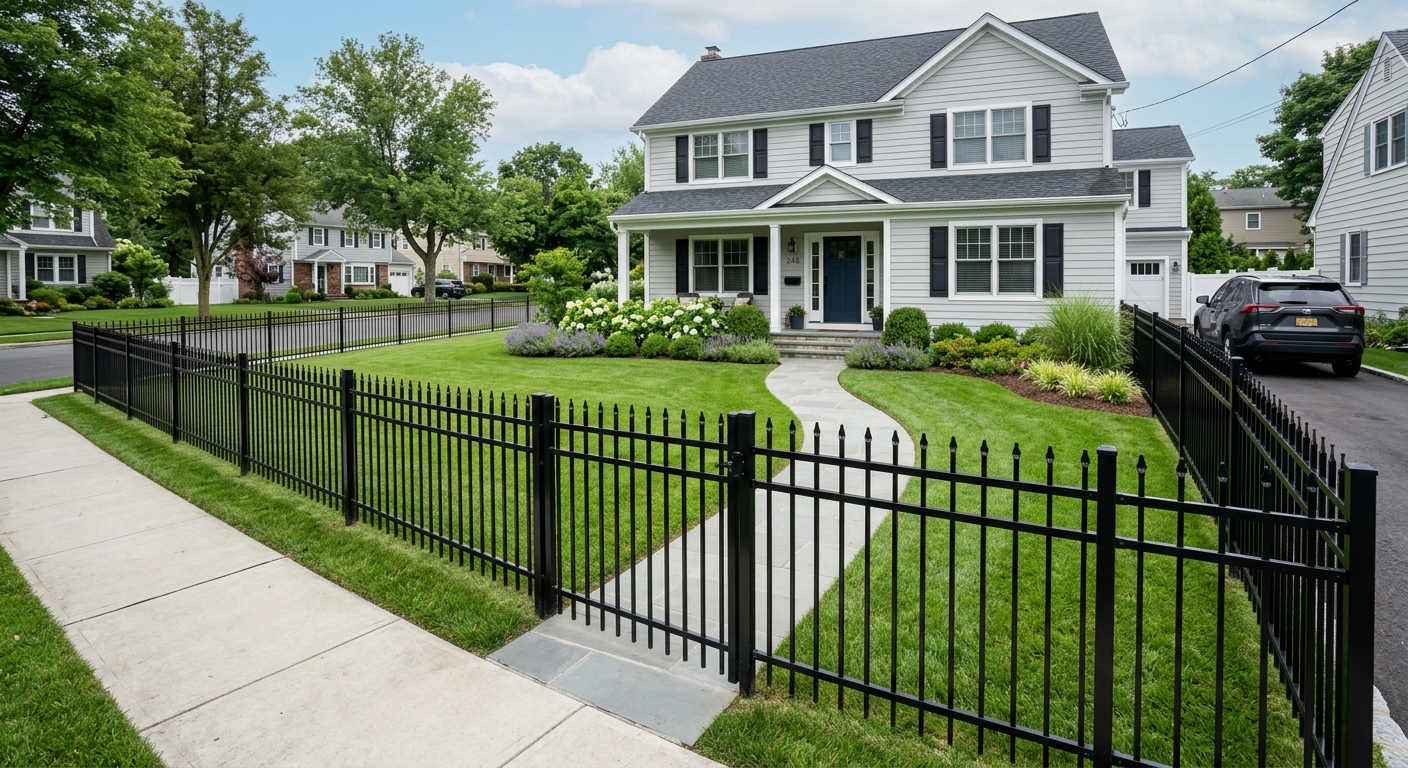
Vinyl/PVC offers the “wash-and-forget” approach. In Athabasca’s cold snaps, it can expand/contract, so good installation matters (proper brackets and spacing). Chain-link is the lowest cost and among the longest-lasting options, but it won’t deliver true privacy unless you add privacy slats or a second barrier. Aluminum ornamental gives a clean, rust-resistant look and suits front-yard boundaries where you want visibility with curb appeal.
Post depth is a key decision regardless of material. In the Edmonton region, crews commonly set posts around the frost line depth—often 4–6 inches below the design frost depth—which can mean concrete-set posts and deeper holes. That’s one reason a fence can land near the $3,000–$6,500 wood range at the low end, but climb if you choose cedar or vinyl and add heavier wind-rated framing for privacy.
Example: if your project is a 40 ft privacy run, moving from standard pressure-treated pine to vinyl can be a reasonable budget increase because vinyl’s maintenance profile and longer service life can offset the higher upfront material cost—often pushing total installs toward the $3,500–$8,000 band rather than staying in the low-mid wood pricing.
| Material |
Cold Tolerance |
Lifespan |
Annual Maintenance |
Best For |
Price Band |
| Pressure-treated pine |
Good with proper sealing and post setting |
10–15 years |
Low–moderate (check annually; stain every 2–3 years) |
Budget privacy with periodic upkeep |
$3,000–$6,500 |
| Cedar |
Good; performs well against rot where airflow/drainage is managed |
15–25 years |
Low–moderate (often every 3–4 years) |
Natural look and longer service life |
$3,500–$7,500 |
| Vinyl / PVC |
Very good when installed with correct bracketing and fastener practice |
20–30 years |
Very low (wash/inspect yearly) |
Low-maintenance privacy and clean appearance |
$3,500–$8,000 |
| Chain-link |
Very good |
25–40 years |
Very low (occasional patching) |
Security, pets, and budget-conscious boundary fencing |
$2,000–$4,500 |
| Aluminum ornamental |
Very good |
20–35 years |
Low (wash; tighten hardware) |
Curb appeal and front-yard boundaries |
$4,000–$9,000 |
| Composite / recycled |
Good; resists rot and warping |
25–35 years |
Low (wash/inspect) |
Premium privacy with minimal upkeep |
$4,500–$9,500 |
How to choose a fencing contractor in Athabasca
Hiring the right contractor in Athabasca starts with proving they can legally and safely do the work in Alberta, then confirming the quote matches your scope. First, verify licensing/business registration by checking the contractor’s credentials through the relevant online registry and ensuring the quote is issued in the same legal business name. Next, ask for a certificate of liability insurance and read it carefully: it should list the correct contractor name, coverage amounts, and active dates. For work that includes crews and jobsite activity, confirm worker coverage through WCB (Alberta workers’ compensation coverage) documentation—request the clearance/coverage proof or clearance letter and ensure it aligns with the work being quoted.
Then get 2–3 written quotes that break down labour and materials instead of only offering a single lump sum. Look for clear line items: fence rails, posts, panel type, hardware, gate frame and latch, concrete/gravel amounts, traffic control/access considerations, and disposal or hauling. Check what’s excluded: electrical locates (or are they on you?), permit pulls (included or not), and repairs to existing fencing if neighbours dispute a boundary.
Warranty matters for both workmanship and products. Ask for the workmanship warranty length, whether it covers post setting and fence alignment, and whether the manufacturer warranty is transferable if you sell the home. Payment schedule should be conservative—typically no more than 10–15% upfront, with a holdback until the fence is complete and inspected.
Finally, insist on the start date and an estimated completion window in writing so weather delays and scheduling aren’t handled informally.
- Confirm the legal business name on the quote matches the insurance certificate.
- Verify liability insurance is current and the limits are appropriate for fencing projects.
- Check WCB/worker coverage proof (clearance letter or equivalent documentation).
- Request itemised labour + materials, not a single total without breakdown.
- Ask whether utility locates are included or the homeowner arranges Alberta One-Call.
- Confirm permit responsibilities: permit pull included or separate (if required).
- Review the post-setting method (concrete vs. gravel pack) for frost stability.
- Ensure gate hardware is rated for wind loads and the fence height you want.
- Ask about grading treatment (raked/stepped panels) for sloped yards.
- Confirm disposal/haul-away for old fence and broken concrete posts.
- Get warranty terms in writing: workmanship and product/manufacturer coverage.
- Limit upfront payment to 10–15% and hold back until final walk-through.
Red flags I see too often in Athabasca: quotes that don’t specify post depth or setting method for frost conditions; missing insurance/WCB documentation; “permit included” language without confirming whether a permit is actually required for your height/location; vague scopes that omit disposal or utility locates; and contractors who ask for large upfront payments without a written schedule or contract detail.
Frequently asked questions — fencing in Athabasca
How long does fence installation take in Athabasca?
Most Athabasca installs for a typical backyard run take about 1–3 days on site once materials are on hand and locates are complete. Time expands with deeper post holes required for frost stability, especially if the ground is hard or access is limited. Gates add complexity: a single swing gate may only add a few hours, while a drive-through double gate often takes longer due to stronger framing and careful alignment. Neighbour coordination and any fence removal also affect scheduling. As a benchmark, a small project that lands within the lower end of the $2,000–$4,500 chain-link band is often faster than a heavier privacy build near the $3,000–$6,500 wood range. Contractors should provide a start date and completion estimate in writing.
Can I install a fence on a slope in Athabasca?
Yes—sloped yards are common in Athabasca, and reputable contractors handle them with stepped or raked panel systems. The key is choosing a layout that keeps the fence aligned, keeps posts set at appropriate depth for frost stability, and avoids overly stretched panels. On a slope, “simply leveling the top rail” can create uneven gaps and can stress boards or rails during wind and freeze–thaw cycles. A good quote should describe how the fence will follow grade and whether racking/step patterns will be used. If you’re doing a taller privacy fence, wind and snow load can increase the need for rigid bracing, so ask whether they adjust post spacing. If your project also needs an old fence removal, the slope can slow that prep work too.
What is the most weather-resistant fence for Athabasca's climate?
For Athabasca and the broader Edmonton region’s prairie conditions, chain-link and quality vinyl are often the most weather-resilient in the long term because they resist rot and don’t require frequent staining. Chain-link typically delivers long service life (often 25–40 years) and can handle cold well; it’s also a strong choice if you want a fence that stays functional through ice, snow loads, and wind. Vinyl/PVC can last 20–30 years, but installation quality matters—correct spacing and secure mounting help it perform in extreme cold. Wood can work well too, but it needs maintenance to prevent surface weathering. If you’re cost-benchmarked, chain-link often sits closer to the $2,000–$4,500 band, while privacy-focused vinyl commonly lands nearer $3,500–$8,000 depending on height and gate count.
How do I prevent wood fence rot in Athabasca?
Wood rot prevention starts with frost-stable post setting and keeping water from trapping around the posts. In Alberta, contractors generally set posts below frost depth (commonly about 4–6 inches below design frost) so freeze–thaw doesn’t heave the wood and open gaps for moisture. Next, use proper treated lumber for ground contact, and ensure the fence design allows drainage instead of creating permanent wet pockets (for example, avoid direct contact where water can pool). Regular maintenance matters: pressure-treated pine typically needs staining/sealing every 2–3 years to slow greying and surface breakdown. Cedar has natural rot resistance but isn’t maintenance-free; inspect annually and recoat where needed. Also confirm the fence isn’t buried too deeply—too much soil contact can accelerate decay even with treatment.
What is the cost per linear foot for fencing in Athabasca?
Pricing per linear foot varies based on material, fence height, wind-rated construction, post depth, and gate complexity. In Athabasca, common installed ranges typically translate to roughly $15–$25/ft for chain-link, about $18–$30/ft for standard pressure-treated wood, and around $25–$45/ft for vinyl. Aluminum ornamental and composite often price higher when you factor in framing and hardware. If your quote totals land around the $3,000–$6,500 wood band or the $3,500–$8,000 vinyl band, the per-foot figures should generally align once your linear footage and number of gates are accounted for. Ask contractors to provide the length, number of posts, and gate line items so the per-foot number matches the actual build.
Should I repair or replace my old fence in Athabasca?
Repair can be the right call when the fence posts are solid, the line is reasonably straight, and damage is limited to a few boards or rails. Replace is often more cost-effective when multiple posts are heaving, the bottom rails are rotted, or the fence has significant racking from wind—especially after freeze–thaw has shifted foundations. Because many Athabasca homes include older pre-1981 builds (Statistics Canada, 2021 Census), it’s common to see older posts that were set too shallow or without frost-considerate methods, which leads to recurring failures. A good contractor should assess: post stability (not just board condition), alignment, hardware condition, and whether repairs will simply postpone deeper post-setting work. If removal/disposal is needed, compare it against the labour to re-set posts during a repair.