Fencing options and costs in Heritage Pointe
Fencing options in Heritage Pointe, Alberta tend to revolve around privacy, wind performance, and frost durability. With a population of 2,075 (Statistics Canada, 2021 Census), demand here comes in waves as homeowners upgrade backyards for pets, entertaining, and seasonal living. Heritage Pointe sits in Calgary’s broader housing market, where single-detached homes are common—each upgrade is a potential new fence project, especially around family yards and side-yard access routes that see heavy daily use. For many owners, that makes material choice and post construction the biggest cost levers.
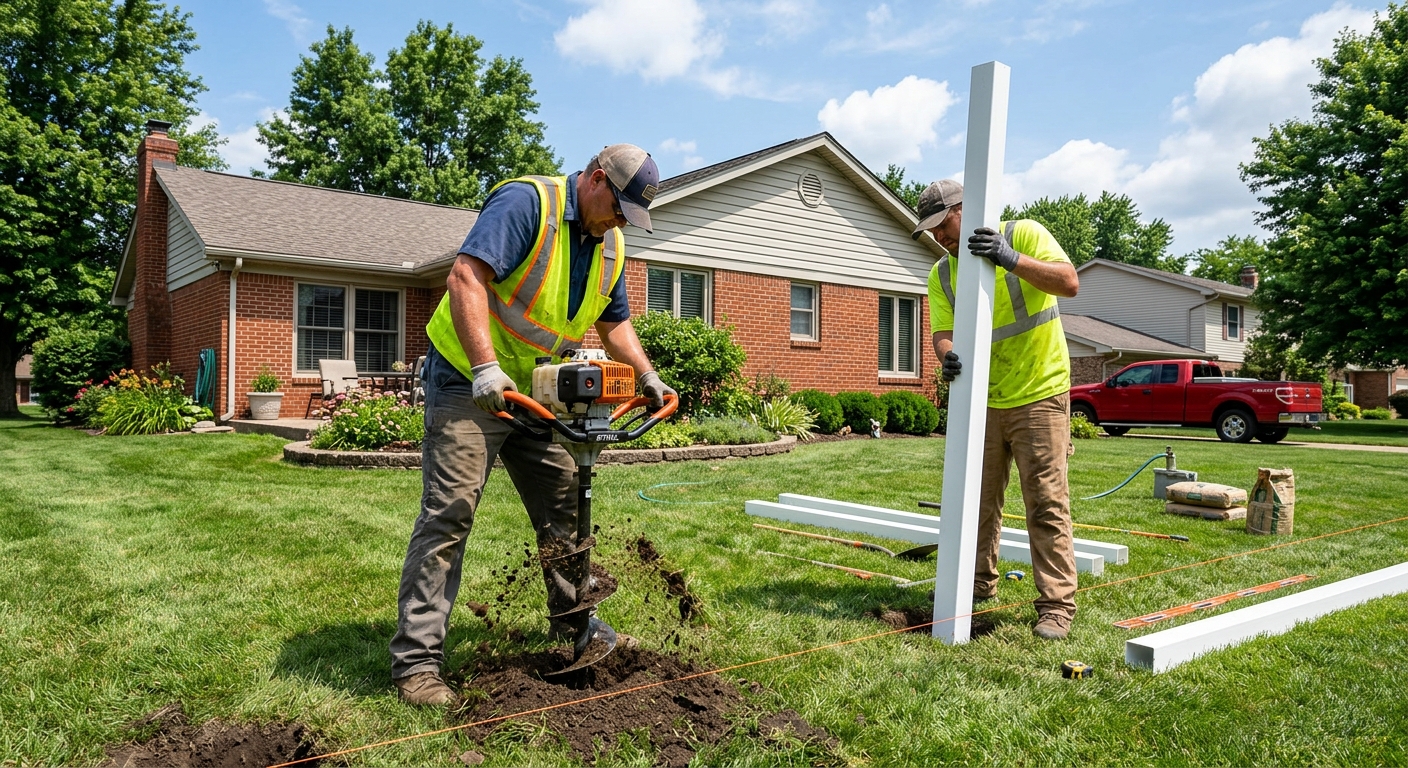
Because the Calgary economic region has a Prairie continental climate with long freeze–thaw cycles, frost protection and wind loading directly affect fencing cost and contractor scheduling. In practice, that means posts are often set to about 4 ft (≈120 cm) deep (or deeper where conditions require) using concrete footings for 6 ft privacy fences and gate posts. Open Prairie exposure also means racking resistance matters; solid wood or vinyl panels typically need closer post spacing and sturdier framing than chain-link, which allows airflow. The result is that wood and vinyl usually land mid-to-upper in typical installed pricing, while chain-link remains the most budget-friendly option.
In Heritage Pointe, trade activity is especially noticeable near established residential areas with open views and frequent wind exposure—owners in backyard-facing lanes and side-yard runs often plan their fence rebuilds around the same seasonal window. Use the table below to compare common materials and realistic price ranges before you request your site-specific quote.
| Material |
Lifespan |
Maintenance |
Privacy Rating |
Price per Linear Foot |
| Pressure-treated pine (standard wood) |
15–25 years |
Stain/seal every 2–3 years; inspect boards annually |
High (solid pickets/panels) |
$40–$80 |
| Cedar (natural rot resistance) |
20–30 years |
Seal or stain every 2–3 years; occasional board replacement |
High (solid pickets/panels) |
$55–$95 |
| Vinyl / PVC (no-maintenance) |
25–35 years |
Minimal cleaning; check for snow impact and hardware |
High (solid privacy styles) |
$45–$90 |
| Chain-link (galvanized steel) |
20–30 years |
Occasional rinse; tighten tension and replace damaged links |
Low to Medium (see-through) |
$25–$55 |
| Aluminum ornamental |
30–40 years |
Wash annually or as needed |
Low to Medium (open design) |
$70–$120 |
| Composite / recycled material |
25–35 years |
Low; periodic cleaning and hardware checks |
High (depending on profile) |
$65–$110 |
Prices are estimates only and vary by project scope, site access and material selection.
What affects the price of fencing in Heritage Pointe
In Heritage Pointe and across the Calgary economic region, fence quotes for the “same” length can vary by 30–50% because the real drivers aren’t only the material. They’re the site conditions (access for excavation), the engineering needed for Prairie wind loads, and the frost-safe post construction required for Alberta ground conditions. A chain-link fence can often stay lighter on posts because airflow reduces wind pressure, while solid wood or vinyl privacy fences need more rigid framing and more substantial post setting to prevent racking.
Frost protection is the most consistent reason prices move. Local guidance for Calgary-area builds commonly targets post holes deep enough to sit below the design frost depth—often around 4 ft (≈120 cm) or deeper—so posts don’t heave during freeze–thaw cycles. Translating that into a budget: deeper holes mean more excavation time, more concrete for footings (especially for 6 ft privacy fences and heavier gate assemblies), and longer posts. Across colder Canadian regions, it’s not unusual for contractors to set posts about 1.5–2.0 m into the ground; each extra scoop and bag of concrete adds labour and material cost.
Second, Prairie exposure affects spacing and reinforcement. If your yard faces prevailing wind, we often reduce panel spans and add bracing where needed—this shifts costs closer to the mid–upper range for wood or vinyl installation (roughly $40–$80 for wood, and $45–$90 for vinyl/PVC, depending on height and style). Third, terrain can raise costs quickly: a sloped grade usually requires stepped panels (extra layout time) rather than simple straight runs.
Concrete examples from typical Heritage Pointe projects: (1) a gate with two hinges and a latch in a privacy fence often adds heavier posts and more concrete than a standard run; (2) removing an older fence can add disposal costs and delay the start date if posts are concrete-set and break during extraction; and (3) a yard with limited side access can force smaller equipment passes, increasing labour for digging and setting.
| Price Factor |
Why It Matters |
Cost Impact |
| Fence length in linear feet |
Most materials and labour scale directly with total run |
Higher length increases cost predictably; partial runs still incur mobilization. |
| Post depth required |
Frost line determines post length and hole depth to prevent heaving |
Deeper holes increase excavation time and concrete volume; can move a project by thousands on long runs. |
| Post setting method |
Concrete setting resists uplift; gravel pack and driven posts vary by conditions |
Concrete footings are typically more expensive than gravel pack and usually add labour. |
| Material choice |
Vinyl/cedar/wood/metal have different framing needs and wind resistance |
Vinyl privacy often costs more than chain-link; cedar usually exceeds standard pressure-treated pine. |
| Gate count and type |
Gates require stronger posts, hardware, and tighter alignment |
Each additional gate can add significant cost; drive-through gates cost more than walk-through. |
| Grade and terrain |
Slopes require stepped, raked, or custom panel heights |
Stepping/raking increases layout time and may require extra rails and pickets. |
| Old fence removal and disposal |
Concrete-set posts and hauling affect labour and tipping/disposal |
Removal can be a major add-on, especially with buried footings. |
| Permit fees and survey / property line locate |
Administrative steps and locating avoid encroachment disputes |
Can add several hundred to over a thousand depending on what’s already available and required. |
Permits & regulations in Alberta
In Alberta, whether you need a permit for a fence usually depends on fence height and location. As a practical rule, fences above a height threshold—commonly around 2.0 m (6.5 ft) at the rear and roughly 1.0–1.2 m (3–4 ft) at the front or corner—often require a building permit. Regardless of height, all fences must respect property lines and municipal setback requirements. For your Heritage Pointe project, you should also plan for utility locates before any digging: call Alberta One-Call so marked lines reduce the risk of striking buried services.
Before anyone drills or excavates, confirm your property pins or order a property line locate if you don’t have clear documentation. This avoids the most common dispute we see—placing a fence slightly over the line, then being forced to move it after neighbour feedback or survey verification. Shared fence ownership and maintenance obligations are handled under provincial line-fences legislation, so it’s worth clarifying who maintains what before you start.
What typically DOES require a permit: higher fences (especially around 2.0 m back yard privacy) and any project where the height or placement triggers municipal thresholds. What typically does NOT require a permit: lower fences that fall under the usual front/corner height rules, routine replacement of like-for-like fence sections, and standard minor repairs (though it can still be worth confirming with the municipality if you’re unsure).
To verify a contractor is set up properly, start by checking their Alberta licence/registration (using the relevant provincial registry if applicable for their fencing/construction scope), then request proof of liability insurance and coverage documentation. Ask for their WSIB/WCB coverage clearance—current certificate and/or clearance letter—and confirm the certificate includes your named project address where possible.
Choosing the right fence material for Heritage Pointe
Choosing a fence material in Heritage Pointe comes down to your priority order: privacy, low maintenance, budget, and lifespan. The big reality in Calgary-area conditions is that wind and freeze–thaw cycles punish fences that weren’t built with frost-safe post setting and solid bracing. If you expect snowdrifts and wind-driven debris, prioritize sturdy framing and correct anchoring for the first several seasons—not just the look at install.
Pressure-treated pine is usually the most budget-friendly path (often aligned with wood pricing roughly $40–$80 per linear foot depending on height and style). However, even pressure-treated wood benefits from a stain/seal schedule—typically every 2–3 years—to limit grey weathering and keep the surface from cracking at fasteners. Cedar offers better natural rot resistance and a premium appearance; it can still require periodic sealing, but it often ages more gracefully than standard pine in Prairie freeze–thaw cycles.
Vinyl/PVC is popular for low maintenance and privacy, and in Calgary it can make sense if it’s installed with correct post spacing and hardware rated for colder temperatures. Still, extreme cold can make brittle or cheap components fail—so you want quality products and proper installation. Chain-link is the lowest cost for longevity and wind performance because it lets air through; it usually won’t meet privacy needs unless you add slats. Aluminum ornamental provides a rust-resistant look and long service life, but it’s rarely a true privacy fence.
On post depth: in the Heritage Pointe/CALGARY exposure zone, concrete-set posts are commonly used for privacy fence stability and frost safety. That said, your local soil and access can affect whether we can use a more efficient method (like a gravel pack) in limited cases—your quote should spell out the setting approach.
Example where the price difference is justified: if a vinyl privacy fence (often within $45–$90 per linear foot) costs about $5–$15 more per foot than pressure-treated pine, the trade-off can be worth it when you want to avoid staining cycles and you expect windy, snow-laden seasons that keep maintenance from being practical for you.
| Material |
Cold Tolerance |
Lifespan |
Annual Maintenance |
Best For |
Price Band |
| Pressure-treated pine |
Good (with proper sealing and hardware) |
15–25 years |
Low to moderate (inspect yearly; stain every 2–3 years) |
Budget-first privacy with acceptable maintenance |
$40–$80 |
| Cedar |
Good (better rot resistance under freeze–thaw) |
20–30 years |
Low to moderate (seal/stain every 2–3 years) |
Premium look, natural resistance, privacy |
$55–$95 |
| Vinyl / PVC |
Good (quality profiles; correct installs) |
25–35 years |
Very low (wash down; check posts/hardware) |
Low maintenance privacy |
$45–$90 |
| Chain-link |
Very good (galvanized steel) |
20–30 years |
Low (tension checks; occasional repairs) |
Security on a budget with airflow |
$25–$55 |
| Aluminum ornamental |
Excellent (no rust) |
30–40 years |
Very low (annual rinse) |
Low-maintenance curb appeal, partial security |
$70–$120 |
| Composite / recycled |
Good (product-dependent; avoid cheap profiles) |
25–35 years |
Low (cleaning and hardware checks) |
Maintenance-light privacy with a modern look |
$65–$110 |
How to choose a fencing contractor in Heritage Pointe
Choosing a fence contractor in Heritage Pointe should start with verifying Alberta coverage and credentials—because wind-prone yards and frost-set posts make workmanship critical. First, ask for proof of liability insurance: you should receive a current certificate of insurance (COI) and verify coverage limits are sufficient for property damage. Next, confirm WSIB/WCB/WCB coverage: a reputable installer can provide a clearance letter or documentation showing they are in good standing. Finally, verify the contractor’s Alberta licensing/registration for their trade scope. Where you look: the contractor’s own website and invoices may list licence numbers, but you should still confirm details using the appropriate Alberta registry or the stated licence number on their documents.
Get 2–3 itemised written quotes, not a single lump sum. The best quotes break out labour and materials line-by-line, including post spacing, fence height, gate hardware type, and the post setting method (concrete footings vs alternatives). Read exclusions carefully: confirm whether permit pull support is included (when required), and whether old fence removal and disposal are included or quoted separately. Warranty matters too—ask for the workmanship warranty length and whether it covers post movement, racking, and gate alignment issues after freeze–thaw cycles. Also check whether manufacturer warranties are provided for the material (and if they’re transferable to future owners).
For payment scheduling, never pay more than about 10–15% upfront. Hold back a portion until the job is complete and you’ve had a chance to inspect alignment, hardware, and finished grading. Timeline is part of quality control: insist on a start date and estimated completion window in writing, and ask how weather delays are handled given Alberta spring thaw and winter freeze-ups.
- Request COI for general liability and confirm the address/location is correct on the policy documentation.
- Verify WSIB/WCB clearance or proof of coverage (not just “we’re insured” in an email).
- Confirm the applicable Alberta licence/registration number and match it to their quote and contract.
- Ask for an itemised quote listing labour, posts, rails, panels, fasteners, and hardware.
- Ensure the post setting method is stated (concrete footings, gravel pack, or other) and consistent across quotes.
- Confirm gate type and hardware specs (walk-through vs double; latch style; hinge grade).
- Ask how they handle sloped yards (stepped vs raked sections) and who decides final layout.
- Confirm whether property line locate/survey is required and who arranges it if needed.
- Clarify disposal: is old fence removal and hauling included or an add-on?
- Confirm permit responsibility when required for height thresholds and whether permit fees are included.
- Get warranty details in writing: workmanship coverage terms and manufacturer warranty documents.
- Use a payment schedule with small deposit only and holdback until final inspection and cleanup.
Concrete red flags I see in the Heritage Pointe area: (1) vague quotes that don’t specify post depth or setting method; (2) contractors who won’t provide COI or WSIB/WCB clearance; (3) promising “same-day” installs with no layout or utility locate plan; (4) no written start/completion timeline; and (5) pushing a large upfront payment before any measurements or permits are handled.
Frequently asked questions — fencing in Heritage Pointe
How deep should fence posts be for Heritage Pointe's frost?
For Heritage Pointe, you should plan for post depth that places the base below the effective frost zone so posts don’t heave during freeze–thaw cycles. In the Calgary region, a commonly used target is around 4 ft (≈120 cm) deep, and in some conditions post holes are deeper depending on soil and fence loading—especially for 6 ft privacy fences and gate posts. That depth is why many builds use concrete footings: it stabilizes the post and improves wind/racking resistance on exposed Prairie lots. When you get quotes, make sure they explicitly state post depth, concrete use, and whether they’re setting key posts (corners and gates) differently from standard line posts.
Wood vs vinyl vs aluminum fence — which is best?
“Best” depends on what you want most. Wood (pressure-treated pine) usually hits the lowest mid-range cost—often around $40–$80 per linear foot installed—while still requiring periodic staining/sealing every 2–3 years to keep it looking good in Alberta’s weather swings. Vinyl/PVC is typically higher than basic chain-link but often competes closely with wood pricing (commonly $45–$90 per linear foot for privacy styles) and is valued for low maintenance. Aluminum ornamental is the long-life, curb-appeal option; it usually costs more (often $70–$120 per linear foot) and won’t provide the same privacy as solid wood or vinyl. In Heritage Pointe’s wind exposure, privacy-first yards usually favour wood or vinyl with correct post setting.
Do I need a permit to build a fence in Alberta?
Often, yes for taller fences. In Alberta, fences above common height thresholds—typically around 2.0 m (6.5 ft) at the rear and about 1.0–1.2 m (3–4 ft) at the front or corner—may require a building permit. Even when a permit isn’t required, you still must respect property lines, municipal setback requirements, and any neighbourhood rules. For Heritage Pointe homeowners, the safest approach is to ask your contractor whether your specific height/location triggers a permit and to confirm how they handle the permit process in the written scope. Also remember: before any digging, do Alberta One-Call utility locates so contractors can work safely around buried services.
How long does a wood fence last in Heritage Pointe?
In Heritage Pointe and the Calgary region, a well-built wood fence typically lasts about 15–25 years for pressure-treated pine, assuming correct post setting, adequate framing, and reasonable maintenance. The climate matters: long freeze–thaw cycles can loosen poorly set posts and cause racking in wind-exposed yards. Wood also needs surface care—staining or sealing every 2–3 years is a common maintenance interval to reduce grey weathering and protect against moisture and cracking. If you choose a solid privacy style, robust posts at corners and gates and proper concrete setting usually extend the service life because they resist movement during Alberta winter conditions.
Who owns and maintains a shared fence?
Shared fence ownership and maintenance are generally governed by Alberta line-fences legislation, which sets expectations on how shared boundaries are handled. In practice, if a fence sits on or is accepted as a boundary fence, neighbouring owners may have obligations to contribute to maintenance or replacement, depending on the circumstances. Before building or replacing a fence in Heritage Pointe, it’s wise to discuss scope with neighbours and document agreements (especially for privacy fences and gates). A good contractor can help you align the install with the correct boundary and provide details that make the discussion easier—like proposed heights, materials, and who maintains hardware and panels over time.
How do I find my property line before fencing?
Start by locating your property pins or survey documents. If you don’t have clear information, order a property line locate/survey before installing anything, especially because a fence placed over the line can lead to forced changes. For Alberta builds, this is important even when the fence style seems “minor,” because height and setbacks can be regulated and disputes are expensive. Ask your contractor how they will confirm alignment: do they use survey marks, a property locate service, or a site-specific measurement plan? Also, request utility locates through Alberta One-Call before digging so contractors can safely work near underground services. This combination—verified boundaries and safe excavation—reduces rework and protects your timeline.