Fencing options and costs in Somerset
Somerset, Alberta is a tight-knit community (population 8,320, Statistics Canada, 2021 Census), and fencing demand tends to track local housing confidence—especially where more single-family properties drive backyard upgrades. Even though you may see a mix of housing ages, the Calgary economic region’s long freeze–thaw cycles affect almost every fence quote, from post depth to how rigid your panels need to be. On the Prairies, fences also take meaningful wind loading, so contractors typically design for racking resistance rather than “lightweight” installs.
In practice, this means costs in Somerset often land higher than homeowners expect when they compare online estimates: you’re not only paying for boards or panels—you’re paying for excavation time, frost-protected post setting, and sturdier spacing for privacy styles. You’ll notice extra attention to gate posts too, since they’re the structural “hinge” points that see the most stress during winter freeze and spring thaw. Trade demand can be especially strong in south-adjacent residential corridors where lots are more exposed to prevailing winds, and where homeowners commonly upgrade from older split-rail or weathered wood fencing to privacy or low-maintenance systems.
Below is a practical snapshot of common materials and what they typically cost per linear foot in Somerset, Alberta, before you factor in terrain, access, and your post layout. Use this to compare quotes side-by-side, then fine-tune your design based on privacy needs and how exposed your yard is.
| Material |
Lifespan |
Maintenance |
Privacy Rating |
Price per Linear Foot |
| Pressure-treated pine (standard wood) |
10–15 years |
Stain/seal every 2–3 years |
Medium–High (solid boards) |
$40–$80 |
| Cedar (natural rot resistance) |
15–25 years |
Light stain every 2–4 years |
High (solid boards) |
$55–$95 |
| Vinyl / PVC (no-maintenance) |
20–30 years |
Rinse occasionally |
High (solid privacy styles) |
$45–$90 |
| Chain-link (galvanized steel) |
25–40 years |
Minimal (wash/straighten as needed) |
Low (airflow-through) |
$25–$55 |
| Aluminum ornamental |
25–50 years |
Minimal (rinse; repaint rarely) |
Low–Medium (open pickets) |
$70–$120 |
| Composite / recycled material |
20–30 years |
Occasional wash |
Medium–High (board systems) |
$65–$110 |
Prices are estimates only and vary by project scope, site access and material selection.
What affects the price of fencing in Somerset
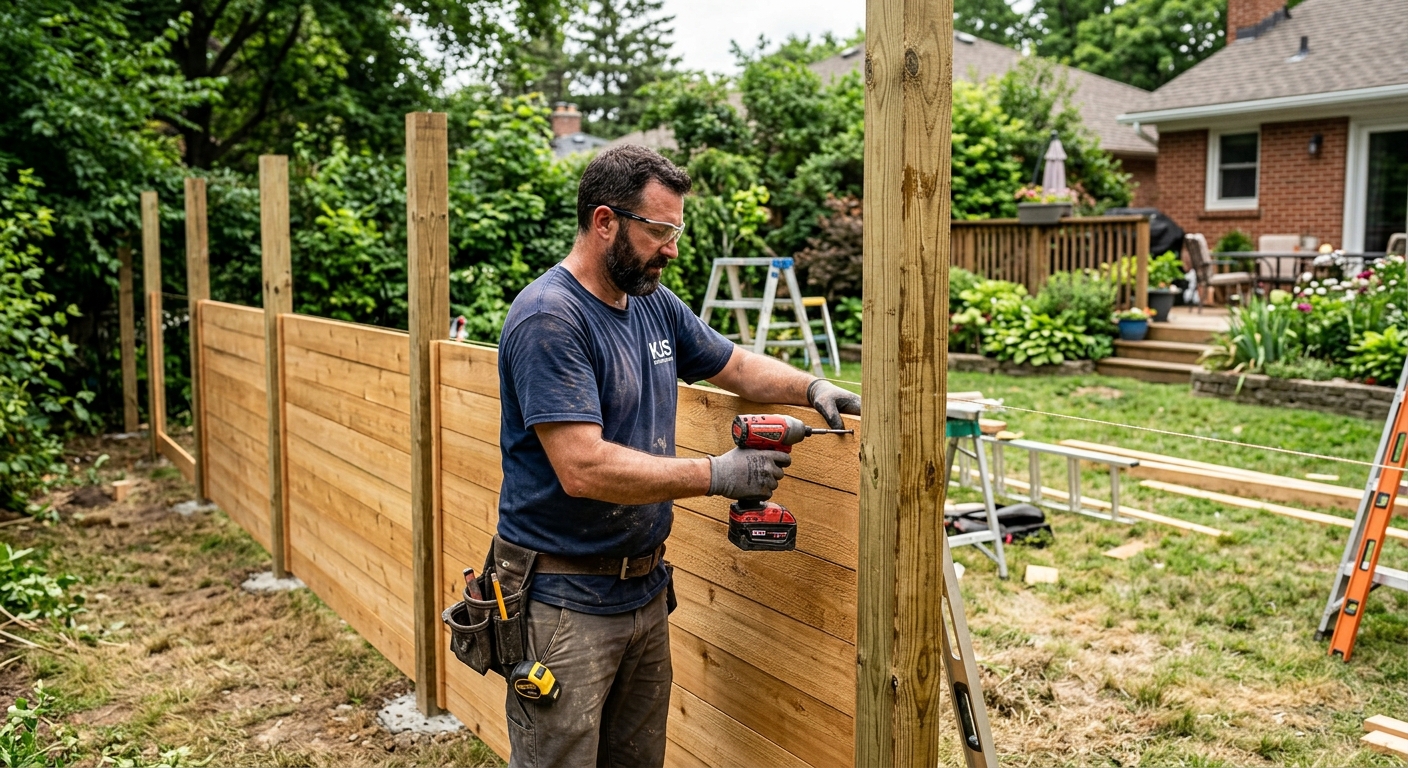
In Somerset and across the Calgary region, two “similar-looking” fences can easily come in 30–50% apart because the big variables aren’t just materials—they’re structure and site work. A privacy fence and an open chain-link fence may both measure 100 linear feet, but the privacy style usually needs tighter post spacing, heavier bracing, and fully concreted footings to resist wind-driven racking on exposed lots. Meanwhile, chain-link panels breathe with the wind, so they can often be built with less structural fuss, which keeps the project closer to the lower–mid pricing band.
Frost protection is the other major swing factor. In the Prairies, the local expectation is to set posts about 4 ft (≈120 cm) deep to land below regional frost depth; contractors often go deeper/with larger holes depending on soil and the fence height. That concrete setting (and longer posts) can raise both labour and material costs compared with milder regions. In contrast, mild, wet coastal conditions in places like BC can accelerate wood rot if treatment is inadequate—so there, proper maintenance and rot-resistant choices drive cost. In Somerset, you’re fighting heaving and wind first, so proper depth and panel rigidity matter most.
Concrete examples from common Somerset jobs: (1) A 6 ft privacy fence on a wind-exposed lot often increases cost versus chain-link by the extra concrete and stronger framing; (2) A sloped backyard can add stair-stepped panels or raked sections; and (3) Retrofitting around an existing fence line may increase labour for old fence removal and post extraction. If you’re comparing wood at roughly $40–$80 per linear foot to vinyl at about $45–$90, the difference is usually justified by how your installer addresses frost-set posts and wind load, not by the panel alone.
| Price Factor |
Why It Matters |
Cost Impact |
| Fence length in linear feet |
The primary driver: more panels and more posts |
High (direct multiplier) |
| Post depth required |
Frost line determines hole depth and post length to prevent heaving |
High (excavation + materials) |
| Post setting method |
Concrete vs. gravel pack vs. driven posts changes labour and stability |
Medium–High |
| Material choice |
Vinyl/cedar/wood behave differently under wind and cold; chain-link is lighter |
Medium–High |
| Gate count and type |
Drive-through double gates and wide openings require stronger frames and hardware |
Medium–High |
| Grade and terrain |
Sloped yards need stepped or raked panel layouts |
Medium |
| Old fence removal and disposal |
Hauling time, deconstruction, and disposal fees add cost |
Low–Medium |
| Permit fees and survey / property line locate |
Requirement depends on height and exact placement; locating prevents encroachment disputes |
Low–Medium |
Permits & regulations in Alberta
In Alberta, fence requirements are tied to height and placement. As a homeowner in Somerset, plan on permits being commonly required when your fence is above typical thresholds—often around 2.0 m (6.5 ft) for the rear and about 1.0–1.2 m (3–4 ft) at the front or corner—especially where municipal rules treat it like a structure affecting sight lines. Regardless of permit needs, every fence must respect property lines and local setback bylaws.
Before any post hole digging, always call for utility locates through Alberta One-Call. This protects you from damaged power lines, gas services, and buried cables. Next, obtain a survey or locate your property pins if you don’t already have them verified. Many fencing disputes come down to “we thought the line was there,” and a locate step prevents costly rework.
For shared fence ownership, Alberta’s line-fence framework governs how responsibilities and costs are handled when fences sit on or near boundary lines.
Step-by-step to verify your contractor is properly set up: ask for (1) their Alberta business licence/registration details (so you can confirm they’re actively operating in the province), (2) a current certificate of liability insurance naming you/your property as applicable, and (3) coverage proof for workers—WSIB/WCB coverage as applicable to their trade staffing. Where to look: the contractor’s own provided COI document (with effective dates), and any online business registry listing they reference. If a contractor won’t provide documentation on request, that’s a red flag before you sign.
Choosing the right fence material for Somerset
The best fence material for Somerset is the one that matches your priorities—privacy, low maintenance, lifespan, and budget—while still surviving Calgary’s freeze–thaw cycle and wind. Pressure-treated pine is usually the lowest upfront option, but in our Prairie conditions it benefits from staining/sealing every 2–3 years to prevent greying and surface breakdown. Cedar looks great and naturally resists rot longer, but it still benefits from periodic maintenance to keep colour and reduce splitting. Vinyl/PVC is popular for low-maintenance homeowners: it typically needs only occasional rinsing, but extreme cold can make panels more prone to cracking if the install isn’t engineered with the correct expansion gaps and solid post bracing. Chain-link is often the longest-lasting “set it and forget it” choice, but it won’t deliver privacy without adding slats or a separate privacy screen. Aluminum ornamental offers a clean, rust-resistant look with minimal care; it’s usually mid-range cost but generally doesn’t provide the same privacy as board systems.
Post depth matters across all materials. In the Calgary economic region, contractors commonly set posts around 4 ft (≈120 cm) deep to get below frost and avoid heaving. For privacy fences, that often includes concrete-set footings for posts and gate points, because wind loading on solid panels is what causes racking. In many Somerset yards, this is exactly why wood or vinyl pricing sits mid-to-upper in the local range (about $40–$80 or $45–$90 per linear foot), while chain-link stays lower (roughly $25–$55).
Example: if your total privacy fence comes to 80 linear feet, moving from chain-link at about $30–$45 per foot to vinyl privacy at about $60–$85 per foot may add roughly $2,400–$3,600 overall. That difference is usually justified when you truly need privacy from wind-driven streets or nearby lots—and when the installer uses frost-set posts and properly spaces rails.
| Material |
Cold Tolerance |
Lifespan |
Annual Maintenance |
Best For |
Price Band |
| Pressure-treated pine |
Good with correct seal/stain |
10–15 years |
1 season check; stain/seal every 2–3 years |
Budget-friendly privacy |
$40–$80 |
| Cedar |
Good |
15–25 years |
Light wash; stain every 2–4 years |
Better look + rot resistance |
$55–$95 |
| Vinyl / PVC |
Good if installed with proper bracing/clearances |
20–30 years |
Rinse as needed (often 0–1 times/year) |
Low maintenance privacy |
$45–$90 |
| Chain-link |
Excellent (galvanized steel) |
25–40 years |
Wash/inspect; minimal |
Security on a budget |
$25–$55 |
| Aluminum ornamental |
Excellent (no rust) |
25–50 years |
Occasional rinse |
Appearance + durability |
$70–$120 |
| Composite / recycled |
Good |
20–30 years |
Wash; inspect rails |
Modern board feel with low upkeep |
$65–$110 |
How to choose a fencing contractor in Somerset
For fencing in Somerset (and across Alberta), you want a contractor who can prove three things: they’re properly licensed/registered to operate, they’re insured, and they can back the work with reliable coverage. Start with verifying their Alberta business registration/licence details online or through documentation they provide. Next, request a certificate of liability insurance—make sure it’s current, and that it includes the work being performed. Third, ask how they handle workers’ coverage (WSIB/WCB depending on their setup). Don’t accept “we’re covered” without the certificate or documentation details.
Then get 2–3 itemised written quotes. Look for a breakdown that shows labour and material separately, including line items for post setting, rails, hardware, and fence components. Avoid quotes that simply provide a single lump sum with no explanation—on Prairie sites with frost-set requirements, scope gaps are where disputes happen. Confirm what’s excluded: permit pull (if required for height), excavation by hand vs. machine, disposal of removed fencing, site restoration, and whether gates/hardware are included. Ask about workmanship warranty length and whether it’s offered directly by the installer. Also ask about manufacturer warranties on materials and whether they’re transferable if you sell your home.
Payment schedule: never pay more than about 10–15% upfront. Hold back a portion until the job is complete and you’ve reviewed alignment, gate swing, and post stability. Finally, require a start date and completion estimate in writing—winter starts and site conditions can shift timelines, but the contractor should still communicate a plan.
- Ask for proof of Alberta business registration/licence and match it to the quote/invoice name.
- Request a current certificate of liability insurance (confirm effective dates).
- Confirm workers’ coverage (WSIB/WCB as applicable) and ask for documentation.
- Get 2–3 quotes that list labour vs materials, not just a total.
- Verify post depth and setting method (concrete vs gravel pack) for frost protection.
- Confirm gate framing strength and hardware (hinges, latches, closers if offered).
- Check if old fence removal/disposal is included or priced separately.
- Ask who pulls permits (if required based on height) and whether that cost is included.
- Request a site plan or layout description referencing property line/locates.
- Ensure warranty terms are in writing: workmanship and material coverage.
- Agree on payment schedule: 10–15% max deposit; holdback until completion.
- Get a written timeline with start date and estimated completion window.
In Somerset, red flags I see often include: (1) quotes that don’t mention post depth/frost setting and rely on “standard” installation, (2) refusal to provide insurance or coverage proof, (3) no itemised scope for gates/hardware and gate alignment, (4) “verbal-only” permit/disposal promises, and (5) asking for large upfront payments (beyond 10–15%) without a signed contract.
Frequently asked questions — fencing in Somerset
What's the most low-maintenance fence?
In Somerset and across the Calgary region’s Prairie climate, vinyl/PVC and aluminum are typically the easiest to live with because they don’t need staining like wood. Chain-link is also low-maintenance, but it won’t provide privacy unless you add slats or a secondary screen. For budgeting, vinyl privacy often falls roughly in the $45–$90 per linear foot range installed, while aluminum ornamental tends to be higher (commonly $70–$120 per linear foot) because of the hardware and fabrication. Whatever you pick, low maintenance only works when the posts are set properly below frost and the fence is braced for wind loading—otherwise you’ll spend money later straightening or replacing panels.
How tall can my fence be in Somerset?
Fence height rules in Alberta are generally tied to whether the fence is at the rear versus the front/corner, and whether it triggers permit requirements. A common practical threshold is that fences above about 2.0 m (6.5 ft) at the rear and around 1.0–1.2 m (3–4 ft) at the front or corner often require a permit. Even when a permit isn’t required, your fence must still respect property lines and municipal setback bylaws. The best approach is to measure your intended height, identify which side(s) of the property the fence is on, and ask your contractor to confirm the permit need before posts are set—especially because adjusting height after concrete is poured is costly.
Should fence posts be set in concrete here?
For most fence layouts in Somerset (given Calgary’s freeze–thaw cycles and expected frost protection), concrete setting for posts is very common—especially for privacy fences and for gate posts, where stresses are higher. Local practice often involves setting posts about 4 ft (≈120 cm) deep to reduce heaving risk below regional frost depth. Whether concrete is needed everywhere depends on soil, fence type, and engineering details, but for solid wood/vinyl privacy systems, installers typically use concrete-set footings to prevent movement and racking under wind load. If you’re comparing quotes, ensure they state the post depth and setting method clearly; that’s usually the difference between a low bid and a durable install.
What's the best fence for privacy?
If privacy is the goal in Somerset, board-style systems are the usual winners: pressure-treated pine, cedar, or vinyl privacy panels with solid infill. Privacy fences also handle wind better when they’re built with the right post depth and spacing for racking resistance—important on open Prairie lots. Pricing typically reflects that structure: wood installation is often around $40–$80 per linear foot, while vinyl privacy can land around $45–$90 per linear foot. If you want “privacy without upkeep,” vinyl usually makes sense, but confirm the contractor uses frost-protected post setting and proper bracing so cold snaps don’t turn into cracking or loosened rails.
How do I compare fencing quotes?
Compare quotes the way you’d compare building materials on a renovation: insist on itemisation and equal scope. Ask each contractor to break out labour vs materials, confirm post depth and setting method, list fence height and panel spacing, and identify what’s included for gates (frame type, hardware, and number of gates). Also confirm removals/disposal, whether a permit is included if height triggers it, and if a property line locate/survey is required. If one quote is much lower—like chain-link around $25–$55 per linear foot versus wood privacy at roughly $40–$80—it may simply be a different product category. The goal is to compare like-for-like fence type, not just length.
How long does fence installation take in Somerset?
Timing in Somerset depends mostly on fence length, number of gates, and how hard excavation is for post holes. A straightforward run with no major grade changes can often be completed in a day or two, while larger privacy projects with many concreted posts, removal/disposal, and sloped terrain can take longer. Weather matters too: cold snaps and frozen ground can slow excavation, but contractors experienced with Calgary frost conditions plan around that. As a rule of thumb, expect a crew to spend the bulk of the time on layout and post installation; panel and rail work is typically faster once posts are cured/positioned as required. Ask for a written start date and completion window before work begins.