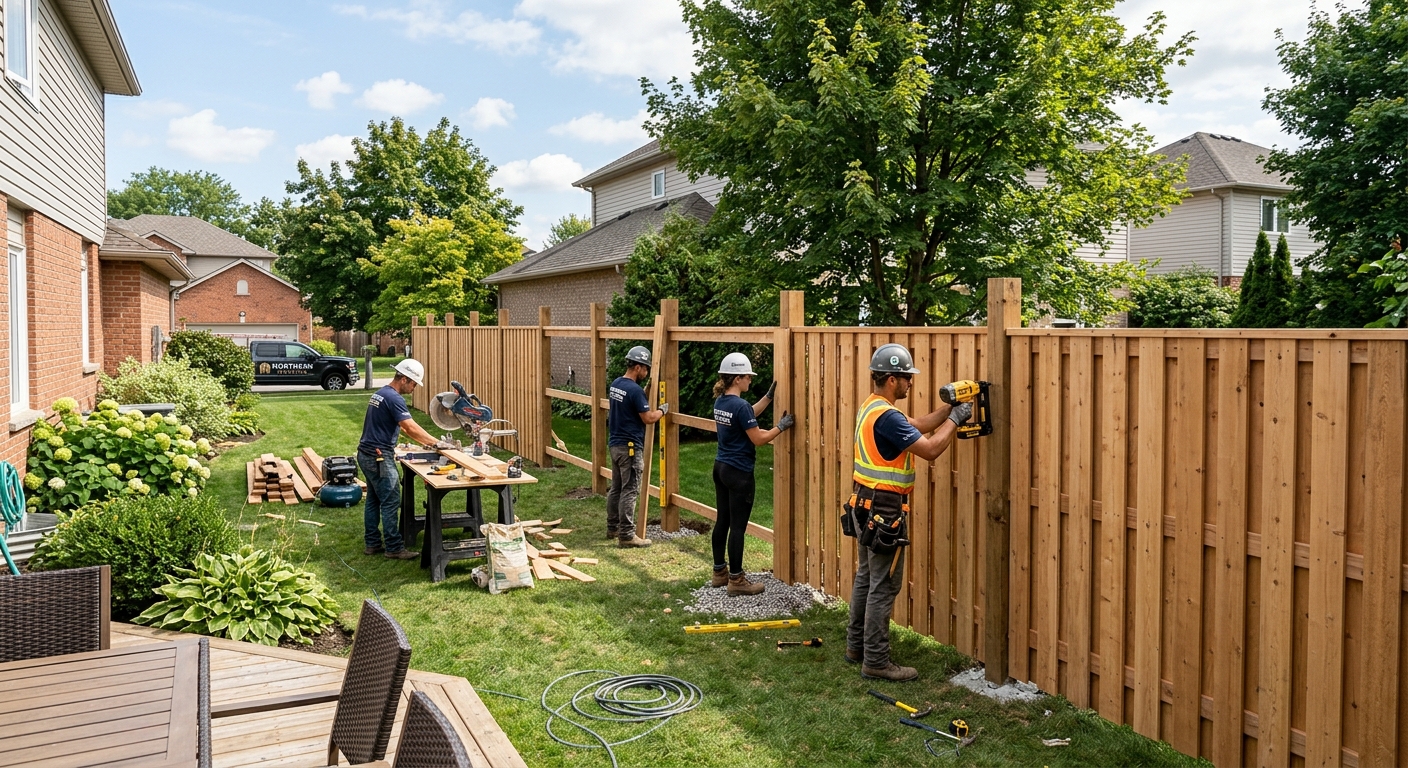
Fencing options and costs in Devon
Devon, Alberta is a homeowner-heavy community with 78.4% of dwellings being single-detached homes (Statistics Canada, 2021 Census). That matters for fencing because detached properties typically have more linear boundary length to secure, and many owners plan upgrades in phases as landscaping matures. It also helps explain the level of steady demand you’ll notice around newer subdivisions and long-established neighbourhoods where older boundary runs need replacement.
In the Edmonton economic region, fencing costs are shaped less by material alone and more by site and climate conditions. Alberta frost depth means contractors must set posts below the frost line to reduce heaving; in practice, that often translates to deeper holes, concrete-set posts, and longer posts—especially for privacy fences. Wind exposure on the Prairies is another cost driver: open, exposed lots put additional stress on panels and fasteners, so installers may use tighter post spacing and more rigid systems than you’d see in sheltered areas. Labour availability can also shift by season, with spring and early summer often bringing higher scheduling pressure.
In Devon, the trade tends to be especially active around the core residential areas near Main Street and the more established blocks closer to the Highway 16 corridor, where boundary fences are frequently upgraded for both security and visual curb appeal. With that context, below is a practical comparison of common fence types, typical lifespan expectations, and realistic installed cost ranges for Devon projects.
| Material |
Lifespan |
Maintenance |
Privacy Rating |
Price per Linear Foot |
Price Range |
| Pressure-treated pine (standard wood) |
10–15 years |
Stain/seal every 2–3 years; inspect fasteners annually |
Good (solid boards) |
$18–$35 |
$3,000–$6,500 |
| Cedar (natural rot resistance) |
15–25 years |
Seal/stain every 2–4 years; occasional board replacement |
Good to very good (solid boards) |
$22–$40 |
$3,500–$7,500 |
| Vinyl / PVC (no-maintenance) |
20–30 years |
Rinse as needed; replace warped sections if extreme cold occurs |
Good (solid panels) |
$25–$50 |
$3,500–$8,000 |
| Chain-link (galvanized steel) |
20–30 years |
Occasional tension/hinge adjustments; wash coating as needed |
Low (open mesh) |
$16–$30 |
$2,000–$4,500 |
| Aluminum ornamental |
30+ years |
No rusting; periodic cleaning and hardware checks |
Low to medium (open pickets) |
$24–$55 |
$4,000–$9,000 |
| Composite / recycled material |
25–30 years |
Minimal upkeep; remove debris, check rails and posts |
Good (solid boards) |
$28–$58 |
$4,000–$9,000 |
Prices are estimates only and vary by project scope, site access and material selection.
What affects the price of fencing in Devon
Even when homeowners ask for “the same fence,” Devon bids across the broader Edmonton area can differ by 30–50%. The biggest reason is that Edmonton-area installs are highly sensitive to frost depth, wind loading, and how accessible your yard is for augers and equipment. Add to that the practical reality that older homes built before 1981 account for 46.6% of the housing stock (Statistics Canada, 2021 Census), and you’ll often see more mature landscaping, older posts to remove, and tighter boundaries that slow labour.
Frost line depth sets how deep posts must be set—typically about 4–6 inches below the design frost depth—to prevent heaving. In Alberta, that commonly means setting posts roughly 1.5–2.0 m into the ground, and in many cases using concrete for long-term stability. Longer posts and concrete increase both material and labour time. Wind exposure on the Prairies also drives tighter post spacing and often heavier rails for privacy fences; otherwise, panels can rack or bow during strong gusts.
In Devon specifically, a few real-world examples show how cost shifts: (1) a long straight run on open, level ground usually lands closer to the lower end of wood fencing budgets (for example, the wood band can be around $3,000–$6,500), because drilling is faster and less work is required to step around grades; (2) a sloped backyard that needs stepped panels can add extra framing time and waste boards, pushing closer to the higher end; (3) removing an old fence and hauling away materials can raise labour and disposal costs enough to make a chain-link job move toward the middle of its range (often $2,000–$4,500)—even though chain-link materials are inexpensive.
As a rule of thumb, the more the site forces deeper holes, extra bracing, and detailed layout/survey time, the more you’ll see your final installed price drift upward within the regional bands.
| Price Factor |
Why It Matters |
Cost Impact |
| Fence length in linear feet |
Every style scales primarily by linear footage plus hardware |
High (major driver) |
| Post depth required |
Frost line determines post length and hole depth for stability |
High (direct labour + concrete/post cost) |
| Post setting method |
Concrete vs. gravel pack vs. driven posts affects labour and material |
Medium to high |
| Material choice |
Vinyl, cedar, and chain-link have different rail/post requirements |
Medium (often shifts overall band) |
| Gate count and type |
Drive-through/double gates require stronger framing and hardware |
Medium to high |
| Grade and terrain |
Sloped yards require raked/stepped panels and extra layout work |
Medium |
| Old fence removal and disposal |
Demolition, hauling, and landfill tipping time |
Medium |
| Permit fees and survey / property line locate |
Some builds need permits; locating affects layout time and dispute risk |
Low to medium (can prevent expensive rework) |
Permits & regulations in Alberta
In Alberta, fences above a height threshold—commonly around 2.0 m (6.5 ft) for rear areas and roughly 1.0–1.2 m (3–4 ft) for front or corner locations—often trigger the need for a building permit. The exact “where and how high” rules can vary by municipal bylaws, so in Devon you’ll want your contractor to confirm the applicable requirements for your address before ordering materials. Regardless of permit needs, all fences must respect property lines and any required setbacks.
Before you dig any post holes, call for utility locates through Alberta One-Call to avoid hitting buried services. Also, plan on obtaining a survey or at least a property-pin locate before installation—boundary disputes are expensive, especially when a fence is built first and corrected later.
For shared fence ownership and line-fence expectations, provincial line-fences legislation governs how responsibilities are handled between neighbours.
What DOES require a permit is typically a taller fence meeting the height triggers (commonly the 2.0 m rear threshold) and any fence that affects how it sits relative to public-facing boundaries. What typically does NOT require a permit is straightforward replacement of like-for-like height within bylaw limits, but you should confirm in writing.
To verify an Alberta contractor for your Devon project, check: (1) the contractor’s licensing status through the appropriate provincial licensing/registration listings (if applicable to their work scope); (2) liability insurance—ask for a current certificate of insurance showing the policy is active and includes your project name/address; and (3) worker coverage—request proof of WSIB/WCB clearance or coverage letter (not just a “we’re insured” statement). Make sure the certificate is dated for the current month, and confirm the coverage includes fencing installation work, not only general contracting.
Choosing the right fence material for Devon
Choosing a fence in Devon is mainly about matching your priorities to what Edmonton-region winters and wind will actually do to the structure. Pressure-treated pine is usually the lowest upfront option, but it needs staining or sealing every 2–3 years to prevent grey weathering and premature surface breakdown. Cedar offers a better look and natural rot resistance, and it typically lasts longer than standard treated lumber, though it still benefits from periodic sealing. Vinyl/PVC is popular for low maintenance—most owners only rinse—but in extreme cold it can become brittle if the installation is off (for example, improper expansion allowance or weak post anchoring). Chain-link has the longest “set it and forget it” reputation and the lowest cost, but it provides little privacy without add-ons. Aluminum ornamental fencing looks clean and won’t rust, yet it’s open—so it’s not ideal if your goal is screening wind and views.
Post depth matters for all options here. Because Alberta frost can heave above-ground or shallow-set posts, contractors commonly set posts concrete-set around 4–6 inches below design frost depth (often roughly 1.5–2.0 m into the ground). For wind and snow load considerations on the Prairies, privacy fences generally need stronger rails and proper post spacing; otherwise, wide panels can rack during gusty fall storms.
To justify price differences with a real example: if a homeowner is choosing between chain-link and vinyl for the same run, chain-link often lands closer to $2,000–$4,500, while vinyl commonly sits around $3,500–$8,000. That extra spend is justified when privacy, wind buffering, and a more finished appearance are the goal—because chain-link won’t meet those needs on its own.
| Material |
Cold Tolerance |
Lifespan |
Annual Maintenance |
Best For |
Price Band |
| Pressure-treated pine |
Good when posts are frost-set and wood is sealed |
10–15 years |
1-hour inspection + stain/seal every 2–3 years |
Budget-friendly boundary security and classic look |
$3,000–$6,500 |
| Cedar |
Excellent rot resistance in damp freeze-thaw cycles |
15–25 years |
Inspect annually; seal/stain every 2–4 years |
Appearance + durability without premium vinyl cost |
$3,500–$7,500 |
| Vinyl / PVC |
Good if installed with correct hardware and spacing |
20–30 years |
Minimal—rinse/spot clean as needed |
Low maintenance privacy or boundary screening |
$3,500–$8,000 |
| Chain-link |
Very good; galvanized steel withstands freeze-thaw |
20–30 years |
Occasional tightening and hardware checks |
Lowest cost security with long service life |
$2,000–$4,500 |
| Aluminum ornamental |
Very good; won’t rust in Alberta winters |
30+ years |
Minimal cleaning; check gate alignment |
Decorative boundary definition and curb appeal |
$4,000–$9,000 |
| Composite / recycled |
Good for freeze-thaw with proper framing |
25–30 years |
Low—annual inspection for rail connections |
Solid privacy look with minimal upkeep |
$4,000–$9,000 |
How to choose a fencing contractor in Devon
Choosing the right fencing contractor in Devon starts with verification and paper trails. First, confirm liability insurance: request a certificate of insurance showing active coverage and the correct business name, and ensure it’s appropriate for construction/trades work (not only general liability for small projects). Second, check worker coverage—WSIB/WCB proof or a clearance letter should be provided for the coverage period. Third, verify licensing/registration where required for their specific work scope; if a contractor can’t produce what you’re asking for, treat it as a serious concern.
Next, get 2–3 itemised written quotes. Ask for a breakdown that separates labour (excavation, setting, install, gate framing) from materials (posts, rails, fence panels, hardware) and clearly states how they handle concrete, disposal, and any special posts required for slopes. Avoid comparing “lump sum” only quotes—two contractors can include different scopes under the same number.
Read the scope carefully: is permit pulling included (if required), and is survey/property-line locating included if needed? Confirm whether old fence removal and disposal are included or billed separately.
For warranty, separate workmanship warranty from product/manufacturer warranty. Ask how long the workmanship warranty lasts, whether it covers adjustments after winter movement, and whether the manufacturer warranty is transferable to a new owner if you sell.
Payment schedule matters: never pay more than 10–15% upfront. Use a holdback until the project is fully complete and cleaned up. Finally, require a start date and completion estimate in writing—fences are weather-dependent in Alberta, and good contractors plan around frost and access.
- Ask for proof of current liability insurance (certificate with your address/project).
- Request WSIB/WCB clearance or coverage letter dated for the current month.
- Confirm licence/registration relevant to fencing installation and contracting.
- Require 2–3 itemised quotes (labour vs materials) instead of one lump sum.
- Ensure post-depth plan is stated (frost considerations and setting method).
- Clarify whether gates include reinforced framing and correct hardware.
- Confirm disposal/hauling of old fence (or state it as excluded).
- Ask whether concrete supply and fencing-specific fasteners are included.
- Get slope handling details (stepped vs raked sections) for your yard grade.
- Check warranty terms for workmanship and manufacturer coverage separately.
- Set a payment schedule with 10–15% max upfront and a completion holdback.
- Make sure the quote states who is responsible for permits/property-line locating if required.
Red flags in Devon include contractors who (1) won’t provide insurance/coverage documents on request, (2) propose shallow or “surface-set” posts without frost depth planning, (3) refuse itemised pricing or scope details, (4) won’t specify warranty lengths in writing, and (5) ask for large upfront payments beyond 10–15%.
Frequently asked questions — fencing in Devon
How do I find my property line before fencing?
In Devon, the safest approach is to locate your property pins (or order a survey if pins are missing/unclear) before any post holes get dug. Even if you have a “good idea” where the line is, fences built on the wrong side create neighbour disputes and costly rework. I recommend starting with your property tax documents and any past survey paperwork, then confirming pin locations with a qualified surveyor or the locate service approach your contractor uses. Also, align your fence layout with any municipal boundary/setback rules before materials are ordered—older lots in the Edmonton region can have legacy boundary interpretations, and that’s where mistakes happen. If the contractor can’t help you confirm the boundary in writing, pause and verify before you commit.
What's the most low-maintenance fence?
For low maintenance in Alberta winters, vinyl/PVC and properly galvanized chain-link are usually at the top. Vinyl typically needs only periodic rinsing and hardware checks, while chain-link requires tension/hardware adjustments occasionally but doesn’t demand staining or sealing. That said, “low maintenance” depends heavily on correct installation: posts must be set to handle frost movement, and gates need proper alignment so they don’t sag after freeze-thaw cycles. Budget-wise, homeowners often compare chain-link around $2,000–$4,500 versus vinyl in the $3,500–$8,000 band. If privacy is a requirement, vinyl’s solid panels usually justify the difference, especially on windy Prairie lots where open mesh won’t shield views or gusts.
How tall can my fence be in Devon?
Fence height limits in Devon follow municipal bylaw rules, and Alberta often triggers permitting when heights exceed typical thresholds (commonly around 2.0 m for rear areas and about 1.0–1.2 m for front or corner areas). Because corner lots and front-facing boundaries can be treated differently, you should confirm your address-specific allowance before construction. A good contractor will ask where your fence sits (front, rear, or side/corner) and provide a written confirmation about whether a permit is likely required. If your plan is for a taller privacy fence, it’s especially important to verify early, since permit timing affects scheduling. With Devon’s mix of older homes and established landscaping, fence height proposals sometimes need layout adjustments, so planning ahead prevents delays and rework.
Should fence posts be set in concrete here?
In Devon and the Edmonton region, concrete-set posts are very often recommended because posts must be stable against Alberta frost heaving. Typically, posts should be set below the design frost depth—contractors commonly plan for holes about 4–6 inches below design frost depth—so that freeze-thaw movement doesn’t lift the posts over winter. In many projects, that leads to concrete setting as the most dependable method, particularly for privacy fences and gates that carry higher loads. There are alternatives in certain circumstances (like specific engineered gravel pack methods), but they’re not “one size fits all,” especially on exposed windy lots. If a quote doesn’t clearly describe post depth and setting method, ask directly—your long-term alignment depends on it.
What's the best fence for privacy?
For privacy in Devon, solid-panel systems are the most effective: vinyl/PVC privacy fences, cedar or pressure-treated wood boards, and composite/recycled boards all provide meaningful screening. Chain-link is generally not considered private on its own because the mesh is open, and aluminum ornamental pickets are also usually too see-through for true privacy. Your best choice also depends on Alberta wind: sturdier post spacing and rigid rails help prevent racking and keep panels aligned when gusts hit. If you’re comparing costs, privacy options often land in the middle of the wood and vinyl bands—wood installs are commonly in the $3,000–$6,500 range, while vinyl often sits around $3,500–$8,000. When budget allows, vinyl or cedar are often the most “set and keep your look” approaches.
How do I compare fencing quotes?
To compare Devon fencing quotes fairly, insist on itemised written estimates that separate labour and materials and clearly list what’s included. Look for differences in: post depth and setting method, gate reinforcement (especially for double or drive-through gates), fence height and panel style, and whether old fence removal/disposal is included. Confirm whether permits are handled (if the fence meets Alberta/municipal triggers) and whether property-line locate/survey support is included or excluded. Also compare warranty terms: workmanship duration and manufacturer coverage should be stated separately. Finally, check payment schedule—good contractors keep upfront payment to around 10–15% and use a holdback after completion. Price alone can mislead; for example, a “cheap” chain-link quote near $2,000–$4,500 can be expensive if it excludes line locates, concrete, or necessary gate framing.