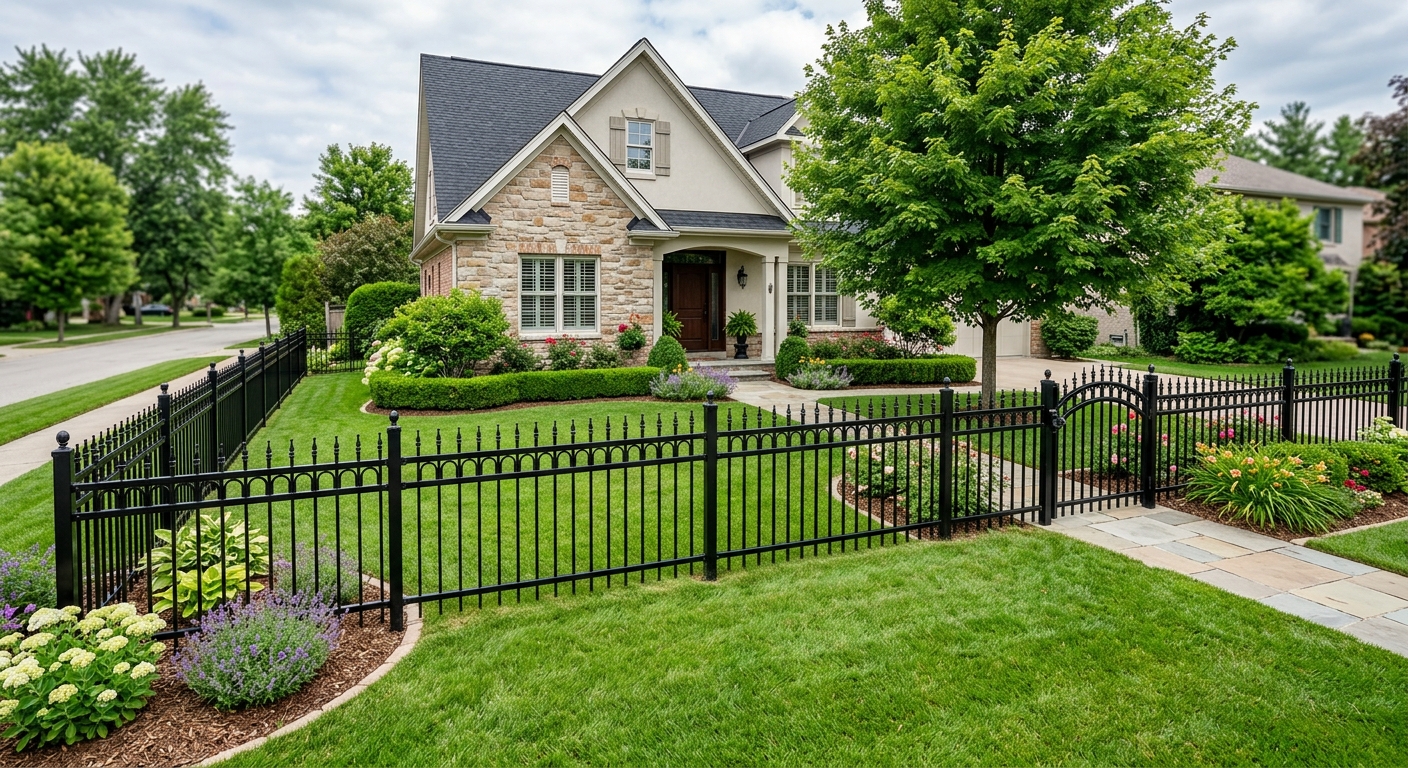
Fencing options and costs in Hinton
Fencing in Hinton is all about choosing a style that can handle Alberta’s freeze–thaw winters without shifting, twisting, or sagging. With a population of 9,817 (Statistics Canada, 2021 Census) and a high rate of homeowners—2,875 homeowner households, or 71.8% of households (Statistics Canada, 2021 Census)—there’s steady demand for private backyards, perimeter security, and pets/wildlife-friendly yards. Detached homes make up 55.6% of dwellings, so many projects start with a classic backyard run, then expand to gates or front-yard edging as residents settle in.
In the Banff–Jasper–Rocky Mountain House cold-climate, mountain-foothills zone, your fence cost is driven more by ground conditions and exposure than in milder Alberta markets. Frost heave risk pushes contractors to set posts at least 4 ft deep (often deeper in exposed pockets), and rocky or compact soils typically mean more augering time, spoil removal, and heavy-duty posts. Wind and snow loading also matter: exposed lots benefit from shorter bays, tighter post spacing, and heavier rails—especially for solid wood and vinyl privacy panels—so you usually pay a bit more than a comparable Prairie install.
In Hinton, we see especially strong demand in neighbourhoods around the east and west ends of town—where lots are more exposed and yards are longer—plus on properties with sloped drives or treed backlines near the river corridor. Once you know which materials fit your privacy and maintenance comfort level, you’re ready to compare realistic price bands for your linear footage and site setup.
| Material |
Lifespan |
Maintenance |
Privacy Rating |
Price per Linear Foot |
| Pressure-treated pine (standard wood) |
10–15 years |
Stain/seal every 2–3 years; inspect posts and pickets |
7/10 (solid boards or close spacing) |
$45 – $85 |
| Cedar (natural rot resistance) |
15–25 years |
Light staining every 2–4 years; periodic fastener checks |
8/10 (solid board styles) |
$65 – $95 |
| Vinyl / PVC (no-maintenance) |
20–30 years |
Rinse as needed; replace rare damaged sections |
9/10 (privacy slat styles) |
$60 – $110 |
| Chain-link (galvanized steel) |
25–40 years |
Minimal; keep tensioned and touch-up if damaged |
3/10 (security only) |
$30 – $55 |
| Aluminum ornamental |
25–40 years |
Occasional wash; inspect hardware |
4/10 (open picket) |
$70 – $130 |
| Composite / recycled material |
20–30 years |
Low; clean and monitor for surface wear |
8/10 (board-style privacy) |
$75 – $120 |
Prices are estimates only and vary by project scope, site access and material selection.
What affects the price of fencing in Hinton
It’s common to see fencing quotes for the “same” job differ by 30–50% across the Banff–Jasper–Rocky Mountain House region and other parts of Alberta. In Hinton, that spread comes down to how contractors handle cold-climate fundamentals: post depth, concrete setting, soil conditions, wind bracing, and access for augers and trucks. A tight backyard with limited staging time can add labour even when the fence length is short, and heavier materials (or more gates) cost more to install and transport.
The biggest technical driver is frost. Local practice typically sets posts 4–6 inches below the design frost depth, which often means posts around 1.5–2.0 m into the ground. That requires longer posts, more excavation, and concrete setting (not tamped gravel) to resist freeze–thaw lateral movement. The result is higher labour time per hole and more concrete volume than many homeowners expect when they compare against lower-cost Prairie builds. On exposed lots, wind exposure also encourages tighter post spacing and heavier rails; this is why solid wood and vinyl often land closer to the higher end of the wood or vinyl bands (for example, wood commonly lands around $45 – $85, and vinyl can run near $60 – $110).
Two to three local examples that move the price quickly in Hinton: (1) rocky glacial soils can slow augering and force larger spoil removal—adding time and disposal; (2) sloped front yards near driveways often need stepped/raked panels and more labour fittings; (3) winter access—when ground is partially frozen or snowbanked—can mean additional trip planning and faster, more expensive field work. Housing stock also plays a role: with 53.6% of homes built before 1981 (Statistics Canada, 2021 Census), some properties have older fence lines, buried posts, or rebar in the ground, which can increase removal costs.
| Price Factor |
Why It Matters |
Cost Impact |
| Fence length in linear feet |
More linear footage means more posts, rails, and labour hours. |
High (primary driver of the total) |
| Post depth required |
Frost line depth determines hole depth and how long posts must be. |
High (adds excavation and material) |
| Post setting method |
Concrete resists freeze–thaw heave better than gravel pack. |
Medium to high (concrete volume + labour) |
| Material choice |
Vinyl/cedar boards, rail profiles, and hardware vary in cost and weight. |
Medium to high (drives most band differences) |
| Gate count and type |
Drive-through and double gates require more hardware and reinforcement. |
High (gates are labour- and materials-heavy) |
| Grade and terrain |
Slopes require stepped or raked designs and additional measurements. |
Medium (more fittings, more labour time) |
| Old fence removal and disposal |
Hauling and stump/footing removal adds labour and tipping fees. |
Medium (can change price noticeably) |
| Permit fees and survey / property line locate |
Locates prevent encroachment mistakes and delays. |
Low to medium (varies by site requirements) |
Permits & regulations in Alberta
In Alberta, many fence projects may require a building permit once you exceed common height thresholds—typically 2.0 m (6.5 ft) at the rear and around 1.0–1.2 m (3–4 ft) at the front or corner, depending on location and local rules. Regardless of permit requirements, fences must stay within property lines and follow municipal setback requirements. Because these details can change based on where the fence sits (frontage vs. interior yard), the safest approach for Hinton homeowners is to confirm your exact line and height plan before digging.
Before any post hole is dug, you should arrange utility locates through Alberta One-Call (utility marking). Even if you’ve had fencing there before, locate service is still important because services and later repairs can shift. For properties with uncertain pin visibility or older boundary markers, get a survey or at minimum a property pin locate so the new fence doesn’t drift into a neighbour’s parcel or create a dispute.
Shared fence ownership is handled through provincial line-fences legislation principles, which generally expect shared responsibilities for mutual boundaries where applicable; however, your agreement should be clear in writing.
What typically DOES require a permit: taller fences over common thresholds, fences with special structural elements, and any project specifically flagged by your municipality or building department during pre-checks. What typically does NOT: smaller, garden-level repairs in-kind and standard fence replacements that stay under the height limits and meet setbacks (still verify).
To verify a contractor in Hinton, check: (1) Alberta licence/registration in the contractor’s online registry listing (use the contractor’s legal name as written on the proposal), (2) certificate of insurance for general liability with the required coverage, and (3) WSIB/WCB coverage status—request the current clearance letter or confirm active coverage. Don’t rely on a verbal statement; ask for documents and keep copies with your contract.
Choosing the right fence material for Hinton
Choosing a fence material in Hinton should start with how you live outdoors: privacy needs, how often you want to maintain it, and what you can realistically budget for deep frost-resistant posts. Pressure-treated pine is the usual budget route, but it will weather and typically needs staining every 2–3 years to avoid grey surface breakdown. Cedar has better natural rot resistance and often looks great longer, though it still benefits from periodic staining and hardware checks. Vinyl/PVC offers low upkeep and strong privacy with board-style panels, but in extreme cold it can become brittle if installed with the wrong hardware or if boards don’t move/contract properly. Chain-link is the lowest-cost long-life security option, but it won’t give privacy without added screening. Aluminum ornamental looks clean, won’t rust, and handles winter well, but it’s still open by design. Composite/recycled materials can provide privacy similar to wood while reducing maintenance, but they cost more upfront.
Because the Banff–Jasper–Rocky Mountain House region is frost-active, your posts still matter as much as your chosen material. In most residential Hinton installs, concrete-set posts are standard practice when frost depth is significant; that improves resistance to racking over years of freeze–thaw. For wind, shorter bays and heavier rails help solid materials perform better. Snow loading and wildlife pressure can also bash rails, so you’ll want solid bracing on corners and gate posts.
Here’s a concrete way to think about cost justification: if a cedar privacy option lands nearer the higher wood band (often around $65 – $95 per linear foot), the extra compared with pressure-treated pine (roughly $45 – $85) can make sense if you want fewer replacements and a nicer long-term appearance—especially when most of the labour cost is already tied to deep, concrete-set posts. If your priority is minimizing upkeep and you’re okay paying more upfront, vinyl around $60 – $110 can be a practical swap.
| Material |
Cold Tolerance |
Lifespan |
Annual Maintenance |
Best For |
Price Band |
| Pressure-treated pine |
Good if properly sealed and installed on deep concrete-set posts |
10–15 years |
Low to moderate (stain/inspect every 2–3 years) |
Budget privacy with acceptable upkeep |
$45 – $85 |
| Cedar |
Very good in freeze–thaw with correct hardware and spacing |
15–25 years |
Low to moderate (stain/inspect every 2–4 years) |
Natural look, better rot resistance |
$65 – $95 |
| Vinyl / PVC |
Good; must be installed with correct expansion practices in cold snaps |
20–30 years |
Very low (rinse/spot-check) |
Low maintenance privacy |
$60 – $110 |
| Chain-link |
Excellent (galvanized steel handles winter well) |
25–40 years |
Very low (tension/hardware checks) |
Security and pet control |
$30 – $55 |
| Aluminum ornamental |
Excellent (won’t rust and stays stable) |
25–40 years |
Very low (wash/inspect) |
Street appeal with light security |
$70 – $130 |
| Composite / recycled |
Good; performs well when installed correctly and not under-stressed |
20–30 years |
Low (clean and monitor) |
Privacy with reduced upkeep |
$75 – $120 |
How to choose a fencing contractor in Hinton
Choosing a contractor in Hinton is less about flashy photos and more about how they build for cold weather. In Alberta, you should verify: (1) the contractor’s Alberta licensing/registration details (confirm the legal business name matches the quote and invoice), (2) liability insurance with current coverage, and (3) WSIB/WCB coverage status—ask for a clearance letter or proof of active coverage. If they can’t produce documents quickly, treat it as a red flag; fencing is labour-intensive and mistakes can cause costly post shifts in winter.
Next, request 2–3 itemised written quotes. A fair fence quote breaks labour (excavation, post installation, rails, gate build/hinging) separately from materials (posts, concrete volume, fasteners, rails, panels, hardware). Make sure it states whether permit pulling is included, whether old fence removal and disposal is part of the scope, and what happens if underground obstacles are found. Get start date and completion estimate in writing, and ask for the expected weather/access constraints—especially important in freeze–thaw periods.
On payment, never pay more than 10–15% upfront. Holdback until completion (and verify warranty start date). Look for a workmanship warranty and confirm whether it’s tied to the installer only or also includes material defects from the manufacturer. Finally, ensure warranties are documented and, if applicable, ask whether they transfer to future owners if you sell.
- Confirm the quote uses your fence dimensions in linear feet plus post spacing and gate sizes.
- Ask how deep posts will be set and whether the plan uses concrete (typical for Hinton frost resistance).
- Verify liability insurance is active and ask for the certificate with your name listed as a job-site party where applicable.
- Provide WSIB/WCB clearance letter or proof of coverage—don’t accept “we’re covered” without documents.
- Request itemised labour vs materials (no single “lump sum” line items).
- Confirm whether permit pulling is included or your responsibility.
- Clarify property-line responsibility: who locates pins/survey reference, and what happens if lines are disputed.
- Ask if they include disposal of old fence panels, posts, and concrete rubble (and tipping fees if applicable).
- Ensure gates include hardware type (hinges, latches, bracing) and whether posts are reinforced.
- Check for slope solution: stepped or raked panels and how they keep top rails level by design.
- Get a written start/completion timeline and a contingency plan for winter access issues.
- Review warranty terms in writing: workmanship duration, exclusions, and transferability.
Red flags I see in Hinton: contractors who won’t state post depth and setting method, quotes that omit gate hardware specifics, “cash only” pressure to speed payment, no insurance/coverage proof provided up front, and proposals that don’t mention utility locates or property line verification. If any of those show up, slow down—those gaps usually cost homeowners after the ground freezes and the fence begins to rack.
Frequently asked questions — fencing in Hinton
How tall can my fence be in Hinton?
In Hinton and across Alberta, fence height rules often depend on whether the fence is in the front, corner, or rear portion of the lot and how local setbacks are defined. A common guideline used during planning is around 2.0 m (6.5 ft) for rear fences and roughly 1.0–1.2 m (3–4 ft) for front or corner areas, with permits sometimes required above these thresholds. Because municipal details can affect what applies to your exact placement, confirm the planned height and location with your contractor and—if needed—with the town’s permit process before posts are dug. If you’re matching an existing fence line from an older build (many Hinton homes predate 1981), check whether the prior fence was compliant, too.
Should fence posts be set in concrete here?
For Hinton, yes—concrete-set posts are typically the safest approach when frost depth is significant and you want long-term stability through freeze–thaw cycles. In the Banff–Jasper–Rocky Mountain House cold-climate zone, posts are commonly set at least 4 ft deep and sometimes deeper in exposed or challenging pockets, and concrete helps resist lateral movement and frost heave better than tamped gravel packs. Concrete also improves performance for gates and privacy fences that see higher wind loading and vibration. If a contractor suggests only gravel pack in a heavy frost environment, ask how they’re addressing post depth, soil type (rocky vs. compact), and lateral loads.
What's the best fence for privacy?
For privacy in Hinton, solid wood styles, vinyl privacy panels, and cedar board fences are usually the top picks. Vinyl/PVC often appeals to homeowners who want “set it and forget it” maintenance, while cedar looks natural longer, and wood can be the more budget-friendly route depending on board choice and rail stiffness. Since your fence must resist wind and winter conditions, prioritize tight post spacing, solid rails, and proper bracing on corners and gates. Price-wise, wood privacy often fits within $45 – $85 per linear foot, while vinyl privacy is commonly around $60 – $110. The extra cost is usually tied to stronger framing and deep concrete-set posts, not just the panel material.
How do I compare fencing quotes?
Compare itemised quotes side-by-side, not the overall totals. Ask each contractor to list labour (excavation/auger work, post installation, rails, gate build) separately from materials (posts, panels, hardware) and to specify the post depth and post setting method. Confirm whether concrete volume and spoil disposal are included, and whether permit pulling and property line locating are part of the scope. Ensure quotes include the same fence height, post spacing, gate type (single vs. double/drive-through), and whether the design is stepped for slopes. In this region, missing details like concrete setting or frost-depth planning can make a cheaper quote look better—then cost more later once the fence shifts.
How long does fence installation take in Hinton?
Typical residential installations in Hinton often run from a few days to about a week, depending on linear footage, number of gates, soil difficulty (rocky vs. soft), and whether old fencing must be removed. Deep post holes and concrete setting are time-intensive; you may also see scheduling delays when snowbanks, access constraints, or freeze–thaw conditions affect trenching and augering. A longer run with gates and sloped ground usually takes longer because panels must be stepped or raked precisely. To avoid surprises, ask your contractor for a written timeline with estimated start and completion dates, and confirm whether material delivery is included in their schedule.
Can I install a fence on a slope in Hinton?
Yes, you can install a fence on a slope in Hinton, and many lots here need a design adjustment because terrain changes from yard to yard. The key is how the fence follows the grade: stepped panels (each section rises or drops) or raked top rails (rails stay at a consistent angle while panels align). Either way, the posts still require proper depth and concrete setting to prevent uneven lift. Your installer should measure the slope before ordering materials so post spacing and panel counts match the final layout. Sloped fences also tend to need more fittings and careful alignment around gates and corners, so it’s smart to compare slope notes in each quote rather than assuming all proposals include the same solution.