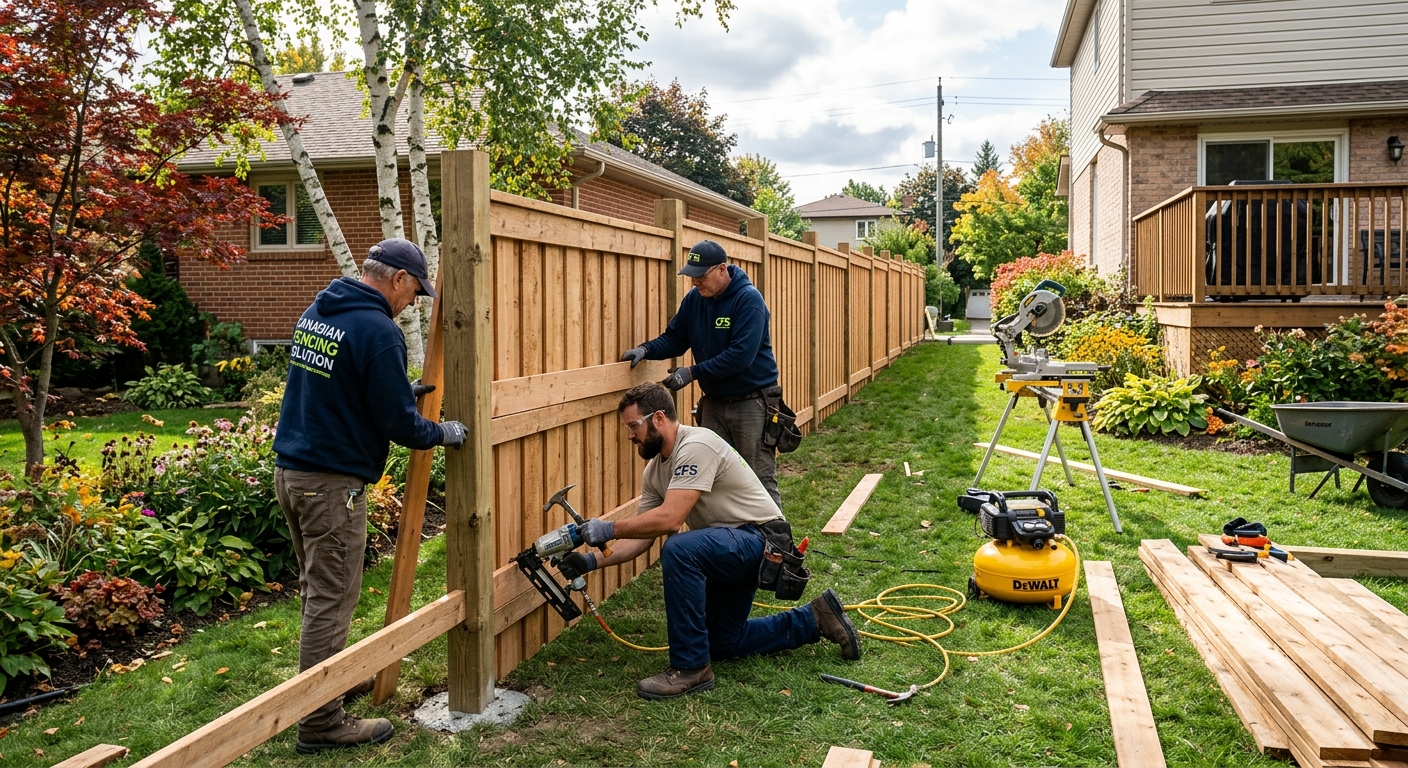
Fencing options and costs in Dover
Dover, Alberta homeowners usually start with one big question: “Do we want privacy, or do we want the lowest-cost, longest-life option?” With Dover’s population sitting at 10,795 (Statistics Canada, 2021 Census), and many households living in detached homes that commonly need perimeter protection and privacy, the local demand for new installs and replacements stays steady. In practice, fence work is especially busy around areas with more backyards exposed to wind, such as the residential pockets near downtown Dover where yard lines and gate locations tend to be more accessible.
Pricing in Dover is heavily shaped by the Calgary economic region’s Prairie continental climate—long freeze–thaw cycles and strong gusts across open exposure. That means post holes and foundations matter more than in milder parts of Canada: most installs rely on posts set about 4 ft (≈120 cm) deep to reduce heaving risk and to resist racking on solid panels. Privacy fences (wood or vinyl) also need stronger bracing and closer attention to wind loading than chain-link, which naturally lets airflow through.
Contractors in the Calgary region generally have the crews and material sourcing to offer multiple product lines, but access (narrow side yards, landscaping, or buried utilities) can shift labour time and concrete volume. As a result, homeowners often see a noticeable spread between wood/vinyl privacy and chain-link, even when the fence height looks similar from the curb. Use the table below to compare common materials, typical lifespan and maintenance expectations, and the realistic installed price range per linear foot for Dover.
| Material |
Lifespan |
Maintenance |
Privacy Rating |
Price per Linear Foot |
| Pressure-treated pine (standard wood) |
15–20 years |
Stain/seal every 2–3 years |
High |
$40–$80 |
| Cedar (natural rot resistance) |
20–25 years |
Light re-stain every 2–4 years |
High |
$55–$95 |
| Vinyl / PVC (no-maintenance) |
25–30 years |
Minimal cleaning; inspect posts |
High |
$45–$90 |
| Chain-link (galvanized steel) |
25–35 years |
Occasional washing; tighten hardware |
Low–Medium |
$25–$55 |
| Aluminum ornamental |
20–35 years |
Rinse/clean as needed |
Low–Medium |
$70–$120 |
| Composite / recycled material |
25–35 years |
Wash occasionally; rare touch-ups |
High |
$60–$105 |
Prices are estimates only and vary by project scope, site access and material selection.
What affects the price of fencing in Dover
In Dover, two quotes for what looks like the “same fence” can differ by 30–50% once you factor in foundation depth, wind bracing, and how much labour is required to handle the site. In the Calgary economic region, frost protection is a major driver: contractors typically set posts about 4–6 inches below the design frost depth, and in colder Alberta this often works out to roughly 1.5–2.0 m into the ground. That pushes excavation time, concrete volume, and sometimes the need for longer posts—so even when material choice stays the same, your installed price can change.
Wind exposure on the Prairies also matters. Solid panels (wood/vinyl) catch more gust load and can rack if posts are too far apart or if concrete footings are reduced. That’s why heavier fence builds land closer to the mid–upper parts of the band—wood or vinyl often fall around $40–$80 or $45–$90 per linear foot depending on height and bracing details. Chain-link, by contrast, is usually closer to the lower–mid range (often $25–$55) because airflow reduces lateral force.
Concrete examples from Dover-area jobs: (1) a 6 ft privacy run through rocky soil may increase excavation and concrete costs even if the fence line length is unchanged; (2) a backyard with heavy snow drift exposure often benefits from extra bracing at corners and gate posts, which raises labour; (3) if your yard is flat and access is easy for a skid steer, the same height fence can come in closer to the low end of the price band because excavation is faster and waste is lower. Lastly, housing age matters: newer properties can have cleaner, straighter property lines, while older yards sometimes require additional removal and re-layout that adds cost.
| Price Factor |
Why It Matters |
Cost Impact |
| Fence length in linear feet |
The primary driver of materials, labour hours, and total post count |
Highest; scales directly with scope |
| Post depth required |
Frost line depth determines post length and hole depth to prevent heaving |
Medium to high increase on deeper-set posts |
| Post setting method |
Concrete vs. gravel pack vs. driven posts affects stability and winter performance |
Concrete typically adds cost, especially for 6 ft fences |
| Material choice |
Different materials carry different hardware needs and installation complexity |
Vinyl/cedar higher than chain-link; aluminum often highest |
| Gate count and type |
Gates require reinforced frames, hinges, and often heavier concrete at posts |
Higher with drive-through (double) gates |
| Grade and terrain |
Slopes require stepped design or raked panels to maintain consistent height |
Medium; adds labour for alignment and layout |
| Old fence removal and disposal |
Hauling, tipping fees, and debris handling can be significant |
Low to medium depending on condition and access |
| Permit fees and survey / property line locate |
Proper locate work prevents encroachment disputes and rework |
Low to medium; can be high if a survey is required late |
Permits & regulations in Alberta
In Alberta, fences above common height thresholds—often around 2.0 m (6.5 ft) in the rear and roughly 1.0–1.2 m (3–4 ft) at the front or corner—may require a building permit. Whether you need one depends on your fence location relative to the street and your lot layout, but it’s safest to confirm before you dig. Regardless of permit needs, every fence must respect property lines and municipal setback requirements.
Before you install any fence posts, you must arrange utility locates so you don’t hit buried power, gas, or telecommunications lines. In Alberta, use Alberta One-Call for the locate process. If you don’t already have reliable property pins or a current survey, get a locate or survey before fencing—this reduces costly disputes and rework.
Shared fence ownership and responsibilities are typically governed by provincial line-fences legislation. That means if a fence is on (or shared across) a boundary, expectations around replacement, maintenance, and cost sharing are handled under those rules, not just neighbour agreement.
To verify a Dover-area contractor: confirm they are properly licensed for their scope, that they carry liability insurance with an appropriate certificate of insurance naming you as additional insured if offered, and that they have required WCB/WSIB coverage. Ask for current clearance or proof documentation directly—then compare policy dates to your start date.
Choosing the right fence material for Dover
Choosing a fence in Dover is about matching the material to how your yard behaves in Calgary-area winters: freeze–thaw cycling, wind-driven snow, and the need for posts set below the regional frost depth. Pressure-treated pine is the budget-friendly route and can look sharp when installed well, but expect grey weathering unless you stain and seal about every 2–3 years. Cedar has natural rot resistance and usually ages more gracefully, though it still benefits from periodic staining to maintain its look and prevent surface checking.
Vinyl/PVC is the low-maintenance favourite for many homeowners because it doesn’t require staining, and it typically holds colour better than raw wood. The trade-off is that it’s more sensitive to installation quality: posts and rails must be square, and it may crack if it’s forced or improperly mounted in extreme cold. Chain-link is the lowest-cost and longest-life choice for security with minimal wind stress because it allows airflow; however, privacy is limited unless you add privacy slats, which also changes airflow and wind behaviour. Aluminum ornamental offers no-rust performance and curb appeal, but it doesn’t deliver privacy.
Because posts in the Calgary region are commonly set about 4 ft (≈120 cm) deep (often with concrete footings for stronger privacy builds), concrete-set posts are generally recommended for 6 ft privacy fences and gate posts to prevent racking and heaving. For wind and snow load, prioritize well-braced corners and reinforced gate hardware.
Example: if you’re choosing between pressure-treated pine at roughly $40–$80 and cedar at about $55–$95 per linear foot, paying the cedar premium can be justified when you want a cleaner long-term appearance and higher resistance to rot in damp freeze–thaw seasons—especially if you plan to keep the fence for 20+ years.
| Material |
Cold Tolerance |
Lifespan |
Annual Maintenance |
Best For |
Price Band |
| Pressure-treated pine |
Good with proper staining and correct post depth |
15–20 years |
Plan on 1–2 hours/section checks; stain every 2–3 years |
Budget privacy with a traditional look |
$40–$80 |
| Cedar |
Excellent when sealed/stained properly |
20–25 years |
Inspect annually; re-stain every 2–4 years |
Premium appearance and rot resistance |
$55–$95 |
| Vinyl / PVC |
Good; must be installed without forcing in cold |
25–30 years |
Low—wash/inspect; tighten hardware as needed |
Low-maintenance privacy |
$45–$90 |
| Chain-link |
Very good; galvanized hardware handles cold well |
25–35 years |
Low—rinse and check tension occasionally |
Security on a budget |
$25–$55 |
| Aluminum ornamental |
Excellent; no rust |
20–35 years |
Very low—occasional rinse |
Curb appeal with light security |
$70–$120 |
| Composite / recycled |
Good; still needs correct bracing and panel alignment |
25–35 years |
Low—wash as needed; inspect posts and fasteners |
Long-term privacy with minimal upkeep |
$60–$105 |
How to choose a fencing contractor in Dover
When you’re hiring in Dover (and throughout the Calgary region), start by verifying the contractor can legally and safely do the work you’re paying for. Ask for their Alberta licence details for the scope they’re installing, and request a certificate of liability insurance—make sure the coverage is active for your project dates. For worker protection, confirm WCB coverage (often referred to as WCB/WSIB coverage depending on wording in documents) and request proof or a clearance letter where applicable.
Next, get 2–3 itemised written quotes, not a single lump-sum estimate. You want labour and material lines separated: post material, rails, fasteners, concrete (if used), gate hardware, and any disposal or cleanup fees. Review the scope exclusions carefully. For example, does the quote include permit pull if required, utility locating, and property line locating/survey work? Clarify whether old fence removal is included and what happens to debris (haul-away and tipping fees).
Warranty matters for both product and workmanship. Ask for the workmanship warranty length and whether it’s transferable if you sell your home. Also confirm manufacturer warranty terms for panels, posts, and gate components. For payment, never pay more than 10–15% upfront; a small deposit is typical, but hold back until substantial completion and final grading/cleanup are done. Finally, require a written start date and a completion estimate so you can plan around winter weather delays and curing times for concrete footings.
- Ask for proof of Alberta licence for the installation scope.
- Request a current certificate of liability insurance.
- Confirm WCB/WSIB coverage with a clearance letter or equivalent proof.
- Get 2–3 itemised quotes (labour + materials + concrete + disposal lines).
- Confirm post depth and whether footings are concrete-set where needed.
- Clarify gate hardware specs (hinge type, latch type, reinforcement).
- Verify who completes utility locates before digging post holes.
- Confirm if permit pull is included and who obtains the permit.
- Ask about property line locating and whether a survey is recommended/required.
- Check workmanship warranty length and what it covers (posts, sagging, alignment).
- Confirm product/manufacturer warranty terms and whether they transfer to a new owner.
- Agree on payment schedule: ≤10–15% upfront, hold back until final walkthrough.
Red flags to watch for in Dover: contractors who won’t provide insurance/WCB documentation, quotes that don’t specify post depth or concrete setting method, vague scope language (no disposal/pull-permit clarity), refusal to put start and completion dates in writing, or pricing that appears unusually low without an explanation of materials, bracing, or footing details.
Frequently asked questions — fencing in Dover
How do I prevent wood fence rot in Dover?
To prevent rot in Dover, focus on the two things Alberta freezes most aggressively: moisture trapped at the bottom of posts and poor post depth. Make sure posts are set deep enough for frost protection (often around 4 ft deep in the Calgary region) and that concrete footings are used for privacy builds and gate posts so the post stays firm through freeze–thaw. From there, use pressure-treated wood designed for exterior use and keep the bottoms elevated where possible (avoid direct soil contact with untreated parts). Finally, plan staining: even cedar benefits from re-staining, and pressure-treated pine typically needs staining every 2–3 years to reduce grey weathering and surface cracking.
What is the cost per linear foot for fencing in Dover?
In Dover, the installed price per linear foot depends heavily on height, material, and whether concrete footings are included with wind-bracing. As a practical guide, wood privacy typically lands around $40–$80 per linear foot, and vinyl/PVC is often about $45–$90. If you’re looking for a budget option, chain-link is frequently in the $25–$55 range, while aluminum ornamental commonly sits higher (often about $70–$120). Your quote can move within those bands based on fence length, gate count, terrain, access, and how much excavation is required.
Should I repair or replace my old fence in Dover?
Repair is usually worth it when only a few panels or sections are damaged, and the posts are still straight, properly set, and not soft at the base. In Alberta’s freeze–thaw winters, rot often starts at post bottoms—if you see wobbling, leaning, or repeated failures at the same line, replacement is often cheaper in the long run because the system is failing as a whole. Another reason to replace: if your old fence is out of alignment and you need to match current height/spacing for privacy and wind performance. A contractor should assess posts first; the decision is typically “posts are good, sections are bad” versus “posts are compromised,” not just “boards look rough.”
How do I handle a fence dispute with a neighbour in Alberta?
Start by confirming what side of the property line the fence is on. In Alberta, boundary responsibilities can be governed by provincial line-fences legislation, so don’t rely only on a verbal agreement. Before you argue, gather documentation: any prior fence drawings, a survey or property pin locate, and photos showing the condition over time. If you need to talk repair vs replacement, bring a written plan and ask your neighbour to review it. If the issue is placement/encroachment, a survey/locate can quickly clarify responsibility. Keep communication respectful and in writing. If you can’t agree, you may need mediation or legal advice—but accurate locate work usually reduces conflicts.
What fence style offers the best wind resistance in Dover?
For Dover’s Prairie wind exposure, wind-resistant fencing is about structure, not just style. Solid privacy panels (wood or vinyl) can perform very well when posts are set deep for frost protection and when bracing and rail sizing are appropriate for gust loads. Chain-link tends to “feel” more wind-resistant because it allows airflow, which reduces racking pressure, but it won’t provide privacy. Practically, for maximum wind performance with privacy, choose a properly braced solid fence with concrete-set posts at corners and gate locations, and use tighter post spacing where the yard is most exposed. If snow drift blocks airflow, ensure gates and corner sections are reinforced because those are where movement starts.
How much does a fence cost in Dover?
Total fence cost in Dover depends on linear feet, material, fence height, gate count, and site conditions like slope and access. To estimate quickly: multiply your linear footage by the per-linear-foot range for your material, then add allowances for gates, concrete footings, and any removal/disposal. For example, a wood privacy fence often runs about $40–$80 per linear foot, while vinyl/PVC is frequently around $45–$90. A chain-link fence can be much lower (often $25–$55), but it won’t deliver the same privacy level. Get an itemised quote so you can see exactly what’s included—especially post depth and whether excavation and concrete are part of the scope.