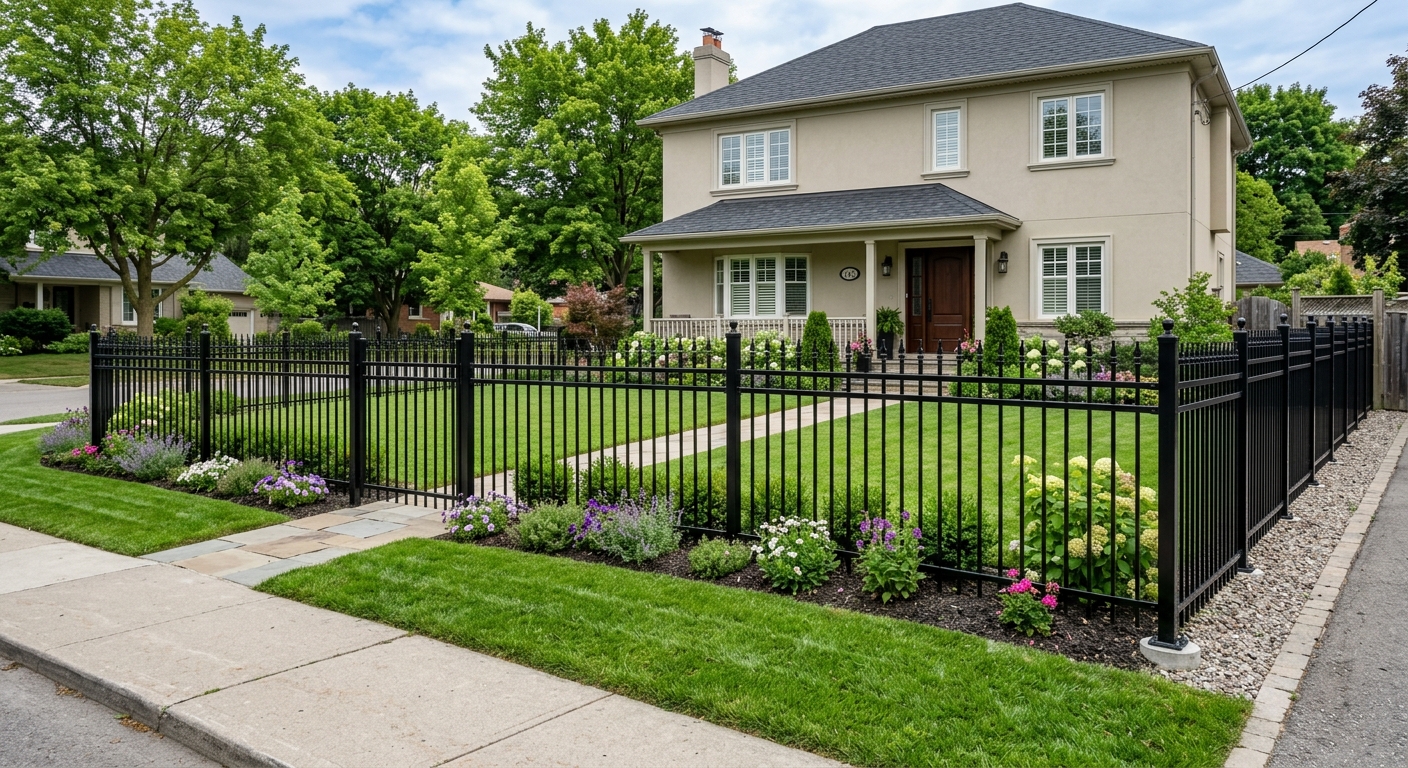
Fencing options and costs in Lamont
Lamont homeowners typically have a lot of fence decisions to make, because so many local dwellings are single-detached homes—about 73.0% of properties—meaning there’s strong, steady demand for backyard privacy and yard boundaries. With 525 homeowner households (77.2% of households own), fencing is a common home-improvement project rather than a purely commercial need. That local mix matters when you’re comparing quotes: more owner-occupied lots usually means more frequent upgrades, repairs, and replacement cycles for older rails and posts.
In the Camrose–Drumheller economic region, the biggest cost drivers are frost depth, Prairie wind exposure, and soil drainage. Frost lines across much of Alberta often sit roughly in the 1.5–2.1 m (5–7 ft) range, so permanent residential posts usually need to be set deep—commonly around 90 cm or deeper, and at least 15 cm below the local frost line—to reduce frost heave and leaning. Where soils are heavier or less draining, you’ll typically see contractors use deeper holes and more concrete per post, which adds labour and materials.
On wind-exposed corners and along lanes where gusts hit directly, trades also plan for heavier end/corner posts and tighter bracing. In Lamont, this type of demand is especially common around the more open residential edges and newer subdivisions near town entrances, where yards feel more “Prairie-exposed.” With those realities in mind, the table below gives practical cost bands by material so you can compare options before we discuss your site details.
| Material |
Lifespan |
Maintenance |
Privacy Rating |
Price per Linear Foot |
| Pressure-treated pine (standard wood) |
10–15 years |
Stain/seal every 2–3 years; inspect posts after freeze-thaw |
Good (solid/tall styles) |
$45–$80 |
| Cedar (natural rot resistance) |
15–25 years |
Seal or stain every 2–4 years to prevent greying and cupping |
Good (solid/tall styles) |
$60–$95 |
| Vinyl / PVC (no-maintenance) |
20–30 years |
Occasional wash; check for post anchoring on very windy runs |
Very good (board-style panels) |
$70–$120 |
| Chain-link (galvanized steel) |
20–35 years |
Minimal; periodic straightening/tension checks |
Low (open mesh) |
$30–$60 |
| Aluminum ornamental |
25–40 years |
Wash as needed; inspect fasteners |
Low to medium (ornamental pickets) |
$65–$110 |
| Composite / recycled material |
20–30 years |
Wash; rare repairs if installed with correct footing |
Good (solid/board designs) |
$80–$125 |
Prices are estimates only and vary by project scope, site access and material selection.
What affects the price of fencing in Lamont
In Lamont and across the Camrose–Drumheller region, it’s normal to see the “same” fence idea priced 30–50% apart between quotes. The gap usually comes from how crews build for Alberta conditions: frost depth determines post depth and anchoring method, and Prairie wind drives stronger bracing and tighter spacing—especially for privacy-style vinyl and wood. Contractor availability also plays a role when multiple jobs stack up before winter or when crews are booked for longer rural runs outside town.
On frost: in cold Alberta settings, posts typically need to go 1.5–2.0 m into the ground (or at minimum to roughly 15 cm below the frost line), which means longer posts, deeper augers, more concrete, and more time per hole. That’s why a basic materials list can look similar, yet installed pricing differs. In windy conditions, we also plan for heavier end/corner posts so the fence resists racking and doesn’t start to lean after repeated freeze-thaw and gust cycles.
Two examples of how local conditions shift costs in Lamont: (1) clayey or poorly draining soil often requires deeper excavation and more concrete per post for stability, which pushes total pricing upward; and (2) very exposed corner runs may require extra bracing rails and thicker end posts even if the panel length is short. Where yards are sheltered and soil drains well, some jobs can use standard spacing and reduce post-to-post labour, pulling costs closer to the lower end of the regional bands—often near wood pricing (for example, around the $45–$80 range) or chain-link pricing (roughly $30–$60). Where sites are open to wind and you’re choosing privacy vinyl, expect to budget more in the $70–$120 band, because the footing and framing choices are part of the performance, not just the material.
| Price Factor |
Why It Matters |
Cost Impact |
| Fence length in linear feet |
Labour and materials scale directly with total run length |
Often the largest driver; increases almost linearly |
| Post depth required |
Frost line determines hole depth and post length for heave resistance |
Deeper holes can add significant labour and concrete |
| Post setting method |
Concrete vs. gravel pack vs. driven posts changes time and material |
Concrete-set posts typically cost more |
| Material choice |
Vinyl and engineered rails need heavier framing where wind is strong |
Ranges broadly (chain-link lowest; vinyl highest in this market) |
| Gate count and type |
Gates require stronger hardware and end post construction |
Can add noticeable cost even on short fences |
| Grade and terrain |
Slope affects panel alignment, racking, and stepped/raked design |
May increase labour and require more hardware |
| Old fence removal and disposal |
Hauling and teardown add labour and dump/handling fees |
Often adds a meaningful surcharge |
| Permit fees and survey / property line locate |
Documentation and locating work prevent encroachment disputes |
Varies by scope; survey can raise the total |
Permits & regulations in Alberta
In Alberta, fences may require a building permit when the fence height exceeds common thresholds—often around 2.0 m (6.5 ft) at the rear and approximately 1.0–1.2 m (3–4 ft) at the front or corner, depending on the location and how your local rules are applied. Even when a permit isn’t required, you still need to respect property lines and the setback requirements in your municipality’s bylaws. In Lamont, I recommend you confirm details before ordering materials, because fence height and placement at corners are the situations that trigger the most questions.
Before you dig any post holes, you must call for utility locates through Alberta One-Call (or the appropriate service for your area). Utility marking should happen before excavation and re-checks are often needed if work pauses. Also, obtain a survey or at minimum locate your property pins so your new fence doesn’t encroach on a neighbour’s land; disputes and rework are costly.
Shared fence responsibilities follow provincial line-fences rules: if a fence is treated as a boundary or jointly used structure, maintenance and cost-sharing are governed by those rules rather than a “who built it first” assumption.
Steps to verify your contractor’s credentials in Alberta: (1) check their trade/contractor eligibility through Alberta’s relevant business registry or licensing search tools (as applicable to their work scope); (2) ask for a current certificate of insurance and verify liability limits match the job size; (3) request proof of WCB coverage/clearance and confirm it covers the fencing crew; and (4) keep copies of the clearance and insurance certificate with your contract. If permit pull is required, your quote should state who applies and what’s included.
Choosing the right fence material for Lamont
Choosing a fence material in Lamont is mostly about balancing performance in freeze-thaw, wind-driven stress, and how often you want to maintain the surface. Pressure-treated pine is usually the most budget-friendly upfront option, but it needs staining or sealing every 2–3 years to limit grey weathering and keep boards from drying unevenly. Cedar looks great and resists rot better, but it still benefits from periodic sealing to maintain appearance and reduce cupping. Vinyl/PVC is the low-maintenance pick—no annual staining—but extreme cold snaps can make panels feel brittle if the post anchoring and framing aren’t engineered correctly. Chain-link offers the best cost-to-longevity ratio for security, yet it doesn’t provide privacy unless paired with slats or screening. Aluminum ornamental is rust-resistant and attractive, but it’s a mid-range option that won’t block sightlines the way board-style privacy fences do.
Post depth matters as much as panel material. In Camrose–Drumheller’s frost conditions, permanent residential posts typically need to be set deep enough to sit about 15 cm below the local frost line (often translating to roughly 1.5–2.0 m in colder Alberta locations, depending on soil and design), with concrete-set posts commonly recommended where stability is critical. That’s why two fences with similar heights can price differently: the framing and footing strategy changes with wind exposure and ground conditions, not just the cladding.
For wind and snow load, end/corner posts and rails are where you don’t want to “value engineer.” On exposed runs, heavier posts and added bracing reduce racking. A concrete example: if you’re comparing pressure-treated pine around the $45–$80 range versus vinyl/privacy around the $70–$120 band, the extra upfront cost is usually justified when you want to avoid repeated staining work and want a fence that maintains a cleaner look through Alberta’s winter cycles—provided it’s installed with the right post depth and concrete anchoring.
| Material |
Cold Tolerance |
Lifespan |
Annual Maintenance |
Best For |
Price Band |
| Pressure-treated pine |
Good (with correct treatment and sealing) |
10–15 years |
Low to moderate (stain/seal every 2–3 years) |
Budget privacy and traditional look |
$45–$80 |
| Cedar |
Good (resists rot but needs care) |
15–25 years |
Low to moderate (seal/stain every 2–4 years) |
Appearance + natural durability |
$60–$95 |
| Vinyl / PVC |
Very good (cold-ready with proper framing) |
20–30 years |
Very low (wash/inspect) |
Low-maintenance privacy in windy areas |
$70–$120 |
| Chain-link |
Excellent |
20–35 years |
Very low (tension/straightening checks) |
Security on a tight budget |
$30–$60 |
| Aluminum ornamental |
Excellent |
25–40 years |
Very low (wash/fastener checks) |
Front yards and decorative boundaries |
$65–$110 |
| Composite / recycled |
Very good (as long as posts are engineered correctly) |
20–30 years |
Very low (occasional wash) |
Long-life privacy with fewer upkeep tasks |
$80–$125 |
How to choose a fencing contractor in Lamont
Choosing the right fencing contractor in Lamont starts with verification, not just the price. In Alberta, ask for their current liability insurance certificate and confirm it covers fence installation work on your type of property. For coverage through workers, request proof of WSIB/WCB coverage/clearance—then check that the certificate is current and includes the correct named business. If a contractor can’t provide documents promptly, treat that as a major warning sign.
Next, get 2–3 itemised written quotes that break out labour and materials (posts, rails, panels, concrete, hardware) instead of one lump sum. Make sure the quote states what’s included for: utility locates coordination, post-hole excavation depth, and the anchoring method (concrete-set versus gravel pack versus driven posts). Ask whether permit pull is included when your fence height triggers it. Confirm how old fence removal and disposal is handled—hauling and dump fees should be explicit.
Warranty should be clear and in writing: workmanship warranty length, manufacturer warranty coverage for material defects, and whether the warranty is transferable to you as the homeowner. For payment, never pay more than 10–15% upfront. Use a holdback until the fence is complete and approved. Also, insist on a start date and completion estimate in writing so there’s a real schedule, not a vague “sometime in the next few weeks.”
- Provide current insurance certificate (liability) with coverage dates visible
- Provide WCB/WSIB clearance proof for the fencing crew
- Use site-specific post depth details that reference frost protection approach
- Quote includes footing method (concrete-set depth and concrete quantity assumptions)
- Itemised labour and materials breakdown (no single-line “fence cost” only)
- Clear description of materials (grade, thickness, colour line, hardware brand)
- Permit pull responsibilities stated (who applies and what’s included)
- Utility locate responsibility and timeline included
- Old fence removal and disposal scope listed separately
- Warranty terms stated: workmanship length and product warranty coverage
- Payment schedule with a holdback until final completion/cleanup
- Start date and completion estimate included in the written contract
Red flags I see in Lamont when things go sideways: a quote that doesn’t specify post depth or concrete placement; promises of “tamped gravel only” on a privacy fence in exposed wind areas; refusal to provide insurance or WCB/WSIB clearance documents; vague warranty language (“lifetime fence”) without workmanship terms; and contracts that require a large upfront payment with no holdback or completion inspection plan.
Frequently asked questions — fencing in Lamont
Wood vs vinyl vs aluminum fence — which is best?
There isn’t one single “best” for Lamont—there’s a best fit. If you want privacy and are comfortable maintaining wood, pressure-treated pine (often priced roughly in the $45–$80 range) can work well, but you should plan for staining/sealing every 2–3 years. Vinyl/PVC (commonly in the $70–$120 range) is the usual choice when homeowners want low upkeep and a consistent look through Alberta freeze-thaw cycles; the key is correct post anchoring and bracing for wind. Aluminum is excellent for front-yards or decorative boundaries because it won’t rust, but it won’t block views the way board-style privacy fences do. For Camrose–Drumheller conditions, the “best” decision usually comes down to whether you prioritize low maintenance (vinyl), traditional affordability (wood), or curb appeal with open sightlines (aluminum). (Statistics Canada, 2021 Census)
Do I need a permit to build a fence in Alberta?
Often you do, but it depends on height and placement. In Alberta, fences above typical thresholds—commonly around 2.0 m (6.5 ft) at the rear and about 1.0–1.2 m (3–4 ft) at the front or corners—may require a building permit. Even if a permit isn’t required, you still must meet property line rules and municipal setback bylaws. In Lamont, I recommend confirming requirements before you dig, because fence corners and tall privacy fences are the situations that tend to trigger review. Also, call Alberta One-Call for utility locates before post holes. A good contractor will tell you whether they’re pulling the permit as part of the scope and will list it on the quote—don’t assume.
How long does a wood fence last in Lamont?
In Lamont, a properly installed wood fence usually lasts about 10–15 years for pressure-treated pine and closer to 15–25 years for cedar, assuming it’s maintained. The limiting factors are Alberta’s freeze-thaw cycles, moisture retention in soil, and wind-driven stress at end/corner posts. Because local frost depth is often in the 1.5–2.1 m range, post depth and anchoring matter—if posts are set too shallow, you can see leaning or sagging over time as frost heave works the ground. Maintenance is the other half: staining/sealing every 2–3 years for pine helps prevent surface breakdown. If you have older fencing or yards built before 1981 are being renovated, it’s common to see posts degrade first and then panels follow, even if the fence height hasn’t changed. (Statistics Canada, 2021 Census)
Who owns and maintains a shared fence?
In Alberta, shared fence responsibilities are governed by provincial line-fences legislation rather than purely “who paid first.” In practical terms, if the fence is treated as a boundary or shared structure between properties, both sides may have rights and obligations related to maintenance and cost-sharing. If you’re planning replacement in Lamont, start with clear documentation: your property pins or survey, and photos/notes of the fence condition. Then discuss how the fence is being treated (boundary vs private). A reputable contractor can help you confirm layout to reduce the risk of encroachment, but the legal ownership questions should be clarified under the provincial line-fences rules. If neighbours disagree on shared responsibility, it’s worth getting local guidance before you dismantle anything so you don’t create a costly rework situation.
How do I find my property line before fencing?
Before you install a fence in Lamont, you should verify property lines using your property pins or a survey. The simplest step is locating the pins on your lot (often with the information from your land title documents), then measuring to ensure your proposed fence sits entirely within your boundary and meets municipal setback rules. If pins are missing, damaged, or unclear, order a survey or property line locate rather than relying on neighbour memory or “approximate” offsets. This matters because fence repairs or full replacements become expensive when the boundary is wrong—especially when posts are already set deep for frost protection. Also, call Alberta One-Call before digging so you don’t hit utilities while confirming the exact fence route. Getting this right early can save you dollars that otherwise get lost to corrections.
What's the most low-maintenance fence?
For low maintenance in Lamont, vinyl/PVC is usually the top choice: it typically needs only occasional washing and visual checks, with no routine staining like wood. In Alberta’s winters, the big caveat is that vinyl still needs correct installation—deep, properly anchored posts and solid end/corner construction—so the fence holds up under wind and freeze-thaw movement. If you’re comparing budgets, vinyl privacy often lands in the $70–$120 range depending on height, layout complexity, and footing requirements. Cedar can be lower maintenance than pine but still needs sealing/staining every few years to preserve its look. Chain-link is also very low-maintenance (often around the $30–$60 range), but it doesn’t provide privacy without additions like slats or screening. Your “lowest maintenance” answer should match your goal: privacy (vinyl) versus security (chain-link) with minimal upkeep.