Fencing options and costs in Chestermere
Chestermere homeowners often start their fencing search with a single priority—privacy or curb appeal—then quickly notice that pricing swings a lot between materials and installation methods. With 91.1% of households in the town owning their homes (Statistics Canada, 2021 Census), demand stays steady year-round because most projects are attached to property upgrades rather than short-term rentals. Chestermere’s housing stock is also dominated by single-detached homes (80.2% of dwellings), which typically means longer yard lines and more gate openings to manage.
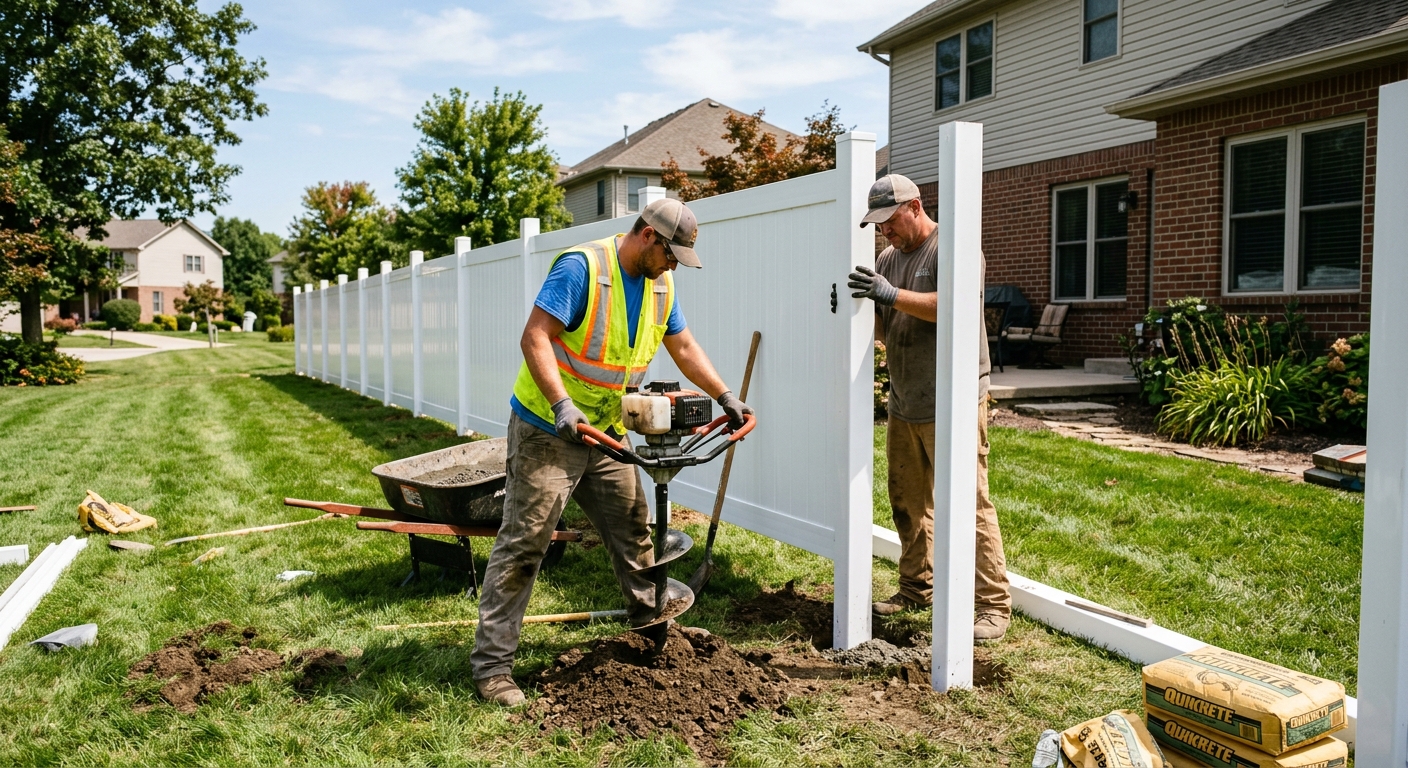
In the Calgary economic region, fencing costs are shaped by the Prairie continental climate: long freeze–thaw cycles and strong, open-wind exposure. That combination makes frost protection and wind-loading the two biggest cost drivers. Contractors commonly set posts about 4 ft (approximately 120 cm) deep to sit below the regional frost risk, especially for taller privacy fences (6 ft) and gate posts. More excavation and concrete volume means higher labour hours compared with fence builds in milder regions. Material availability also matters: pressure-treated wood and vinyl tend to be stocked widely, while cedar and composite can require longer lead times depending on the season and panel size.
If you’re fencing around new-growth areas near Chaparral Valley, expect higher demand for privacy and rear-yard gates as homeowners finish landscaping and hardscaping. From there, the next step is comparing realistic cost ranges across common materials.
| Material |
Lifespan |
Maintenance |
Privacy Rating |
Price per Linear Foot |
Price Range |
| Pressure-treated pine (standard wood) |
10–15 years |
Stain/paint every 2–3 years to reduce greying and cupping |
High (solid boards) |
$40–$80 |
$40 – $80 |
| Cedar (natural rot resistance) |
15–25 years |
Light sanding/re-stain as needed; usually every 3–5 years |
High (solid boards) |
$55–$95 |
$55 – $95 |
| Vinyl / PVC (no-maintenance) |
20–30 years |
Wash occasionally; check for panel warping in extreme cold |
High (solid privacy panels) |
$45–$90 |
$45 – $90 |
| Chain-link (galvanized steel) |
25–40 years |
Minimal; occasionally tighten hardware and inspect posts |
Low–Medium (airflow, add privacy slats if desired) |
$25–$55 |
$25 – $55 |
| Aluminum ornamental |
30–40 years |
Rinse/wash; no rust with proper coating |
Low (open pickets) |
$70–$120 |
$70 – $120 |
| Composite / recycled material |
25–35 years |
Low; protect from scratches and consider seasonal cleaning |
Medium–High (solid options vary) |
$65–$110 |
$65 – $110 |
Prices are estimates only and vary by project scope, site access and material selection.
What affects the price of fencing in Chestermere
It’s common to see quotes for the same fence in Chestermere vary by 30–50% across Calgary and neighbouring communities because the cost isn’t only the material—it’s the way posts are installed, how much excavation is required, and how the contractor handles wind-loading and terrain. In practice, one contractor may price a lighter post scheme or use shallower setting, while another will spec deeper frost-ready footings and tighter spacing for a true privacy build. Those choices directly translate into labour hours, concrete volume, and the price you pay per linear foot. Even with similar material types, differences in panel layout, gate hardware, and removal/disposal can shift the total quickly.
In Alberta, freeze–thaw is a real budget factor. A common rule of thumb is setting fence posts about 4–6 inches below the design frost depth so they don’t heave. In colder prairie conditions, that often works out to roughly 1.5–2.0 m of embedment, which requires longer posts and deeper holes—then concrete setting to stabilize them. Wind exposure on the Prairies also drives stronger builds: solid wood or vinyl privacy fences typically need sturdier posts, closer spacing, and fully concreted footings to prevent racking. By contrast, chain-link is more forgiving because it lets wind pass through.
Two local examples: if your yard line runs through open exposure on the windward side, contractors usually increase post frequency and use heavier rails (pushing the job from mid-range wood pricing closer to the upper band such as $40–$80 per linear foot). If you’re removing an older fence built years ago, the excavation and disposal time can add cost beyond what homeowners expect—especially when boards are damaged and posts are rusted into the ground. For comparison, chain-link can land in the $25–$55 range when the site is straightforward, while 6 ft privacy projects with concreted posts and full panel bracing often move into the $40–$90 territory depending on wood or vinyl selection.
| Price Factor |
Why It Matters |
Cost Impact |
| Fence length in linear feet |
Most costs scale directly with footage: posts, rails, and fasteners |
High |
| Post depth required |
Frost line determines how deep holes must be to prevent heaving |
High (can swing 15–30%+) |
| Post setting method |
Concrete setting resists wind movement; gravel packs can reduce concrete but require careful compaction |
Medium–High |
| Material choice |
Vinyl/cedar and solid privacy panels require different framing strength than chain-link |
High |
| Gate count and type |
Double drive gates and heavy privacy gates need reinforced posts and hardware |
Medium–High |
| Grade and terrain |
Slopes require stepped or raked panels, plus extra layout time and materials |
Medium |
| Old fence removal and disposal |
Rusted posts and buried footings increase labour and hauling costs |
Medium |
| Permit fees and survey / property line locate |
Some fencing heights/locations trigger permitting; accurate layout avoids rework |
Low–Medium |
Permits & regulations in Alberta
In Alberta, fences can fall under permit requirements depending on height and placement. As a general homeowner guideline in many Alberta municipalities, fences above roughly 2.0 m (6.5 ft) at the rear and around 1.0–1.2 m (3–4 ft) at the front or corner may require a building permit. The exact trigger can vary by location within a property (front yard vs. rear yard) and by municipal policy, so confirm with the City of Chestermere (or your local permitting office) before ordering materials or digging post holes.
All fences must respect property lines and setback requirements. Before digging, you also need utility locates so you don’t hit buried services—use Alberta One-Call. Many disputes come from assuming property lines; that’s why getting a survey or locating your pins before installing helps protect you from encroachment and neighbour conflicts. Shared fence ownership is handled under Alberta’s line-fences framework, so keep records of any shared arrangements.
What typically does not require a permit is a low, standard fence below common height thresholds, or minor repairs that don’t change height, location, or footprint. What does require a permit is a new fence or replacement that exceeds height thresholds or is otherwise subject to municipal review.
Contractor checks for Chestermere: ask for proof of an Alberta licence/registration where applicable for the work they perform, plus current liability insurance and evidence of WSIB/WCB coverage. Look for a certificate of insurance showing limits and coverage dates, and confirm coverage details on request (a clearance letter, if they can provide it). If they can’t produce documents quickly, treat that as a serious red flag.
Choosing the right fence material for Chestermere
Choosing fencing in Chestermere is mostly about matching material to your priorities—privacy, low maintenance, and lifespan—while respecting the Prairie climate. Pressure-treated pine is the budget-friendly route, but it typically needs staining or painting every 2–3 years to slow grey weathering and surface cracking. Cedar offers a nicer natural appearance and better rot resistance, though it still benefits from regular maintenance to keep it looking sharp. Vinyl/PVC is popular for low upkeep because there’s no annual painting, but in deep cold it can become brittle at damaged edges, so you want proper framing and correct installation. Chain-link is the lowest-cost option for security and long life, but it won’t deliver the privacy most Chestermere homeowners want unless you add slats or switch to a solid-panel system.
For Calgary-area frost conditions, post embedment matters more than brand names. Even if you choose chain-link, good practice is to set posts below the frost-affected zone—often achieved with deeper holes and, for heavier privacy builds, concrete-set footings. On wind-exposed lines, solid boards and vinyl panels usually need sturdier posts and tighter bracing to prevent racking from wind gusts and snow load movement.
Here’s where the price difference is often justified: a standard pine privacy fence may start around the mid-range of $40–$80 per linear foot, while vinyl privacy often lands closer to $45–$90 per linear foot. If you plan to keep the home long-term and want to avoid staining schedules, the vinyl premium can be worth it—especially when you factor in that most single-detached homeowners (80.2% of dwellings) tend to invest in long-range yard upgrades.
| Material |
Cold Tolerance |
Lifespan |
Annual Maintenance |
Best For |
Price Band |
| Pressure-treated pine |
Good (with proper staining and correct detailing) |
10–15 years |
Check fasteners; stain/paint every 2–3 years |
Budget-friendly privacy with planned upkeep |
$40–$80 |
| Cedar |
Good (naturally rot-resistant) |
15–25 years |
Inspect and re-stain roughly every 3–5 years |
Appearance-focused privacy |
$55–$95 |
| Vinyl / PVC |
Very good (avoid impact damage at edges) |
20–30 years |
Wash as needed; periodic hardware checks |
Low maintenance privacy |
$45–$90 |
| Chain-link |
Excellent (steel is stable in freeze–thaw) |
25–40 years |
Minimal; tighten/inspect annually |
Security, dog runs, airflow |
$25–$55 |
| Aluminum ornamental |
Excellent (coated metal resists winter corrosion) |
30–40 years |
Rinse/wash; inspect gates and fasteners |
Curb appeal without heavy privacy |
$70–$120 |
| Composite / recycled |
Good (kept away from mechanical damage) |
25–35 years |
Low; clean and check framing |
Long-life solid panels |
$65–$110 |
How to choose a fencing contractor in Chestermere
Choosing the right fencing contractor in Chestermere starts with verifying coverage and workmanship responsibility. Ask for documentation for: (1) Alberta licensing/registration where applicable to their work, (2) liability insurance, and (3) WSIB/WCB coverage. For liability insurance, request a certificate showing policy limits and the current coverage period. For WCB/WSIB, ask for confirmation of active coverage; some contractors provide a clearance letter during bid time. If they can’t provide these documents quickly, you’re taking on risk for injuries or damage during excavation and post-setting.
Next, get 2–3 itemised written quotes rather than a lump-sum number. Your quote should separate labour and materials, list the fence height, post spacing, post embedment depth, gate hardware type, and whether rails are included. Carefully read exclusions: is permit pulling included (if required), is removal and disposal included, and are adjustments for slopes/step-downs included or billed as extras?
Warranty matters in Alberta’s freeze–thaw climate. Ask for (a) a workmanship warranty length for installation and post-setting, and (b) the product/manufacturer warranty for the material. Also ask whether warranties are transferable if you sell the home.
On payment, never pay more than 10–15% upfront. Use a holdback approach until the job is complete and gate operation and alignment are verified. Require a written timeline with start date and completion estimate so weather delays are planned for, not surprises.
- Confirm the bid includes post depth and post spacing (not just “standard installation”).
- Require a clear line-item for gate types and hardware (self-closing, hinges, latches).
- Verify concrete vs. gravel pack setting is specified per fence section.
- Check that disposal/removal of old fence materials is included or excluded—price it either way.
- Ask whether the layout includes an allowance for correcting an out-of-square property line locate.
- Request proof of liability insurance with policy limits and effective dates.
- Request proof of WSIB/WCB coverage for their workers.
- Make sure the quote states who calls for utility locates and when it happens.
- Confirm warranty terms for workmanship and product are written on the contract.
- Set a realistic payment schedule: small deposit, then progress payments, then holdback.
- Get a written start date and a completion estimate with weather/weatherproofing notes.
- Ask for photos of similar fences installed in the Calgary area (wind-exposed privacy builds).
Red flags I see around Chestermere: contractors who won’t specify post depth in writing, quotes that are missing gate hardware details, no proof of insurance/WSIB/WCB on request, charging large upfront deposits, and delaying documentation until after you’ve paid or signed.
Frequently asked questions — fencing in Chestermere
What fence style offers the best wind resistance in Chestermere?
In Chestermere, the best wind resistance usually comes from a properly built solid privacy fence—but only when it’s engineered for Prairie gusts. That means solid panels mounted on sturdy framing, with posts set deeply enough for freeze–thaw stability and correctly spaced for racking resistance. For many homeowners, vinyl or wood privacy performs well when posts are concrete-set and braced at corners and gate locations. Chain-link can also survive wind for decades, but it won’t stop wind the same way because airflow passes through. If your fence line is open and exposed, expect contractors to tighten post spacing and beef up rails; that structural work is why privacy builds often sit above lighter systems (for example, wood and vinyl commonly trend around the mid-range of $40–$80 per linear foot depending on height and access).
How much does a fence cost in Chestermere?
Fence pricing in Chestermere is usually quoted per linear foot, then adjusted for gates, terrain, and removal. In the Calgary economic region, typical installed ranges move roughly from $25–$55 per linear foot for chain-link to about $40–$80 per linear foot for standard wood, with vinyl/ PVC privacy often trending mid-to-upper (commonly $45–$90 per linear foot). Those bands reflect local realities: deeper post holes to manage frost heaving, more excavation and concrete on tall privacy fences, and labour time for windy-site bracing. Your final number will also depend on gate count (especially double drive gates), sloped grades that require stepped panels, and whether you need old fence removal and disposal.
How deep should fence posts be for Chestermere's frost?
For Chestermere (Calgary region freeze–thaw), fence posts generally need to be set well below frost-affected soil to reduce heaving risk. Local practice often follows guidance to set posts about 4 ft (approximately 120 cm) deep to get below the regional frost concern—then, depending on fence height and engineering approach, contractors may go deeper based on the design frost depth and soil conditions. In practical terms, that frequently results in around 1.5–2.0 m of embedment for certain privacy builds where frost protection and stability are critical. It’s also why solid privacy fences usually include concrete setting for footings: it keeps alignment during winter cycles. Always confirm embedment details in your contract so you’re not relying on “standard depth” language.
Wood vs vinyl vs aluminum fence — which is best?
“Best” depends on what you want most in Chestermere. Wood (pressure-treated) is often the best value for privacy, but it requires staining or painting every 2–3 years to manage weathering and cracking. Vinyl/PVC typically wins for low maintenance—less upkeep and consistent colour—while still offering solid privacy, though it costs more up front (commonly around $45–$90 per linear foot for installed vinyl privacy). Aluminum is best for curb appeal and security with an open look; it won’t provide the same privacy because pickets are spaced. If your priority is privacy in Prairie wind, choose a solid privacy system (wood or vinyl) built with deep post setting and correct bracing. If your priority is appearance without heavy maintenance, aluminum is strong—just accept the trade-off on privacy.
Do I need a permit to build a fence in Alberta?
In Alberta, permits are commonly tied to fence height and location. As a guideline often used in municipalities, fences above about 2.0 m (6.5 ft) at the rear and around 1.0–1.2 m (3–4 ft) at the front or corner may require a building permit. Even when a permit isn’t required, you still need to follow property line rules and municipal setback bylaws, and you should avoid digging until utility locates are completed (use Alberta One-Call). Before building in Chestermere, verify the height/placement trigger and confirm whether your project needs a survey or property pin locate to prevent encroachment. Your contractor should be able to tell you if permit pulling is included in the quote.
How long does a wood fence last in Chestermere?
A wood fence in Chestermere commonly lasts 10–15 years for standard pressure-treated pine when it’s built well and maintained. With good staining/painting cycles and proper post setting, you can reach toward the upper end, because the biggest failures in our climate usually come from poor embedment (heaving), untreated exposed board ends, and loose hardware that worsens under wind and freeze–thaw. Cedar can last longer—often 15–25 years—because of its natural rot resistance, but it still needs upkeep to keep it looking clean. If you’re planning a long-term privacy solution, ensure your quote specifies deep post embedment consistent with local frost protection practices and includes a clear maintenance plan so the fence stays solid through winter cycles.