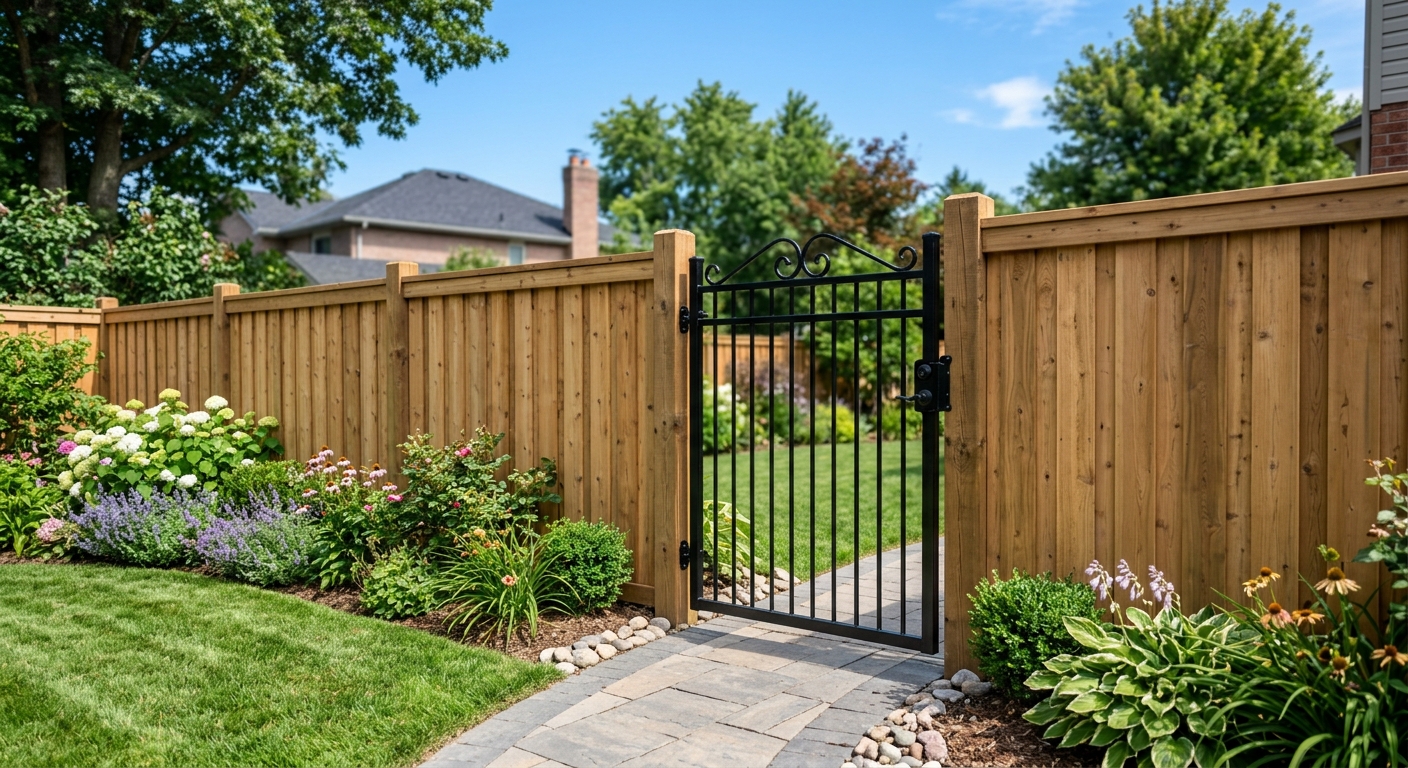
Fencing options and costs in Hamptons
In Hamptons, Alberta, choosing a fence is less about what looks best on day one and more about what will survive the wind, snow, and freeze–thaw cycles year after year. With a population of 7,360 (Statistics Canada, 2021 Census), Hamptons is a tight community where most homeowners share similar lot sizes, so fence demand tends to track the number of single-family dwellings—especially along busy collector roads and newer subdivisions where privacy and pet containment are priorities. Calgary’s wider economic region also brings a steady flow of tradespeople, but the long winter conditions still shape pricing and availability.
In the Calgary Prairie continental climate, frost protection and wind loading are primary cost drivers. Contractors commonly set posts about 4 ft (≈120 cm) deep to get below the regional frost line, often with concrete footings for 6 ft privacy fences and heavier gate posts. Open Prairie exposure also means solid panels are more likely to rack unless spacing, bracing, and anchoring are done correctly—one reason wood and vinyl typically land mid-to-upper in the market range.
Across Hamptons, trade demand is especially high around newer phases near highway-access corridors where yards are more exposed and homeowners upgrade from temporary mesh or partially built runs. If you’re comparing materials, the table below gives a practical starting point for lifespan, maintenance, and typical installed costs before you book a site visit.
| Material |
Lifespan |
Maintenance |
Privacy Rating |
Price per Linear Foot |
| Pressure-treated pine (standard wood) |
10–15 years |
Stain/seal every 2–3 years; inspect posts annually |
High (solid panels) |
$40–$80 |
| Cedar (natural rot resistance) |
15–25 years |
Light staining/oiling every 2–4 years (helps colour and performance) |
High (solid panels) |
$55–$95 |
| Vinyl / PVC (no-maintenance) |
20–30 years |
Rinse as needed; occasional panel/base checks after storms |
High (solid or semi-solid options) |
$45–$90 |
| Chain-link (galvanized steel) |
20–40 years |
Occasional cleaning; straighten posts if wind damage occurs |
Low to Medium (see-through) |
$25–$55 |
| Aluminum ornamental |
25–40 years |
Wash periodically; inspect hardware for tightness |
Low (decorative pickets) |
$70–$120 |
| Composite / recycled material |
20–30 years |
Low; clean with mild soap; avoid harsh solvents |
Medium to High (depends on slat/panel design) |
$60–$110 |
Prices are estimates only and vary by project scope, site access and material selection.
What affects the price of fencing in Hamptons
In Hamptons and across the Calgary region, it’s common to see quotes for the “same” fence run differ by 30–50%. The biggest reason is that fencing quotes aren’t just material prices—they’re heavily influenced by how deep and how securely posts must be installed for Alberta’s freeze–thaw cycles. In cold conditions, frost line depth sets how deep posts must be set—typically 4–6 inches below the design frost depth—to prevent heaving. That usually translates to posts needing to go roughly 1.5–2.0 m into the ground, which means longer posts, more excavation, and more concrete setting.
Next, wind exposure on the Prairies drives tighter post spacing and sturdier panels. Solid wood or vinyl privacy fences tend to require additional bracing and fully concreted footings so panels don’t rack under gusts and blowing snow. Chain-link, by comparison, allows airflow and often stays lower-cost because it doesn’t experience the same wind-pressure forces. That’s why many homeowners see chain-link land around the lower-mid band (about $25–$55 per linear foot), while privacy styles sit toward the mid–upper ranges (wood/vinyl often $40–$90 per linear foot depending on material grade and height).
Concrete examples you’ll feel in Hamptons: (1) a straight 50 linear foot run on flat ground may cost far less than the same length on a steep slope that requires stepped or raked sections; (2) replacing an old fence can add disposal and hauling time, especially if posts are concreted; and (3) a gate with heavy hinges or a double driveway gate typically increases labour and hardware costs because it needs reinforced posts set deeper.
For context, Hamptons’ population of 7,360 (Statistics Canada, 2021 Census) means fewer “big-box” trade crews, so crews with the right experience for frost-depth installs can command more time on site—another factor behind quote spread.
| Price Factor |
Why It Matters |
Cost Impact |
| Fence length in linear feet |
The primary driver—every post, rail, and panel scales with total length. |
Major (often the largest portion of the bill) |
| Post depth required |
Frost line determines hole depth, minimum embedment, and the need for longer lumber/posts. |
Major (more excavation and materials) |
| Post setting method |
Concrete setting is typically required for solid privacy and heavier gates; gravel pack is a different approach. |
Medium to major (concrete and labour) |
| Material choice |
Vinyl/cedar and engineered composite cost more than chain-link; aluminium costs for hardware and finish. |
Medium to major (drives per-foot pricing) |
| Gate count and type |
Double gates, drive-through gates, and heavier privacy gates need reinforcement and longer lead times. |
Major for gates; small runs can still add a lot |
| Grade and terrain |
Sloped yards require stepped or raked layouts to keep top rails aligned and panels secure. |
Medium (extra measuring, fitting, and labour) |
| Old fence removal and disposal |
Concrete footings, buried boards, and debris disposal add time and equipment. |
Medium (can be noticeable on replacement jobs) |
| Permit fees and survey / property line locate |
When required, permits and locate services prevent boundary disputes and rework. |
Low to medium (varies by scope and municipality rules) |
Permits & regulations in Alberta
In Alberta, fence rules are tied to height and placement. As a homeowner in Hamptons, you should expect that fences above a typical height threshold—often around 2.0 m (6.5 ft) at the rear and about 1.0–1.2 m (3–4 ft) at the front or corner—may trigger a building permit requirement depending on the lot and the fence’s location. Even when a permit isn’t required, every fence must respect property lines and municipal setback bylaws.
Before any post holes are dug, call for utility locates (in Alberta this is handled through Alberta One-Call). Also, obtain a survey or at least confirm your property pins/locate your boundary markers so the installer isn’t guessing where the line is. This is one of the most common sources of disputes—especially when older fences were built a few feet off-line and neighbours assumed it was “correct.” Shared fence ownership rules are addressed under Alberta line-fences legislation, so document any agreements in writing and keep copies.
What does require a permit? Higher fences that exceed common threshold heights (particularly in front/corner areas where visibility and setbacks matter) and any project that alters the fence height significantly or affects required clearances. What typically does NOT require a permit? Like-for-like replacements at or below typical limits, standard-height backyard runs, and cosmetic panel swaps—provided setbacks and boundary locations are respected.
To verify your contractor in Hamptons: ask for their Alberta business licence details, a current certificate of liability insurance, and proof of WSIB/WCB coverage (or a clearance letter where applicable). You can also check online registries for status and request the clearance certificate before work starts. If they can’t provide documents on day one, that’s a red flag.
Choosing the right fence material for Hamptons
Choosing fencing for Hamptons is about matching your priorities—privacy, low maintenance, budget, and lifespan—to a climate that stresses materials with frost heave, wind gusts, and heavy snow loads. Pressure-treated pine is usually the best entry budget, but it needs staining or sealing every 2–3 years to prevent grey weathering and to keep the boards looking sharp. Cedar is a step up: it naturally resists rot and holds its look better, but it still benefits from periodic maintenance. Vinyl/PVC is the most “hands-off” option for many families; however, extreme cold can make it more prone to panel cracking if the install isn’t engineered for movement and proper post spacing.
Chain-link is the longest-life, lowest-cost barrier—often chosen for pets and security when privacy isn’t the main goal. If privacy is the goal, aluminum ornamental is usually best for appearance and longevity, but it won’t block sight lines the way solid wood/vinyl panels do.
For Calgary-area frost conditions, post depth matters more than people expect. For most solid fences, posts are typically set around 4 ft (≈120 cm) deep (or deeper depending on the design frost considerations) with concrete footings for stability. That supports strong bracing and reduces racking in high wind exposure. In practice, that means vinyl and wood privacy fences often cost more than chain-link because you’re paying for the structural installation, not just the material.
A practical example: if chain-link is around $25–$55 per linear foot, switching to a wood privacy fence is commonly a jump to about $40–$80 per linear foot. The extra cost is often justified because you gain real privacy and a sturdier, more wind-resistant build—especially when posts are concreted and spaced for the open Prairie exposure.
| Material |
Cold Tolerance |
Lifespan |
Annual Maintenance |
Best For |
Price Band |
| Pressure-treated pine |
Good when posts are properly set below frost |
10–15 years |
Quick inspection; stain/seal every 2–3 years |
Budget privacy with traditional appearance |
$40–$80 |
| Cedar |
Good; resists rot and weathering better than pine |
15–25 years |
Inspect annually; stain/oil every 2–4 years |
Natural look privacy |
$55–$95 |
| Vinyl / PVC |
Fair to good; relies on proper install in deep freeze |
20–30 years |
Rinse as needed; check fasteners and base |
No-maintenance privacy |
$45–$90 |
| Chain-link |
Excellent; metal tolerates cold cycles well |
20–40 years |
Occasional cleaning; check tension and posts |
Security and pets on a budget |
$25–$55 |
| Aluminum ornamental |
Excellent; non-rusting design |
25–40 years |
Wash and tighten hardware periodically |
Front-yard curb appeal and boundary definition |
$70–$120 |
| Composite / recycled |
Good; depends on design and movement allowances |
20–30 years |
Low; mild cleaning |
Low-maintenance look with solid-panel privacy |
$60–$110 |
How to choose a fencing contractor in Hamptons
Choosing the right contractor in Hamptons is mostly about proof. Start with licensing and coverage: ask for an Alberta business licence (or the contractor’s legal business registration details) and a certificate of liability insurance that shows adequate limits and coverage through the job dates. For workers’ protection, confirm WSIB/WCB coverage—either a clearance letter or a current account/status document—so you’re not exposed if a labourer is injured on your property.
Then request 2–3 itemised written quotes. A proper fence quote breaks out labour and materials separately: post installation, rails/bracing, panels, gate hardware, concrete supply, and any sand/gravel approach. Avoid “lump sum” only bids; you want to see what’s included and what’s excluded (permit pull, site prep, tree/shrub removal, disposal of old fence material, and repair of landscape damage). If you’re replacing an older fence, ask whether old posts are removed, cut, or left and how that affects long-term stability and warranty coverage.
Warranty should be in writing. Look for a workmanship warranty length (often stated as a set number of years), and a separate manufacturer/product warranty. Ask if the warranty is transferable to a new owner, since resale matters—especially in tight suburban markets.
For payment schedule, never agree to more than 10–15% upfront. Hold back the remainder until the job is complete and you’ve walked the line for alignment, post plumb, and proper gate operation. Finally, lock in a start date and completion estimate in writing, not just “as weather allows,” and confirm how the crew handles frost/ground conditions.
- Ask for certificate of liability insurance and verify it covers fencing work on residential sites.
- Confirm WSIB/WCB coverage with a clearance letter or current status document.
- Request an Alberta business licence or legal business registration details before signing.
- Get quotes broken into labour vs materials (posts, rails, concrete, gates, hardware).
- Confirm post depth approach for Alberta frost protection (typically ~4 ft deep with footings).
- Clarify whether permits are included and who pulls them (if required by height/setback).
- Ask how they handle property line locate and whether a survey locate is recommended.
- Verify disposal is included for old fence boards/posts and concrete footings.
- Check gate hardware quality (hinges, latches, reinforcement) and who supplies it.
- Ensure warranty covers workmanship and not just materials; ask the exact duration.
- Confirm payment schedule (10–15% max deposit; holdback until completion).
- Require a written start date, estimated completion window, and weather contingency plan.
Concrete red flags in Hamptons: (1) they suggest shallow post holes “because it’s not that cold,” (2) they can’t show proof of WSIB/WCB coverage or liability insurance, (3) they won’t provide an itemised scope—especially around concrete footings and gate reinforcement, (4) they ask for large upfront payments, and (5) they avoid discussing permits/property line locate when your proposed fence is over typical height thresholds.
Frequently asked questions — fencing in Hamptons
Should I repair or replace my old fence in Hamptons?
If your fence posts are still solid and only a few boards are loose, repairing is usually cheaper and faster. In Hamptons and the broader Calgary region, the key is whether posts have heaved or shifted after freeze–thaw cycles. If you notice wobbly corners, leaning sections that keep returning, or bases that look lifted from the ground, replacement is often the better long-term value. Also consider whether the existing layout can be stabilized to meet typical Alberta frost-depth expectations; a “patch job” on underset posts can lead to repeated alignment issues. A new fence may run roughly $40–$80 per linear foot for wood privacy or around $25–$55 per linear foot for chain-link, so the decision often comes down to how many posts and rails need correcting.
How do I handle a fence dispute with a neighbour in Alberta?
Fence disputes usually come down to two things: property line location and responsibility for shared fencing. Start by confirming your boundary using survey pins or a property line locate service—don’t rely on the “fence that’s always been there.” In Alberta, shared fence ownership rules are addressed under provincial line-fences legislation, but the practical step is to document what both parties agree to (in writing) and keep photos/measurements. If you can’t resolve it directly, involve the appropriate municipal process and consider mediation before large spending begins. For safety and fairness, pause work until the boundary is verified; rework to move a fence a few feet later can wipe out the savings of going cheap upfront. Also remember utility locates should be completed before any digging.
What fence style offers the best wind resistance in Hamptons?
In Hamptons, the best wind resistance usually comes from a fence that balances airflow with structural rigidity. Fully solid privacy panels can perform very well when they’re installed with correct post depth, concrete footings, and adequate bracing—especially for 6 ft runs exposed to Prairie wind. If your yard is very open and you’re seeing racking on existing boards, ensure the contractor uses tight post spacing and reinforced corner and gate posts. Chain-link tends to handle wind pressures better because it allows airflow, which can reduce the forces that twist and rack panels. That’s why some homeowners choose chain-link or semi-privacy designs when airflow is a priority. Ultimately, the “best style” depends on whether you want sightline privacy or maximum wind permeability, but for solid fences the install quality is what keeps them standing.
How much does a fence cost in Hamptons?
Installed fencing costs in Hamptons typically follow the same Calgary economic-region pricing ranges you’ll see across nearby communities, adjusted for height, material, access, and how much ground excavation is needed. For example, wood fence installation commonly lands around $40–$80 per linear foot, while vinyl privacy is often in the $45–$90 range depending on height and panel style. Chain-link tends to be lower, around $25–$55 per linear foot. Your quote can shift by 30–50% even for similar fences because Alberta frost protection drives longer posts and more concrete setting, and Prairie exposure can require sturdier bracing. If you share fence length, height, gate count, and whether you need removal of an old fence, you can get a much tighter estimate.
How deep should fence posts be for Hamptons's frost?
For fence stability in Hamptons and the Calgary region, posts typically need to be set deep enough to reduce heaving from freeze–thaw. Local guidance generally targets about 4 ft (≈120 cm) deep to get below the regional frost line, and many installs effectively require setting about 4–6 inches below the design frost depth. For homeowners, the practical takeaway is that the contractor should be using proper hole depth calculations and not just “one shovel length.” On solid privacy fences and heavier gate posts, concrete footings are commonly used to lock posts in place and resist wind-driven movement. If soil is rocky or excavation is difficult, a good contractor should still meet the embedment requirement and then adjust bracing and post reinforcement rather than skipping depth or concrete.
Wood vs vinyl vs aluminum fence — which is best?
“Best” depends on your priorities. Wood (pressure-treated pine or cedar) is a strong value for privacy and traditional look, often landing around $40–$80 per linear foot for installed wood privacy. The trade-off is maintenance: you’ll typically stain/seal every 2–3 years to keep the boards protected and looking consistent. Vinyl/PVC is usually best if you want low maintenance and long-term colour stability; it typically sits around $45–$90 per linear foot, and a proper Alberta install matters to avoid cold-related cracking (correct post spacing, movement allowance, and secure bases). Aluminum ornamental is excellent for longevity and curb appeal, often in the $70–$120 per linear foot range, but it won’t deliver full privacy like solid wood/vinyl panels. If you want privacy in an open Prairie yard, choose wood or vinyl with correctly concreted, frost-protected posts.