Fencing options and costs in Three Hills
Fence shopping in Three Hills usually starts with the same question: “What will this cost, and what will last?” The answer comes down to local demand and the realities of site conditions. In Three Hills, there are 805 homeowner households (68.8% of households own), and 75.1% of dwellings are single-detached homes—each detached property is a typical candidate for yard fencing, gates, and privacy upgrades. With 56.0% of homes built before 1981, many yards also have older fence lines that need replacement or re-stretching when owners refresh their landscaping.
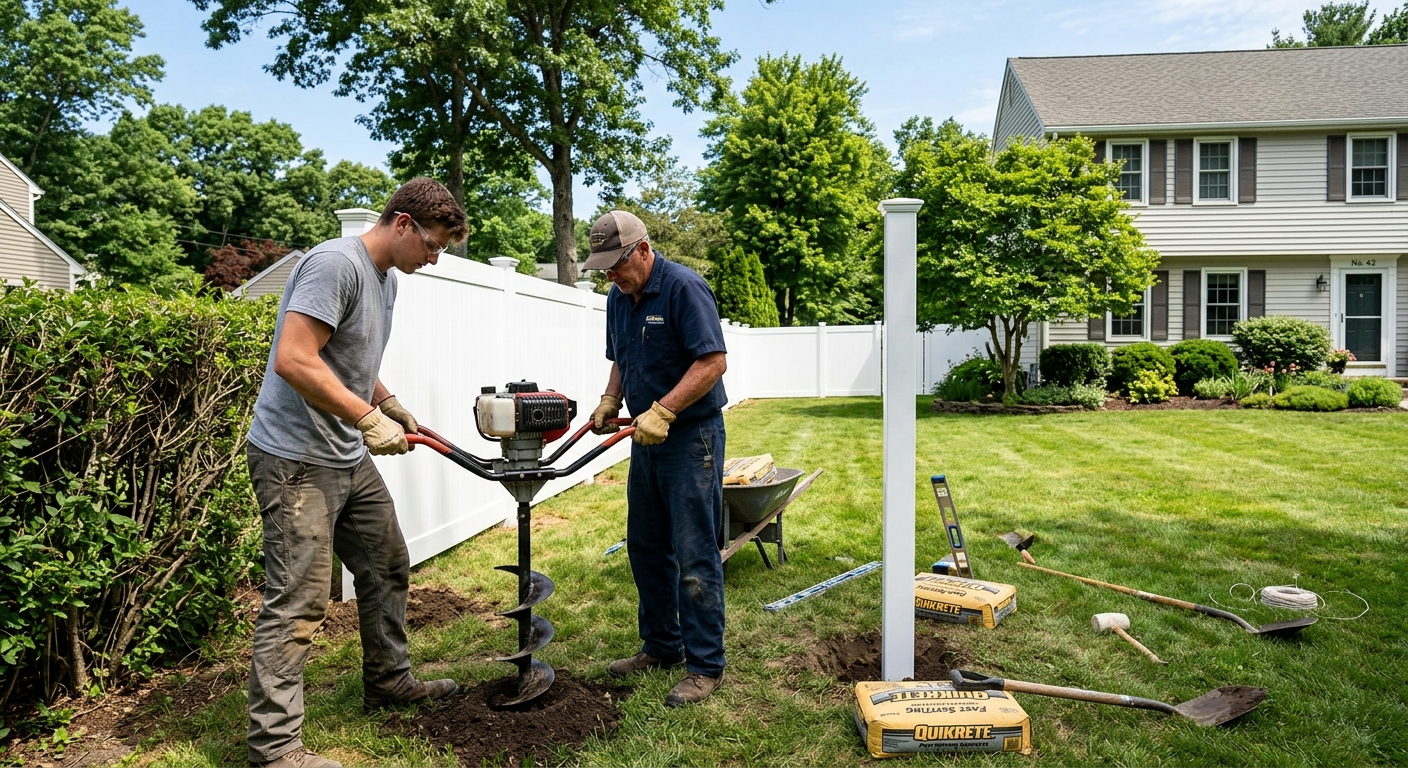
In the Lethbridge–Medicine Hat economic region, fencing costs are shaped by freeze–thaw cycles, prairie wind loading, and the way crews must set posts below frost to reduce winter heave and later leaning. Southern Alberta frost lines are often around 4 feet, so residential installs commonly use machine-dug holes and concrete-set posts. That means more labour hours, longer posts, and higher concrete quantities than in milder areas. On wind-exposed lots (common in and around the south side of town and open acreage edges), contractors also tend to recommend tighter post spacing or heavier rails, especially for solid privacy panels.
If you’re near the downtown core or the more exposed edges of the community, you’ll often see fencing demand spike in spring because people want snow cleared and grade work completed before summer installs. From there, comparing materials side-by-side is the fastest way to align budget with durability—see the table below.
| Material |
Lifespan |
Maintenance |
Privacy Rating |
Price per Linear Foot |
| Pressure-treated pine (standard wood) |
10–15 years |
Stain/seal every 2–3 years; inspect posts after freeze–thaw |
High (solid pickets) |
$35 – $65 |
| Cedar (natural rot resistance) |
15–25 years |
Seal or stain every 2–4 years; occasional board replacement |
High (solid style) |
$45 – $75 |
| Vinyl / PVC (no-maintenance) |
20–30 years |
Rinse annually; replace warped sections if impact damage occurs |
High (privacy panels) |
$48 – $80 |
| Chain-link (galvanized steel) |
20–35 years |
Occasional re-tension; rinse with hose as needed |
Low (open mesh) |
$25 – $50 |
| Aluminum ornamental |
25–40 years |
Wash yearly; tighten hardware as needed |
Medium–Low (semi-privacy depends on layout) |
$55 – $110 |
| Composite / recycled material |
20–30 years |
Minimal; clean annually; check for rail fastening wear |
High (solid composite privacy boards) |
$60 – $95 |
Prices are estimates only and vary by project scope, site access and material selection.
What affects the price of fencing in Three Hills
In Three Hills, even when two neighbours want “the same fence,” bids can differ by 30–50% across the Lethbridge–Medicine Hat region and across Alberta because crews price risk and ground conditions differently. One yard may need extra post length and concrete to sit below frost, while another is more accessible and can use faster excavation and staging. Labour availability also shifts with seasonal workload; when multiple homes request spring replacements, installation scheduling and mobilization can move the price.
Frost line depth is a major driver. In practice, many contractors aim to set posts about 4–6 inches below the design frost depth to reduce heaving and later leaning. In cold Alberta regions, that often means posts set roughly 1.5–2.0 m into the ground, which raises both material cost (longer posts) and labour time (deeper holes, more concrete). Prairie wind exposure further increases costs: open windy lots often require tighter post spacing and sturdier rails, which is especially noticeable for solid privacy wood and vinyl where sail effect is higher. By contrast, chain-link tends to be less wind-sail sensitive, which is one reason it’s typically closer to the lower Alberta price band.
Here are a few concrete examples from Southern Alberta that commonly show up in Three Hills quotes. Example one: a 40 m run of solid privacy board fence on clay that holds moisture typically requires more concrete-set posts than a run on fast-draining sandy soil, adding roughly $3–$10 per linear foot in labour and materials. Example two: a gate at a drive entrance increases hardware cost and requires stronger posts; that can add the equivalent of 10–20 linear feet of material and labour to the overall line. Example three: removing an old fence with embedded posts and attached concrete footings can raise disposal and excavation time enough to push a wood project from the low-$40s up toward the upper end—while a straightforward chain-link replacement often stays nearer the $25–$50 band.
Home age matters too. With 56.0% of housing built before 1981, older property lines often have legacy supports, uneven grade, and older fence posts that may not match current spacing expectations—so the “tear out and reset” portion can change your final total by hundreds of dollars, not just tens.
| Price Factor |
Why It Matters |
Cost Impact |
| Fence length in linear feet |
The main material and labour driver; more run means more posts, rails and fasteners. |
Largest impact (scale-up effect on mobilization and installation time) |
| Post depth required |
Frost line determines required embedment to prevent heaving. |
Deep settings increase excavation, concrete and post length |
| Post setting method |
Concrete-set posts are more robust; gravel pack or driven posts vary by soil and design. |
Concrete generally increases cost versus gravel/tamped solutions |
| Material choice |
Different systems carry different hardware, rail designs and storm/wind allowances. |
Vinyl/cedar often above pressure-treated wood; chain-link often lowest |
| Gate count and type |
Gates require heavier framing, hinges, latches and stronger corner posts. |
Each gate can add the equivalent of ~10–20 linear feet in budget |
| Grade and terrain |
Sloped yards require stepped or raked panels; it increases layout time and material trimming. |
Extra labour plus sometimes extra posts/rails |
| Old fence removal and disposal |
Legacy posts may be concrete-set or set into older backfill. |
Tear-out and dump fees can add significant value to the quote |
| Permit fees and survey / property line locate |
Some projects require permits; locating pins prevents costly boundary disputes. |
Administrative and survey costs vary by site readiness |
Permits & regulations in Alberta
In Alberta, fence requirements are primarily about height limits, property line compliance, and—often—whether your fence is high enough to trigger a building permit. As a general planning reference for homeowners in Three Hills, fences above a threshold typically around 2.0 m (6.5 ft) at the rear and about 1.0–1.2 m (3–4 ft) at the front or corner can require a building permit. Exact thresholds and local setback rules can vary by municipality, but the safe approach is to confirm your lot’s frontage/corner classification before ordering materials.
Before digging any post holes, call for utility locates through Alberta One-Call. Even if you’re sure where services are, locates are the step that prevents costly utility strikes. Next, obtain a survey or at least a property pin locate before installation, especially if you have older fencing or irregular lot lines—encroachment disputes are expensive once posts are concreted in.
Shared fence ownership rules are governed by provincial line-fences legislation, so if your fence is on or near a boundary, communicate early with the neighbour about maintenance responsibilities and any planned height or style changes.
What typically does NOT require a permit: minor repairs, replacing like-for-like sections on the same footing/footprint, and changing a small amount of fencing where height stays under local triggers. What DOES require a permit: installing or upgrading to a fence that exceeds the usual height threshold (commonly around 2.0 m at the rear and 1.0–1.2 m at front/corners), or altering to a substantially different height or location that affects bylaw compliance.
To verify your contractor in Three Hills, confirm (1) an Alberta licence/registration where applicable, (2) liability insurance with adequate limits—ask for a certificate of insurance naming you as an interested party if your contractor allows it, and (3) WSIB/WCB coverage. Where to look: request the certificate of insurance from the contractor, and use the appropriate online registry/coverage verification tools for their worker coverage. If they can’t provide documentation before scheduling, that’s a red flag.
Choosing the right fence material for Three Hills
Choosing the right fence material in Three Hills is easiest when you match your priorities—privacy, low maintenance, upfront budget, and lifespan—to Alberta’s freeze–thaw winters and prairie wind. Three Hills is full of single-detached homes, so many people want a defined boundary with privacy that holds up in wind. That’s why material choice and post installation (depth and setting) matter as much as the “look” of the panels.
Pressure-treated pine is the budget-friendly route, but it needs planning: without staining/sealing, grey weathering and surface checks can appear in a few years, and harsh winters speed the wear at the bottom rails and near post interfaces. Cedar offers better natural rot resistance and a warmer appearance, but it still benefits from routine sealing to maintain its colour and prevent excessive splitting. Vinyl/PVC is popular for low maintenance because it doesn’t require staining; however, in extreme cold it can become less forgiving with impact, and it still needs properly spaced/secured posts to resist wind racking. Chain-link is the lowest-cost option with the longest functional life, but it provides low privacy unless you add privacy slats or screening. Aluminum is rust-resistant and clean-looking with mid-range cost, but it’s ornamental and typically not a full privacy solution. Composite/recycled materials can deliver solid privacy with low maintenance, but the upfront price is usually above pressure-treated wood.
For post depth, Lethbridge–Medicine Hat’s frost dynamics mean posts typically must be set deep enough to sit below frost—often around 4 feet design depth—so concrete-set posts are commonly recommended on residential runs. That’s especially true where soil moisture increases heave risk. In windy sites, tighter post spacing and stronger rails help reduce fence movement; this is a key justification for paying more for sturdier systems rather than swapping to the cheapest panel.
For example, a pressure-treated privacy fence might land near the lower wood range (often around the mid-$30s to $60s per linear foot), while a vinyl privacy fence can commonly be closer to the $40–$80 per linear foot band. The extra cost is usually justified when you want fewer upkeep visits for staining and you’re trying to avoid the “restore every few years” cycle—especially if you’re replacing an older, pre-1981 fence that’s already showing rot at the base.
| Material |
Cold Tolerance |
Lifespan |
Annual Maintenance |
Best For |
Price Band |
| Pressure-treated pine |
Good with proper staining and concrete-set posts |
10–15 years |
Seal/stain every 2–3 years; inspect rails and post bases after winter |
Budget-conscious privacy with routine upkeep |
$35 – $70 |
| Cedar |
Good; performs well when kept sealed and fasteners protected |
15–25 years |
Stain/seal every 2–4 years; minor board replacement as needed |
Natural look and better rot resistance |
$45 – $75 |
| Vinyl / PVC |
Very good in cold when installed correctly; avoid impact damage |
20–30 years |
Rinse annually; check hardware/anchors after high wind events |
Low maintenance privacy and clean appearance |
$40 – $80 |
| Chain-link |
Excellent; steel mesh handles freeze–thaw well |
20–35 years |
Re-tension occasionally; rinse as needed |
Security and durability on a budget |
$25 – $50 |
| Aluminum ornamental |
Excellent; won’t rust and resists cold cracking when quality grade is used |
25–40 years |
Wash yearly; tighten connections |
Front-yard curb appeal and long-term reliability |
$50 – $110 |
| Composite / recycled |
Good; stable boards with proper fasteners and spacing |
20–30 years |
Minimal cleaning; check panel alignment after winter movement |
Low maintenance privacy with modern materials |
$60 – $95 |
How to choose a fencing contractor in Three Hills
Choosing a contractor in Three Hills comes down to proof and process, not just a good price. First, verify Alberta licensing/registration where applicable and make sure they carry liability insurance. Ask for a current certificate of insurance and confirm coverage limits are appropriate for fencing work. Next, check WSIB/WCB coverage—request documentation and, if provided, confirm using the insurer’s/board’s clearance tools or online verification methods. A legitimate crew can explain their coverage quickly and provide paperwork without hesitation.
Get 2–3 itemised written quotes. The most useful quotes break down labour and materials separately: number of posts, post setting method (concrete-set depth), rails, panel type, gate hardware, and removal/disposal. Avoid “lump sum” bids that don’t show what’s included. Ask whether the permit pull is included (if required), whether a property line locate/survey allowance is included, and whether disposal of old fencing is part of the cost.
Warranty should be clear. Ask for the workmanship warranty length (how long for post setting, alignment, and structural failure), and the product/manufacturer warranty length for the fence components. Confirm whether the warranty is transferable if you sell the home, since that can matter for longer-lived materials like vinyl, aluminum, and composite systems.
For payment schedule, never pay more than 10–15% upfront. Hold back a portion until the gate alignment and fence straightness are completed and cleaned up. Finally, timeline matters: require a start date and completion estimate in writing, including weather contingencies for freeze–thaw and snow impacts.
- Provide proof of Alberta coverage and appropriate licence/registration before contract signing
- Show current liability insurance certificate (and confirm coverage limits)
- Confirm WSIB/WCB clearance or provide verification documents on request
- Use a site plan or sketch showing exact fence line, gate locations, and post placement spacing
- Quote itemizes labour vs materials (posts, rails, hardware, panels, concrete)
- States post depth and setting method explicitly (e.g., concrete-set below frost)
- Clarifies what is excluded: grading, landscaping touch-ups, snow removal, or utility marking
- Includes permit pull and/or notes “permit required—homeowner responsible” clearly
- Specifies disposal of old fence and any dump fees (or provides a disposal allowance)
- Provides a workmanship warranty term and what conditions void it
- Uses a written timeline with weather delays described
- Avoids large upfront payments and agrees to staged payments tied to milestones
In Three Hills, common red flags include: (1) refusing to confirm WSIB/WCB or insurance in writing, (2) giving a “cheap” price with no itemization for post depth or concrete, (3) starting without utility locates or a boundary plan, (4) offering only an informal verbal warranty, and (5) asking for most payment upfront (beyond 10–15%).
Frequently asked questions — fencing in Three Hills
How long does fence installation take in Three Hills?
In Three Hills, installation time depends mainly on linear footage, post setting method, and how many gates you’re adding. A straightforward chain-link run can move quickly because the system is lighter, but wood privacy and vinyl usually take longer due to deeper excavation for frost-depth post setting and the assembly pace of rails and pickets/panels. On typical residential lots, smaller projects (short runs with one walk gate) may take a couple days, while longer privacy fence lines often stretch to several days, especially if crew time is lost to weather or if old fence removal is included. Contractors also schedule around spring thaw; freeze–thaw can slow digging if soil becomes saturated. If you’re comparing quotes near the $25–$50 band for chain-link versus $35–$70 for wood, ask each contractor how they allocate time for concrete setting and final alignment—those steps are where timelines diverge.
Can I install a fence on a slope in Three Hills?
Yes—slope is common around Three Hills, and fencing on grade is usually handled with stepped or raked panel layouts. The critical thing is how the contractor manages transitions at the slope: stepped rails keep consistent spacing by dropping the panel level in increments, while raked systems follow the grade with gradual changes. Either approach must still respect frost-depth post setting, meaning posts may need different embedment depths or careful hole depth planning so the fence doesn’t tilt or rack over winter. Expect a small labour and layout premium on sloped yards because installation requires more measuring, trimming, and sometimes additional posts. In practice, homeowners choosing solid privacy wood or vinyl (often closer to the higher wood/vinyl bands) should budget for that extra layout work, while open chain-link is typically simpler. The goal is straight lines visually and stable post geometry structurally.
What is the most weather-resistant fence for Three Hills's climate?
For Three Hills, the “most weather-resistant” often means a system that combines durable posts with panels that tolerate wind and freeze–thaw. On many Alberta prairie lots, well-installed vinyl privacy, composite, and cedar tend to perform strongly because the components resist rot and don’t require constant repainting. However, weather resistance depends just as much on installation: posts set below frost depth using proper excavation and concrete setting reduce heaving and long-term leaning. If you want the lowest maintenance with solid performance, vinyl can be a strong choice, especially compared with pressure-treated wood that needs staining/sealing every 2–3 years to avoid premature greying and surface checking. If budget is the biggest driver, chain-link is extremely long-lasting in cold weather and often lands in the $25–$50 per linear foot range, but it won’t provide privacy unless you add screening. For ornamental looks with high durability, aluminum also performs well in Alberta winters.
How do I prevent wood fence rot in Three Hills?
Preventing wood rot is mostly about moisture control and post base integrity. In Alberta winters, freeze–thaw forces water movement at the ground line, so the most important step is proper post setting below frost and keeping water from pooling around post bases. Contractors typically set posts with concrete to stabilize them, then ensure the pickets/rails don’t trap standing moisture against the posts. Use exterior-rated fasteners and good end-cut sealing practices for boards. For pressure-treated pine and cedar, routine staining or sealing matters: pressure-treated typically needs staining every 2–3 years, and cedar is best kept sealed every 2–4 years to slow fibre breakdown and splitting. After heavy snow seasons or spring melt, inspect the lowest 30–50 cm for loosening, wicking, or missing sealant. If your current fence was built before 1981 and shows rot at the base, that’s often a sign the original post embedment and water management weren’t optimized for deep frost cycles.
What is the cost per linear foot for fencing in Three Hills?
In Three Hills, installed costs commonly align with local Alberta price bands: chain-link often comes in around $25–$50 per linear foot, pressure-treated wood around $35–$70, and vinyl/PVC around $40–$80. Aluminum ornamental and premium metal systems often range roughly $50–$110 per linear foot, depending on style and height. Cedar privacy typically lands between wood and vinyl in many projects because of material costs and the time to install. Your actual price per linear foot can move up or down based on factors like post depth requirements (to get below frost), post setting method (concrete vs alternative approaches), wind exposure, number and type of gates, and whether old fence removal/disposal is included. A simple, accessible yard with minimal slope may price closer to the low end; a windy, sloped site needing concrete-set posts and extra layout time will price nearer the upper end.
Should I repair or replace my old fence in Three Hills?
Repair is usually worth considering when the fence line is mostly structurally sound—posts are straight, rails are intact, and rot is limited to a few boards near the top or minor sections of bottom rails. If the fence is leaning, multiple posts show base failure, or you see extensive rot along a long stretch (common when older pre-1981 fences were installed with shallow/insufficient post embedment), replacement is often more cost-effective and longer-lasting. In Three Hills, the deeper frost-related movement means a fence with compromised post stability can continue to fail even if you replace a few panels. As a rule of thumb, if more than a third of the posts are weak or if repair would involve repeated board replacements every season, replacement typically wins. If you compare quotes, check that repair quotes still include proper post setting depth and correct hardware—not just “board swaps.” The decision should also consider whether you’re moving to a more weather-resistant material (like cedar or vinyl) to reduce recurring maintenance.