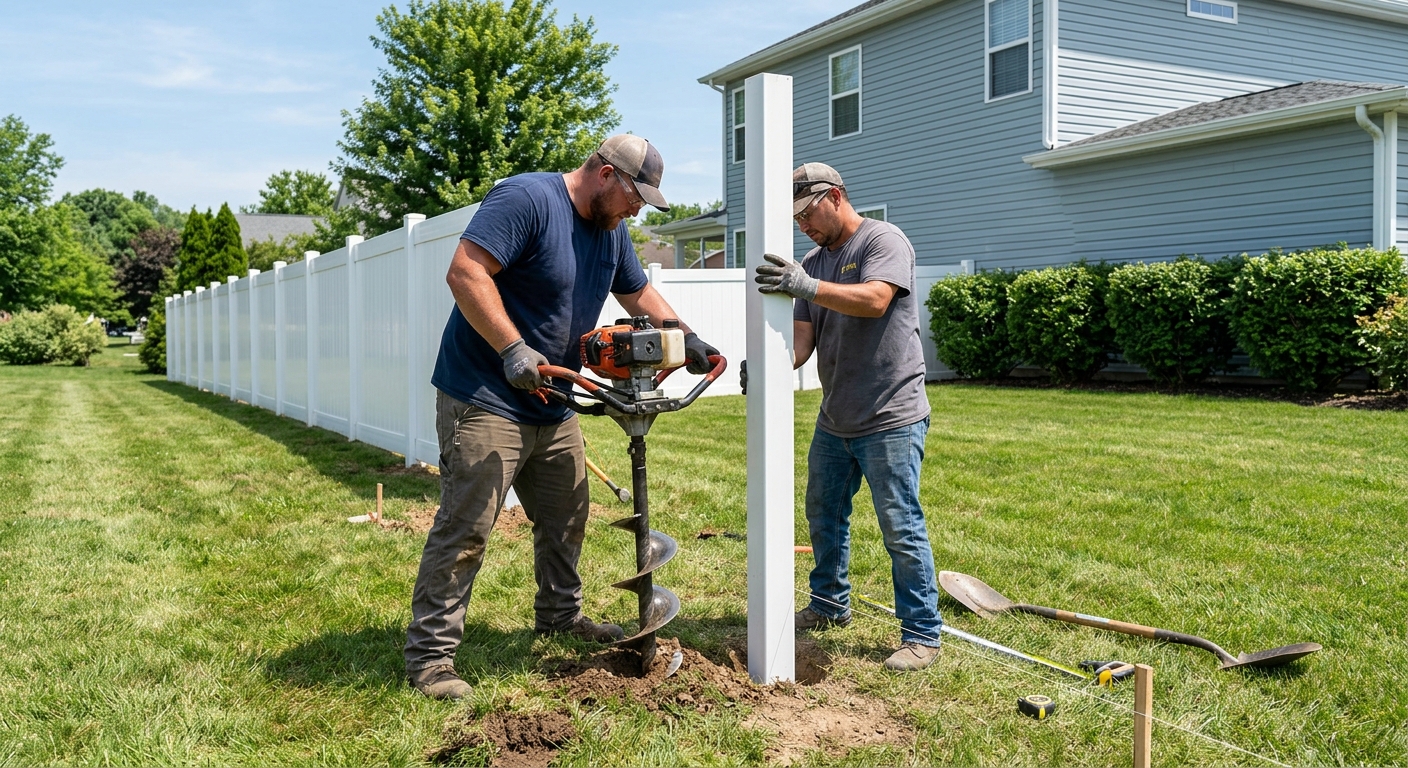
Fencing options and costs in Carter Crest
Carter Crest, Alberta is a small community (population 1,716 per Statistics Canada, 2021 Census) where most backyards are built around single-family living and perimeter protection—meaning fences are a practical upgrade as much as a curb-appeal choice. In a Calgary-area market where housing demand stays steady, you’ll see the strongest contractor availability for common backyard styles, especially in the more active residential pockets where property lots are being re-landscaped and rear yards are being upgraded.
Because the Calgary economic region sits in a Prairie continental climate, your fence budget is shaped by long freeze–thaw cycles and open wind exposure. That affects both how posts are installed (depth, backfill and whether concrete is used) and how solid privacy panels resist racking in gusty conditions. In Carter Crest, that means installed costs often track the “heavier structure” materials higher than light, airy systems.
For many homeowners, especially around the Carter Crest residential belt near the main collector roads and newer infill yards, privacy and pet containment drive the decision. If you’re comparing options, start with the installed price expectations per linear foot and then match lifespan and maintenance to your comfort level—staining schedules in cold winters aren’t optional, but some materials eliminate the routine work entirely.
Below is a practical comparison to help you line up materials with the typical Calgary-area price range and the realities of frost protection and wind loading before you request an itemised quote.
| Material |
Lifespan |
Maintenance |
Privacy Rating |
Price per Linear Foot |
| Pressure-treated pine (standard wood) |
10–15 years |
Stain/seal every 2–3 years; hardware checks |
Medium–High (solid panels) |
$40–$80 |
| Cedar (natural rot resistance) |
15–25 years |
Seal/stain every 2–4 years; keep bottom edges protected |
High (solid boards) |
$55–$95 |
| Vinyl / PVC (no-maintenance) |
25–30+ years |
Occasional wash; inspect for impact damage in extreme cold |
High (privacy styles) |
$45–$90 |
| Chain-link (galvanized steel) |
20–30 years |
Minimal; rinse/spot-coat if needed |
Low–Medium (airflow, not privacy) |
$25–$55 |
| Aluminum ornamental |
30+ years |
Occasional wash; tighten fittings after storms |
Low–Medium (decorative) |
$70–$120 |
| Composite / recycled material |
20–30 years |
Wash; avoid harsh cleaners; inspect for warping in impacts |
High (thicker privacy styles) |
$60–$110 |
Prices are estimates only and vary by project scope, site access and material selection.
What affects the price of fencing in Carter Crest
In Carter Crest and the wider Calgary market, two quotes for what looks like the same fence can differ by 30–50% once you factor in Calgary’s build requirements for wind and frost. The core reason is installation depth and structural support. On the Prairies, frost protection is a primary cost driver: fence posts are typically set about 4 ft (≈120 cm) deep to get below regional frost conditions, which means more excavation, more concrete, and longer posts. That installation reality pushes costs toward the mid–upper range of the local bands—especially for 6 ft privacy fences where solid panels catch wind.
Wind exposure also changes how contractors space posts and rails. With open Prairie exposure, solid wood or vinyl often needs tighter spacing and sturdier framing to prevent racking. In milder or wetter regions (for example, the coastal BC climate) wood rot pressure becomes the driver; here, the freeze–thaw cycle and uplift/heaving risk are the reason you’ll see concrete-setting emphasized more often.
Concrete examples homeowners feel in their budget: (1) a backyard with rocky soil may require different auger sizes and slower excavation than you’d expect, increasing labour; (2) a sloped lot may force stepped rails or raked panel sections, adding framing time; and (3) removing an old fence and hauling it away can add disposal labour that isn’t included in “material-only” assumptions. If you compare a chain-link run (often in the lower–mid range) to a privacy fence with concrete-set posts, the structural work is why the higher range—such as wood at about $40–$80 per linear foot—can be justified.
| Price Factor |
Why It Matters |
Cost Impact |
| Fence length in linear feet |
The primary driver of labour, rails and materials |
Higher length increases cost proportionally |
| Post depth required |
Frost line determines post length and hole depth |
Deeper holes typically increase labour + concrete |
| Post setting method |
Concrete vs. gravel pack vs. driven posts changes performance |
Concrete usually costs more but reduces heaving risk |
| Material choice |
Vinyl vs. cedar vs. chain-link affects panel weight and pricing |
Vinyl/wood mid-range; chain-link lower; metal higher |
| Gate count and type |
Drive-through double gates require extra bracing |
Gates raise total price more than homeowners expect |
| Grade and terrain |
Sloped yards require stepped or raked panels |
More cutting, layout and labour time |
| Old fence removal and disposal |
Demolition, hauling and dumps fees add time and cost |
Often a meaningful add-on if not quoted separately |
| Permit fees and survey / property line locate |
May be required for taller fences or unclear boundaries |
Can add fixed costs plus scheduling time |
Permits & regulations in Alberta
In Alberta, fences above a common height threshold often require a building permit, and the trigger is usually around 2.0 m (6.5 ft) for rear yards, with front or corner areas frequently governed by lower thresholds (often about 1.0–1.2 m or 3–4 ft). Carter Crest homeowners should also plan for property-line and setback compliance: your fence can’t encroach on neighbouring land, and setback rules are typically tied to the location of the fence relative to streets, lanes and lot lines.
Before any post hole is dug anywhere in Alberta, call for utility locates through Alberta One-Call (and follow any contractor marking requirements). That step helps avoid buried services and delays. If you’re not 100% sure where the property pins are, obtain a survey or a property line locate so you can avoid expensive “fence moved after dispute” scenarios.
Shared fence responsibilities are governed by Alberta line-fences principles, so if you’re upgrading a boundary fence, clarify ownership and cost sharing up front.
Licence and insurance checks are practical too: a permitted or complex project aside, you should verify your contractor is properly licensed (where applicable) and carries liability insurance. Ask for a WSIB/WCB clearance letter and keep the certificate of insurance on file for your records. If a contractor can’t provide current documents, that’s a major red flag in Carter Crest where winter timelines can’t afford delays.
Choosing the right fence material for Carter Crest
Choosing a fence material in Carter Crest comes down to matching your priorities—privacy, maintenance level, budget and lifespan—to the realities of Calgary’s freeze–thaw weather and strong Prairie winds. Pressure-treated pine is the budget-friendly option up front, but it generally needs staining or sealing every 2–3 years to reduce grey weathering and keep fasteners and board edges performing. Cedar looks and weathers more gracefully and has natural rot resistance, yet it still benefits from periodic sealing to protect against moisture cycles.
Vinyl/PVC is popular with homeowners who want no routine work: you’re typically washing it rather than staining it. However, in extreme cold snaps, vinyl can become brittle if it’s not installed correctly (for example, improper expansion allowances or impacts). Chain-link is usually the lowest cost and longest life for years of functionality, but it offers little privacy—often solved by adding privacy slats or planting. Aluminum ornamental provides rust-resistant decorative fencing; it won’t give you the “solid backyard” feeling unless you choose a privacy-style design, and cost is typically mid-range to high.
For Calgary-area privacy fences, the post depth matters as much as the material. When posts are set about 4 ft deep to address frost heaving risk, you get a sturdier foundation that helps solid panels resist wind racking. Concrete-set posts are commonly used for privacy fences and gate posts because a failure is most expensive after the fact.
Where the price difference is justified: if a cedar privacy option is $55–$95 per linear foot while pressure-treated pine runs about $40–$80, cedar’s longer lifespan and better long-term appearance can make sense for homeowners who don’t want frequent re-staining or board replacement.
| Material |
Cold Tolerance |
Lifespan |
Annual Maintenance |
Best For |
Price Band |
| Pressure-treated pine |
Good with proper sealing and correct post setting |
10–15 years |
Light inspection; stain/seal every 2–3 years |
Budget privacy with acceptable upkeep |
$40–$80 |
| Cedar |
Excellent for Alberta conditions when sealed and installed correctly |
15–25 years |
Light inspection; seal/stain every 2–4 years |
Better appearance and reduced rot risk |
$55–$95 |
| Vinyl / PVC |
Good in cold when panels are installed with correct clearances |
25–30+ years |
Wash/inspect after storms; check for impact damage |
Low-maintenance privacy |
$45–$90 |
| Chain-link |
Very good; galvanized components handle freeze–thaw well |
20–30 years |
Minimal; rinse and inspect tension |
Security and containment without privacy |
$25–$55 |
| Aluminum ornamental |
Very good; corrosion resistance in winter conditions |
30+ years |
Wash/inspect fittings |
Decorative fencing with long-term durability |
$70–$120 |
| Composite / recycled |
Good cold performance; best with proper fastening |
20–30 years |
Wash; inspect for impacts and fastener integrity |
Privacy with reduced maintenance |
$60–$110 |
How to choose a fencing contractor in Carter Crest
Start with proof, not promises. In Alberta, verify three things before signing: (1) licensing or professional registration where required for the contractor’s scope, (2) liability insurance, and (3) WSIB/WCB coverage for workplace safety. You can check online business registration details, but the most direct approach is to ask for a certificate of insurance and a WSIB/WCB clearance letter—then confirm dates and that the coverage is active. If you can’t reach someone quickly for documentation, that often signals trouble when there’s a winter schedule issue.
Next, get 2–3 itemised written quotes. Make sure each quote breaks down labour and materials (posts, rails, panels, hardware, concrete and excavation), not just a lump-sum number. The scope should specify what’s included: permit pull support (if needed), topsoil restoration, fence line locating vs. survey responsibility, and old fence removal and disposal. For warranty terms, ask for both workmanship warranty length and product/manufacturer warranty details, and whether coverage is transferable to you as the homeowner.
For payment structure, never pay more than 10–15% upfront. Hold back a portion until the job is complete and walkthrough items are addressed. Finally, get an agreed start date and a realistic completion estimate in writing—especially important in Carter Crest where weather windows can be tight and frost-protection planning affects schedule.
- Provide current proof of liability insurance (with limits) and WSIB/WCB clearance.
- Show a valid business registration and contact details that match their quote.
- Quote fence length in linear feet and height in feet/metres, with clear panel layout.
- Specify post depth and post setting method (concrete vs. gravel) for frost conditions.
- Include gate hardware details (hinges, latches, bracing and swing direction).
- List materials brand/specs: lumber grade, vinyl line, coating type and fastener type.
- Confirm who arranges utility locates and where that cost is billed.
- Clarify property line locating: survey by you vs. included locate by contractor.
- Itemise removal/disposal if an old fence is coming out.
- Confirm grading treatment: stepped panels vs. raked rails on sloped yards.
- Give a workmanship warranty in writing and define what “repair” includes.
- State payment milestones and retainage/holdback amount.
Concrete red flags I see with fencing contractors in Carter Crest: refusing to itemise post depth and concrete setting for privacy fences; quoting only a “per-foot” number without layout and gate details; starting excavation without documented utility locates; vague warranty language (no workmanship term in writing); and requesting a large deposit upfront (more than 15%) before any measurable work begins.
Frequently asked questions — fencing in Carter Crest
How do I find my property line before fencing?
In Carter Crest and across Alberta, the safest approach is to confirm where your pins are before anyone digs. Start by locating your existing survey paperwork (if you have it) and then book a property line locate or get a new survey if the boundary is unclear. If the fence will be near a shared boundary, verify who owns what and how costs are handled under Alberta line-fences principles. Don’t rely on “what looks right” from the sidewalk or a neighbour’s older fence line—old fences can be offset.
Also, before any post hole is dug, call Alberta One-Call so utilities are marked. That step helps avoid costly rework that can turn a reasonable project—say, within wood at about $40–$80 per linear foot—into a much higher bill because of delays and repairs.
What's the most low-maintenance fence?
For low maintenance in Carter Crest, vinyl/PVC is usually the top choice because it’s generally “wash and inspect.” It won’t rot like untreated wood, and it doesn’t require the same staining schedule. Still, you should expect occasional cleaning and a quick check after wind events to ensure posts and rails are secure.
Chain-link is also low maintenance, but it’s not privacy-focused—unless you add slats or planters. Aluminum ornamental is low maintenance too, with rust resistance and minimal upkeep. If you’re comparing costs, vinyl privacy commonly sits around $45–$90 per linear foot installed, while chain-link is often $25–$55. If budget is tight and privacy isn’t essential, chain-link can be the practical “set it and forget it” option.
How tall can my fence be in Carter Crest?
Height rules in Alberta commonly differ for rear yards versus front or corner locations. A typical guideline homeowners run into is a rear-yard threshold around 2.0 m (6.5 ft) where a building permit is often required, and lower front/corner limits commonly around 1.0–1.2 m (3–4 ft). Even if a permit isn’t triggered, your fence still must follow property line setbacks and placement rules.
Because local interpretations can vary by municipal bylaws and your exact location, the best move in Carter Crest is to ask your fencing contractor to clarify the height category before ordering materials. If you’re aiming for a 6 ft privacy fence, plan for the heavier structural install and potential permit steps—those factors are part of why privacy fence quotes can land toward the mid–upper range (for example, wood around $40–$80 per linear foot).
Should fence posts be set in concrete here?
In the Calgary-area climate, concrete setting is commonly used for fence posts—especially for privacy fences and gate posts—because frost heaving risk matters during the long freeze–thaw cycles. Local guidance typically expects posts around 4 ft (≈120 cm) deep to be below regional frost effects. When you’re setting that deep, concrete footings can add stability against uplift and movement.
That said, some installations use an engineered approach (like gravel-supported methods) for certain conditions. The right choice depends on soil type, fence height, wind exposure and whether the design uses heavier panels. If you want the best long-term performance for a solid wood or vinyl privacy fence, ask your contractor to explain their post-depth and post-setting method in writing.
What's the best fence for privacy?
For privacy in Carter Crest, solid wood, cedar, or vinyl privacy styles are usually the best match because they block sightlines and define yard boundaries in wind-exposed Prairie conditions. Among these, cedar offers natural rot resistance and a more premium look, while vinyl delivers the lowest routine maintenance (wash and inspect). Pressure-treated pine can be a good budget privacy route, but it generally requires staining or sealing every 2–3 years to keep it looking clean and protected.
One reason privacy fences cost more locally is the structural install: heavier solid panels require sturdy framing, tighter post/rail support and frost-safe installation. That’s why privacy fence pricing often sits higher than chain-link. For example, installed wood privacy commonly falls around $40–$80 per linear foot, while chain-link is often $25–$55 but won’t provide the same privacy.
How do I compare fencing quotes?
To compare fencing quotes in Alberta (and specifically in the Carter Crest area), make sure you’re comparing apples to apples. Ask for itemised quotes that break down labour and materials, including post depth, post setting method (concrete vs. other), rail configuration, panel spacing, and gate hardware. Confirm whether disposal of the old fence is included, and whether utility locates and property line locate are handled (or billed separately).
Don’t choose the lowest number until you’ve checked scope and warranty. A quote that looks cheap may omit concrete setting for frost protection or use lighter framing—issues that show up later as sagging, loose posts and racked panels. If one quote is for vinyl privacy at the higher end (for example, $45–$90 per linear foot) while another is “too low,” it’s worth asking what was reduced in the install details.