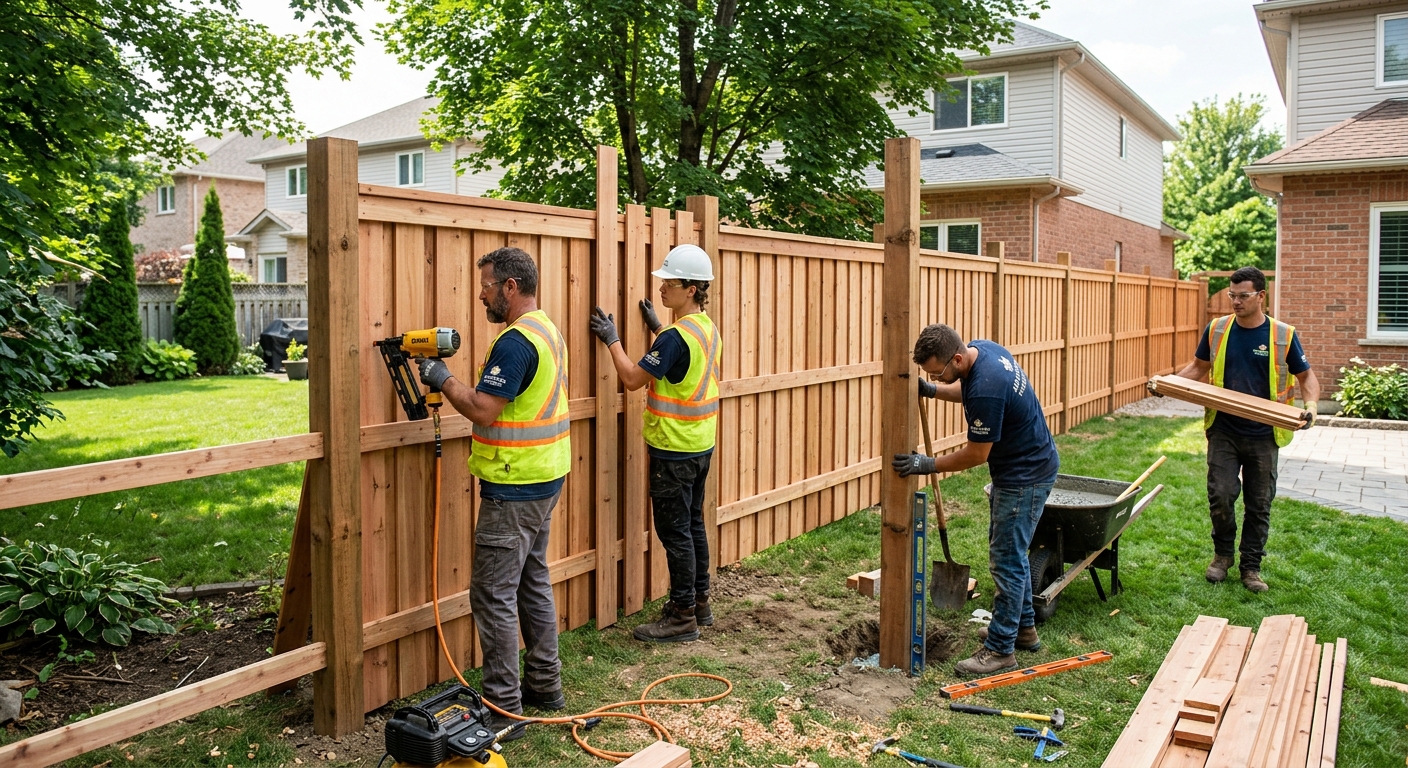
Fencing options and costs in Lloydminster
Lloydminster homeowners often start fencing projects when they’re replacing an older run, adding privacy around patios, or tightening security along wide lots. With a 2021 population of 31,582 (Statistics Canada, 2021 Census), there’s steady demand for trades, and detached homes in the area are a strong indicator of ongoing fence upkeep because private backyards and side yards tend to need regular panel and post maintenance. In the Wood Buffalo–Cold Lake economic region, fencing pricing is shaped by deep frost risk and frequent wind, which affects how deep posts must be set and how rigid the system needs to be—especially for tall privacy lines.
In practice, that means many installs in Lloydminster use deeper excavations and more robust post spacing than you’d see in milder parts of Alberta or southern Canada. Concrete-set posts are common where soil is frost-susceptible, because frost heave can lift shallow posts and cause leaning rails over a few seasons. Wind exposure on the Prairies also encourages heavier rail assemblies and less flexible systems; vinyl can perform well, but it needs proper anchoring and correct panel orientation to reduce “sail” effect. Chain-link is often the cost-friendlier choice for front boundaries where privacy isn’t the priority, while vinyl and wood get most demand around neighbourhoods with lots of backyard-facing activity—particularly in and around the North End.
Below is a practical cost-and-performance comparison to help you budget before you request an itemised quote for your specific layout and gate count.
| Material |
Lifespan |
Maintenance |
Privacy Rating |
Price per Linear Foot |
| Pressure-treated pine (standard wood) |
12–18 years |
Stain/seal every 2–3 years; periodic rail tighten-up |
High |
$40 – $80 |
| Cedar (natural rot resistance) |
15–25 years |
Seal or stain every 2–4 years; replace warped boards as needed |
High |
$55 – $95 |
| Vinyl / PVC (no-maintenance) |
20–30 years |
Rinse seasonally; check posts/fasteners after freeze-thaw cycles |
High |
$55 – $110 |
| Chain-link (galvanized steel) |
20–35 years |
Occasional tension adjustment and occasional coating touch-ups |
Low to Medium |
$30 – $60 |
| Aluminum ornamental |
25–40 years |
Light wash; inspect fittings after storms |
Low |
$70 – $140 |
| Composite / recycled material |
20–30 years |
Rinse annually; inspect for any board movement |
High |
$60 – $120 |
Prices are estimates only and vary by project scope, site access and material selection.
What affects the price of fencing in Lloydminster
In Lloydminster and across the Wood Buffalo–Cold Lake region, two bids for the “same” fence can differ by 30–50% because northern frost conditions change the fundamentals: post depth, excavation time, and how contractors stabilize posts in heavier soils. Labour rates also swing depending on how easy it is to access the back lane, how much frozen ground needs to be removed, and whether specialized crews are needed for taller privacy runs with more rigid bracing. Material delivery and waste handling are another swing factor—especially when municipalities require strict line placement or when gate hardware must be upgraded for wind and snow load.
Frost line depth is the big driver. In cold climates, posts must be set roughly 4–6 inches below the design frost depth to reduce frost heave, which typically means deeper holes, longer posts, and more labour. Where posts need to go around 1.5–2.0 m into the ground, many crews switch to concrete-set or engineered post settings, and that can push your project toward higher bands. On exposed Prairie lots, wind exposure encourages tighter spacing and heavier panels; that’s why a taller vinyl or wood privacy fence is often priced nearer the upper part of the $55 – $110 range, while chain-link tends to stay closer to $30 – $60 because it’s lighter with lower sail area.
Concrete examples from Lloydminster: (1) a 60–80 linear foot run with 2 gates on a relatively flat lot can land closer to the low end of wood installation bands, while the same length with 4+ posts in utility-protected areas often increases labour and hardware costs; (2) removing an old fence that’s already leaning can cost more than you expect because crews must dig out embedded bases; (3) sloped grades that require stepped rails usually add labour and sometimes change the materials—so the quote shifts even if the linear footage is identical. If you’re planning a replacement on older housing stock where fences were built closer to the property line, a survey/locate can add cost but prevents rework.
| Price Factor |
Why It Matters |
Cost Impact |
| Fence length in linear feet |
Every material and labour step scales with linear feet plus corner and gate extras |
High (primary driver) |
| Post depth required |
Frost heave risk dictates hole depth and post length for stability |
High (often shifts the whole bid band) |
| Post setting method |
Concrete-set posts take more labour and materials than gravel packs; driven options vary by soil |
Medium to High |
| Material choice |
Vinyl, cedar and chain-link all behave differently under freeze-thaw and wind; rail thickness changes bracing needs |
Medium to High |
| Gate count and type |
Drive-through double gates require stronger frames and often heavier hardware for wind |
Medium |
| Grade and terrain |
Slopes require stepped designs or raked panels, increasing labour and sometimes waste |
Medium |
| Old fence removal and disposal |
Disassembly, hauling, and hidden embedded posts add time |
Medium |
| Permit fees and survey / property line locate |
Required documentation and locating protects you from encroachment and rework |
Low to Medium (but can be essential) |
Permits & regulations in Alberta
In Alberta, fences above a height threshold—often around 2.0 m (6.5 ft) for rear areas and about 1.0–1.2 m (3–4 ft) for front or corner areas—may require a building permit depending on your lot and the applicable municipal requirements. Regardless of height, you must stay within your property lines and follow municipal setback rules. For Lloydminster homeowners, the most common mistakes we see are fences set too close to the line (leading to neighbour disputes) or installing before confirming where utilities and easements run.
Before digging post holes, you must call for utility locates through the Alberta One-Call system so buried services are marked. Also consider obtaining a survey or at least a property pin locate before installation—especially if your fence is replacing an older boundary line you can’t clearly verify. Shared fence responsibilities are handled under provincial line-fences legislation, so if you’re sharing a boundary fence, both maintenance and cost-sharing can be governed by those rules.
In terms of what typically does not need a permit: many homeowners’ routine replacements of a fence that stays below the height threshold and doesn’t change the footprint or the boundary alignment often avoid permitting, but the exact threshold can vary by placement. What does require a permit is typically building a fence above the noted height thresholds or changing a fence’s location/size in a way that alters how it sits relative to setbacks. Finally, verify your contractor’s Alberta licence status, confirm they carry liability insurance (request the certificate), and ask how they handle WCB coverage—then review the WCB status or clearance evidence they provide before work starts.
Choosing the right fence material for Lloydminster
Choosing a fence for Lloydminster is less about looks and more about matching your priorities to freeze-thaw performance, wind exposure, and maintenance tolerance. Pressure-treated pine is the most budget-friendly starting point, but it usually needs staining or sealing every 2–3 years to prevent grey weathering and cracking at board ends. Cedar offers better natural rot resistance and a warmer appearance, yet it still benefits from periodic sealing to keep edges tight and boards from cupping. Vinyl/PVC is popular for low hassle—no staining, easy rinse-cleaning—but in extreme cold it can become brittle if the system isn’t built with correct post depth, spacing, and proper fasteners. Chain-link is the longest-life option for low cost, but it offers little privacy unless you add slats or privacy screening. Aluminum ornamental fences are rust-resistant and clean-looking, but they’re more decorative than private and usually land in higher mid-range costs.
Because of the Wood Buffalo–Cold Lake frost environment, post-depth matters for all materials. In practice, most installs rely on posts set below the local frost risk—about 4–6 inches under design frost depth—so concrete-set posts are common where soil is prone to heaving. Wind and snow load considerations also influence panel choices: rigid privacy systems need stronger bracing in exposed areas, while chain-link can tolerate wind with fewer dramatic forces on rails.
Dollar example: if you’re comparing a wood privacy fence in the $40 – $80 band to vinyl in the $55 – $110 band for the same length and two gates, the extra upfront cost is often justified when you want “install-and-forget” maintenance and fewer board replacements over time. If you’re comfortable with staining and you want to keep the initial budget down, pressure-treated pine can still be a smart fit—provided posts are set correctly for frost and the rails are braced for wind.
| Material |
Cold Tolerance |
Lifespan |
Annual Maintenance |
Best For |
Price Band |
| Pressure-treated pine |
Good when posts are properly set below frost risk |
12–18 years |
Light inspections; stain/seal every 2–3 years (seasonal check) |
Budget privacy with planned upkeep |
$40 – $80 |
| Cedar |
Good; resists rot from wet cycles better than pine |
15–25 years |
Seal/stain as needed (usually every 2–4 years) |
Longer-lasting natural look |
$55 – $95 |
| Vinyl / PVC |
Very good if built with correct bracing and fasteners |
20–30 years |
Rinse/inspect; check fittings after freeze-thaw extremes |
Low-maintenance privacy |
$55 – $110 |
| Chain-link |
Excellent; metal tolerates freeze-thaw well |
20–35 years |
Inspect tension; occasional minor repairs |
Security with minimal cost and maximum durability |
$30 – $60 |
| Aluminum ornamental |
Very good; corrosion-resistant metal |
25–40 years |
Wash and visual checks |
Attractive boundary fencing with open visibility |
$70 – $140 |
| Composite / recycled |
Good; stable boards when installed to spec |
20–30 years |
Rinse annually; inspect for movement |
Privacy with less maintenance than wood |
$60 – $120 |
How to choose a fencing contractor in Lloydminster
When you’re hiring in Alberta, don’t guess—verify. Ask for the contractor’s Alberta licence (if applicable to their fencing business structure), proof of liability insurance, and their WCB/WCB clearance information. To check insurance, request a certificate of insurance naming the worksite and confirming active coverage. For WCB, look for documentation showing they’re registered and in good standing (or clearance evidence) before signing. A reputable contractor won’t hesitate to provide these documents early, before excavation starts.
Get 2–3 itemised written quotes that break labour and materials separately: posts, rails, fasteners, hardware, concrete quantities (if used), removal/disposal, gates, and any bracing required for wind. Avoid a simple lump sum unless it explicitly lists exclusions in the same document. Read the scope for what’s not included: permit pulling, locate fees, utility hand-digging, concrete supply, damaged lawn restoration, and whether old fence removal and hauling are included. Warranty matters too—confirm the workmanship warranty length, whether the product/manufacturer warranty is included, and if it transfers to a homeowner if you sell the property.
For payment, never pay more than about 10–15% upfront. Use a holdback until the job is complete and final adjustments are done—especially important with gate alignment and post settings. Finally, insist on a start date and an estimated completion timeline in writing so you can plan around frozen-ground access and winter scheduling in Lloydminster.
- Request insurance certificate and confirm it covers fencing installation activities at your address.
- Ask for WCB/WCB clearance evidence before any work begins.
- Get itemised labour and materials (not a single line total).
- Confirm post depth standard and whether posts are concrete-set or gravel-packed.
- Ensure gates are quoted with frames, hinges, latches, and any reinforcement.
- Ask if utility hand-digging is included after locates.
- Clarify whether permit pulling is included if height/placement requires it.
- Confirm old fence removal and disposal is included (and how it’s hauled away).
- Ask how they handle sloped yards (stepped vs. raked) and who sets the line level.
- Review warranty terms for workmanship and materials; ask for it in writing.
- Check payment schedule: limit upfront deposit to 10–15% and hold back on final completion.
- Verify the scope includes cleanup and any restoration of disturbed areas.
Common red flags in Lloydminster: contractors who won’t provide insurance/WCB documentation, vague quotes that don’t specify post setting or concrete quantities, refusing to put the start/completion date in writing, quoting a “best price” without gate hardware details, or pressuring you for a large upfront payment before excavation begins.
Frequently asked questions — fencing in Lloydminster
Do I need a permit to build a fence in Alberta?
In Alberta, fences may need a building permit when they exceed height thresholds—often around 2.0 m (6.5 ft) for rear locations and about 1.0–1.2 m (3–4 ft) for front or corner areas. The exact requirement can depend on placement and applicable municipal rules in Lloydminster, so the safe approach is to ask your contractor to confirm based on your lot and proposed height before ordering materials. Regardless of permits, you must stay within your property lines and follow setbacks. Before any digging, call Alberta One-Call for utility locates and consider a survey/locate of your pins to prevent encroachment disputes. If your plan is to replace an existing fence at the same height and footprint, you may be exempt from permitting—just verify first so you don’t get delays or redo work.
How long does a wood fence last in Lloydminster?
For Lloydminster and the broader Wood Buffalo–Cold Lake region, wood longevity depends heavily on how deep posts are set and whether the fence is stained early enough to handle freeze-thaw cycles. Pressure-treated pine typically lasts about 12–18 years when installed correctly with proper post depth below frost risk and periodic staining every 2–3 years. Cedar can often reach 15–25 years because it resists rot better, though it still benefits from sealing to prevent edge splitting and cupping. If a wood fence is installed too shallow, frost heave can lift posts and make rails loosen, which shortens lifespan even if the boards are still sound. That’s why wood projects priced around the $40 – $80 band can vary—correct post setting can be the difference between “fine for a decade” and “needs replacement sooner.”
Who owns and maintains a shared fence?
In Alberta, shared fence responsibilities are governed by provincial line-fences legislation. In practical terms for Lloydminster neighbours, the key is whether the fence is recognized as a boundary/shared structure, which can affect how maintenance and costs are handled. Typically, both parties may share in upkeep when the fence is on the shared boundary, but the specific obligations can depend on the circumstances and how the boundary is established. If you’re replacing a shared fence, ask for clarity in writing about which side supplies materials, how costs are split, and what “maintenance” means for both parties (for example, board replacement versus full rebuild). Before any work, confirm the property line location (survey or pin locate) to avoid a situation where you’ve built on the wrong side and end up owning most of the maintenance burden yourself.
How do I find my property line before fencing?
Before fencing in Lloydminster, confirm the property line using your survey or by locating the property pins. The simplest safe process is to pull your most recent survey paperwork (if you have it) and then request a pin locate so you can mark corners and line points accurately. If you don’t have survey documentation, booking a professional survey is the most reliable way to confirm boundaries—especially if you’re replacing an older fence that may have drifted over time. Also, do utility locates before digging through the Alberta One-Call system. This matters because moving a fence line after installation can be costly and can create disputes with neighbours. Taking these steps up front may seem like an extra expense, but it prevents rework and helps you stay within setbacks and property lines.
What's the most low-maintenance fence?
For low maintenance in Lloydminster, vinyl/PVC often ranks highest because it doesn’t require staining, and it generally holds up well under Alberta’s freeze-thaw when installed correctly. Most vinyl systems are expected to last roughly 20–30 years, with seasonal rinsing and periodic inspection of posts and fasteners being the main tasks. In contrast, pressure-treated pine needs staining or sealing every 2–3 years to limit weathering, and cedar still needs periodic sealing even though it resists rot better. Chain-link is also low maintenance mechanically and can last 20–35 years, but it offers little privacy unless you add privacy slats or screening, so it may not meet your “privacy” goal. If you want privacy and minimal upkeep, budget for vinyl in the $55 – $110 band rather than going with the lowest-cost $30 – $60 chain-link option.
How tall can my fence be in Lloydminster?
Fence height limits in Alberta can depend on where the fence sits on your lot (rear versus front/corner) and how it aligns with municipal requirements in Lloydminster. A common Alberta guideline used for permitting is that rear fences may be considered around 2.0 m (6.5 ft), while front or corner fences are often around 1.0–1.2 m (3–4 ft) before permitting becomes more likely. Even if you can build taller, you still need to respect property lines and setbacks and consider wind exposure—especially for taller privacy fences on open Prairie lots. Tall fencing can also increase the need for stronger post bracing due to snow load and wind “sail,” which can raise project cost versus a shorter run. If you tell your contractor your target height and where the fence sits, they can confirm whether you’re likely in permit territory and recommend materials suited to Lloydminster conditions.