Fencing options and costs in Mayfield
Mayfield, Alberta is a small community (population 1,973 as of the 2021 Census) where many homeowners maintain their properties year-round, and a typical detached home setting creates steady demand for boundary fences and back-yard privacy panels (Statistics Canada, 2021 Census). In practical terms, that means contractors who can handle long excavation days, wind-stiff framing, and accurate layout are often booked ahead in busy seasons.
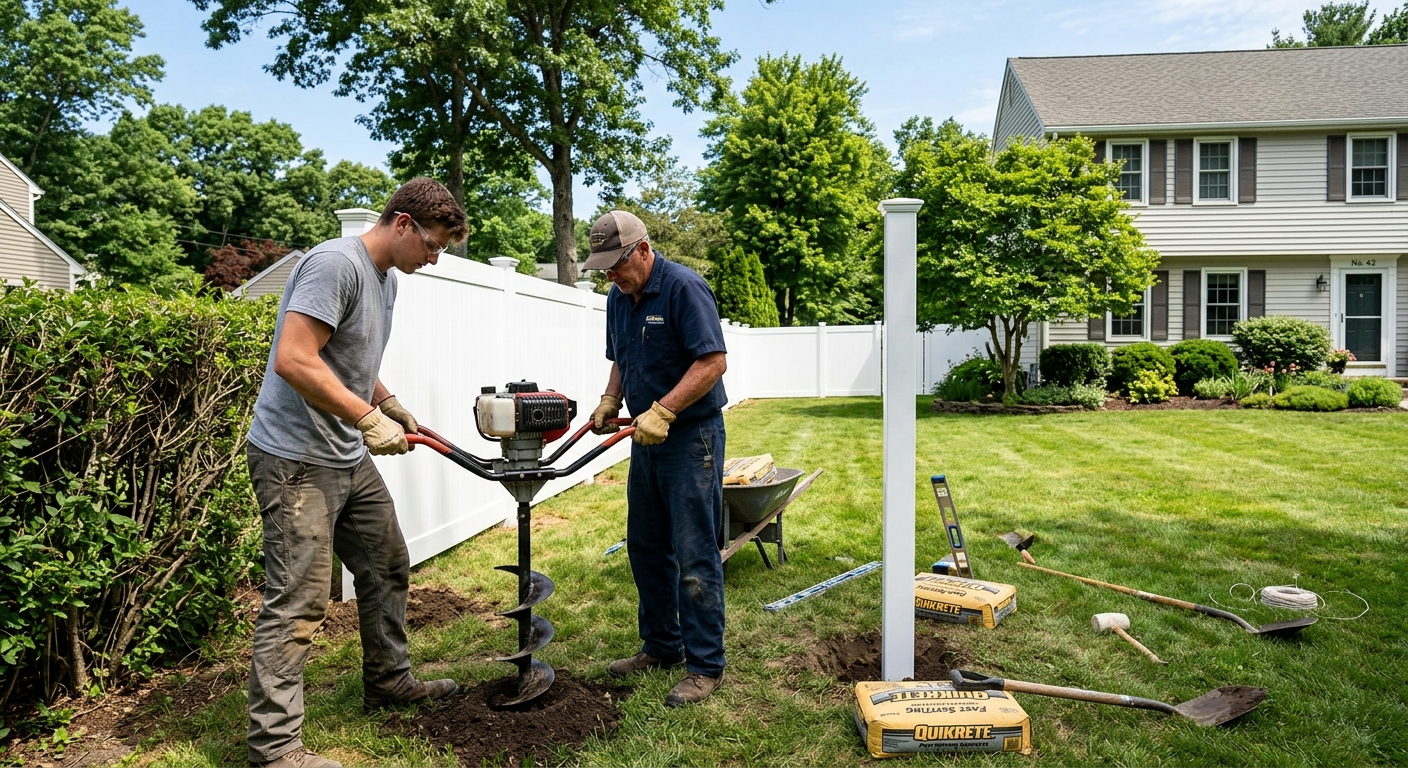
Across the Calgary economic region, fence pricing is strongly shaped by a Prairie continental climate: long freeze–thaw cycles and open exposure to wind loads. Those conditions make frost protection a primary cost driver. Local guidance expects posts set to roughly 4 ft (≈120 cm) deep (often below the regional frost line) for post stability and to reduce heaving, especially for 6 ft privacy fences and heavier gate posts. Because excavation and concrete volume increase with that depth, labour and materials typically land in a wider band than in milder regions.
We also see higher demand in neighbourhood pockets like the newer residential areas where back yards are still open to prairie wind. If you’re comparing options, the mid–upper pricing you’ll see for wood and vinyl makes sense here—solid panels don’t vent wind the way chain-link does. Use the table below to benchmark typical material choices against lifespan, maintenance, privacy, and per-linear-foot pricing, then we’ll break down what pushes quotes up or down for your exact yard.
| Material |
Lifespan |
Maintenance |
Privacy Rating |
Price per Linear Foot |
| Pressure-treated pine (standard wood) |
10–15 years |
Stain/seal every 2–3 years |
High (solid boards) |
$40 – $80 |
| Cedar (natural rot resistance) |
15–25 years |
Light staining/stripping as needed every 3–5 years |
High (board-by-board) |
$55 – $95 |
| Vinyl / PVC (no-maintenance) |
20–30 years |
Wash rinse 1–2 times per year |
High (solid styles) |
$45 – $90 |
| Chain-link (galvanized steel) |
25–40 years |
Minimal; occasional tension checks |
Low–Medium (airflow) |
$25 – $55 |
| Aluminum ornamental |
25–40 years |
Minimal; rinse seasonally |
Low (decorative spacing) |
$70 – $120 |
| Composite / recycled |
20–30 years |
Wash; inspect hardware annually |
Medium–High (depends on slat/board spacing) |
$65 – $110 |
Prices are estimates only and vary by project scope, site access and material selection.
What affects the price of fencing in Mayfield
In Mayfield and throughout the Calgary region, you can see quotes for what seems like the same fence vary by 30–50% because the quote isn’t just “height and length”—it’s how deep the posts must go, how the fence resists wind, and how difficult the site is to excavate. In a Prairie continental climate, solid panels catch more wind than chain-link, so contractors typically use tighter post spacing and sturdier bracing. That’s why a wood or vinyl privacy fence often lands in the mid–upper part of the $40–$80 and $45–$90 per linear foot bands, while chain-link tends to stay closer to the lower–mid end of $25–$55.
Frost line depth is the biggest structural driver. For Alberta and Calgary-area conditions, posts are commonly set about 4–6 inches below the design frost depth (often translating to roughly 1.5–2.0 m of embedment). Deeper holes mean longer excavation time, longer posts (or added bracing/extension), and more concrete when we concrete-set for stability. Wind exposure on the Prairies also affects engineering: heavier panels can require additional hardware and rails to reduce racking.
Two local examples that frequently change the price in Mayfield: (1) yards with hard, rocky subsoil can add time and equipment cost to reach the required embedment depth; (2) corners and gate lines need extra bracing and stronger posts, so the “small” section can cost nearly as much per foot as straight runs. A third common example is winter scheduling—if the ground is partially frozen, excavation productivity drops, which can push labour up even when materials stay the same.
| Price Factor |
Why It Matters |
Cost Impact |
| Fence length in linear feet — the primary cost driver |
Every extra foot adds rails, fasteners, and post structure |
Directly proportional increase; big projects dominate the final total |
| Post depth required — frost line determines post length and hole depth |
Deeper embedment improves stability and reduces heaving |
Longer posts + more excavation; can raise labour and concrete volume |
| Post setting method — concrete vs. gravel pack vs. driven posts |
Concrete-set posts resist movement in freeze–thaw climates |
Concrete-setting adds materials and labour; gravel/driven options can be cheaper but need suitability |
| Material choice — vinyl vs. cedar vs. chain-link |
Panel weight, bracing needs, and material unit cost vary |
Vinyl/cedar typically mid–upper; chain-link low–mid; aluminum often top end |
| Gate count and type — walk-through vs. drive-through (double) |
Gates require stronger posts, hardware, and alignment |
More posts/rails and premium hardware; gate runs often cost more per foot |
| Grade and terrain — sloped yards require stepped or raked panels |
Uneven grades change how boards are cut and braced |
Extra labour and waste; stepped sections can raise the effective per-foot cost |
| Old fence removal and disposal |
Demolition, hauling, and site restoration take time |
Can add substantial labour; disposal fees may apply |
| Permit fees and survey / property line locate |
Ensures compliance with setback/bylaw rules and prevents encroachment |
Typically a smaller line item, but survey/locate can be necessary for corners |
Permits & regulations in Alberta
In Alberta, fence permit requirements depend on height and location. As a practical rule, fences above roughly 2.0 m (6.5 ft) at the rear and about 1.0–1.2 m (3–4 ft) at the front or corner often require a building permit. Even when a permit is not required, your fence must still respect property lines and municipal setback bylaws for your site.
Before any post holes are dug, arrange utility locates by calling Alberta One-Call (this is required for safe digging, and it prevents costly delays if lines are present). For peace of mind—and to avoid disputes with neighbours—verify your boundary with a survey or property pin locate before installing, especially at corners and where landscaping or older fences don’t match modern measurements. Shared fence ownership and line-fence decisions are generally handled under Alberta’s line-fences rules, so it’s wise to clarify who is responsible for maintenance and replacement of shared boundary sections.
What typically DOES require a permit: privacy-style fences that exceed the height threshold, drive gates with larger structural elements, and any fence configuration that may impact access/visibility at corners. What typically does NOT: lower fences below thresholds and standard replacement of an existing fence in the same footprint and height—provided you remain within bylaw limits and you don’t change location or exceed the height threshold.
When hiring, confirm your contractor’s Alberta licence (if applicable to their scope), request proof of liability insurance and ask for WSIB/WCB coverage clearance. Where to look: online company registry listings (for the business identity), your contractor’s certificate of insurance showing active coverage, and a recent clearance letter or account confirmation for worker coverage. Keep copies for your records.
Choosing the right fence material for Mayfield
Choosing a fence in Mayfield is about matching material to your priorities—privacy, low maintenance, lifespan, and budget—while respecting Calgary-region winter conditions. Pressure-treated pine is the budget-friendly option for many homeowners, but it needs staining or sealing every 2–3 years to prevent grey weathering and to keep boards looking good. Cedar offers a natural look and rot resistance, often lasting 15–25 years, yet it still benefits from periodic maintenance. Vinyl/PVC is genuinely low maintenance, but in extreme cold it can be more sensitive to expansion/contraction, so we use correct installation practices—proper spacing, solid post setting, and quality rails—rather than treating it like “no rules needed.”
Chain-link is the most cost-effective and typically the longest-lasting with minimal upkeep, but it won’t provide the same privacy as solid boards. Aluminum ornamental is rust-resistant and clean-looking, yet it’s also less private due to open pickets. For Calgary’s wind and snow load conditions, solid wood/vinyl privacy fences often require more robust post-and-rail construction and fully concreted footing where soil conditions warrant it—especially around gates where the loads are concentrated.
For frost protection, the embedment guidance in the Calgary region usually means concrete-set posts (or an equivalent frost-stable method) are a common best practice because you’re placing posts below the freeze–thaw movement zone. Is concrete always mandatory? Not necessarily, but in open Prairie yards with heavier privacy panels, it’s one of the most reliable ways to reduce long-term shifting.
Dollar example: if you’re deciding between chain-link and a privacy fence, a straight section might land around the lower band of $25 – $55 per linear foot for chain-link versus a privacy wood fence closer to the mid band of $40 – $80. That “extra” buys you actual privacy and a more enclosed yard feel—which is often worth it in Mayfield back-yard setups.
| Material |
Cold Tolerance |
Lifespan |
Annual Maintenance |
Best For |
Price Band |
| Pressure-treated pine |
Good with proper staining and vented design |
10–15 years |
Visual inspection; usually 0–1 minor touch-ups |
Budget-friendly privacy with a classic look |
$40 – $80 |
| Cedar |
Good; naturally handles freeze cycles better than many woods |
15–25 years |
Light cleaning; stain as needed every few years |
Appearance and rot resistance |
$55 – $95 |
| Vinyl / PVC |
Very good in cold when installed with correct clearances |
20–30 years |
Rinse wash; check posts/rails annually |
Low maintenance and solid privacy |
$45 – $90 |
| Chain-link |
Excellent; galvanized steel tolerates Alberta winters well |
25–40 years |
Minimal; occasional tension checks |
Security and pet containment without full privacy |
$25 – $55 |
| Aluminum ornamental |
Excellent; no rust in freeze–thaw cycles |
25–40 years |
Rinse wash; inspect hardware |
Curbsiding appearance with tidy, long life |
$70 – $120 |
| Composite / recycled |
Good; resistant to moisture-related decay |
20–30 years |
Wash; inspect and tighten fasteners annually |
Privacy with less traditional wood upkeep |
$65 – $110 |
How to choose a fencing contractor in Mayfield
Choosing the right contractor matters more in Mayfield than many homeowners expect because fencing performance depends on installation details—post embedment depth, bracing, hardware quality, and correct layout. Start by verifying Alberta coverage and legitimacy. Ask for a certificate of liability insurance and ensure it’s active and matches the company doing the work. For worker protection, request proof of WSIB/WCB coverage or a current clearance letter/account confirmation—don’t accept verbal assurances. Also confirm the business details are consistent across their quote documents and insurance paperwork (so the quote, invoice, and coverage align).
Next, get 2–3 written, itemised quotes. Look for a breakdown that separates labour and materials (posts, rails, panels, hardware, concrete/setting method, and gate components). A lump-sum number with no line items makes it hard to compare “apples to apples,” especially when one contractor uses different post spacing or different concrete-setting assumptions for freeze protection.
Read the scope line by line: what’s excluded (for example, permit pulls, survey locate, utility locating fees, landscaping restoration), and what’s included (old fence removal, disposal, and grade/step adjustments). Warranty clarity is also critical. Ask for the workmanship warranty length (how long the installer stands behind alignment, sagging, and hardware failure) and the manufacturer warranty for materials—plus whether it’s transferable if you sell your home.
Payment schedule: never pay more than 10–15% upfront. Use a holdback until substantial completion, and confirm when final payment is due. Finally, insist on a start date and completion estimate in writing so delays don’t erode your schedule.
- Verify insurance: request certificate of liability with matching contractor name
- Request WSIB/WCB clearance or coverage proof before work begins
- Confirm fencing length measurement method and post count calculation
- Ask how post depth will be handled for frost protection (embedment and setting method)
- Require itemised quote: posts, rails, panels, concrete/hardware, gates, and labour
- Check whether utility locates are arranged or whether you pay directly
- Confirm old fence removal/disposal inclusions and where debris goes
- Ensure gates are specified: type, frame material, hinges/latches, and number of gates
- Ask about how slopes will be handled (stepped vs. raked) and whether it changes pricing
- Get warranty terms in writing: workmanship duration and manufacturer warranty details
- Review payment terms: cap deposit at 10–15% and use a holdback
- Ask for a schedule: start date, milestones, and estimated completion window
In Mayfield, red flags I commonly see include: quotes that omit post depth or setting method, a “no need to locate utilities” claim, warranties that only cover product but not workmanship, an offer to take most payment up front, and vague exclusions that don’t address gate bracing, slope adjustments, or old fence disposal.
Frequently asked questions — fencing in Mayfield
What's the most low-maintenance fence?
For Mayfield and the Calgary region, vinyl/PVC is usually the most low-maintenance choice: you’ll typically just rinse it and visually check hardware seasonally. Chain-link is also very low upkeep because galvanized steel handles freeze–thaw cycles well, but it won’t give you true privacy. If you want a balance of low maintenance and privacy, vinyl in the $45 – $90 per linear foot range is often the practical sweet spot, especially where wind exposure is high and solid panels need sturdier post construction. Cedar and pressure-treated wood can look great, but they require planned maintenance—staining/sealing every few years—to prevent weathering and to keep fasteners and boards performing.
How tall can my fence be in Mayfield?
In Alberta, height limits are tied to your location on the property (front/corner versus rear) and local bylaws. A common threshold used for permit decisions is about 2.0 m (6.5 ft) at the rear and roughly 1.0–1.2 m (3–4 ft) at the front or corner. If you’re planning a solid privacy fence around a corner or along a front exposure, you may run into stricter rules or permit requirements sooner. Because Mayfield has varied lot setups and visibility considerations, the safest path is to confirm your exact boundary, setback lines, and fence height in writing with your contractor before you order materials. That prevents rework and ensures your posts are set to the required depth for frost protection.
Should fence posts be set in concrete here?
In the Calgary area, many privacy fence installations benefit from concrete-set posts because frost protection is a major structural requirement in freeze–thaw conditions. Local guidance commonly expects embedment to roughly 4 ft (≈120 cm) deep to get below the regional frost line, and often about 1.5–2.0 m into the ground depending on design frost depth. Concrete-setting increases labour and concrete volume, which is one reason wood and vinyl often land toward the mid–upper portions of the price bands. That said, concrete isn’t automatically the only acceptable method in every situation—soil type, post size, and the fence style matter. A good contractor will explain the chosen method and how it prevents heaving and racking in Alberta weather.
What's the best fence for privacy?
If privacy is the priority in Mayfield, you typically want a solid panel design: board-on-board wood, cedar privacy, or vinyl/PVC privacy styles. Chain-link provides security and airflow but only low–medium privacy unless you add slats or privacy screens. The Calgary region’s wind exposure means solid fences should be built with proper bracing and sturdy post-and-rail systems to reduce racking; that’s also why privacy fences generally cost more than lighter, more breathable options. Budget-wise, wood privacy frequently appears in the $40 – $80 per linear foot band, while vinyl privacy tends to be closer to $45 – $90. The “best” choice usually depends on whether you want to pay for lower upkeep now (vinyl) or manage staining cycles later (wood/cedar).
How do I compare fencing quotes?
Compare quotes by itemisation, not just the total. Ask each contractor to break out labour versus materials, and confirm what’s included for posts (depth and setting method), rails, panel type, hardware, and gates. Since Alberta frost depth and wind loading drive costs, make sure the quote states the embedment approach (often roughly 4 ft deep guidance for stability, with holes dug below frost movement) and whether concrete is included. Also check exclusions: utility locating responsibilities, old fence removal/disposal, permit pulls (if applicable), and landscaping restoration. Finally, compare whether each quote uses comparable material grades and thickness. If one quote is significantly cheaper—say it’s far below typical chain-link $25 – $55—it may be cutting corners on post depth, bracing, or hardware quality rather than offering a better deal.
How long does fence installation take in Mayfield?
Timelines in Mayfield depend on length, grade complexity, and whether we’re removing an old fence. For typical back-yard projects with straightforward access, many installs take only a few days once materials are on site, but frost-protection excavation and gate construction can add time. Longer fences with multiple gate sections require more layout time, more post holes (often with concrete setting), and more bracing to handle wind loads. If your yard is sloped, expect extra time for stepped/raked panels and careful alignment. Weather can also affect productivity in freeze–thaw periods, even when the schedule is confirmed. A reputable contractor will provide a written start date and completion estimate, and it should line up with their planned post setting and curing steps.