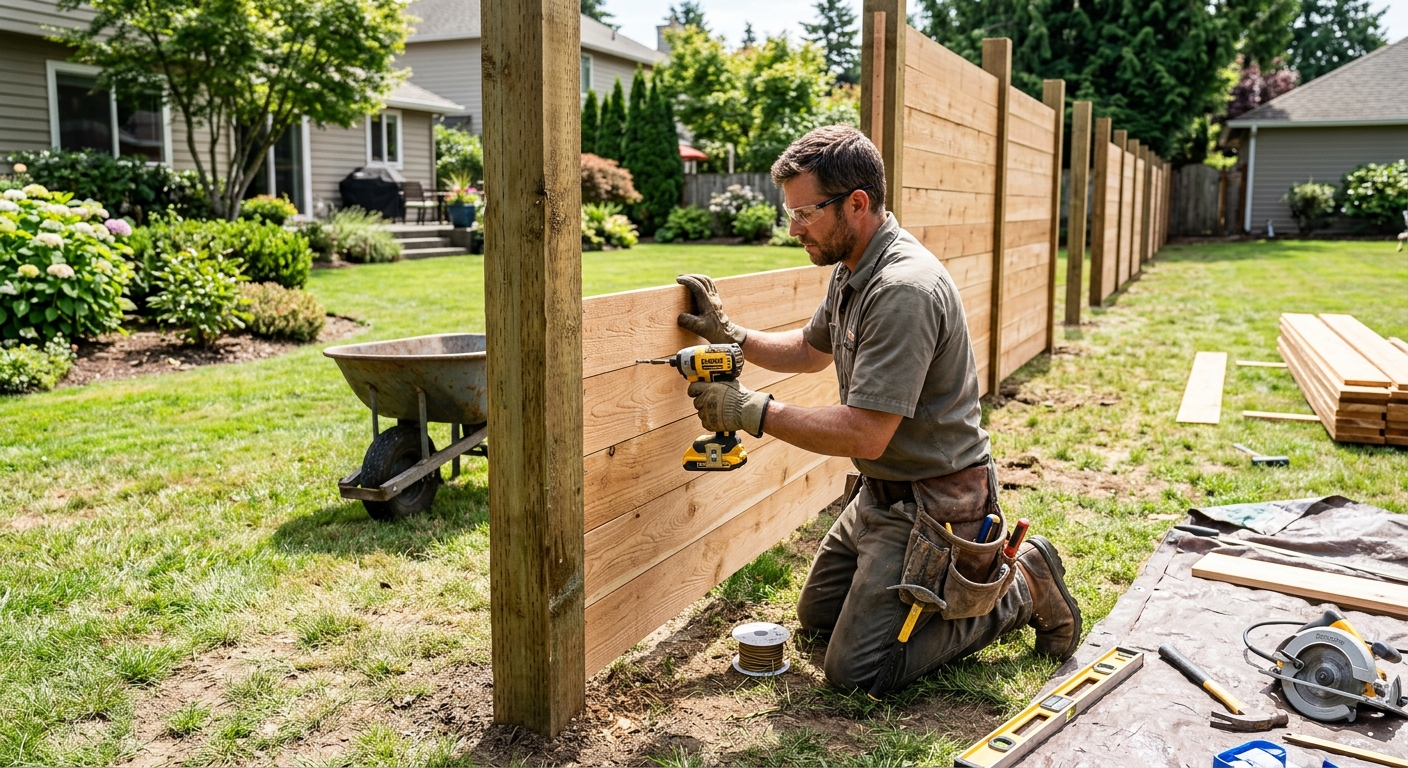
Fencing options and costs in Blackfalds
Fencing in Blackfalds is a practical must for many homeowners, especially in a community where detached homes make up 71.8% of dwellings—each one is a potential yard boundary and gate need. With homeowner households at 77.8% (Statistics Canada, 2021 Census), local demand is steady and contractors tend to be booked around spring and early fall, when soil is workable for digging and post-setting.
In the Red Deer economic region, pricing is shaped by Alberta’s freeze–thaw cycles and wind. Posts typically need to be set below the frost depth (often about 4–6 inches beneath the design frost line) to reduce heaving, which means deeper holes, longer posts, and more labour. Wind exposure on prairie lots also matters: to resist racking and blowouts, installers may tighten post spacing and use heavier rails or more robust panel hardware—choices that can raise install cost versus sheltered backyards. In Blackfalds, this is especially noticeable in more exposed areas such as the newer developments around the Blackfalds Lake direction and other subdivision edges where lots open up.
Material choice usually drives the biggest swing. If you want a quicker payback on a lower upfront budget, wood or chain-link can fit. If you value long-term upkeep, vinyl or aluminum can cost more but reduce maintenance time during Alberta winters. Below is a side-by-side view of common options with typical lifespan and budget ranges in Blackfalds, before we dig into the price factors that move bids up or down.
| Material |
Lifespan |
Maintenance |
Privacy Rating |
Price per Linear Foot |
Price Range |
| Pressure-treated pine (standard wood) |
10–15 years |
Stain/seal every 2–3 years; fastener checks |
High (solid board/close picket) |
$15–$28 |
$3,500–$6,500 |
| Cedar (natural rot resistance) |
15–25 years |
Light staining/oiling as needed (often every 3–4 years) |
High (solid board/close picket) |
$18–$35 |
$4,500–$8,000 |
| Vinyl / PVC (no-maintenance) |
20–30 years |
Minimal; rinse and inspect for warping |
Medium–High (solid infill styles) |
$20–$38 |
$5,000–$9,000 |
| Chain-link (galvanized steel) |
20–40 years |
Occasional tension/visual checks |
Low (privacy add-on screens optional) |
$14–$24 |
$2,500–$5,000 |
| Aluminum ornamental |
25–40 years |
Wash annually; tighten hardware |
Low–Medium (ornamental pickets) |
$22–$45 |
$5,000–$10,000 |
| Composite / recycled |
20–30 years |
Occasional cleaning; inspect posts and connectors |
Medium–High (solid sections) |
$24–$45 |
$6,000–$11,000 |
Prices are estimates only and vary by project scope, site access and material selection.
What affects the price of fencing in Blackfalds
Two quotes for the “same” fence in Red Deer-area pricing can differ by 30–50% because the hidden variables aren’t identical: post depth strategy, wind-resistance design, gate scope, soil conditions, and whether an old fence comes out and gets disposed. Even within Alberta, labour availability and how contractors schedule winter-proofing materials can shift the final number—especially when work overlaps tight spring digging windows.
First, frost line depth is a cost driver. Contractors commonly set posts 4–6 inches below the design frost depth, which in cold prairie conditions often means 1.5–2.0 m of penetration depending on the ground and the local frost calculation. That depth can require concrete-set posts for stability and longer rails, which increases material and labour time. Second, wind exposure on the Prairies influences design: tighter post spacing, heavier posts, and reduced “sail area” in the panel pattern help resist racking and blowouts. If you’re installing along an exposed edge of your lot, you may see prices move closer to the higher end of the wood range—think closer to the $45–$85/linear foot band—rather than a quick baseboard-style install.
Two common Blackfalds examples: (1) if your soil holds water near spring thaws, contractors may need more drainage prep and a slightly different concrete plan, which adds labour; (2) if you’re on harder clay or rocky fill, excavation can take longer and increases equipment time. On the flip side, a straightforward run through level ground with easy access can keep chain-link closer to the $35–$70/linear foot band. Where homes are newer—remember only 10.1% of stock was built before 1981 (Statistics Canada, 2021 Census)—many properties have clearer layouts and defined property lines, which can reduce survey/locate friction and change costs by hundreds of dollars.
| Price Factor |
Why It Matters |
Cost Impact |
| Fence length in linear feet — the primary cost driver |
Materials and labour scale directly with length |
High (often the biggest swing) |
| Post depth required — frost line determines post length and hole depth |
Deeper holes reduce heaving but increase labour and concrete |
High |
| Post setting method — concrete vs. gravel pack vs. driven posts |
Concrete increases stability in windy or moisture-prone ground |
Medium–High |
| Material choice — vinyl vs. cedar vs. chain-link |
Upfront cost and wind resistance design differ by system |
High |
| Gate count and type — walk-through vs. drive-through (double) |
Gates require stronger frames, hardware, and often extra bracing |
Medium–High |
| Grade and terrain — sloped yards require stepped or raked panels |
More cuts, hardware adjustments, and more time on layout |
Medium |
| Old fence removal and disposal |
Tear-out labour, hauling, and any hidden footing removal |
Medium |
| Permit fees and survey / property line locate |
Locates reduce encroachment risk; permits can be required for tall runs |
Low–Medium |
Permits & regulations in Alberta
In Alberta, whether you need a building permit often comes down to fence height and location. As a practical guideline homeowners use in Blackfalds, fences above a height threshold—commonly around 2.0 m (6.5 ft) at the rear and about 1.0–1.2 m (3–4 ft) at the front or corner—may require a building permit. Your local municipal bylaw can also set additional rules on placement, setbacks, and sightlines, so your contractor should confirm the requirements before work starts.
All fences must respect property lines and municipal setback bylaws. Before digging any post hole, call for utility locates through the proper Alberta One-Call process (utility location is mandatory for safe excavation). If you’re not sure where your property line sits, get a survey or have pins located before installing—encroachment disputes are expensive to fix after posts are set. Shared fence ownership responsibilities are governed by Alberta’s line-fences legislation, so if you’re tying into or replacing a shared boundary, clarify ownership and maintenance obligations up front.
What typically DOES require a permit: installing a fence over the height threshold and any project that a municipality considers a regulated structure due to height or location. What typically does NOT: basic fence repairs in the same footprint and same height, and replacement with similar materials and height where the bylaw allows it (contractor should confirm in writing).
To verify your contractor in Alberta, check three things: (1) Alberta business registration/licence details online from the appropriate public business registry pages; (2) proof of liability insurance via an up-to-date certificate of insurance naming you as the certificate holder or showing your project address; (3) WSIB/WCB coverage—ask for the clearance letter/status confirmation so you know subcontractors and payroll are covered.
Choosing the right fence material for Blackfalds
In Blackfalds, the “best” fence material is the one that matches your priorities while surviving Alberta winters and prairie wind. Pressure-treated pine is the budget-friendly route, but it typically needs staining or sealing every 2–3 years to limit grey weathering and surface checking. Cedar looks great and resists rot naturally, yet it still benefits from periodic staining and proper post siting so moisture doesn’t pool at the base. Vinyl/PVC is popular for low maintenance: it doesn’t require painting, but in extreme cold it can become brittle if the system is under-built—so good hardware and proper post depth matter as much as the material. Chain-link is usually the lowest cost with the longest life, but it offers little privacy unless you add privacy slats or screen material. Aluminum ornamental is mid-range: it won’t rust like steel, won’t rot like wood, and handles wind loads well, but privacy is limited by the picket spacing.
Post depth in this region is commonly driven by frost. Even if you choose a material that lasts long, poorly set posts can fail first. With Red Deer-area frost conditions, many installs use concrete-set posts and dig below the frost depth to reduce heaving. On windy runs, contractors may tighten post spacing and select sturdier posts/rails for wood and vinyl systems so the panels don’t rack. Snow load matters too: closed-top styles and heavier rails hold shape better through freeze-thaw cycles.
A simple dollar example: if a cedar privacy fence in Blackfalds comes in around the upper wood-to-premium band (often $4,500–$8,000 for typical residential runs depending on length and gates), it can justify the difference over basic pressure-treated pine when you plan to keep it 15–25 years and want fewer aesthetic touch-ups. If your priority is cost control and longevity above privacy, chain-link often lands closer to the lower band (for example, $2,500–$5,000 in many straightforward projects), then privacy screens can be added later if needed.
| Material |
Cold Tolerance |
Lifespan |
Annual Maintenance |
Best For |
Price Band |
| Pressure-treated pine |
Good (if posts are set correctly) |
10–15 years |
2–3 yearly stain/seal check; hardware inspection |
Budget privacy with periodic upkeep |
$45–$85 (wood install band) |
| Cedar |
Very good (natural rot resistance) |
15–25 years |
Every 3–4 years stain/oil; inspect for loose rails |
Longer-life privacy and better curb appeal |
$55–$95 (wood premium end) |
| Vinyl / PVC |
Good (avoid under-built systems) |
20–30 years |
Occasional rinse; inspect posts and fasteners |
Low maintenance and neat look |
$55–$100 (vinyl/PVC band) |
| Chain-link |
Excellent |
20–40 years |
Visual checks; tension adjustments |
Security and value with optional privacy inserts |
$35–$70 (chain-link band) |
| Aluminum ornamental |
Excellent |
25–40 years |
Wash annually; tighten hardware |
Rust-free appearance and modern curb appeal |
$70–$140 (metal/aluminum band) |
| Composite / recycled |
Good (system-dependent) |
20–30 years |
Clean as needed; inspect connectors |
Durable privacy with less wood care |
$75–$130 (premium composite installs) |
How to choose a fencing contractor in Blackfalds
Choosing a fencing contractor in Blackfalds is mostly about verifying coverage and matching the quote to your actual site conditions. In Alberta, start by confirming the contractor’s business licence/registration details from public online sources, then request insurance and work coverage documentation. Ask for a certificate of liability insurance showing you/project address (or at least the policy active dates) and verify WSIB/WCB coverage via a clearance letter or status confirmation—don’t accept “we’re covered” without paperwork. If they’re using subcontractors, coverage should still be clearly documented in your project file.
Next, get 2–3 itemised written quotes rather than lump sums. A proper quote breaks down labour and materials, includes line-by-line post quantities, and states whether concrete is used, what the rail system is, and how gates are framed and installed. Read the scope carefully: is permit pulling included if required? Is old fence tear-out and disposal included? Are utility locate costs or property-line locating part of the bid? For warranties, ask for the workmanship warranty length and whether it’s transferable to a future owner (and confirm the manufacturer warranty terms for materials).
Finally, payment schedule matters. Never pay more than 10–15% upfront—hold back a reasonable portion until the job is complete and inspected. Get a start date and a completion estimate in writing, and clarify what happens if frost won’t allow proper post setting (a reputable crew will communicate constraints early).
- Proof of active Alberta business registration/licence details.
- Liability insurance certificate with current dates.
- WSIB/WCB clearance letter or written confirmation of coverage.
- 2–3 itemised quotes with labour + materials breakdown (not a single number).
- Clear scope: fence type, height, post spacing, and gate hardware model.
- Post-setting method stated (concrete vs gravel pack vs driven) and included quantities.
- Disposal/haul-away included or explicitly excluded.
- Permit pulling included where height/location triggers a permit.
- Utility locate responsibility stated (and confirmation they won’t dig without it).
- Warranty terms written for workmanship and materials; ask if transferable.
- Payment schedule with small deposit (10–15% max) and holdback until final.
- Start date, completion timeline, and weather-related scheduling plan in writing.
Red flags I commonly see in Blackfalds-area bids include: contractors who won’t provide insurance/WSIB/WCB documentation, quotes that omit post spacing and setting depth, vague warranty wording (“lifetime” with no workmanship terms), a payment plan demanding large upfront deposits, and scope gaps like “removal not included” after you’ve already budgeted for it.
Frequently asked questions — fencing in Blackfalds
What's the best fence for privacy?
For privacy in Blackfalds and the wider Red Deer region, a solid-panel wood fence (pressure-treated pine or cedar) or a vinyl/PVC privacy style is usually the top choice. Wood and vinyl can be built with close spacing for a high privacy rating, and both can be designed to handle wind by using solid rails and appropriate post spacing. In Alberta’s freeze–thaw conditions, privacy failures often come from post movement rather than the panel material, so the quote should specify frost-aware post depth and whether posts are concrete-set. If you want a budget privacy option, pressure-treated pine commonly fits the wood install band (roughly $45–$85 per linear foot). If you want longer-lasting, low-care privacy, cedar or vinyl/PVC typically costs more but can better hold its look through winters (vinyl/PVC commonly in the $55–$100 band).
How do I compare fencing quotes?
To compare fencing quotes in Blackfalds, ignore the overall total until you’ve compared the line items. Ask each contractor for an itemised breakdown: fence type and height, linear footage, number and spacing of posts, gate type(s), and the post-setting method (concrete-set vs gravel pack). Confirm whether old fence removal and disposal are included, and whether permit pulling is included if height triggers a permit. Quotes can swing 30–50% when one company uses deeper frost-safe holes and a stronger wind design while another assumes minimal post depth or uses lighter components. Also check the warranty details: workmanship coverage length and whether the manufacturer warranty transfers. A good quote will make the scope match your yard reality—level runs versus sloped grade, accessibility for equipment, and any drainage or standing water that could affect post stability.
How long does fence installation take in Blackfalds?
Installation time in Blackfalds depends mainly on length, number of gates, and how quickly posts can be set below the frost-affected zone. For many residential projects, a typical crew can complete a straightforward run in a day or two once materials arrive, but deeper post-setting and concrete curing can extend schedules. If your site is sloped and requires stepped/raked panels, expect extra layout and cutting time. If you’re doing tear-out and disposal of an old fence, add at least a day depending on how much foundation remains and how easy it is to haul away materials. Weather also matters in Alberta—crews may pause if ground is too frozen for consistent post-hole excavation. When comparing bids, ask for a start date, a completion estimate in writing, and a plan for weather delays so you’re not guessing during the spring thaw.
Can I install a fence on a slope in Blackfalds?
Yes, you can install a fence on a slope in Blackfalds, but the construction method changes the final look and cost. Most contractors handle sloped yards using stepped panels (each section changes height in steps) or raked panels (a consistent angle following the slope). Stepped installation is common for wood and vinyl privacy fences and can reduce cutting complexity, while raked panels can look smoother but may require more precise alignment. Either way, you should expect additional layout time and sometimes more materials due to off-standard lengths and rails. If you’re in a wind-exposed area, don’t assume you can “save” money on racking resistance just because the fence is on a slope—post depth and bracing still need to be frost-aware and sturdy. This is one reason quotes may differ even for the same linear footage and height.
What is the most weather-resistant fence for Blackfalds's climate?
For Alberta weather resistance, the most robust choices are typically chain-link (galvanized steel) and aluminum ornamental, because they don’t rot and won’t rust the way untreated metal or untreated wood can. Chain-link is commonly chosen when long service life matters most, and it’s often in the $35–$70 per linear foot range. Aluminum also performs well through snow, wind, and cold snaps; it’s frequently priced higher and often falls in the $70–$140 range depending on style and height. If you need privacy, wood or vinyl can still perform well, but you must match the system to Red Deer-area freeze–thaw conditions with proper post depth and stable post setting. A “weather-resistant” fence isn’t only the material—it’s also correct installation below frost depth so posts don’t heave and tilt.
How do I prevent wood fence rot in Blackfalds?
To prevent wood fence rot in Blackfalds, focus on the parts that trap moisture. Start with frost-aware post installation: posts should be set below the frost-affected zone and installed in a way that limits water at the base. Concrete-set posts can reduce movement in heaving-prone ground, but the drainage approach still matters. Use quality pressure-treated lumber for budget builds and cedar for improved rot resistance; both need proper fastening and good panel design so water doesn’t collect at horizontal surfaces. Keep bottom clearance reasonable so boards aren’t sitting in standing water during spring thaws. For pressure-treated pine, plan for staining/sealing every 2–3 years to reduce grey weathering and surface breakdown. If you’re replacing an older fence, ask the contractor to inspect any remaining footings or wet soil patches—rot often starts where water lingers around the first few fence posts.