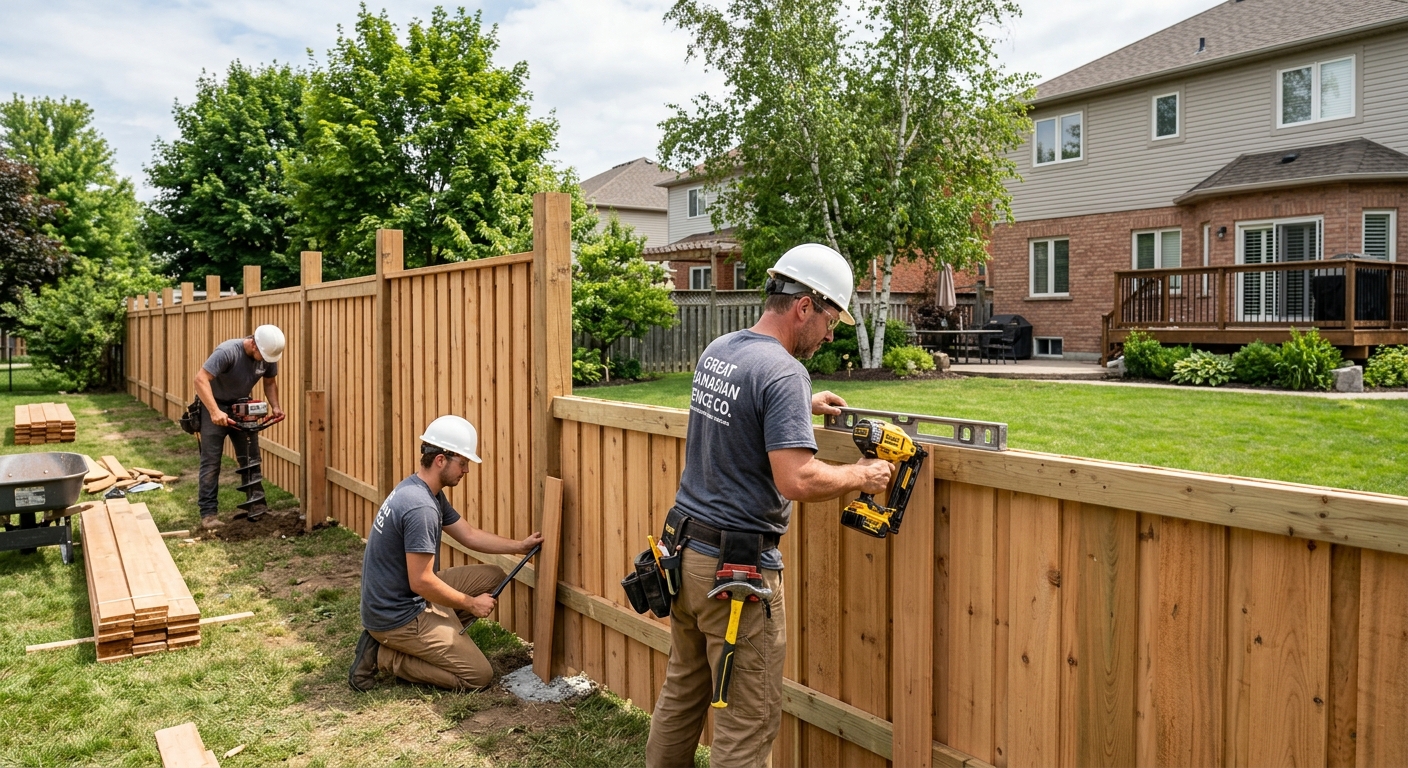
Fencing options and costs in Tuscany
Tuscany, Alberta is a growing community west of Calgary with a population of about 19,700 people (Statistics Canada, 2021 Census). That matters for fencing demand because most lots in neighbourhoods like the Tuscany Lakes area are residential properties where homeowners commonly upgrade backyards for privacy, pet safety and wind management. As a result, fencing contractors tend to be busier in the late spring through early fall—especially when projects line up with landscaping schedules.
In the Calgary economic region, costs are shaped more by the “how” than the “what.” Prairie continental freeze–thaw cycles mean frost protection is a primary driver: fence posts typically need to be set roughly 4 ft (about 120 cm) deep to sit below the regional frost line and reduce heaving. Open Prairie exposure also means your fence must handle wind loading, so privacy panels (wood/vinyl) often need closer post spacing and properly concreted footings—pushing labour and materials up compared with more breathable systems.
For homeowners, the realistic range in Calgary for installed fencing commonly lands around 25–100 per linear foot depending on material, height, terrain and access. Chain-link is usually the budget-friendly baseline, while wood and vinyl privacy fences generally sit mid-to-upper in that band. For the cold snaps and temperature swings common in Alberta, choosing the right post depth and bracing is often what separates a “cheap build” from one that stays straight through winter.
Use the table below to compare typical lifespan and maintenance expectations, then match the option to your privacy goal and budget before you request quotes.
| Material |
Lifespan |
Maintenance |
Privacy Rating |
Price per Linear Foot |
| Pressure-treated pine (standard wood) |
10–15 years |
Stain/seal every 2–3 years; inspect posts after freeze–thaw |
High (solid boards) |
$40 – $80 |
| Cedar (natural rot resistance) |
15–20 years |
Annual inspection; stain as needed (often every 2–3 years) |
High (solid boards) |
$55 – $95 |
| Vinyl / PVC (no-maintenance) |
20–30 years |
Rinse as needed; check for snow/ice impacts and frost movement |
High (privacy panels) |
$45 – $90 |
| Chain-link (galvanized steel) |
20–30 years |
Minimal; occasionally tighten hardware and rinse |
Low–Medium (airflow) |
$25 – $55 |
| Aluminum ornamental |
25–40 years |
Low; occasional cleaning |
Medium (lattice/spacing dependent) |
$70 – $120 |
| Composite / recycled material |
20–30 years |
Low; clean and inspect for panel/board fastener wear |
High (solid profiles) |
$60 – $110 |
Prices are estimates only and vary by project scope, site access and material selection.
What affects the price of fencing in Tuscany
If two neighbours in Tuscany ask for a quote for “the same” fence, it can still swing by roughly 30–50% across the Calgary area. The main reason is that Alberta’s frost depth and Prairie wind loading don’t just change material—they change how we build. Post holes often must be excavated deep enough to resist heaving (commonly about 4–6 inches below the design frost depth), which typically means longer posts, more excavation time and more concrete. In milder parts of Canada you might set posts shallower, but in Alberta that added depth is part of making the fence survive multiple freeze–thaw cycles.
Wind exposure also plays a big role. Open Prairie sites mean solid wood or vinyl privacy panels see more racking stress, so we usually use closer post spacing, stronger bracing, and fully concreted footings—while chain-link’s airflow lets wind move through it. That’s why chain-link often comes in around the lower–mid range (for example, roughly $25–$55 per linear foot), while wood/vinyl privacy can land mid-to-upper (often within $40–$80 and $45–$90 per linear foot respectively, depending on height and details).
Two or three local examples: (1) A 6 ft privacy fence with corner posts and a gate typically needs heavier post supports and deeper concrete at high-stress points, increasing labour. (2) A sloped yard that requires stepped panels often adds layout time and extra material. (3) If removal of an old fence includes hauling away concrete footings, disposal and backfill can push costs up more than homeowners expect. Even housing age matters—newer builds sometimes have cleaner access for skid steer or trenching, while older yards may have denser landscaping and buried obstacles that slow installation. For any of these scenarios, the quote should reflect post depth, footing method and access—not just the fence material.
| Price Factor |
Why It Matters |
Cost Impact |
| Fence length in linear feet |
Labour and materials scale directly with total run length |
Highest single driver; typically the biggest share of the quote |
| Post depth required |
Frost protection determines hole depth and required post length |
Deeper holes add excavation time and concrete cost |
| Post setting method |
Concrete vs. gravel pack vs. driven posts affects stability and long-term movement |
Concrete-set posts cost more upfront but reduce heaving/racking |
| Material choice |
Vinyl/cedar/wood/chain-link vary in hardware, panel strength and longevity |
Changes both materials price and bracing complexity |
| Gate count and type |
Gates require heavier hardware, hinges, and often stronger posts |
Each gate can add significant labour and material |
| Grade and terrain |
Slopes require stepped or raked panels and more layout time |
More measuring, cut labour and sometimes extra posts |
| Old fence removal and disposal |
Haul-away, break-up of footings and recycling/disposal fees |
Can add days of work depending on footing depth and access |
| Permit fees and survey / property line locate |
Administrative and locate costs can be required before digging |
Small to moderate add-ons, but they can delay scheduling |
Permits & regulations in Alberta
In Alberta, fences above a height threshold—typically 2.0 m (6.5 ft) at the rear and 1.0–1.2 m (3–4 ft) at the front or corner—often require a building permit. Exact thresholds can vary based on location and where the fence sits on your lot, so a quick check with the municipality before you buy materials can save time. Regardless of permit requirements, fences must respect property lines and municipal setback bylaws.
Before digging any post hole, call for utility locates through Alberta One-Call to mark buried services. Even in a newer Tuscany build, there can be service lines, irrigation or communication cables. If you’re not 100% sure where the property pins are, obtain a survey or at least a property line locate before installation—fencing disputes often begin with “assumed” boundaries.
Shared fence ownership and responsibilities are governed by provincial line-fences legislation, which can affect how costs are handled if you and your neighbour agree on a shared boundary fence.
What usually DOES require a permit: building a fence above the typical rear/front height thresholds, and any project that materially changes the fence footprint or location near setbacks. What typically does NOT require a permit: replacing an existing fence in the same location and height with no change to boundaries or setbacks (confirm locally).
To verify a Tuscany contractor’s qualifications in Alberta: (1) check the contractor’s licensing/registration status through the appropriate online registry (and confirm it matches the legal business name), (2) request a current certificate of insurance (liability coverage showing it’s active for the work), (3) confirm WSIB/WCB clearance or coverage documentation as applicable, and (4) keep copies of everything in your contract package.
Choosing the right fence material for Tuscany
Choosing the right material for Tuscany is mostly about matching your priorities to Alberta’s reality: long freeze–thaw cycles, open Prairie winds and snow/ice impacts. Pressure-treated pine is the budget-friendly start, but it typically needs staining or sealing every 2–3 years to prevent grey weathering and to protect the surface around fasteners. Cedar looks better longer and has natural rot resistance, but it still benefits from periodic maintenance so boards and posts don’t dry out and loosen after repeated winters.
Vinyl/PVC is a strong “set it and forget it” option because it doesn’t require staining. The trade-off is that vinyl pricing is usually higher upfront, and extreme cold can make it more brittle if the installation details (like post spacing and bracing) aren’t right. Chain-link is the lowest cost and very durable in Alberta, and its airflow helps reduce wind load racking—but you don’t get privacy unless you add slats or a different screen solution. Aluminum ornamental fencing offers an attractive, rust-resistant finish with lower maintenance; it’s generally mid-range and works best when your goal is appearance and security, not full privacy.
Because Calgary-region frost protection often means deep, concrete-set posts for solid panels (commonly around 4 ft/120 cm), the “best” materials are the ones that stay straight and properly fastened once installed. That’s why a 6 ft privacy fence made with wood or vinyl can cost more than chain-link, but it may be worth it if you’re spending money for privacy where wind-driven racking would otherwise ruin a cheaper build.
For example, if chain-link lands around $25–$55 per linear foot but a solid wood privacy fence comes in closer to $40–$80 per linear foot, the extra cost is justified when you need real sightline blocking across an exposed backyard. The deeper post setting and stronger bracing that privacy fences require are exactly what increases the installed price.
| Material |
Cold Tolerance |
Lifespan |
Annual Maintenance |
Best For |
Price Band |
| Pressure-treated pine |
Good (with correct installation and proper post setting) |
10–15 years |
Inspect after winter; stain/seal every 2–3 years |
Budget privacy with straightforward upkeep |
$40 – $80 |
| Cedar |
Good (rot resistance helps) |
15–20 years |
Inspect hardware; stain as needed (often every 2–3 years) |
Natural look privacy |
$55 – $95 |
| Vinyl / PVC |
Good (installation matters in extreme cold) |
20–30 years |
Low; rinse and check for impact damage |
Low-maintenance privacy |
$45 – $90 |
| Chain-link |
Excellent |
20–30 years |
Low; tighten and rinse |
Security and durability with airflow |
$25 – $55 |
| Aluminum ornamental |
Excellent |
25–40 years |
Low; occasional cleaning |
Decorative fencing and curb appeal |
$70 – $120 |
| Composite / recycled |
Good (choose quality boards and fasteners) |
20–30 years |
Low; inspect fasteners and joints |
Solid look with reduced maintenance |
$60 – $110 |
How to choose a fencing contractor in Tuscany
To choose a fencing contractor in Tuscany, start with proof—not promises. In Alberta, verify licensing/registration details on the appropriate online registry using the contractor’s legal business name, not just a trade nickname. Ask for a current liability insurance certificate and confirm the effective dates cover your project window. For labour coverage, request documentation showing WSIB/WCB compliance as applicable; a reputable fence contractor should provide clearance/certificates without pushing back. If they can’t produce documents quickly, that’s usually a sign to move on.
Next, get 2–3 itemised written quotes. You want a breakdown that separates labour (excavation, set posts, install rails/panels, gate build) from materials (posts, concrete, panels/boards, hardware). Avoid lump-sum quotes that don’t specify post depth, spacing and the footing method—those details directly affect performance in Calgary-area freeze–thaw cycles.
Read the scope carefully: is permit pulling included (if required), and who handles utility locates? Is old fence removal and disposal included? If your yard is sloped or has buried obstacles, ask how they’ll handle stepped panels and unexpected obstructions.
Ask about warranties: get the workmanship warranty length in writing, plus the manufacturer warranty for the product. Confirm whether any warranty is transferable if you sell the property.
For payment, keep control of the risk: never pay more than 10–15% upfront, and request a holdback until substantial completion. Timeline matters too—get a start date and completion estimate in writing, including weather contingencies for post-hole excavation.
- Provide proof of current liability insurance (certificate with project dates)
- Confirm WSIB/WCB coverage documentation for workers on site
- Verify Alberta registration/licensing matches the contract name
- Quote includes post depth and hole method (concrete set vs gravel pack)
- Specifies post spacing appropriate for solid wind-loaded privacy panels
- Includes gate hardware details and reinforcement posts
- Itemises materials and labour separately
- States whether permits are required and who pulls them
- Confirms utility locates responsibility and timing (Alberta One-Call)
- Includes disposal/removal scope for old fencing and debris
- Provides workmanship warranty terms and what triggers service calls
- Uses a payment schedule with 10–15% max deposit and holdback
Red flags I see in Tuscany include: quoting without stating post depth or footing method, refusing to itemise labour/materials, offering large upfront payments, vague warranty language (no start/end dates or conditions), and “same price for every fence” estimates that ignore gates, slopes or access constraints.
Frequently asked questions — fencing in Tuscany
How do I handle a fence dispute with a neighbour in Alberta?
In Alberta (and around Tuscany), disputes usually come down to property lines, fence location and who agreed to the original boundary. Start by confirming the fence footprint against your survey or property line locate rather than relying on where the fence “looks” correct. If the neighbour disputes placement, pause work and document everything (photos, measurements, and any prior correspondence). Alberta’s line-fences approach governs shared boundary responsibilities, but the practical first step is to clarify the boundary with a surveyor. If you already hired a contractor, ask them to stop digging until the boundary is confirmed to avoid encroachment costs. Keeping written quotes and scope notes also helps if you need to negotiate repair costs or a replacement plan.
What fence style offers the best wind resistance in Tuscany?
In Tuscany, wind resistance is mainly about how the fence handles Prairie wind loading and how well posts are set below the frost line. Solid privacy fences (wood/vinyl) can perform well if they’re built with the right post depth, concrete-set footings and properly engineered bracing, plus correct post spacing for a solid panel. Chain-link often “feels” sturdier in extreme winds because airflow reduces racking forces, which is one reason it’s commonly used along exposed lines. If your yard is open and winds are frequent, chain-link with optional screening can reduce stress on posts. Either way, the biggest performance factor is footing design—don’t pick a style first and then compromise on post setting.
How much does a fence cost in Tuscany?
Installed fencing costs in the Tuscany area generally follow the Calgary-region ranges homeowners see across the market. As a practical benchmark, chain-link often lands roughly around $25–$55 per linear foot, while pressure-treated wood typically sits mid-range at about $40–$80 per linear foot. Vinyl privacy commonly runs about $45–$90 per linear foot depending on height, gate count and how many corner/braced posts are needed. If you add gates, removal of an old fence, or a sloped-grade stepped layout, your cost can climb because labour and footing work increase. The quickest way to get to an accurate number is an itemised quote that includes post depth, post spacing and concrete quantity—not just the material name.
How deep should fence posts be for Tuscany's frost?
For Tuscany and the broader Calgary economic region, freeze–thaw cycles are why post depth matters. Local build practice often sets posts about 4 ft (approximately 120 cm) deep to get below the regional frost line and help prevent heaving. Many contractors aim for a depth that’s roughly 4–6 inches below the design frost depth, which can mean deeper holes depending on engineering assumptions and soil conditions. Taller fences like 6 ft privacy styles often require concrete setting at corners and gate posts, and sometimes across the run for maximum stability. If your contractor proposes shallow holes or “gravel only” without an engineered rationale, ask them how they’ll prevent winter movement.
Wood vs vinyl vs aluminum fence — which is best?
“Best” depends on whether you prioritise privacy, low maintenance or curb appeal in Alberta’s climate. Wood (pressure-treated pine or cedar) gives strong privacy and is often one of the most flexible looks for neighbourhoods around Tuscany, but it typically needs staining or sealing every 2–3 years to stay looking sharp. Vinyl/PVC is usually the lowest-maintenance privacy choice long-term (no staining), but it costs more upfront—often roughly in the $45–$90 per linear foot band—so you’ll want correct post spacing and bracing for cold and wind. Aluminum is rust-resistant and very low maintenance; however, it usually offers less privacy due to open pickets, and it commonly sits higher—often around $70–$120 per linear foot.
Do I need a permit to build a fence in Alberta?
In Alberta, you often need a building permit when your fence exceeds typical height thresholds—commonly around 2.0 m (6.5 ft) at the rear and about 1.0–1.2 m (3–4 ft) at the front or corner—though exact local rules can depend on where the fence sits. Even when a permit isn’t required, you still must follow property line rules and municipal setbacks. Before you dig post holes in Tuscany, ensure utility locates are completed via Alberta One-Call, and confirm the property line with a survey or locate if there’s any uncertainty. Many routine replacements in the same location and height may not require a permit, but don’t assume—ask your contractor to confirm requirements for your specific fence plan.