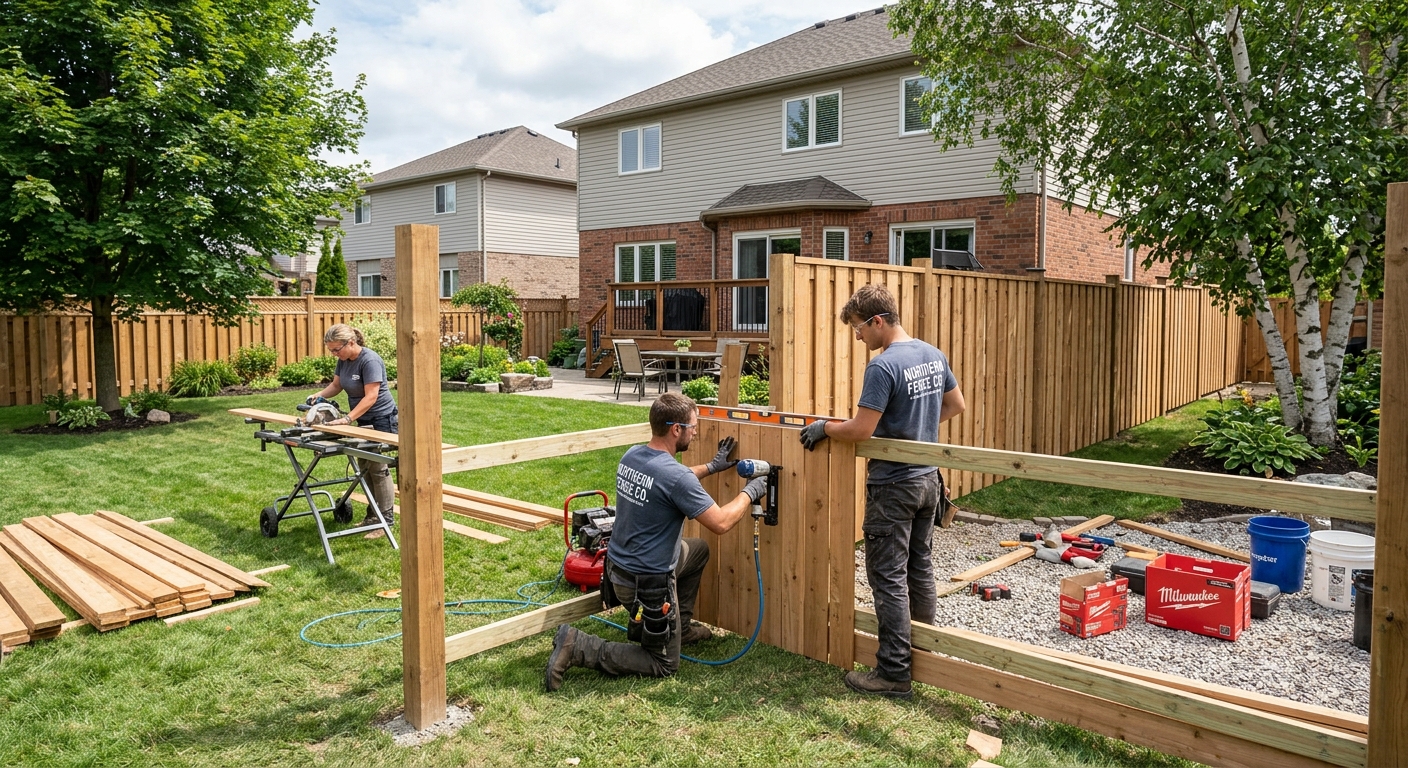
Fencing options and costs in Royal Oak
In Royal Oak, Alberta, choosing the right fence usually comes down to balancing privacy, curb appeal, and how your yard survives Calgary’s freeze–thaw winters. With a population of 11,580 in the 2021 Census (Statistics Canada, 2021 Census), the area continues to support steady demand for exterior trades, and every new backyard build or refresh tends to trigger fence questions for homeowners. Royal Oak also draws buyers from the broader Calgary economic region, where most fences are exposed to wind and winter weather, pushing materials and install methods toward “built for prairie conditions” rather than decorative-only builds.
On the cost side, Calgary-area pricing is shaped by the need to set posts below the frost line and use proper wind-bracing. In practice, contractors commonly set posts about 4 ft (≈120 cm) deep (or deeper depending on site conditions), especially for 6 ft privacy fences and gate posts. That extra excavation, longer posts, and concrete footings are primary reasons vinyl and wood privacy systems can cost more than lighter chain-link. Meanwhile, chain-link remains a lower-cost option because airflow reduces racking forces, even though privacy is limited.
Within Royal Oak, demand tends to be especially strong around newer residential clusters near the main access corridors and upcoming infill areas, where homeowners often replace temporary builders’ fencing with longer-lived privacy or decorative lines. If you’re deciding between options, the table below gives typical material choices and their installed cost ranges per linear foot for a Royal Oak/Coverall Calgary market comparison.
| Material |
Lifespan |
Maintenance |
Privacy Rating |
Price per Linear Foot |
| Pressure-treated pine (standard wood) |
15–25 years |
Stain/seal every 2–3 years |
Good (solid panels) |
$40–$80 |
| Cedar (natural rot resistance) |
20–30 years |
Light stain every 2–4 years |
Good–Excellent (solid panels) |
$55–$90 |
| Vinyl / PVC (no-maintenance) |
25–35 years |
Occasional rinse only |
Excellent (solid privacy styles) |
$45–$90 |
| Chain-link (galvanized steel) |
20–35 years |
Minimal (wash as needed) |
Poor–Fair (airflow through) |
$25–$55 |
| Aluminum ornamental |
30–45 years |
Minimal (wash/inspect) |
Low–Fair (open pickets) |
$70–$120 |
| Composite / recycled material |
25–35 years |
Very low (wash; no staining) |
Good–Excellent (solid options) |
$60–$110 |
Prices are estimates only and vary by project scope, site access and material selection.
What affects the price of fencing in Royal Oak
It’s common to see fence quotes for what looks like the “same” job vary by 30–50% across Calgary and Alberta. In Royal Oak, that gap usually comes from hidden variables: how deep posts must be set for frost protection, how much concrete is required, how windy the line is (open Prairie exposure), and whether the contractor is pricing a basic install or a more engineered approach to prevent racking. Even labour availability can shift pricing; when weather windows narrow in late fall or early spring, excavation crews and fencing installers often get booked tightly.
Frost depth is the biggest technical driver. In Calgary’s Prairie continental climate, posts are commonly set about 4–6 inches below the design frost depth to prevent heaving; that typically means 1.5–2.0 m into the ground and often concrete setting with longer posts. When those holes are deeper, you spend more time excavating and more on materials. Wind exposure on the Prairies also drives tighter post spacing and sturdier panels, especially for solid wood or vinyl privacy. In contrast, chain-link costs less because it “lets wind through,” reducing uplift and side-loading.
Here are a few concrete examples that can raise or lower your Royal Oak cost:
- Long straight runs on flat lots often land near mid-range pricing, while short runs with many corners increase labour due to extra alignment and post reinforcement.
- A 6 ft privacy fence tends to be more expensive than an open system because the posts and bracing are built for stronger wind loading; pricing typically aligns closer to the wood/vinyl bands (for example, $40–$80 for wood and $45–$90 for vinyl).
- Yards with hardpan or lots of buried debris can add excavation time and disposal cost.
- If you’re replacing an old chain-link line, removal may still be labour-intensive even though new material could be cheaper (chain-link commonly sits in the $25–$55 band).
Housing-stock age also matters. Many Royal Oak lots include established landscaping and older boundary fences; removal and re-locating around mature shrubs or existing footing can add hours—and those labour hours show up in the final number.
| Price Factor |
Why It Matters |
Cost Impact |
| Fence length in linear feet |
More panels and more posts equal more labour and materials. |
Major driver (often the largest line-item change) |
| Post depth required |
Frost protection sets minimum hole depth and post length. |
Higher depth increases excavation and concrete volume |
| Post setting method |
Concrete vs gravel pack vs driven methods affect stability. |
Concrete-setting typically costs more but reduces heaving risk |
| Material choice |
Vinyl/wood/cedar need different bracing and hardware; chain-link is lighter. |
Shifts you between roughly $25–$55, $40–$90, and $70–$120 bands |
| Gate count and type |
Drive-through gates require heavier frames and more hardware. |
Single gates add cost; double gates can add significant labour and material |
| Grade and terrain |
Slopes require stepped sections or raked panels to keep alignment. |
Can increase labour and sometimes require extra posts |
| Old fence removal and disposal |
Hauling and disposal can add time and equipment needs. |
Often a noticeable but project-specific add-on |
| Permit fees and survey / property line locate |
Overlapping property lines can create costly changes. |
Varies by scope; survey locate can prevent rework later |
Permits & regulations in Alberta
In Alberta, whether you need a permit often depends on fence height and where the fence sits on your property. As a practical rule, fences above a height threshold—commonly around 2.0 m (6.5 ft) at the rear and 1.0–1.2 m (3–4 ft) along the front or corners—may require a building permit. Regardless of permit requirements, all fences must respect property lines and municipal setback bylaws (and those setbacks can vary by location and configuration). Because regulations can be interpreted differently depending on orientation and proximity to lanes/streets, it’s smart to confirm specifics with your municipality before posts are dug.
Before digging, you should always call for utility locates through Alberta One-Call. You also need to verify where your property line is—ideally with a survey or by locating the pins—so you don’t accidentally build on a neighbour’s land. If you’re building or replacing a boundary line fence, shared fence ownership and maintenance responsibilities are handled under provincial line-fences legislation, so clarify roles early to avoid disputes.
Here’s a homeowner-friendly way to verify your contractor in Royal Oak: ask for their Alberta licence details and confirm coverage before work begins. Look online for the applicable contractor registration/clearance, then request:
- Certificate of Liability Insurance (ask for current dates and the correct insured party)
- Workplace safety coverage (WSIB/WCB coverage information, as applicable)
- A written clearance or proof document showing the coverage is in good standing
In many cases, a typical fence replacement or backyard privacy fence installation does not trigger complex engineering, but height, location, and any permit requirements do determine whether permits are needed—so always confirm with your contractor’s planned approach and your municipal requirements.
Choosing the right fence material for Royal Oak
The right fence material in Royal Oak should match your priorities—privacy, low maintenance, budget, and expected lifespan—while also fitting Calgary’s prairie winters. Pressure-treated pine is the budget-friendly route, but it generally needs staining or sealing every 2–3 years to prevent grey weathering and protect the wood surface. Cedar costs more upfront, yet many homeowners choose it because it resists rot better and looks warmer over time, though it still benefits from regular maintenance to stay attractive. Vinyl/PVC offers “set it and forget it” low maintenance, but in extreme cold it can become brittle if the system isn’t properly installed with correct post spacing and bracing. Chain-link is the longest-lasting, lowest-cost option in many runs, but it provides no true privacy unless you add slats or screening.
In Calgary’s freeze–thaw cycle, privacy panels and solid systems usually require reliable frost-protected posts. That means the fence line often uses concrete-set posts or equivalent engineered stability for longer life—especially for 6 ft privacy fences and gate posts. Wind and snow loads also matter: open chain-link handles wind better, while solid wood/vinyl needs sturdier posts, tighter spacing, and proper alignment to resist racking. For most Royal Oak yards, that structural requirement is why privacy systems often land in the mid-to-upper pricing bands (wood around $40–$80/linear ft and vinyl often $45–$90/linear ft).
A practical dollar example: if you’re comparing a chain-link fence at roughly $25–$55/linear ft versus vinyl privacy at about $45–$90/linear ft, the difference can be justified when you need visual screening year-round and want minimal upkeep. If you only need boundary definition and security, chain-link can be the smarter spend—especially for large runs where labour and materials scale quickly.
| Material |
Cold Tolerance |
Lifespan |
Annual Maintenance |
Best For |
Price Band |
| Pressure-treated pine |
Good (with proper sealing) |
15–25 years |
Low–moderate (inspect; stain every 2–3 years) |
Budget privacy with a “repairable” option |
$40–$80 |
| Cedar |
Good (naturally rot-resistant) |
20–30 years |
Low–moderate (light staining/maintenance every 2–4 years) |
Appearance-focused privacy |
$55–$90 |
| Vinyl / PVC |
Good (can be impacted by poor installation) |
25–35 years |
Minimal (rinse and inspect) |
No-maintenance privacy |
$45–$90 |
| Chain-link |
Excellent |
20–35 years |
Minimal (wash as needed) |
Security, boundaries, and windy yards |
$25–$55 |
| Aluminum ornamental |
Excellent (won’t rust) |
30–45 years |
Minimal (wash/inspect fasteners) |
Decorative perimeter fencing |
$70–$120 |
| Composite / recycled material |
Good (temperature stable) |
25–35 years |
Very low (wash; no staining) |
Long-lived privacy with low upkeep |
$60–$110 |
How to choose a fencing contractor in Royal Oak
Choosing the right fence contractor in Royal Oak starts with verification. In Alberta, confirm the contractor’s business licensing/registration and make sure they carry current liability insurance. Ask for a certificate of insurance showing the expiry date and the insured entity. For safety coverage, request proof of WSIB/WCB coverage (as applicable) or a clearance letter—this is especially important when work involves excavation, concrete footing, and working around existing utilities. Don’t accept verbal assurances; ask to see documents before scheduling.
Next, get 2–3 itemised written quotes rather than a single lump sum. Itemised quotes should separate labour (excavation, post setting, panel assembly, gate installation), materials (posts, rails, panels, hardware), and extras (permits if required, survey/property line locate, and disposal). Carefully read what’s excluded: removal and hauling of the old fence, grading/backfill, damage restoration to sod/landscaping, and whether gate hardware is included (latches, hinges, posts, and whether closures are installed).
Warranty matters, too. Ask for the workmanship warranty length and whether product/manufacturer warranties apply to boards, vinyl components, or hardware—then confirm if it’s transferable if you sell your home. For payment, avoid paying more than 10–15% upfront. Holdback is a fair approach—keep remaining funds until the job is complete and gate operation, line straightness, and post integrity are confirmed. Finally, insist on a written start date and an estimated completion window based on weather—especially important in Calgary-area freeze–thaw seasons.
- Ask for proof of Alberta business registration/licence before work starts
- Request certificate of liability insurance (current dates, correct legal name)
- Provide WSIB/WCB coverage proof or clearance letter (as applicable)
- Get 2–3 itemised quotes (labour vs materials vs extras)
- Confirm permit pull responsibility if a permit is required for your height/location
- Verify whether old fence removal and disposal are included
- Confirm post setting method (concrete vs alternatives) and hole depth assumptions
- Ask how gates are reinforced for wind and alignment (especially drive-through)
- Clarify slope handling (stepped vs raked sections) for your lot
- Check warranty terms: workmanship vs product warranty; is it transferable?
- Set a payment schedule with 10–15% maximum deposit and holdback until completion
- Get a written timeline and site protection plan for lawns/paths
Red flags in Royal Oak include: quoting only a total price with no itemisation, refusing to show insurance/coverage documents, skipping utility locates and asking you to “figure it out later,” offering vague “lifetime” warranties without stating workmanship terms, and starting excavation without a clear property-line plan or without confirming permit requirements for higher fences.
Frequently asked questions — fencing in Royal Oak
Who owns and maintains a shared fence?
In Royal Oak and across Alberta, shared fence ownership and maintenance are typically handled through provincial line-fences rules, but the exact responsibility can depend on your lot’s circumstances and how the fence is defined on title. Generally, neighbours may share responsibility for maintenance and costs when the fence serves as a boundary, but it’s still worth confirming in writing—especially when replacing an older fence that may not have been built to today’s standards. Practically, for snowy Calgary winters, maintenance matters: if a shared fence starts to lean from frost heave or wind racking, repairs can become a shared expense. If you’re planning a privacy upgrade, clarify whether one side is upgrading beyond a basic shared fence, since that can change cost responsibility.
How do I find my property line before fencing?
Before any post holes are dug in Royal Oak, you should verify your property line. The best approach is to use your survey (if available) and locate property pins, or arrange a property line locate through a survey provider. Even if you “know where it is,” fence offsets can create disputes—especially in newer neighbourhood areas where lot boundaries and landscaping can be confusing. Also, call Alberta One-Call for utility locates before digging so you don’t hit buried services. When you provide your contractor with the confirmed line, they can plan panel starts, gate locations, and stepped sections for slope without costly rework.
What's the most low-maintenance fence?
For low maintenance in Alberta’s prairie climate, many homeowners prefer vinyl/PVC or aluminum ornamental because they don’t require staining and typically only need occasional rinsing and inspection. Vinyl privacy systems often perform well in cold when installed with correct post spacing and proper bracing for wind loads. Chain-link is also low maintenance because it’s durable and airy, but it doesn’t provide visual privacy. If you’re comparing budgets, vinyl privacy commonly lands around $45–$90 per linear foot installed, while chain-link often comes in around $25–$55. In exchange for paying more upfront, vinyl usually saves you the recurring staining work associated with wood in freeze–thaw weather.
How tall can my fence be in Royal Oak?
Height rules depend on where the fence sits (front/corner versus rear) and how it’s classified by municipal bylaws. In Alberta, permit triggers commonly relate to heights around 2.0 m (6.5 ft) at the rear and roughly 1.0–1.2 m (3–4 ft) at the front/corner. Because Royal Oak homeowners can face different setbacks depending on lot layout, the safest way is to confirm the specific height you want with your municipality before ordering materials. Your contractor should also be able to tell you whether the design is likely to require a permit. This matters because solid privacy panels can also experience strong wind and snow impacts, so taller fences often need sturdier post bracing and more robust concrete-set installation.
Should fence posts be set in concrete here?
In Royal Oak’s Calgary region, concrete setting is commonly used because the frost line and freeze–thaw cycle can cause heaving if posts aren’t installed below the regional frost protection depth. Local installer practice often sets posts about 4 ft (≈120 cm) deep (or deeper depending on conditions), especially for 6 ft privacy fences and gate posts. Concrete footings improve stability in prairie winds and help the fence stay plumb through winter cycles. That said, the “right” method depends on soil conditions, drainage, and your fence type. If someone quotes a solid privacy fence without discussing frost depth and post anchoring, that’s usually a concern—especially compared with chain-link, where airflow reduces forces on posts.
What's the best fence for privacy?
For privacy in Royal Oak, the best options are typically solid privacy panels in wood/cedar or vinyl, because they block sightlines year-round. Vinyl privacy often wins with homeowners who want minimal upkeep and consistent appearance; it commonly sits around $45–$90 per linear foot installed. Cedar can be a good “high-appearance” privacy choice but still needs maintenance. Pressure-treated pine is usually the most budget-friendly route for solid panels, often around $40–$80 per linear foot, but it will require periodic staining/sealing to keep it looking sharp. Whatever material you choose, solid systems must be installed for wind load: proper post spacing, frost-protected depth, and well-anchored gate posts are what keep privacy fences from racking after heavy prairie winds and snow.