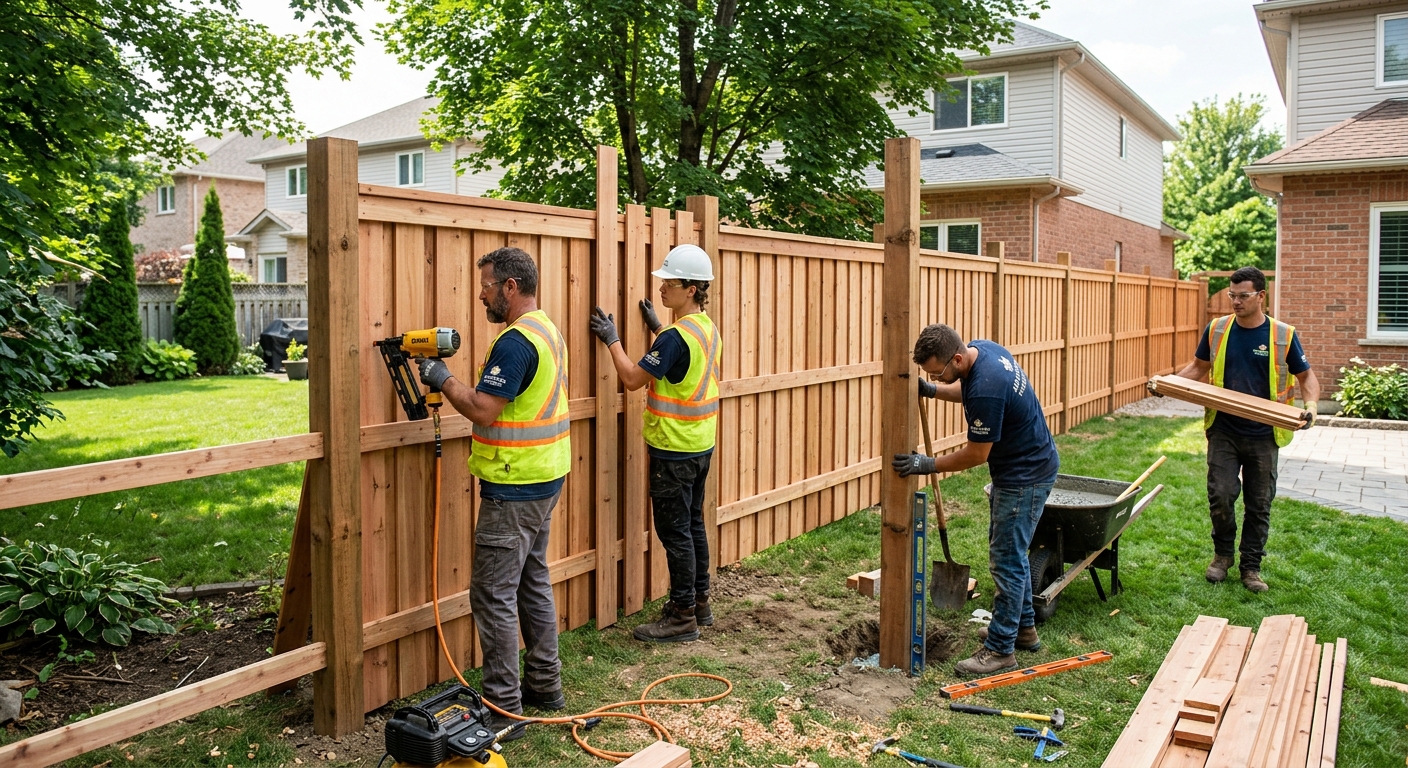
Fencing options and costs in Monterey Park
In Monterey Park, Alberta, fencing demand is steady because many homeowners have detached houses that suit perimeter upgrades—Monterey Park’s population was 10,475 in the 2021 Census (Statistics Canada, 2021 Census). When you live in a detached home, a fence is rarely just “curb appeal”; it’s also boundary clarity, wind control, and practical privacy for yards and patios.
Calgary’s Prairie continental climate is a major cost driver. Long freeze–thaw cycles mean frost heave is a real risk if posts are set too shallow. In practice, contractors plan post holes around 4 ft (≈120 cm) deep to get below the regional frost line, usually with concrete footings for 6 ft privacy fences and gate posts. That increases excavation time, concrete volume, and labour—especially during the shoulder seasons when access and soil conditions vary.
At the same time, open Prairie exposure creates higher wind loading than many sheltered neighbourhoods. Solid panels (wood and vinyl privacy) need tighter spacing and sturdier posts to resist racking, while chain-link can cost less because it allows airflow.
In Monterey Park, trade is often busiest around the newer suburban residential pockets near local commercial corridors and busier streets—those properties typically have more frontage and more gate openings, which raises linear footage and hardware costs. With that in mind, here’s a practical comparison of common fence materials and what homeowners usually budget per linear foot for installation.
| Material |
Lifespan |
Maintenance |
Privacy Rating |
Price per Linear Foot |
| Pressure-treated pine (standard wood) |
10–15 years |
Stain/seal every 2–3 years; fastener checks |
High (solid boards) |
$40–$80 |
| Cedar (natural rot resistance) |
15–20 years |
Seasonal inspections; stain/finish every 2–4 years |
High (solid boards) |
$55–$95 |
| Vinyl / PVC (no-maintenance) |
20–30 years |
Occasional wash; keep clear of debris |
High (solid panels) |
$45–$90 |
| Chain-link (galvanized steel) |
25–35 years |
Minimal; straighten if needed after storms |
Low–Medium (open mesh) |
$25–$55 |
| Aluminum ornamental |
25–40 years |
Wash annually; inspect gates |
Low–Medium (open pickets) |
$70–$120 |
| Composite / recycled material |
20–30 years |
Low; periodic cleaning |
High (solid styles) |
$70–$110 |
Prices are estimates only and vary by project scope, site access and material selection.
What affects the price of fencing in Monterey Park
In Monterey Park, two “similar” fences can come in 30–50% apart because Calgary-area bids often differ in frost protection details, wind engineering, and how much labour is allocated to proper post installation. In practice, the material itself is only part of the story: the job’s structural system (post depth, spacing, bracing, and gate hardware) is what keeps panels from leaning or racking after Alberta freeze–thaw cycles.
First, frost line depth sets how deep posts must be set to prevent heaving. Even though the exact frost depth varies by soil and site exposure, Calgary-area crews commonly set posts about 4 ft deep, and that typically translates to roughly 1.5–2.0 m into the ground when you account for hole depth, gravel base, and concrete footing. That means longer posts, more excavation, and concrete—pushing costs above lighter systems in milder regions.
Second, wind exposure on the Prairies drives tighter post spacing and heavier panels for privacy styles. Open-air products like chain-link cost less because airflow reduces the load on posts. Coastal BC may see faster wood weathering from moisture, while Monterey Park’s freeze–thaw punishes poor anchoring—so you’ll often see crews quoting higher labour for “proper set” rather than surface-level fixes.
Concrete examples from recent Calgary-area installs: (1) a 6 ft privacy fence with concrete-set gate posts can cost noticeably more than an identical run without a gate because the hinge load is much higher; (2) a sloped yard that requires stepped sections usually increases post count and fitting time, raising the installed cost even if linear footage is similar. If you’re budgeting, wood and vinyl privacy typically fall mid-to-upper ranges (for wood often aligning with the $40–$80 band; vinyl commonly closer to $45–$90), while chain-link often stays in the lower–mid range (around $25–$55) because it needs less bracing and lower wind resistance.
| Price Factor |
Why It Matters |
Cost Impact |
| Fence length in linear feet |
Labour and materials scale directly with footage |
High (primary driver) |
| Post depth required |
Frost protection determines post length and hole depth |
Medium–High |
| Post setting method |
Concrete vs. gravel pack vs. driven posts changes labour and stability |
Medium–High |
| Material choice |
Vinyl/cedar privacy needs stronger framing than chain-link |
Medium |
| Gate count and type |
Drive-through or double gates need more bracing and heavier hinges |
High |
| Grade and terrain |
Slope requires stepping/raking, extra labour and sometimes extra posts |
Medium |
| Old fence removal and disposal |
Haul-away, sorting, and sometimes stump/gravel restoration |
Medium |
| Permit fees and survey / property line locate |
Compliance costs add time; locate prevents rework |
Low–Medium |
Permits & regulations in Alberta
In Alberta, fencing rules are mainly about setbacks, property lines, and (in many communities) permit thresholds based on height. A common threshold homeowners run into is that taller fences—often around 2.0 m (6.5 ft) at the rear and roughly 1.0–1.2 m (3–4 ft) at the front or corner—may require a building permit. Your exact requirement depends on where the fence sits (rear vs. front/corner) and local bylaws for the parcel.
Before you dig any post hole in Monterey Park, call for utility locates through Alberta One-Call. You should also arrange a survey or property line locate so you’re building on your land, not on a line you think is “close enough.” Shared fence ownership is typically handled under provincial line-fences legislation, so it’s smart to confirm whether your boundary is jointly maintained with a neighbour.
Work that typically does require a permit: fences above the applicable height threshold, and sometimes fences that change the footprint near driveways, accessory buildings, or require substantial structural changes. Work that typically does not require a permit: replacing an existing fence with the same height and location, or installing standard-height panels that clearly fall under the permit threshold—however, you still need to follow setbacks and property line requirements.
To verify your contractor in Alberta, ask for (1) an Alberta licence/registration details where applicable—check via the relevant online registry; (2) proof of liability insurance (request a current certificate); and (3) WSIB/WCB coverage—confirm with a clearance letter or current account documentation. If they can’t provide certificates on request, treat it as a major red flag.
Choosing the right fence material for Monterey Park
Choosing the right fence material in Monterey Park is about matching your priorities—privacy, low maintenance, and budget—to the realities of Calgary’s freeze–thaw and wind exposure. For privacy yards, solid-panel systems are strongest, but they must be installed with proper post depth and sturdy framing. Calgary-area crews commonly set posts to about 4 ft deep (≈120 cm) to help avoid frost heave and to improve long-term straightness for 6 ft privacy fences and gate posts.
Pressure-treated pine is usually the budget option, but it needs staining/sealing about every 2–3 years to prevent grey weathering and reduce moisture penetration at fasteners and board ends. Cedar looks better longer and has better natural rot resistance, but it still benefits from periodic staining to maintain colour and slow surface breakdown. Vinyl/PVC is popular for low maintenance—no staining—but extreme cold can make poor-quality components brittle, so it’s important to use quality systems and correct post spacing. Chain-link is the lowest-cost path and lasts a long time, but it offers little privacy unless you plan planting or privacy slats. Aluminum ornamental is rust-resistant and durable, yet it’s also open for visibility—excellent if security and aesthetics matter more than full privacy.
Concrete example: if you’re comparing a wood privacy fence against vinyl, the difference can be justified when you don’t want to budget ongoing staining. A wood install commonly aligns with the $40–$80 band, while vinyl privacy often sits higher within the $45–$90 range, so paying the extra can be “worth it” if you value time and long-term consistency through winters.
Bottom line: with Monterey Park’s Prairie wind and Alberta cold, concrete-set posts are typically the safer approach for 6 ft privacy fences, especially for gates. Whether you choose wood, cedar, or vinyl, the installation system and correct anchoring generally matter as much as the material name.
| Material |
Cold Tolerance |
Lifespan |
Annual Maintenance |
Best For |
Price Band |
| Pressure-treated pine |
Good with proper anchoring and finish |
10–15 years |
Low to moderate (check boards/fasteners; re-stain as needed) |
Budget privacy with willingness to maintain |
$40–$80 |
| Cedar |
Good; performs well in freeze–thaw when well sealed |
15–20 years |
Low to moderate (stain/finish every few years) |
Premium look and solid privacy |
$55–$95 |
| Vinyl / PVC |
Very good; needs quality components in deep cold |
20–30 years |
Minimal (wash; inspect sagging/bracing) |
Low-maintenance privacy |
$45–$90 |
| Chain-link |
Excellent (metal resists cold; less panel stress) |
25–35 years |
Minimal (straighten/patch if damaged) |
Security on a budget |
$25–$55 |
| Aluminum ornamental |
Excellent; no rust |
25–40 years |
Minimal (wash; tighten hardware) |
Aesthetics and visibility |
$70–$120 |
| Composite / recycled |
Good; stable with correct installation |
20–30 years |
Low (clean; inspect connections) |
Long-life privacy with reduced upkeep |
$70–$110 |
How to choose a fencing contractor in Monterey Park
Choosing a fencing contractor in Monterey Park starts with proof, not promises. In Alberta, verify licensing/registration where applicable and confirm liability insurance with a current certificate (you want to see the effective dates and coverage limits). Next, check WSIB/WCB coverage: ask for a clearance letter or documentation that shows your project workers are covered. If a contractor won’t provide these documents, walk away—fencing work involves excavation, concrete, and overhead/ground contact risks.
Get 2–3 itemised written quotes, not lump sums. A good quote breaks out labour and materials (posts, rails, pickets/panels, hardware, concrete/footings, gate materials, and excavation). Review what’s excluded: tree/rock removal, trenching beyond standard limits, permit fees, survey/locate, and disposal. Ask whether removal of the old fence and haul-away are included line-by-line; if not, you might face surprise charges.
Warranty matters in Alberta’s climate swings. Confirm the workmanship warranty length and what it covers (post movement, loose rails, gate sagging) and whether it’s transferable if you sell your home. Also confirm product/manufacturer warranties for vinyl/metal/composite and fasteners.
For payment scheduling, avoid large upfront deposits. A typical safe approach is no more than 10–15% upfront, then progress payments tied to milestones. Hold back until the job is complete and gates/straightness are verified. Finally, require a start date and completion estimate in writing so you can plan around winter conditions and curing time for concrete footings.
- Ask for proof of WCB/WSIB clearance and current liability insurance
- Confirm who pulls permits (if required) and whether permit fees are included
- Require an itemised quote: labour, materials, concrete, and hardware
- Make sure post depth and setting method are explicitly stated (frost protection plan)
- Confirm gate type and hardware (hinge/bracing details)
- Ask how they handle buried services (utility locate procedures)
- Verify how they’ll build on a slope (stepped vs. raked panels)
- Check disposal/haul-away for old fencing in writing
- Request a workmanship warranty in writing (duration and scope)
- Confirm product warranty terms and whether warranties are transferable
- Review payment schedule—keep upfront to 10–15% and hold a completion holdback
- Get an installation schedule and curing time expectations for concrete
Red flags I commonly see in Monterey Park: contractors who won’t specify post depth or concrete setting in the quote, vague “materials included” language, missing or expired insurance paperwork, pushing for a large upfront payment (beyond 10–15%), and promising an unrealistically fast timeline with no mention of curing or inspection/cleanup.
Frequently asked questions — fencing in Monterey Park
Should fence posts be set in concrete here?
In Monterey Park and across the Calgary area, it’s usually the safer choice for privacy fences and gates. The Prairie continental climate’s long freeze–thaw cycles can heave posts if the footing is too shallow or poorly anchored. Local practice typically sets posts about 4 ft (≈120 cm) deep to help get below the regional frost line, and 6 ft privacy fences plus gate posts commonly use concrete footings for stability against racking and wind load. If a contractor proposes “no concrete, just gravel” for a solid fence, ask them to explain the engineering plan: post depth, hole diameter, bracing, and how they’ll prevent movement. For lighter styles like chain-link, gravel packs can sometimes be used—but for solid privacy panels, concrete-set posts are generally the expectation.
What's the best fence for privacy?
For privacy in Alberta’s windy Prairie setting, a solid-panel wood (pressure-treated or cedar) or vinyl privacy fence typically performs best because it blocks line of sight and wind patterns are managed through sturdier framing. If your priority is low maintenance, vinyl often justifies its higher upfront cost within the $45–$90 per linear foot band. If you’re aiming for a good balance of cost and aesthetics, cedar privacy can land mid-to-upper pricing (commonly higher than standard pressure-treated pine). If budget is the main driver, pressure-treated wood can fit the $40–$80 range, but you’ll plan for staining/sealing about every 2–3 years. Whatever material you choose, ensure correct post depth and spacing so the fence stays straight over Alberta winters.
How do I compare fencing quotes?
Compare quotes line-by-line, not by the final total. Ask each contractor to itemise labour and materials (posts, rails, panels/pickets, hardware, concrete/footings, and excavation). Confirm whether the quote includes permit work (if the fence is above the local height threshold), utility locates, property line locate/survey, and disposal of the old fence. You should also see the post plan: depth and setting method, because Calgary-area frost protection requirements can change cost materially. Two bids can differ by 30–50% when one includes proper concrete footings and bracing, while another uses lighter framing or shallower holes. Finally, verify warranty details and the payment schedule; reputable contractors will keep upfront costs around 10–15% and hold back until completion.
How long does fence installation take in Monterey Park?
Typical installation time depends on linear feet, number of gates, slope complexity, and—most importantly for Alberta—whether concrete footings are required. For a straightforward run with few posts and one gate, many crews can install within a couple of working days, but curing time affects when gates are fully functional and when final adjustments are made. In winter shoulder conditions around Calgary, excavation can slow, and soil can be harder—so schedule time matters. If you’re doing removals and disposal, expect added time for haul-away and base repairs. To avoid surprises, request a start date and completion estimate in writing, and ask whether they’ll plan concrete curing into the timeline. A well-scoped project often completes faster than a vague one, because fewer field decisions reduce downtime.
Can I install a fence on a slope in Monterey Park?
Yes, but it requires a plan. Sloped yards in Monterey Park are common, and Prairie winds can exaggerate any unevenness if panels aren’t installed correctly. The usual approaches are stepped panels (each section sits at a different elevation) or raked panels (creating a smooth slope). Stepped systems are often easier to keep structurally straight for privacy fences, especially on 6 ft heights where rails and posts need to remain plumb. Expect the fence to require more layout labour and sometimes additional post count or adjustments, which can increase cost even if linear footage looks similar. Ask your contractor how they’ll handle grades, how they’ll account for frost depth on uneven ground, and whether the quote includes extra fittings for stepped/raked construction.
What is the most weather-resistant fence for Monterey Park's climate?
For Calgary-area freeze–thaw cycles and wind, the most weather-resistant options are usually galvanized chain-link (low panel stress and excellent metal longevity) and well-installed vinyl privacy systems (long life with minimal upkeep) when paired with correct post depth and sturdy bracing. Chain-link typically costs less—often aligning with about $25–$55 per linear foot—and it can handle Alberta winters with minimal maintenance, though it won’t provide full privacy. Vinyl and composite generally offer longer service life (often 20+ years) with less annual work, commonly in the $45–$90 band depending on height and system quality. Wood can be durable too, but its weather performance depends heavily on proper staining and fastener protection. In every case, workmanship—especially concrete setting where needed and proper spacing for wind loads—drives real-world performance.