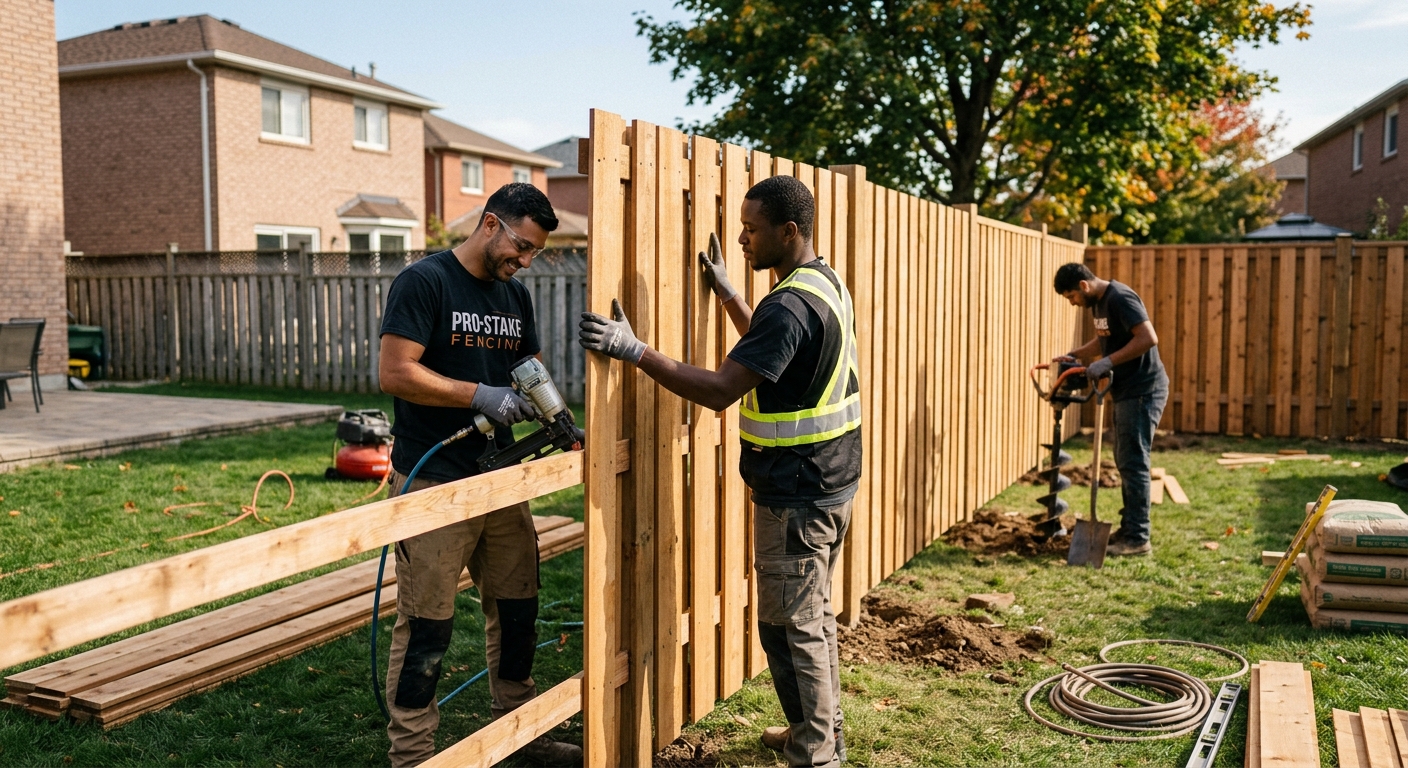
Fencing options and costs in Haddow
In Haddow, Alberta, the right fence starts with matching your goal—privacy, curb appeal, or low hassle—to what our Prairie climate demands. With Haddow sitting at a population of 4,352 (Statistics Canada, 2021 Census), demand is steady but not frantic, so pricing usually depends more on job details than on “scarcity.” Also, each single-detached household is a common driver of year-to-year fence replacements and gate upgrades, because backyard boundaries and storm-season wear show up sooner than many people expect.
In the Calgary economic region, long freeze–thaw cycles and open Prairie exposure mean frost protection and wind loading are the primary cost drivers. That’s why many contractors plan for about 4 ft (≈120 cm) post depth with concrete footings for privacy fencing and especially for gate posts—extra excavation, more concrete, and longer install time compared with fence regions where frost is milder. Solid panel fences (wood privacy, vinyl privacy) also need tighter engineering than chain-link because gusts can rack the system.
In Haddow, we tend to see particularly strong demand in the more exposed residential pockets along the busier access routes, where winter winds are more noticeable and yards often have fewer natural windbreaks. If you’re calling for pricing now, the fastest way to compare options is to look at typical lifespan, upkeep, and “per linear foot” targets before we discuss site access, terrain, and gate count—so you can see where each dollar goes.
Below are common material options we install in Haddow and the Calgary region.
| Material |
Lifespan |
Maintenance |
Privacy Rating |
Price per Linear Foot |
| Pressure-treated pine (standard wood) |
10–15 years |
Stain/seal every 2–3 years |
High (solid boards) |
$40 – $70 |
| Cedar (natural rot resistance) |
15–25 years |
Annual check; stain every 3–4 years |
High (boards/lap) |
$60 – $90 |
| Vinyl / PVC (no-maintenance) |
25–30 years |
Wash as needed |
High (solid panels) |
$55 – $95 |
| Chain-link (galvanized steel) |
25–40 years |
Occasional rinse; tension check |
Low–Medium (open mesh) |
$25 – $55 |
| Aluminum ornamental |
30–40 years |
Wash; inspect fasteners |
Low–Medium (open pickets) |
$70 – $120 |
| Composite / recycled material |
20–30 years |
Rinse; inspect annually |
High (solid styles available) |
$65 – $110 |
Prices are estimates only and vary by project scope, site access and material selection.
What affects the price of fencing in Haddow
Two homeowners can receive quotes for what looks like the “same fence” and still see the price vary by roughly 30–50% across Calgary and the wider Alberta region. In practice, the difference usually comes from frost protection details, wind-driven structural requirements, and how much labour time is needed for excavation, post setting, and coordination around access constraints (driveways, utility lines, and landscaping). Even when material costs are similar, labour and installation complexity can swing the total.
Frost depth is the first lever. In Alberta, we typically plan post holes about 4–6 inches below the design frost depth to prevent heaving, and that often means posts are set around 1.5–2.0 m into the ground. That depth pushes costs upward because it increases excavation time, concrete volume, and the length of materials you need. In a windy Prairie setting like Haddow, wind loads also matter: solid wood or vinyl privacy fences generally require sturdier posts, closer spacing, and fully concreted footings to resist racking—while chain-link can be cheaper because it lets airflow pass.
Concrete examples we see locally: (1) a straight backyard run with easy access tends to land near the mid-range of the wood and vinyl bands (for example, wood often starts around the mid-$40s to $60 range per linear foot), but (2) adding two gate posts usually increases cost because gate frames need heavier hardware and deeper, more accurate footings. (3) If your fence follows a slope and needs stepped panels, that adds layout time and custom cutting; the same happens if there’s old fence removal—hauling debris and disposing materials can noticeably raise the labour line.
The takeaway: if you’re budgeting, start from the local fence-price reality (wood and vinyl typically sit mid to upper of the Prairie range, and chain-link stays lower), then add cost for depth, terrain, and gates.
| Price Factor |
Why It Matters |
Cost Impact |
| Fence length in linear feet |
The primary cost driver; more posts, rails, and labour per run |
High (direct proportional) |
| Post depth required |
Frost line determines hole depth and post length to prevent heaving |
Medium–High |
| Post setting method |
Concrete-set posts resist wind better than loose gravel pack on open lots |
Medium |
| Material choice |
Vinyl/cedar privacy panels handle wind differently than chain-link |
High (material + hardware) |
| Gate count and type |
Drive-through double gates need heavier frames and stronger posts |
High |
| Grade and terrain |
Slope requires stepped/raked panels and more layout time |
Medium |
| Old fence removal and disposal |
Haul-away and disposal adds labour and sometimes dump fees |
Medium |
| Permit fees and survey / property line locate |
Required on higher fences; locating pins avoids encroachment disputes |
Low–Medium (project dependent) |
Permits & regulations in Alberta
In Alberta, fences above a height threshold often require a building permit—commonly around 2.0 m (6.5 ft) at the rear and 1.0–1.2 m (3–4 ft) at the front or corner, depending on location and context. Regardless of height, every fence must be built within the property lines and in line with municipal setback bylaws. For a homeowner in Haddow, the practical risk isn’t just enforcement—it’s the costly neighbour dispute that happens when panels creep over a boundary.
Before you dig any post holes, you must call for utility locates through Alberta One-Call (and ensure your contractor is present for the marks). Even if it “looks” clear, frost-depth digging goes down roughly 1.5–2.0 m, so it’s not the time to guess. Also, get a survey or property-line locate so you can confirm where your pins are—especially if you have a corner lot or mature landscaping that may mask boundary markers.
Permits vs. “usually not”: a permit is typically needed for higher fences (around those common thresholds), and sometimes where specific requirements apply in your area. Routine fence replacement that stays under the typical height limits often does not require a permit, but a contractor should verify this for your exact alignment and height.
To verify an Alberta contractor, I recommend three checks: (1) licensing/registration information through the relevant public registry or contractor listing, (2) a current certificate of insurance naming you as additional insured where applicable, and (3) proof of WSIB/WCB coverage—look for the clearance letter or active account confirmation, and ask for it before work starts.
Choosing the right fence material for Haddow
Choosing a fence material in Haddow is mostly about balancing privacy, maintenance time, and how well the fence handles cold, wind, and freeze–thaw. Pressure-treated pine is the budget-friendly route, but it needs regular staining (typically every 2–3 years) to avoid grey weathering and to keep the wood protected. Cedar has better natural rot resistance and usually looks nicer longer, yet it still needs periodic care and sealing in Alberta’s weather.
Vinyl/PVC offers the “set it and forget it” advantage—low maintenance and strong privacy in solid-panel styles—but it can become brittle if it’s not designed for cold exposure, so you want quality product and proper installation hardware. Chain-link is the lowest cost and performs well long-term for durability, but it won’t provide the privacy most Haddow homeowners want unless you add slats/landscaping. Aluminum ornamental fencing gives curb appeal and resists rust, though it’s better for security and views than true privacy.
For frost line conditions in the Calgary region, post depth matters more than people think. No matter the material, privacy-style fences generally benefit from concrete-set posts at depths planned for frost protection (often roughly 4 ft/≈120 cm or deeper depending on the site design). The open-air exposure also affects wind loading, so solid panels typically need sturdier posts and tighter construction than chain-link.
As a real dollars-and-sense example: upgrading from chain-link (often $25–$55 per linear foot) to a wood privacy fence (commonly $40–$80) can be justified when you want real enclosure and better yard usability through windy seasons—especially because the wood system costs more partly due to the structural requirements around posts and concrete footings.
| Material |
Cold Tolerance |
Lifespan |
Annual Maintenance |
Best For |
Price Band |
| Pressure-treated pine |
Good when protected and properly installed |
10–15 years |
Inspect seasonally; stain/repair every 2–3 years |
Budget privacy with regular upkeep |
$40 – $70 |
| Cedar |
Good; resists rot better than standard pine |
15–25 years |
Inspect annually; seal/stain every 3–4 years |
Premium look with moderate maintenance |
$60 – $90 |
| Vinyl / PVC |
Good with quality product rated for cold |
25–30 years |
Wash as needed; check posts/hardware |
Low-maintenance privacy |
$55 – $95 |
| Chain-link |
Excellent (metal mesh handles cold) |
25–40 years |
Rinse; check tension and hardware |
Security and long life |
$25 – $55 |
| Aluminum ornamental |
Excellent (no rust) |
30–40 years |
Wash and inspect fasteners |
Security + curb appeal (not privacy) |
$70 – $120 |
| Composite / recycled |
Good; performance depends on fastening system |
20–30 years |
Inspect annually; clean as needed |
Solid privacy with reduced upkeep |
$65 – $110 |
How to choose a fencing contractor in Haddow
When choosing a fencing contractor in Haddow, I focus on three things: compliance, clarity, and workmanship accountability—because the fence is only as good as the posts, the set depth, and the way the system is built to resist wind racking and freeze–thaw movement. Start by verifying Alberta coverage and credentials. Ask for (1) an Alberta contractor profile/licence information (if applicable to their business structure), (2) proof of liability insurance with an active policy period, and (3) proof of WSIB/WCB coverage (the clearance letter or account confirmation). If they won’t provide documentation up front, that’s a major warning sign for your job.
Next, get 2–3 itemised written quotes. “Itemised” matters: you want labour and materials broken out, including post setting method (concrete-set depth), rail system, hardware, and how gates are framed. Make sure the scope lists what’s excluded—like permit pull responsibility, utility locate fees, and whether removal/disposal is included. A quote that’s only a lump sum is harder to defend if conditions change.
Warranty should be specific: workmanship warranty length, product/manufacturer warranty terms, and whether it’s transferable to you as the homeowner. Payment should stay controlled—never pay more than 10–15% upfront, and use a holdback until the job is complete and you’ve inspected alignment and hardware. Finally, require a start date and an estimated completion timeline in writing so winter weather doesn’t leave the job half-finished.
- Verify insurance: liability policy, active dates, and coverage limits
- Confirm WSIB/WCB clearance letter or active account evidence
- Request a fence-specific breakdown: labour, materials, posts, rails, and hardware
- Confirm post depth planning for frost protection and whether concrete footings are included
- Ask how they handle slopes: stepped vs. raked panels and how it’s measured
- Ensure gate framing is included (not “builder-grade” latches or light hinges)
- Check whether utility locates and re-locates are included in their scope
- Clarify debris removal and disposal: dump fees and haul-away
- Confirm warranty details in writing (workmanship vs. product)
- Use an agreed schedule: start date and completion estimate
- Keep payment staged: small deposit, then progress payments, holdback at completion
- Require permit pull responsibility where higher fences typically require permits
In Haddow, a few red flags I commonly see: (1) they refuse to show insurance/coverage paperwork, (2) they promise shallow post holes without frost-depth planning, (3) they quote a “privacy fence” without stating how wind load will be handled (post spacing, bracing, concrete), (4) they use vague scopes like “remove old fence” with no disposal line item, and (5) they push for large upfront payments beyond 10–15%.
Frequently asked questions — fencing in Haddow
What is the most weather-resistant fence for Haddow's climate?
The most weather-resistant option for Haddow and the broader Calgary region is usually chain-link with a galvanized (and often professionally tensioned) system, because the open mesh handles wind and snow loading without the racking you can get with solid panels. In many installs, chain-link also delivers the best long-term value within the local price band of about $25–$55 per linear foot, especially when posts are set deep enough for frost protection. That said, “most resistant” depends on your priority: if you need privacy, a quality vinyl privacy system with properly set posts can be very durable, but it’s still engineered around the same freeze–thaw realities. For homeowners who want enclosure and minimal labour later, I often steer people toward vinyl or composite privacy—provided the contractor plans concrete-set footings for gate posts and keeps spacing appropriate for Prairie wind exposure. (Statistics Canada, 2021 Census)
How do I prevent wood fence rot in Haddow?
To prevent wood rot in Haddow, the biggest improvement is getting the post setting right and reducing water contact. Use proper pressure-treated lumber (or cedar where you’re paying for appearance) and ensure it’s installed above grade where required. The contractor should set posts to frost-protected depth and then use good drainage and backfill practices—standing water around the base accelerates decay. Staining is also key: pressure-treated pine typically needs staining/sealing about every 2–3 years in Alberta conditions; cedar often needs periodic sealing too even though it’s naturally more rot-resistant. Finally, keep vegetation from touching panels and avoid letting sprinklers repeatedly wet the fence line. If you’re budgeting, the “cheapest” wood option can end up costing more if maintenance is skipped; the wood band in Calgary commonly sits around $40–$80 per linear foot depending on whether the system is built for wind load and long-term post performance.
What is the cost per linear foot for fencing in Haddow?
In Haddow, fence pricing usually tracks the Calgary economic region’s typical per-linear-foot installation ranges, with the final number depending on height, gates, terrain, and post-setting depth for frost protection. As a practical reference, wood installations commonly fall around $40–$80 per linear foot, vinyl/privacy around $45–$90, and chain-link around $25–$55. If you’re choosing ornamental aluminum, it’s often the upper end, commonly $70–$120 per linear foot. For budgeting, remember that Prairie wind exposure pushes privacy systems toward sturdier posts and concrete-set footings—so two projects with different materials can still have similar labour lines, but different material and hardware costs.
Should I repair or replace my old fence in Haddow?
Repair is usually worth considering when the posts are solid (no wobble, heaving, or significant rot at the ground line), and the rails and pickets can be replaced without dismantling the entire run. Replace is often the better value when you see repeated post movement, widespread board rot, sagging sections from failed connections, or hardware corrosion—because the structural problems usually return if the foundation isn’t corrected. In Haddow’s freeze–thaw cycle, even “small” base issues can worsen over a couple winters. If your old fence is already leaning, I’d compare the cost of selective repairs (new boards/rails and re-tensioning) against a full rebuild that includes properly set posts for frost protection. Chain-link repairs are often cheaper, while full privacy fence replacements may land closer to the wood or vinyl bands (commonly $40–$80 for wood and $45–$90 for vinyl), but you gain better alignment and stronger wind resistance.
How do I handle a fence dispute with a neighbour in Alberta?
For fence disputes in Alberta, start by confirming the facts: your property line and fence location. If you don’t have a recent survey, request a property line locate or have pins re-verified so you’re not arguing about assumptions. Then document everything with photos, dates, and the fence measurements. Shared fence ownership rules are governed by Alberta’s line-fences legislation, so the “who pays” conversation should align with that framework rather than verbal agreements. Practical next steps: communicate in writing (email is fine), propose a joint inspection, and ask for a written estimate from a fence contractor that separates repair vs. replacement options. Keep in mind height and permit requirements if the fence is tall or modified—permits may apply in certain height scenarios. The goal is to avoid escalation and get to a plan for correction that’s buildable under local requirements and consistent with the property line.
What fence style offers the best wind resistance in Haddow?
For Haddow, the best wind resistance usually comes from a fence system that’s engineered for Prairie gusts and built with frost-protected post support—especially for privacy styles. The open airflow of chain-link typically performs better in wind than solid panels because it reduces pressure on the fence. However, if you want privacy, you can still achieve strong wind performance by using solid wood/vinyl with proper post spacing, heavy gate hardware, and concrete-set posts planned for frost depth (often around 4 ft/≈120 cm or deeper depending on design). In real installations across the Calgary region, well-built privacy fences typically hold up when the structure is rigid enough to resist racking, not just when the panels look solid. If you’re balancing performance and cost, chain-link in the $25–$55 band is often a strong “wind-first” choice, while wood and vinyl privacy can be worth the mid-range to upper-range pricing when you need enclosure.