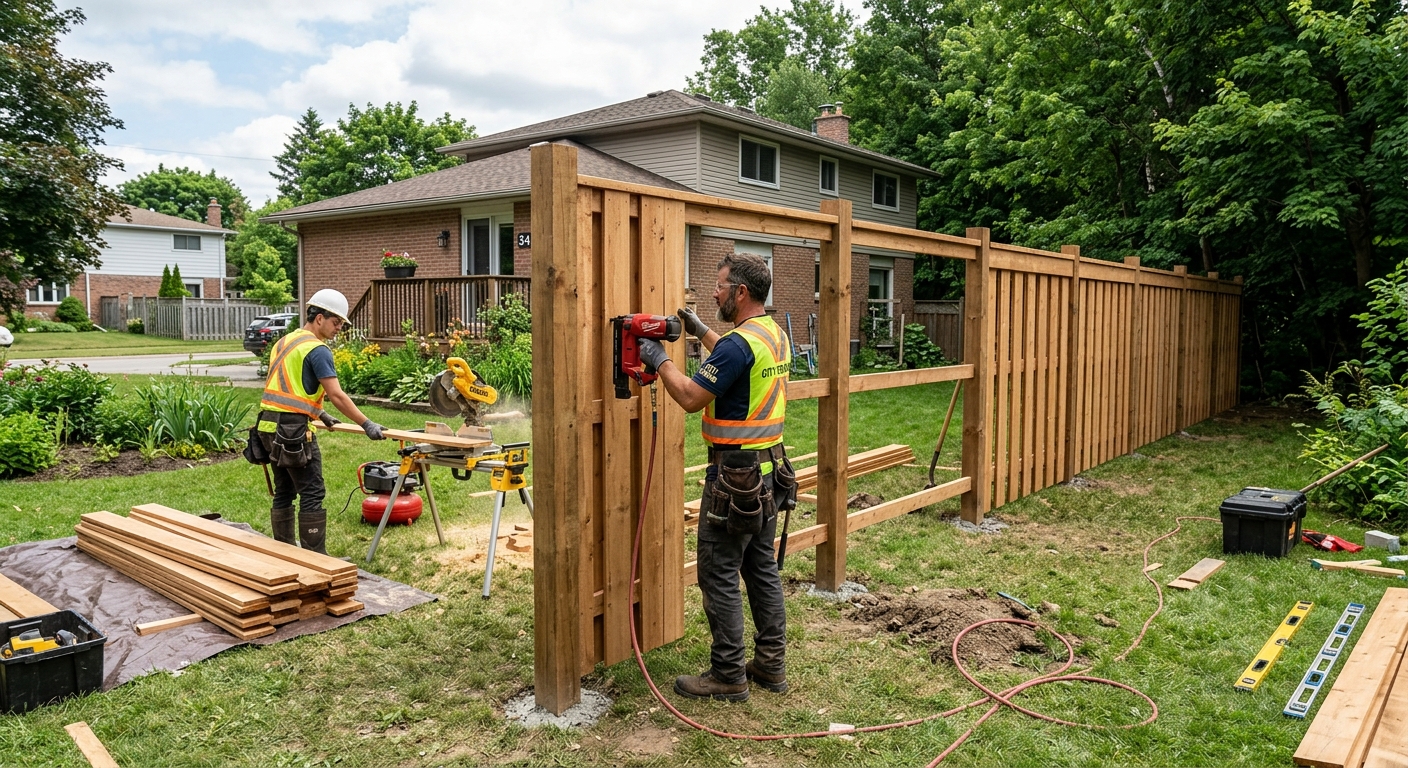
Fencing options and costs in High Level
High Level is a town where fencing demand stays steady year-round, because homeowners consistently maintain yards for privacy, pets, and winter durability. With 64.3% of local households owning (Statistics Canada, 2021 Census) and single-detached homes making up 47.9% of dwellings, you’ll see plenty of back-lane and yard-boundary upgrades each spring and early summer. That ownership mix is why contractor schedules can tighten quickly once thaw starts and access improves.
In the Athabasca–Grande Prairie–Peace River region, fencing costs are shaped by climate and exposure more than anything else. Winter frost routinely pushes the frost line to roughly 4–6 feet, meaning posts must be set deep and often concreted to prevent frost heave and leaning. Prairie winds also load fences like sails; if you choose heavier privacy panels, you typically need tighter post spacing, larger diameters, and more robust footings, which is why installed prices can land nearer the top of Alberta’s typical ranges. Site access matters too—rural-style lots, snow banks, and occasional hardpan/rock pockets around High Level can slow excavation and increase labour.
Trade is especially in demand around the busier residential pockets off 100 Avenue and near the newer subdivisions at the edge of town, where homeowners commonly add backyard privacy and front-lot boundary definition after renovations. With that context, here’s a practical comparison of common materials and what they usually cost per installed linear foot.
| Material |
Lifespan |
Maintenance |
Privacy Rating |
Price per Linear Foot |
| Pressure-treated pine (standard wood) |
10–15 years |
Stain/seal every 2–3 years; periodic fastener checks |
Medium to High (depends on board spacing) |
$35–$70 |
| Cedar (natural rot resistance) |
15–25 years |
Light stain/brighten as needed every 3–4 years |
High (solid board styles) |
$45–$80 |
| Vinyl / PVC (no-maintenance) |
20–30 years |
Rinse with water; inspect for impact damage |
High (solid styles) |
$40–$80 |
| Chain-link (galvanized steel) |
25–40 years |
Minimal; occasional tensioning and post checks |
Low (privacy comes from slats/vines) |
$25–$50 |
| Aluminum ornamental |
20–35 years |
Occasional wash; touch up minor scuffs |
Low to Medium (open pickets) |
$45–$90 |
| Composite / recycled material |
25–35 years |
Very low; debris cleaning and hardware inspections |
Medium to High (solid panels) |
$55–$100 |
Prices are estimates only and vary by project scope, site access and material selection.
What affects the price of fencing in High Level
In High Level, it’s common to see fence quotes for the “same length” vary by 30–50% across the Athabasca–Grande Prairie–Peace River region and Alberta because the real drivers aren’t just material—they’re depth, wind-loading decisions, and how contractors handle frozen ground. Two crews can quote the same style (for example, a wood privacy fence), but if one assumes easy digging and shallow footings while the other designs for frost heave and heavy prairie winds, the installed cost can swing notably.
The biggest reason is the frost line. A practical rule of thumb is setting posts about 4–6 inches below the design frost depth, which in Alberta typically pushes hole depth and post length to roughly 1.5–2.0 m into the ground. That means more labour time, longer posts, and often more concrete. In cold conditions, deeper augering and concrete per post can push your project toward the higher end of ranges—wood installed costs may land closer to the higher segment of $35–$70 per linear foot, while vinyl can similarly move within or toward $40–$80 depending on rail thickness and post spec.
Wind exposure on the Prairies also changes engineering “on the ground.” Privacy fences with heavier panels usually need tighter post spacing and bigger diameters, while open styles like chain-link can span longer between posts because the wind pressure passes through more easily (often keeping you closer to $25–$50). Coastal BC’s milder but wetter conditions can accelerate rot issues if wood isn’t treated properly, but in High Level your cost pressure is more about frost and movement than rot.
Concrete-setting decisions can raise or lower cost quickly. For example: 1) clay pockets often require slower augering and more concrete for stable footings; 2) rocky hardpan can increase labour time and sometimes reduce feasible post placement; and 3) a fully level lot may reduce racking/special panel fabrication. If your home is from the 1940s–1970s (26.6% of local homes were built before 1981, Statistics Canada, 2021 Census), mature landscaping can also mean more tree-root obstacles and longer dig times—so even “straight runs” can come in higher when removal is needed.
| Price Factor |
Why It Matters |
Cost Impact |
| Fence length in linear feet |
Most materials and labour scale directly with total length |
High (primary driver) |
| Post depth required |
Frost line depth determines how far down posts must go to resist heave |
Medium to High |
| Post setting method |
Concrete setting stabilizes posts; gravel/drive methods vary by soil |
Medium to High (can shift pricing materially) |
| Material choice |
Vinyl, cedar, and chain-link differ in hardware, weight, and durability |
High (wide band differences) |
| Gate count and type |
Drive-through double gates require stronger frames and hinges |
Medium to High |
| Grade and terrain |
Sloped yards may need stepped panels or raked sections |
Medium |
| Old fence removal and disposal |
Hauling and demo add labour and tipping/transport costs |
Medium |
| Permit fees and survey / property line locate |
Locates/surveys prevent boundary disputes and support code compliance |
Low to Medium (project dependent) |
Permits & regulations in Alberta
In Alberta, fences above a height threshold—commonly around 2.0 m (6.5 ft) for rear yards and roughly 1.0–1.2 m (3–4 ft) for front or corner areas—often trigger a building permit requirement. Exact thresholds can vary with municipal bylaw and location within the property, so in High Level you should confirm with the town office before ordering materials or digging. Regardless of height, fences must respect property lines and any municipal setback rules.
Before you dig any post holes, call for utility locates through Alberta One-Call. Even if you “know” where services run, upgrades from prior owners and buried splices can create surprises. Also consider getting a survey or property line locate (pins) before installation; this reduces the risk of encroaching on a neighbour’s land or a dedicated easement.
Shared fence ownership between neighbours is typically handled through provincial line-fences legislation and any local arrangements. If you’re building a boundary fence and want to split costs or clarify maintenance responsibilities, get the agreement in writing.
What usually requires a permit: taller fences above the typical rear/front thresholds, and any fence requiring special conditions (for example, installations on or near utility corridors). What typically does not: standard-height boundary fences in ordinary back-lot applications that fall below the threshold and don’t alter required setbacks. To protect yourself, verify your contractor’s Alberta licence (when applicable to their trade), liability insurance, and WCB/WCB clearance.
Step-by-step check (what to ask for and where to look): request their insurance certificate (look for current general liability and the named insured), ask for WSIB/WCB clearance or account verification (depending on the coverage type), and confirm their registration status through the appropriate online registry. For the final paper trail, keep copies of the insurance certificate and any clearance letter in your project file.
Choosing the right fence material for High Level
Choosing a fence material in High Level is really choosing how you want the fence to behave through freeze–thaw cycles, prairie wind, and snow drift. For most homeowners, the decision comes down to privacy, low maintenance, and lifespan—then budget. Pressure-treated pine is the most budget-friendly starting point, but it typically needs staining every 2–3 years to avoid grey weathering and to keep the boards looking good. Cedar offers better natural rot resistance and a warmer look, but it still benefits from routine maintenance in Alberta’s conditions.
Vinyl/PVC is popular for “set it and forget it,” with minimal cleaning and no routine staining, but extreme cold can make it more vulnerable to impact damage. Chain-link is the lowest initial cost and can last decades, but it won’t give privacy unless you add slats or grow-through options. Aluminum ornamental provides a clean, no-rust look and good long-term durability; however, because it’s open by design, privacy is usually low to medium.
Post depth matters in all of these choices. Because the frost line can push to about 4–6 feet in the region, you should expect posts to be set about 1.5–2.0 m into the ground, with concrete commonly used to resist frost heave and leaning. On prairie-exposed lots, heavier privacy panels often mean tighter post spacing and larger posts/rails—so even vinyl or cedar can cost more than budget examples when the wind-loading design calls for it.
Where the price difference is justified: a typical wood privacy fence might land in the mid band around $35–$70 per linear foot when standard specs are appropriate, but if you compare that to a chain-link run at roughly $25–$50, the savings may not be worth it if your main goal is backyard privacy. In that case, investing the extra cost in a solid privacy style—paired with proper post depth and spacing—is usually the better long-term outcome.
| Material |
Cold Tolerance |
Lifespan |
Annual Maintenance |
Best For |
Price Band |
| Pressure-treated pine |
Good (with correct treatment and proper installation) |
10–15 years |
Low to moderate (2–3 year stain cycle) |
Budget-conscious privacy with planned upkeep |
$35–$70 |
| Cedar |
Very good (rot-resistant wood in cold climates) |
15–25 years |
Low to moderate (stain/brighten every 3–4 years) |
Natural look and long-term curb appeal |
$45–$80 |
| Vinyl / PVC |
Good (impact-sensitive in extreme cold) |
20–30 years |
Very low (inspection and occasional wash) |
Low maintenance and solid privacy panels |
$40–$80 |
| Chain-link |
Excellent (metal barrier performs well in Alberta winters) |
25–40 years |
Very low (tension/post checks as needed) |
Security, pet control, and open boundary definition |
$25–$50 |
| Aluminum ornamental |
Excellent (won’t rust; handles freeze–thaw well) |
20–35 years |
Low (wash; touch-ups only if damaged) |
Front yard style where appearance matters |
$45–$90 |
| Composite / recycled |
Good (stable boards; needs correct mounting) |
25–35 years |
Very low (cleaning and hardware inspections) |
Durable privacy with minimal upkeep |
$55–$100 |
How to choose a fencing contractor in High Level
When you’re hiring a fencing contractor in High Level, verify three things up front: Alberta registration/licensing where applicable, liability insurance, and WCB/WCB clearance. Start by asking for a certificate of insurance (confirm it’s current and includes general liability for the work) and a WCB clearance letter or account verification number, depending on the coverage structure. For licensing status, check online through the relevant Alberta registry or the contractor’s listed trade credentials—don’t rely on verbal assurances. If a contractor can’t provide documentation quickly, that’s a strong signal to pause.
Next, get 2–3 itemised written quotes. You want a breakdown that shows labour versus materials, line-item post depth specs, concrete quantity assumptions (if included), gate hardware, and removal/disposal. Avoid lump-sum quotes that don’t state whether permits are included, whether a property line locate is recommended, or whether the price covers hauling and tipping for your old fence. Scope wording matters: ask what’s excluded (for example, rock removal beyond basic excavation, tree trimming, or concrete patching/land restoration).
Warranty is another differentiator. Ask for: the workmanship warranty length, the manufacturer’s product warranty terms, and whether the warranty is transferable if you sell your home. For payment, never pay more than 10–15% upfront; hold back a meaningful portion until the final inspection and punch list are complete. Finally, require a start date and a completion estimate in writing—access and frost-driven scheduling can affect timelines.
- Confirm insurance certificate is current and matches the project address
- Request WCB/WCB clearance documentation before work begins
- Ask whether posts are concrete-set and what hole depth/spec they design to
- Get a site plan or measured layout (not just “we’ll follow the property line”)
- Ensure quotes specify post spacing and panel height
- Ask how gates are braced for wind loading
- Verify whether permit fees (if needed) are included or billed separately
- Confirm whether old fence removal and disposal/hauling are included
- Request concrete/gravel assumptions for your soil type and site conditions
- Check warranty terms for workmanship and product, including transferability
- Use a payment schedule with a holdback until completion/punch list
- Get a written timeline with start date and estimated completion window
Red flags I commonly see in High Level: contractors who won’t show proof of insurance or WCB coverage, quotes that omit post depth/concrete assumptions, very low prices without site-condition allowances, vague scope statements like “materials as required” with no specs, and payment requests for large deposits (over 10–15%) before any work is scheduled.
Frequently asked questions — fencing in High Level
How tall can my fence be in High Level?
In High Level and across Alberta, fence height rules depend on where the fence sits on the property (rear yard versus front/corner) and local setback/bylaw requirements. Many homeowners run into permits when fences exceed common thresholds, often around 2.0 m (6.5 ft) at the rear and roughly 1.0–1.2 m (3–4 ft) near the front or corner. The safest approach is to measure your proposed height, identify the fence location (front/corner versus rear), and confirm with the town office before digging. If your plan is for a tall privacy fence, ask your contractor to include the permit step in the scope or clearly state whether it’s excluded so you aren’t surprised later.
Should fence posts be set in concrete here?
In High Level, concrete-setting is often recommended because frost routinely pushes deep into the ground (often around a 4–6 feet frost line for the region), and frost heave can make posts lean over time if they’re not stabilized. Practically, contractors usually design for posts set roughly 1.5–2.0 m into the ground, with concrete commonly used to resist movement. That said, the exact method can vary by soil—some sites with very stable ground may use an alternative method, but it still needs to be designed for Alberta freeze–thaw. When comparing quotes, make sure the post setting method and hole depth are stated, not left as “as required,” because that’s where large price differences come from.
What's the best fence for privacy?
For privacy in High Level, solid-panel fences work best—typically wood privacy (pressure-treated pine or cedar), vinyl/PVC privacy, or composite panels. The best choice depends on whether you want maximum privacy versus low maintenance. Wood privacy can land around $35–$70 per linear foot when specs fit your site, while cedar and vinyl often move upward within the $40–$80 style ranges depending on post spacing and gate requirements. Keep in mind that prairie winds mean heavier privacy panels usually need tighter post spacing and robust footings. If you want long-term privacy with less upkeep, vinyl/PVC or cedar with correct post depth is often a strong fit for the local climate.
How do I compare fencing quotes?
Start by comparing the technical scope, not just the total price. Ask each contractor for an itemised quote showing labour and materials, including post depth and the post setting method (concrete vs. gravel pack), post spacing, and the exact material type (for example, board width/thickness for wood or rail specs for vinyl). Confirm whether removal/disposal of your old fence is included and whether permit work (if required) is included or excluded. Look for timeline commitments and a workmanship warranty length. As a practical benchmark in High Level: chain-link projects frequently fall around $25–$50, while many privacy styles with stronger footings commonly land within $35–$80, depending on materials and site difficulty.
How long does fence installation take in High Level?
Installation timing depends mainly on access, frost-safe post digging logistics, and how many gates or removals you have. In High Level, most fence work is scheduled for spring through fall, when excavation is manageable and the ground isn’t locked up. For typical backyard runs without heavy rock removal, a crew can often complete a standard section within a few days, while projects with multiple gates, steep slopes, or significant old fence removal can extend the timeline. If your yard is partially treed or there are underground services risks, the job can take longer because utility locates and layout adjustments must happen before holes are dug. When you get your written quote, ask for a specific start date and an estimated completion window.
Can I install a fence on a slope in High Level?
Yes, you can install a fence on a slope in High Level, but the design needs to match the grade so panels don’t tilt, leaving gaps that ruin both privacy and wind performance. Contractors typically use stepped panels (where the fence height changes in increments) or raked sections (where rails angle to follow the slope). Stepped installation is common for privacy fences because it keeps board alignment cleaner and handles uneven ground well. Be sure your quote states whether the fence will be stepped or raked and how they’ll manage drainage and snow drift along the base. Also confirm post depth stays correct despite the slope—frost protection still matters even when the yard rises or falls.