Fencing options and costs in Glamorgan
In Glamorgan, Alberta, choosing a fence usually starts with a practical question: “What will it cost, and will it still look good after the long Calgary winters?” With a population of 6,575 (Statistics Canada, 2021 Census), Glamorgan is a neighbourhood where a lot of homeowners are actively improving outdoor spaces, and each detached property can represent a potential fencing job—strong local demand often shows up around backyards and side-yard expansions. Demand is also shaped by the fact that Calgary-area fences need to stand up to a Prairie continental climate: long freeze–thaw cycles, wind-driven racking, and snow accumulation all increase installation effort.
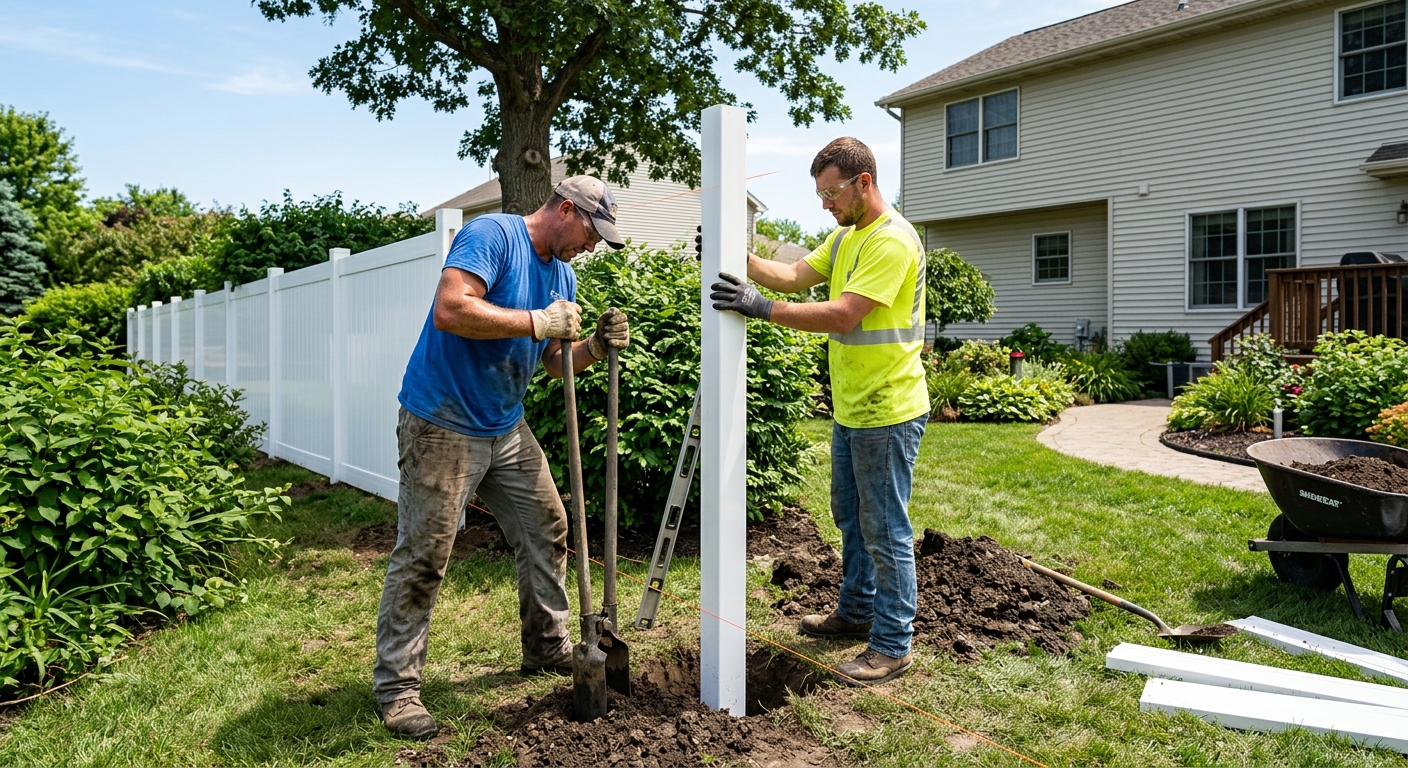
In practical terms, the cost difference you’ll see in Glamorgan isn’t just about material. Calgary’s freeze–thaw pattern drives frost protection: contractors typically set posts about 4 ft (≈120 cm) deep (or deeper depending on depth requirements for your specific area) and commonly use concrete footings for 6 ft privacy fences and for gate posts. That means more excavation time, more concrete, and longer posts than you’d expect in milder regions. Meanwhile, open Prairie exposure around Calgary means solid wood and vinyl privacy panels need closer post spacing and sturdier framing to resist wind load.
Contractor availability is generally strongest in established residential pockets; in Glamorgan, we often see particularly busy schedules for side-yard replacements and backyard privacy upgrades in areas such as the broader Glamorgan community corridor where lots have mature trees and frequent gate work. From there, you can compare material options and budget ranges in the table below.
| Material |
Lifespan |
Maintenance |
Privacy Rating |
Price per Linear Foot |
Price Range |
| Pressure-treated pine (standard wood) |
10–15 years |
Stain/seal every 2–3 years |
8/10 |
$40–$80 |
$40–$80 |
| Cedar (natural rot resistance) |
15–25 years |
Light staining every 3–4 years |
9/10 |
$50–$95 |
$50–$95 |
| Vinyl / PVC (no-maintenance) |
20–30 years |
Rinse/wash as needed |
8/10 |
$45–$90 |
$45–$90 |
| Chain-link (galvanized steel) |
25–35 years |
Occasional washing only |
3/10 |
$25–$55 |
$25–$55 |
| Aluminum ornamental |
30–40 years |
No rust; occasional cleaning |
4/10 |
$70–$120 |
$70–$120 |
| Composite / recycled material |
25–30 years |
Wash and inspect annually |
8/10 |
$60–$105 |
$60–$105 |
Prices are estimates only and vary by project scope, site access and material selection.
What affects the price of fencing in Glamorgan
In Glamorgan, two homeowners can receive quotes that differ by 30–50% for what looks like the “same” fence because the real drivers are hidden in the install details: how many posts are needed, how deep they must be set, whether concrete is required, how difficult access is for equipment, and whether the contractor needs extra bracing for wind load. In the Calgary region, your fence is also exposed to strong Prairie winds, which increases racking pressure—so solid privacy materials typically need sturdier framing and tighter post spacing. That’s why wood and vinyl often sit mid-to-upper in the market, while chain-link remains lower-mid due to its airflow.
Frost line depth is the other major driver. Contractors generally set posts about 4–6 inches below the design frost depth to help prevent heaving; in cold Alberta conditions this commonly works out to roughly 1.5–2.0 m into the ground, meaning longer posts, more excavation, and more concrete setting. In mild climates, you can sometimes get away with shallower holes and less concrete, which is part of why fencing costs are higher here than in warmer parts of Canada. By contrast, coastal BC’s wet climate can accelerate wood rot if treatment isn’t done properly; that tends to shift costs toward maintenance planning and higher-quality products even when post depth is less extreme.
Concrete examples from Glamorgan-area jobs: (1) a 6 ft privacy fence on the same property can jump in price when gate posts land in the frost-prone corner zone—those posts usually get reinforced with concrete footings; (2) a replacement fence on sloped ground often requires stepped panels or raked rails, which increases labour and material; and (3) when old fencing needs removal and disposal, haul-away can be a noticeable line item. Budget planning often reflects the mid-band ranges—wood and vinyl commonly align with the $40–$80 and $45–$90 typical installation bands—while wind-stressed privacy builds can push toward the higher end even with similar lengths.
| Price Factor |
Why It Matters |
Cost Impact |
| Fence length in linear feet |
Most costs scale directly with total linear footage, including posts, rails, and labour. |
High (primary driver) |
| Post depth required |
Frost line determines how far posts must go to prevent heaving and long-term movement. |
High (longer posts + deeper holes) |
| Post setting method |
Concrete vs. gravel pack vs. driven posts changes material volume and installation time. |
Medium to High (big difference on privacy fences) |
| Material choice |
Vinyl and cedar cost more up front; chain-link is lower cost; aluminum is premium. |
Medium to High (often shifts total by tens of percent) |
| Gate count and type |
Drive-through double gates and heavier hardware require more framing and bracing. |
Medium to High (hardware + labour) |
| Grade and terrain |
Slopes can require stepped/raked rails, more cutting, and alignment time. |
Medium (site-specific) |
| Old fence removal and disposal |
Demo, hauling, and dump fees add time and cost beyond new materials. |
Low to Medium (varies widely) |
| Permit fees and survey / property line locate |
Locates and administrative steps reduce risk and avoid costly boundary corrections. |
Low to Medium (but important) |
Permits & regulations in Alberta
In Alberta, fences above certain height thresholds often require a building permit—commonly around 2.0 m (6.5 ft) for rear yards and about 1.0–1.2 m (3–4 ft) for front or corner areas, depending on the specific location and local bylaws. Even when a permit isn’t required, every fence must respect property lines and municipal setback requirements. Before any digging begins, you should arrange utility locates through Alberta One-Call to avoid hitting buried services when installing posts.
To reduce boundary disputes in Glamorgan, get a survey or at least a professional locate of your property pins before you install. Shared fence boundaries can also come with shared responsibility expectations—line-fences rules in Alberta help guide how boundaries and maintenance responsibilities are handled when fences sit between properties.
What typically does require a permit: building a fence above the common height thresholds (especially where it faces streets or sits in rear areas), or any project that clearly exceeds the normal limit set by local requirements. What typically does not: routine repairs like replacing individual pickets/rails on an existing, in-compliance fence, or minor maintenance that doesn’t change height or location.
Before hiring, verify your contractor’s credentials. Start by checking their Alberta licence online, then request a certificate of insurance (general liability) showing current coverage. For workplace coverage, confirm they have WCB/WSIB-style coverage in Alberta (Workers’ Compensation coverage) and that they can provide clearance documentation upon request. A reputable contractor will provide all of this before signing a contract.
Choosing the right fence material for Glamorgan
In Glamorgan’s Prairie continental climate, material choice should match your priorities: privacy, low maintenance, budget, and how long you want the fence to look “fresh” after winter. Pressure-treated pine is usually the budget entry point, but it typically needs staining or sealing every 2–3 years to prevent grey weathering and uneven moisture uptake. Cedar is the nicer-looking natural option and has better rot resistance, yet it still benefits from periodic maintenance to keep its colour and reduce splitting. Vinyl/PVC is popular for low maintenance—its upkeep is mostly washing—but extreme cold can make it feel stiffer and it can crack if the framing is too weak or the posts are improperly set for frost.
Chain-link is the lowest-cost long-life choice, especially if you just want containment and airflow; however, privacy is limited unless you add slats, screens, or privacy fabric, which can shift the overall cost and wind performance. Aluminum ornamental fencing is rust-resistant and stays sharp-looking, but it doesn’t offer true privacy without add-ons. For Calgary wind and snow load, solid privacy panels (wood, cedar, vinyl, and composite) need stronger posts and bracing—often with concrete-set posts at the required depth for frost protection, particularly for 6 ft fences and gate posts.
Concrete price justification: if you’re choosing between standard wood and cedar, you might pay toward the $40–$80 range for pressure-treated pine, and move up into a broader $50–$95 neighbourhood for cedar. That extra cost is most justified when you want fewer maintenance cycles and better long-term appearance in Glamorgan’s freeze–thaw conditions. If you want the lowest maintenance and can invest more upfront, vinyl’s typical $45–$90 band can pay off in time saved—provided the contractor sets posts correctly and uses proper framing for wind racking.
| Material |
Cold Tolerance |
Lifespan |
Annual Maintenance |
Best For |
Price Band |
| Pressure-treated pine |
Good when sealed and properly ventilated |
10–15 years |
Inspect yearly; stain every 2–3 years |
Budget privacy with manageable upkeep |
$40–$80 |
| Cedar |
Good; performs well with periodic sealing |
15–25 years |
Inspect yearly; stain every 3–4 years |
Longer-lasting privacy and best appearance |
$50–$95 |
| Vinyl / PVC |
Very good if framing is solid and post depth is correct |
20–30 years |
Wash/rinse as needed |
Low maintenance privacy |
$45–$90 |
| Chain-link |
Excellent (steel + galvanizing) |
25–35 years |
Occasional washing/inspection |
Secure perimeter with airflow |
$25–$55 |
| Aluminum ornamental |
Excellent; resists winter corrosion |
30–40 years |
Wash/rinse as needed |
Style and durability without rust |
$70–$120 |
| Composite / recycled |
Good; needs correct fastening and drainage details |
25–30 years |
Inspect yearly; wash as needed |
Privacy with longer-term stability |
$60–$105 |
How to choose a fencing contractor in Glamorgan
Choosing a fencing contractor in Glamorgan is mostly about verification and clarity. Start with licensing: in Alberta, ask for their Alberta licence information and confirm it using the appropriate online registry. Next, request proof of general liability insurance and make sure the certificate clearly lists the correct business name and shows active coverage for the fencing scope. For workers, confirm they have current WCB/Workers’ Compensation coverage and can provide clearance documentation if requested. Avoid anyone who can’t show insurance details up front—fences are heavy, excavation is involved, and post holes create job-site risk.
Then get 2–3 itemised written quotes (not just one lump sum). A proper quote breaks out labour and material, and it should clearly state how posts will be set (concrete footing depth and method), spacing, gate hardware, and how privacy panels will be framed for Calgary wind exposure. Read what’s excluded: permit pull fees, utility locating, property line locating/survey, disposal of your old fence, and any rock/gravel removal requirements. Make sure warranty details are spelled out—workmanship warranty length and product/manufacturer warranty terms (and whether warranties are transferable to future owners).
For payment schedule, don’t pay more than about 10–15% upfront. Hold back remaining payments until the job is completed and you’ve had a chance to inspect alignment, gate operation, and post integrity. Ask for a start date and completion estimate in writing so winter scheduling and excavation access are predictable.
- Provide Alberta licence details and confirm them yourself before signing.
- Show a current certificate of general liability insurance.
- Confirm WCB/Workers’ Compensation coverage with clearance documentation if available.
- Use itemised quotes: labour, materials, excavation, concrete, gates/hardware.
- Specify post depth and setting method (concrete vs gravel pack) in writing.
- State post spacing for privacy fencing to resist wind racking.
- List whether permit pull is included or billed separately.
- Confirm utility locate responsibility (who orders the locate and when).
- Clarify property line locate/survey: included or add-on.
- Include disposal/haul-away for old fencing and construction debris.
- Define warranty: workmanship duration and manufacturer/product warranty terms.
- Set payment schedule with a small deposit and final holdback until completion.
Local red flags we see around Glamorgan include: contractors who won’t put post depth requirements into the contract (especially for 6 ft privacy and gates), quotes that omit disposal of an old fence when replacement is stated, vague scope language like “as required” for permits or property line locating, and proposals asking for large upfront payments (well above 10–15%).
Frequently asked questions — fencing in Glamorgan
Who owns and maintains a shared fence?
In Alberta, shared fence responsibilities generally follow line-fences principles: the boundary location matters, and so does how the fence was agreed to or installed. In practical Glamorgan terms, if the fence is truly on the property line, both properties may have maintenance expectations, but ownership and cost-sharing can vary based on the original agreement and the boundary determination. This is why confirming the property line before installing helps—especially in back corners where old fences may not be perfectly located. If you’re budgeting for maintenance, remember that wind exposure in the Calgary area can loosen posts over time; for privacy fences in the $45–$90 vinyl band, good post setting at frost depth is what keeps “shared fence” maintenance from turning into repeated repairs.
How do I find my property line before fencing?
Before you dig post holes in Glamorgan, confirm where your property pins are or arrange a professional locate/survey. Start by checking whether you have a recent survey document from when the home was bought; if it’s outdated or missing, order a locate to identify the boundary pins. This step is important because fences installed even slightly off-line can lead to disputes, especially when upgrading from a chain-link perimeter (often in the $25–$55 band) to a solid privacy fence that you want to keep stable through winter. Also schedule utility locates through Alberta One-Call before any excavation—protecting buried services is part of the job-site responsibility. A reputable contractor will ask for this information early and won’t guess at the boundary.
What's the most low-maintenance fence?
For low maintenance in Alberta’s cold, a vinyl/PVC privacy fence is usually the easiest to live with, because it typically requires little more than rinsing/washing when winter salt or dust builds up. In the Calgary economic region, the key is installation quality: vinyl still depends on correct post depth and a braced layout to resist wind racking during freeze–thaw cycles. If you want “lowest hassle” without sacrificing structure, vinyl in the $45–$90 range often performs well. Aluminum ornamental is also low maintenance (no rust), but it won’t give true privacy without additional screening. Chain-link is low maintenance too, yet it’s not private unless you add privacy elements, which can change upkeep and cost.
How tall can my fence be in Glamorgan?
Height rules depend on where the fence sits (front, corner, side/rear) and can trigger permit requirements. A common Alberta baseline is that fences around 2.0 m (6.5 ft) are often the rear yard threshold where a building permit may be required, while front or corner fences are often around 1.0–1.2 m (3–4 ft). In Glamorgan, you should confirm your exact location and propose height before ordering materials, because privacy upgrades are frequently planned at 6 ft (about 1.8 m) and can still require permits depending on where they fall. A contractor should help by asking for site details and preparing the permit step if it applies.
Should fence posts be set in concrete here?
Often, yes—especially for 6 ft privacy fences, gate posts, and any fence section that will see high wind load across open Prairie exposure. In the Calgary area, contractors typically set posts about 4 ft (≈120 cm) deep or deeper based on frost protection needs to help prevent heaving during long freeze–thaw cycles. Concrete setting increases excavation and concrete volume, which is a major reason privacy fences cost more than chain-link systems. That said, not every project needs concrete for every post; some designs use alternative approaches when conditions allow. The best answer for your yard comes from a site assessment: slope, soil condition, and how solid your panels are for wind resistance.
What's the best fence for privacy?
For real privacy in Glamorgan, solid panel fences win: wood (pressure-treated pine or cedar), vinyl/PVC, or composite privacy styles. The best option depends on how much maintenance you’ll tolerate and how “sturdy” you need it to be under Calgary wind. Vinyl/PVC privacy often lands in the $45–$90 installation band and is popular because it stays clean-looking with minimal upkeep. Cedar usually costs more than pressure-treated pine and can fall toward the $50–$95 neighbourhood, but it offers excellent appearance and rot resistance. If you’re comparing, remember that in Alberta, post depth and concrete setting for frost protection are just as important to privacy longevity as the material itself—loose posts can cause racking and gaps, defeating privacy even with high-end panels.