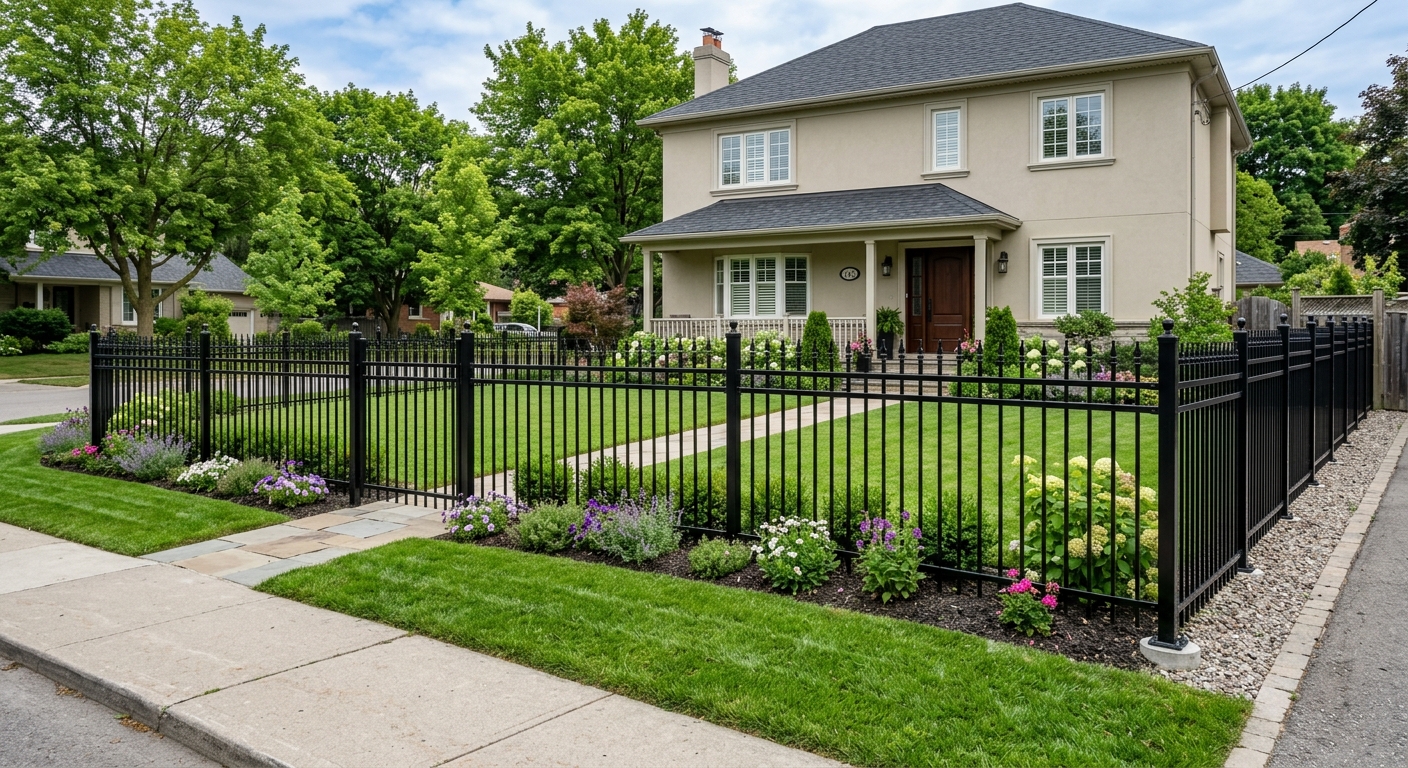
Fencing options and costs in Fox Creek
Fox Creek homeowners often start with one simple question: “What will a fence cost here?” With 510 homeowner households in town (77.3% of households own) and single-detached homes making up 63.6% of dwellings, there’s steady local demand for backyards and perimeter upgrades—especially when families tighten up pets, kids’ play areas, or privacy along busy roads. (Statistics Canada, 2021 Census.)
In the Athabasca–Grande Prairie–Peace River region, fencing pricing is shaped more by climate exposure than in many sheltered parts of Alberta. Frost routinely pushes the effective frost line to about 4–6 feet, so posts need to be set deep and often concreted to prevent frost heave and gradual leaning. On top of that, open Prairie winds make fences behave like sails; privacy styles typically need tighter post spacing and heavier components than open styles like chain-link. Contractor availability and equipment access can also swing the quote if you’re dealing with rocky pockets, hardpan, or longer driveway runs—situations I commonly see around Fox Creek’s more rural edges and larger lots in the town’s northwest/acreage areas.
Below is a practical cost comparison for typical installed fencing. Use it to sanity-check any estimate you receive—then we’ll help you refine it based on your fence length, gate needs, and soil conditions before you sign.
| Material |
Lifespan |
Maintenance |
Privacy Rating |
Price per Linear Foot |
| Pressure-treated pine (standard wood) |
10–15 years |
Stain/seal every 2–3 years; inspect posts annually |
Medium–High |
$35 – $70 |
| Cedar (natural rot resistance) |
15–25 years |
Light staining/oiling every 2–4 years |
High |
$50 – $85 |
| Vinyl / PVC (no-maintenance) |
20–30 years |
Rinse as needed; no staining |
High |
$40 – $80 |
| Chain-link (galvanized steel) |
20–35 years |
Occasional rinse; straighten posts if struck |
Low |
$25 – $50 |
| Aluminum ornamental |
25–40 years |
Wash occasionally; check hardware tightening |
Low–Medium |
$45 – $90 |
| Composite / recycled material |
20–30 years |
Rinse; avoid harsh chemical cleaners |
Medium–High |
$55 – $95 |
Prices are estimates only and vary by project scope, site access and material selection.
What affects the price of fencing in Fox Creek
In Fox Creek and across the Athabasca–Grande Prairie–Peace River region, you can see the same “roughly similar” fence quoted 30–50% apart, even when the style looks identical. The biggest drivers are winter post requirements, wind loading, and how difficult your ground conditions are to excavate. With many homes in the area built before 1981, upgrades often involve older property layouts and buried services that can slow installation and increase locating/marking time. (Statistics Canada, 2021 Census.)
First, frost depth sets the economics. With a frost line roughly 4–6 feet in this region, posts typically need to go about 4–6 feet to the bottom, plus extra depth guidance based on soil—often achieved by setting posts around 1.5–2.0 m into the ground and concreted to resist heaving. That extra depth means longer posts, more auger time, and more concrete per footing—so installed cost per linear foot climbs toward the higher end of typical Alberta ranges (for wood, for example, the $35–$70 band). Wind exposure on the Prairies also matters: heavier privacy panels usually require tighter post spacing and more robust rails, whereas chain-link can often span a bit farther between posts, helping keep projects closer to the $25–$50 band.
In Fox Creek specifically, pricing can rise when you have (1) clay/hardpan pockets that make augering slower and require heavier tools, and (2) rocky or mixed soil that forces re-drilling or reduces footing quality—both often push installers to more conservative footing dimensions. Costs can be lower when your soil is consistent and access is good (tractor/auger reach, minimal rock, and straightforward gate placement), reducing labour hours and waste.
| Price Factor |
Why It Matters |
Cost Impact |
| Fence length in linear feet |
Most labour and materials scale directly with total run |
Major; typically the #1 driver of final price |
| Post depth required |
Frost line determines how long posts must be and how deep the holes go |
High; deeper posts increase excavation and material cost |
| Post setting method |
Concrete setting resists heaving better than gravel-only in frost conditions |
Medium–High; concrete adds cost and time |
| Material choice |
Vinyl/cedar cost more up front; chain-link/aluminium pricing differs by hardware |
High; can shift budget by $10–$35 per foot |
| Gate count and type |
Drive gates and double gates require stronger frames and hinges |
Medium–High; gates are labour-heavy and steel-intensive |
| Grade and terrain |
Slope requires stepped construction or raked panels |
Medium; increases layout time and material waste |
| Old fence removal and disposal |
Demolition, haul-away, and recycling/tipping fees |
Medium; can add significant labour and dump charges |
| Permit fees and survey / property line locate |
Locates reduce disputes and prevent rework if setbacks apply |
Low–Medium; usually smaller than footing/material changes |
Permits & regulations in Alberta
In Alberta, whether you need a permit depends mostly on fence height and location. As a practical guideline, fences above about 2.0 m (6.5 ft) at the rear and 1.0–1.2 m (3–4 ft) at the front or corner often trigger a building permit requirement, but the final call can vary by municipal bylaws and placement. Regardless of permits, all fences must respect property lines and applicable setback rules.
Before digging any post hole in Fox Creek, call for utility locates through Alberta One-Call so you don’t hit underground services. If you’re unsure where your property pins sit, obtain a survey or a property line locate before installation—this is one of the best ways to avoid encroachment disputes and expensive rework.
Shared fence ownership is addressed through Alberta’s line-fence framework. In practice, if you share a boundary fence, both neighbours may have responsibilities for maintenance and costs, but the exact obligations can depend on how the fence is established and agreed between parties.
How to verify your contractor before they dig: ask for their current Alberta licence details (if applicable to their work), liability insurance certificate naming you as an additional insured where possible, and WSIB/WCB coverage confirmation. Typically you’ll see a certificate of insurance document with policy numbers and coverage amounts, plus either a clearance letter or proof of coverage status for workers (for many trades, this is available online or by request). Review these items in advance—don’t wait until after the first post is set.
Choosing the right fence material for Fox Creek
Choosing a fencing material in Fox Creek is really about balancing privacy and longevity against winter realities: deep frost, freeze–thaw, Prairie wind, and snow loading on horizontal rails. Pressure-treated pine is the budget-friendly start, but it’s only “set and forget” if you commit to upkeep—expect staining or sealing every 2–3 years to prevent fast grey weathering and to slow surface checking. Cedar looks better longer and resists rot naturally, but it still benefits from periodic staining to keep colour and reduce warping at exposed edges.
Vinyl/PVC is popular because it’s low maintenance, but in extreme cold it can become brittle if installed poorly. That’s why correct post depth and proper rail/fastener installation matter in Athabasca–Grande Prairie–Peace River conditions—often with concrete-set posts to resist frost heave. Chain-link is usually the lowest cost and longest-lasting option, but it offers minimal privacy unless you add privacy slats or plantings. Aluminum ornamental gives a clean, no-rust look and handles wind well, but it doesn’t block views like wood or vinyl privacy boards. Composite/recycled materials can be a middle-to-high price option with good durability, though costs can climb toward premium bands depending on style and infill.
For a dollar example: if a pressure-treated pine privacy fence lands near the $35–$70 per linear foot band, switching to vinyl typically pushes you toward the $40–$80 band because of higher material and sometimes more robust hardware. That extra spend is justified when you want fewer maintenance trips during long Alberta winters or you prefer a consistent appearance year-round. For open security runs, chain-link closer to the $25–$50 band often beats pricier options for value.
| Material |
Cold Tolerance |
Lifespan |
Annual Maintenance |
Best For |
Price Band |
| Pressure-treated pine |
Good (with proper sealing and deep posts) |
10–15 years |
Inspect + spot-reseal/stain every 2–3 years |
Budget privacy where upkeep is acceptable |
$35 – $70 |
| Cedar |
Good (natural rot resistance in freeze–thaw) |
15–25 years |
Light staining/oiling every 2–4 years |
Better appearance and longer natural resistance |
$50 – $85 |
| Vinyl / PVC |
Good (depends on cold-rated installation) |
20–30 years |
Minimal (rinse as needed; hardware checks) |
Low maintenance privacy in windy yards |
$40 – $80 |
| Chain-link |
Excellent |
20–35 years |
Occasional wash/straightening |
Security and boundary marking with minimal cost |
$25 – $50 |
| Aluminum ornamental |
Excellent (no rust) |
25–40 years |
Wash occasionally; check hardware |
Front-yard curb appeal and durability |
$45 – $90 |
| Composite / recycled |
Good (avoid impact damage) |
20–30 years |
Rinse; periodic hardware checks |
Long-life privacy with low maintenance |
$55 – $95 |
How to choose a fencing contractor in Fox Creek
Start by verifying you’re working with a real fencing contractor who can legally and safely carry out the work. In Alberta, confirm liability insurance by requesting an up-to-date certificate of insurance showing coverage amounts and policy effective dates; ask that your property be referenced and that subcontractors are covered as well. For worker coverage, ask for proof of WSIB/WCB coverage (clearance letter or current coverage status) so you’re not left holding risk if an accident happens on your site.
Next, don’t accept vague lump-sum numbers. Request 2–3 itemised written quotes that separate labour and materials (posts, rails, panels, concrete, hardware) and clearly state the total linear footage included. Make sure the scope spells out what’s included and what’s excluded: permit pull (if required), utility locate timing, fence line locate, property line marking, removal/disposal of the old fence, and whether gates are included in the base price. If you want a privacy fence in high wind areas, confirm post spacing and panel type—many budget quotes assume lighter components.
Warranty is also non-negotiable. Ask for two parts: workmanship warranty length (how long they stand behind installation) and manufacturer/product warranty for materials. Clarify whether warranties are transferable if you sell the home.
For payment, follow a safe schedule—typically no more than 10–15% upfront, then staged payments tied to completed milestones, with a holdback until the job is finished, inspected, and cleaned up. Get the timeline in writing: start date and a completion estimate, along with weather conditions that could affect installation given Fox Creek’s freeze–thaw season.
- Provide itemised quote (labour + each material line item, including concrete and fasteners).
- Confirm post spacing, fence height, and panel/rail construction method in writing.
- List whether concrete footings are used and the typical hole depth.
- State whether disposal/haul-away of removed fencing is included.
- Include gate count, gate type (walk-through vs. double), and hardware specification.
- Verify utility locate coordination and who pays for locate tickets.
- Provide proof of liability insurance certificate before work begins.
- Provide WSIB/WCB coverage proof or clearance letter upon request.
- Show workmanship warranty details (duration, coverage, exclusions).
- Confirm product warranty and whether it is transferable to future owners.
- Agree on a payment schedule with a holdback until final completion.
- Use a signed contract that includes scope, exclusions, and change-order process.
Red flags to watch for in Fox Creek: (1) they won’t provide insurance or WSIB/WCB proof, (2) they price posts as “no concrete needed” without addressing frost depth, (3) they use a single “per foot” number but won’t confirm gate and removal scope, (4) they ask for most payment upfront, and (5) they won’t commit to start/finish dates in writing.
Frequently asked questions — fencing in Fox Creek
How much does a fence cost in Fox Creek?
In Fox Creek, the installed cost depends mainly on fence length, gate count, and how the ground needs to be excavated for frost. For a quick reference, pressure-treated pine typically lands around the wood band of $35 – $70 per linear foot, while vinyl/PVC privacy usually falls in the $40 – $80 per linear foot range. Chain-link is commonly the budget option at about $25 – $50 per linear foot, and ornamental aluminum often sits higher due to hardware, generally $45 – $90 per linear foot. If your fence needs multiple gates, removal of an old run, or extra work for rocky soil, expect the higher end of the range.
How deep should fence posts be for Fox Creek's frost?
In the Athabasca–Grande Prairie–Peace River region, frost can be about 4–6 feet, so the bottom of the post footing needs to be below the effective frost zone. In practice for Fox Creek installs, that often means setting posts roughly 1.5–2.0 m into the ground (final depth depends on your soil and the fence design). Many contractors here also set posts in concrete to reduce movement from frost heave and freeze–thaw cycles. If you’re told a “shallow” post depth is fine, ask how they account for the frost heave risk and what spacing/rail design they’ll use to keep the fence straight in high Prairie winds.
Wood vs vinyl vs aluminum fence — which is best?
There isn’t one “best” for every Fox Creek yard—each material matches different priorities. Wood (especially pressure-treated pine) is usually the most cost-flexible, often coming in around $35 – $70 per linear foot, but it needs periodic maintenance to keep it looking good. Vinyl/PVC is attractive for low upkeep and is commonly priced around $40 – $80 per linear foot; it performs well in cold when posts are set correctly and hardware is installed properly. Aluminum ornamental typically has the longest worry-free ownership feel for appearance and rust resistance, but it won’t provide the same privacy as wood or vinyl and often costs around $45 – $90 per linear foot. If privacy is your #1 goal, wood or vinyl usually wins; if curb appeal and durability matter most, aluminum is a strong choice.
Do I need a permit to build a fence in Alberta?
Often you may need a permit in Alberta depending on fence height and location. A common guideline is that fences above about 2.0 m (6.5 ft) at the rear and above roughly 1.0–1.2 m (3–4 ft) at the front or corner may require a building permit, but your municipality’s rules and placement specifics matter. For anything that’s close to a boundary line or where setback rules could apply, it’s smart to confirm in advance. Also remember: call Alberta One-Call before digging so utilities are located. In any case, fences must stay on your property line and respect applicable setback bylaws.
How long does a wood fence last in Fox Creek?
A wood fence lifespan in Fox Creek typically ranges from about 10 to 15 years for pressure-treated pine, assuming proper post depth, solid rails, and routine maintenance. The freeze–thaw cycles and deep frost in this region are the main challenges because they can move shallow-set posts over time. Cedar can last longer—often 15 to 25 years—thanks to better rot resistance, but it still needs periodic staining to manage weathering and reduce warping. If you want your wood fence to live its full potential, insist on appropriate post setting (often concrete-set posts in frost conditions) and a spacing/racking approach that handles wind loading during Prairie storms.
Who owns and maintains a shared fence?
In Alberta, shared fences are generally governed by line-fence legislation and practical boundary rules. In many cases, ownership and maintenance responsibilities can be shared between neighbours, but the exact obligations can depend on how the fence was originally built, whether both parties agreed to it, and where the boundary lies. For Fox Creek property owners, the safest path is to confirm your property line with pins/survey and then discuss maintenance responsibilities in writing with your neighbour if the fence sits on or near the boundary. If you’re replacing an older shared fence, document what you’re rebuilding (style, height, materials) and keep copies of approvals or agreements—this helps prevent disputes if future changes are needed.