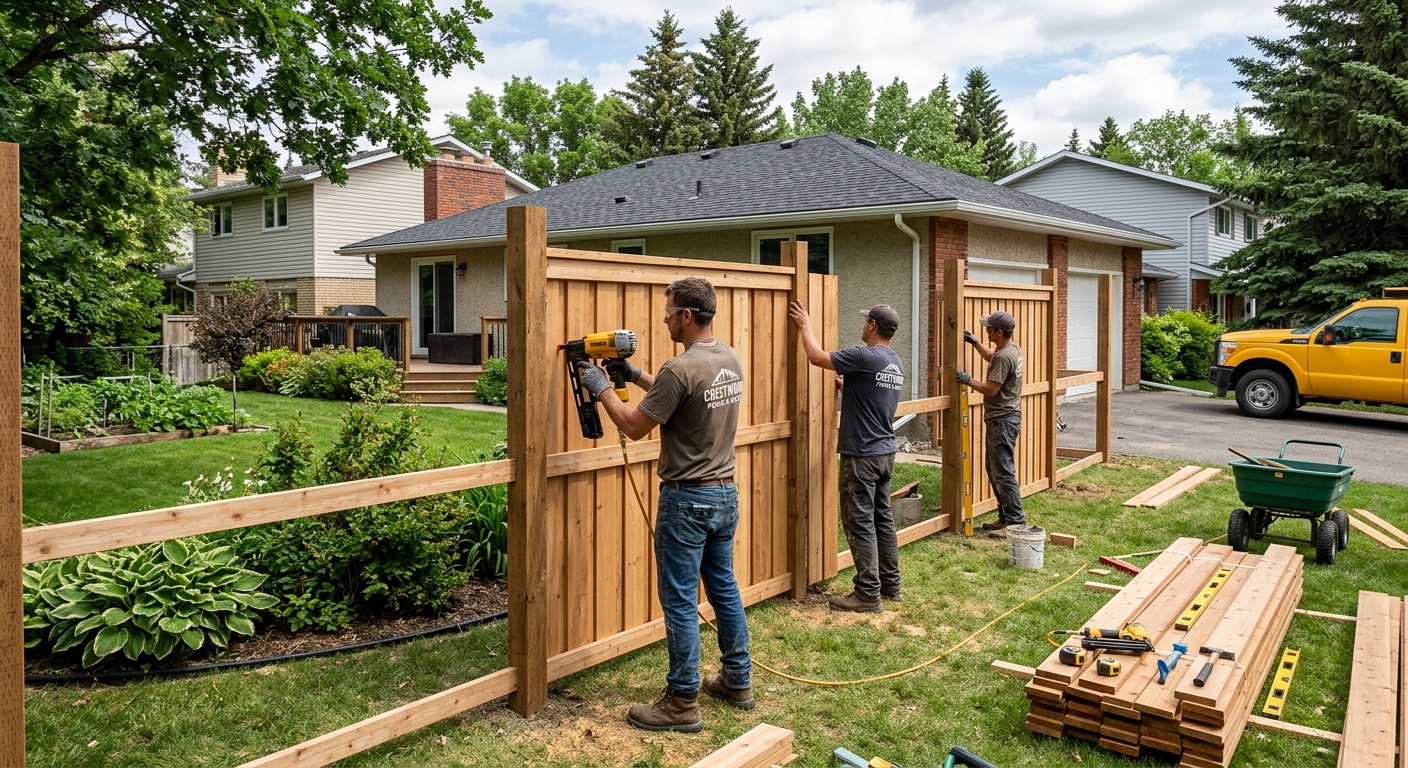
Fencing options and costs in Grovenor
Grovenor has a small-town feel (2,347 residents in 2021, Statistics Canada, 2021 Census), and that tight housing market tends to concentrate repeat fencing work around well-established residential pockets where yards are long and lots are well used. In practical terms, every detached home lot becomes a potential customer—so when homeowners refresh a front run, add a gate, or replace an older boundary fence, demand follows the same predictable pattern. Calgary’s broader economic region also influences contractor scheduling and material pricing, which is why you’ll see slightly different availability and lead times depending on how busy the season is.
In Grovenor and across the Calgary area, the Prairie continental climate drives fencing costs up compared with milder regions: long freeze–thaw cycles mean posts often need to be set deep for frost protection, and wind exposure makes solid privacy panels prone to racking if spacing and bracing aren’t right. For many projects, this is the difference between “cheap fencing” and an installation that still looks straight after the first major winter. Where you need a true privacy look (often along side or rear boundary lines), contractors typically recommend a fully concreted footing strategy—especially for 6 ft privacy fences and gate posts.
In Grovenor, fencing work is especially in demand around established residential streets where properties back onto open exposure—think boundary lines that face prevailing winds and get heavy snow drift. From there, the best way to compare options is the price-and-performance table below.
| Material |
Lifespan |
Maintenance |
Privacy Rating |
Price per Linear Foot |
| Pressure-treated pine (standard wood) |
10–15 years |
Stain/seal every 2–3 years to reduce grey weathering |
8/10 (solid pickets) |
$40–$65 |
| Cedar (natural rot resistance) |
15–25 years |
Seal/stain as needed (typically every 2–4 years) |
9/10 (solid board options) |
$55–$80 |
| Vinyl / PVC (no-maintenance) |
20–30 years |
Rinse as needed; occasional tightening for hardware |
8/10 (solid panels) |
$60–$90 |
| Chain-link (galvanized steel) |
20–30 years |
Low; periodic tension/visual checks |
3/10 (visibility varies) |
$25–$50 |
| Aluminum ornamental |
25–40 years |
Wash annually or as needed |
4/10 (decorative, semi-open) |
$70–$120 |
| Composite / recycled material |
20–35 years |
Minimal; occasional cleaning |
8/10 (solid boards) |
$75–$105 |
Prices are estimates only and vary by project scope, site access and material selection.
What affects the price of fencing in Grovenor
Even when two homeowners describe the “same fence,” quotes in the Calgary region can vary by 30–50% because the true variables are structural and site-related: post depth, wind bracing, gate hardware, excavation conditions, and whether the installer is doing premium frost protection (which costs more in concrete and labour). Material price swings also show up quickly in busy seasons, and contractor availability can tighten during peak spring installs—pushing labour rates and forcing scheduling to less flexible time windows.
In Grovenor, Calgary’s freeze–thaw pattern makes post depth a central cost driver. The typical approach is to set posts roughly 4–6 inches below the design frost depth; in practice that often means placing posts about 1.5–2.0 m into the ground. Deeper holes require more excavation time, longer posts, and more concrete volume. That is why privacy fences (solid wood or vinyl) frequently sit in the mid-to-upper range, while chain-link stays lower because it allows more airflow and can be built with lighter framing.
Wind exposure on the Prairies also drives design changes: solid panels often need tighter post spacing and stronger rails so the fence resists racking. By contrast, a chain-link run can be cheaper per linear foot because it transfers wind loads differently. In milder coastal climates (like coastal BC), wood rot risk drives replacement cycles; in Alberta, the challenge is frost movement and structural stability rather than damp rot—so your budget is mostly spent on footings and bracing rather than rot-resistant treatments alone.
Concrete examples you’ll feel in Grovenor: replacing a 20 ft run with an extra gate can add cost mainly through hardware and reinforcement; switching from gravel pack to full concrete-set posts generally pushes the quote up; and dealing with frozen ground at the start of the season can add excavation time. If your current layout is close to straight and uses simple rails, you might land near the $40–$80 wood band; if you add privacy panels and full concreted gate posts, your budget often moves toward the $45–$90 vinyl/PVC band.
| Price Factor |
Why It Matters |
Cost Impact |
| Fence length in linear feet |
The more lineal footage, the more posts, rails, and labour time |
Direct driver; small unit-price changes matter over long runs |
| Post depth required |
Frost line determines post length and hole depth to prevent heaving |
Deeper setting increases excavation + concrete + material waste |
| Post setting method |
Concrete vs. gravel pack affects stability and cost |
Concrete-set posts typically raise the base quote |
| Material choice |
Vinyl/cedar/wood/chain-link behave differently in wind loading |
Vinyl privacy often costs more than chain-link; cedar can exceed standard treated pine |
| Gate count and type |
Gates need heavier posts, more hardware, and tighter alignment |
Multiple walk gates or a drive-through gate can add substantial labour and reinforcement |
| Grade and terrain |
Slopes require stepped sections or raked panels |
More cutting/layout time, plus possible extra materials |
| Old fence removal and disposal |
Demolition time and dump fees vary by amount and access |
Can add a noticeable portion to the overall total |
| Permit fees and survey / property line locate |
Paperwork and verification time reduces risk of disputes |
Usually a smaller line item, but it affects contractor time and scheduling |
Permits & regulations in Alberta
In Alberta, fences above a height threshold often require a building permit—typically around 2.0 m (6.5 ft) at the rear and 1.0–1.2 m (3–4 ft) along the front or corner areas. Even when a permit isn’t required, you still must respect property lines and any municipal setback requirements. Before you dig any post holes in Grovenor, call for utility locates through Alberta One-Call (to mark buried power, gas, telecom, and water lines). If you’re unsure about the boundary, obtain a survey or a formal property pin locate so you don’t build across a line and end up paying to relocate later.
Shared fence ownership is governed by Alberta’s line-fences legislation. That usually means neighbours can have rights and cost-sharing expectations when a fence is shared, so it’s smart to confirm how your boundary fence is treated before you start work.
How to verify your contractor (step-by-step): (1) Ask for their Alberta contractor licence details and confirm the business is properly registered using the relevant online registry sources used in Alberta; (2) request a certificate of insurance and ensure general liability coverage is active for your project dates; (3) confirm they carry WSIB/WCB coverage (or the applicable clearance proof if they are structured to provide it). (4) Before work begins, ask for written confirmation of clearance and coverage details so you have documentation if anything changes.
Important: fence permits are commonly tied to height thresholds and location (front/corner vs rear), while routine replacements that don’t increase height and stay within required setbacks may not trigger additional approvals—still, you should confirm in writing for your exact layout.
Choosing the right fence material for Grovenor
Choosing a fence in Grovenor is mostly about aligning material performance with your priorities: privacy, low maintenance, budget, and lifespan—then matching it to Alberta’s long freeze–thaw cycles. Pressure-treated pine is usually the budget-friendly entry point, but it benefits from a routine: stain or seal every 2–3 years to limit grey weathering and keep boards from drying unevenly. Cedar looks better and offers better natural rot resistance, but it’s not “no maintenance”—plan on sealing/staining as it weathers to maintain appearance and reduce cupping. Vinyl/PVC is popular for low maintenance because you can rinse it down and move on, but in extreme cold it can become brittle at cut edges and hardware points if the installer doesn’t use proper expansion practices and quality rails.
Chain-link is the longest-life, lowest-cost option, but privacy is limited—usually best when you want boundary definition and pet containment rather than screening. Aluminum ornamental gives a clean, rust-resistant look and high durability, but it’s semi-open for visibility. Because Calgary-area wind loading is real, privacy-style fences (wood, vinyl, composite) usually require careful post spacing and robust bracing—so even if materials differ, the installation quality around posts and rails is what keeps everything straight after winter.
Concrete-set posts are often recommended for solid privacy fences in the Calgary region because posts must be set below frost movement (commonly 1.5–2.0 m into the ground depending on design frost depth). That footing strategy applies across materials, meaning you shouldn’t assume “cheaper materials” automatically reduce structural costs.
Example: if pressure-treated pine and vinyl/PVC both end up at similar installation specs, the difference can be justified—vinyl might cost about $60–$90 per linear foot versus wood often $40–$80—when you value lower maintenance over 10–20+ years. If you’re budget-tight and comfortable with periodic staining, pressure-treated pine can be the smarter payback.
| Material |
Cold Tolerance |
Lifespan |
Annual Maintenance |
Best For |
Price Band |
| Pressure-treated pine |
Good (with proper grading and sealing) |
10–15 years |
Quick inspection; reseal/stain every 2–3 years |
Budget privacy fences where you’ll maintain finish |
$40–$80 |
| Cedar |
Good (better natural rot resistance) |
15–25 years |
Inspection plus seal/stain every 2–4 years |
Appearance-first privacy with better longevity |
$55–$90 |
| Vinyl / PVC |
Good (avoid poor-fit and allow for thermal movement) |
20–30 years |
Minimal; rinse and check hardware |
No-maintenance privacy |
$45–$90 |
| Chain-link |
Excellent (durable steel frame) |
20–30 years |
Low; tension checks and occasional patching |
Security and pets with lower cost |
$25–$55 |
| Aluminum ornamental |
Excellent (no rust in Alberta winters) |
25–40 years |
Low; wash as needed |
Curb appeal and boundary definition |
$70–$120 |
| Composite / recycled material |
Very good (stable boards when installed correctly) |
20–35 years |
Minimal; clean and check fasteners |
Privacy with longer-term low-maintenance goals |
$75–$105 |
How to choose a fencing contractor in Grovenor
Start by verifying the contractor’s Alberta compliance and real-world coverage—then you’ll avoid many of the problems that pop up in Grovenor: loose gate alignment, posts that heave after freeze–thaw, and warranty disputes. For licensing, request their Alberta business/contractor registration details and confirm they’re in good standing. For liability insurance, ask for a current certificate of insurance naming your property and showing active general liability coverage for the project term. For worker protection, confirm WSIB/WCB coverage (or the appropriate clearance documentation). A reputable fencing crew should provide these documents quickly and in writing.
Next, get 2–3 itemised written quotes. You want line items that separate materials (rails, posts, panels, hardware) from labour (excavation, setting, installation, gate build) and show access/dig conditions. Avoid lump sums that don’t state what’s included: ask whether permits are handled, whether old fence removal and disposal are included, and what happens if they discover buried utilities or unexpected rock.
Warranty matters in Alberta’s climate: ask for the workmanship warranty length (how long they stand behind post setting and alignment) and the product/manufacturer warranty terms. Confirm whether warranties are transferable if you sell the home.
Payment schedule: never agree to more than 10–15% upfront. A sensible approach is to pay the remainder after major milestones, holding back a portion until the fence is complete and gate operation is verified. Finally, get a start date and completion estimate in writing, including the expected lead time for materials.
- Confirm Alberta licence/business registration and request documentation before scheduling.
- Ask for a current certificate of general liability insurance.
- Provide proof of WSIB/WCB coverage (or clearance documentation).
- Require itemised quotes (materials vs labour, not a single total).
- Ensure post depth and setting method are specified (concrete-set vs gravel pack).
- Verify who does utility locates coordination and what’s included if marks are off.
- Confirm gate type, hardware brand/grade, and whether double gates include reinforcement.
- Ask how slopes are handled (stepped vs raked) and whether panels are cut to grade.
- Clarify disposal/removal of the old fence and any dump fees.
- Confirm whether permits are included or excluded in the quote.
- Get warranty terms in writing: workmanship duration and manufacturer warranty coverage.
- Use a staged payment plan with no large upfront deposit (max 10–15%).
Red flags to watch for in Grovenor: a contractor who refuses to provide insurance or WSIB/WCB proof; quotes that don’t specify post depth or setting method for frost protection; “low price” offers that exclude concrete footings for privacy gates; vague scope language like “everything included” without listing gates, removal, and permits; and crews who pressure you for full payment upfront or won’t put the start/completion dates in writing.
Frequently asked questions — fencing in Grovenor
Can I install a fence on a slope in Grovenor?
Yes, but the approach matters for both appearance and structural stability. In Grovenor and the wider Calgary area, sloped lots are common, and the safest options are typically stepped sections (separate levels) or raked panels that follow the grade without leaving large gaps that catch wind. For solid privacy fences, stepped construction often performs better during freeze–thaw because it reduces uneven load paths on posts. In your quote, ask how they’ll handle rails on a slope and whether they’ll use different post lengths to maintain proper fence height while still setting posts to frost-safe depth. If you’re aiming for a higher privacy fence, confirm whether height rules in Alberta trigger a permit for your front/corner versus rear location before you dig.
What is the most weather-resistant fence for Grovenor's climate?
For Grovenor’s Prairie freeze–thaw cycles and wind exposure, “weather-resistant” usually means a fence with stable, correctly set posts and a durable system that resists racking. Vinyl/PVC privacy and aluminum ornamental are both strong choices because they don’t rot, and they handle Alberta winters well when installed with proper bracing and hardware. That said, the single biggest determinant is post installation: if posts aren’t set below frost movement (often about 1.5–2.0 m into the ground depending on design), even the best material can shift over time. Chain-link is also very durable and cost-effective (often around $25–$55 per linear foot), but it’s not privacy-focused. For true privacy with minimal maintenance, vinyl commonly lands in the mid-to-upper band (about $45–$90 per linear foot).
How do I prevent wood fence rot in Grovenor?
In Grovenor, rot prevention is less about constant moisture and more about proper installation details that limit water exposure where boards connect. Start by choosing quality pressure-treated pine or cedar and ensuring boards are installed with correct spacing and drainage so water doesn’t pool against the wood. Ask your contractor to use corrosion-resistant fasteners and to keep bottom rails and pickets off soil contact. Apply a proper stain/sealer system: pressure-treated pine typically needs re-staining every 2–3 years, while cedar usually benefits from sealing every 2–4 years to maintain performance. Also request that posts are set with the right frost-protection method; concrete footings and correct post depth reduce movement, which prevents gaps that trap moisture. If you’re comparing options, remember rot isn’t just a material issue—it’s a workmanship detail issue.
What is the cost per linear foot for fencing in Grovenor?
In Grovenor, most fence pricing is best understood as a per-linear-foot range because post spacing, terrain, gates, and footing depth can shift costs quickly. Based on the Calgary region market band, wood installations typically run about $40–$80 per linear foot, while vinyl/PVC is about $45–$90 per linear foot. Chain-link usually comes in lowest, roughly $25–$55 per linear foot, and aluminum ornamental tends to be the highest, about $70–$120 per linear foot. Your exact number can go up if you need concrete-set footings for a privacy fence, multiple gates, or extensive slope-stepping. If you’re budgeting, request itemised quotes so the labour and footing strategy are clear—not just the final total.
Should I repair or replace my old fence in Grovenor?
Often you can repair, but in Alberta you should be cautious if the issue is structural rather than cosmetic. If boards are only weathered, missing caps, or fasteners are loose, repair may be the best value—especially if posts remain plumb and properly set below frost movement. Replace sections (and sometimes rails) when rot is localized or when damage is limited to the top third. If you see leaning posts, repeated post heave, sagging gates, or rusted hardware on rail connections, replacement is usually the safer route because fixing only the panels may not address the root cause. A solid rule: if more than a small portion of the fence line requires post attention, replacement often pencils out. For context, wood projects commonly sit around $40–$80 per linear foot, while vinyl privacy is higher (often $45–$90) but can reduce ongoing maintenance.
How do I handle a fence dispute with a neighbour in Alberta?
In Alberta, fence disputes usually come down to property lines, shared-fence expectations, and responsibility for costs—so start by verifying facts before emotions. First, confirm where the boundary is using your property pins/survey, not just the existing fence location. If you don’t already have it, ask for a proper locate or a survey to establish the true line. Next, review how Alberta’s line-fences legislation applies to your situation (shared fence ownership and cost sharing can be relevant depending on whether the fence serves both properties). Then document everything: photos, measurements, and any written communication. In Grovenor, it’s also worth pausing any digging until you’ve clarified the boundary to avoid relocation costs. Finally, put agreements in writing (even a simple signed note covering scope, costs, and timelines) so expectations stay clear for both sides.