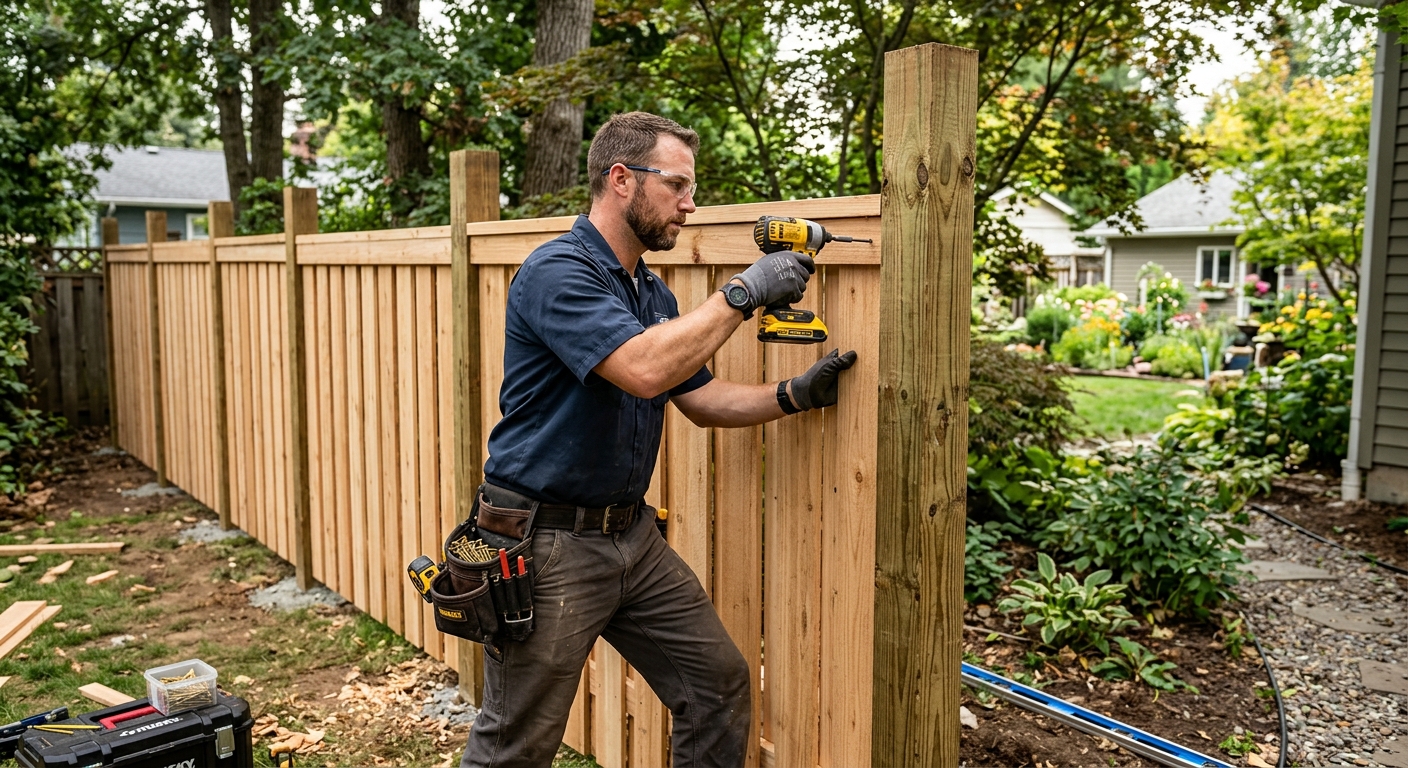
Fencing options and costs in Wetaskiwin
Wetaskiwin homeowners have plenty of fence options, but costs usually hinge on site conditions as much as materials. With 12,594 residents and about 3,285 homeowner households (63.4% of households own), a steady share of yards are maintained or upgraded in any given year, especially for boundary and privacy fencing. Most local housing is single-detached (58.2% of dwellings), which typically means longer runs and more gate work than townhome-style lots.
In the Edmonton economic region, frost depth and wind exposure are the two big drivers. Contractors generally set posts below the frost line—often 4–6 inches below the design frost depth—to reduce heaving, which can push labour and concrete up compared with milder areas. Wind on the Prairies also stresses panels and fasteners, so sturdier post spacing and more rigid systems are commonly recommended, particularly for taller privacy builds. Trade availability can shift by season: summer and early fall projects book quickly because many crews want to work when the ground is easiest to dig and level.
In Wetaskiwin, trades often see higher demand around established residential pockets like Lakeside and the older inner neighbourhoods where many fences were installed decades ago. When homes are built before 1981 (55.7% of dwellings), owners frequently replace ageing boards and hardware in the same season as other exterior upgrades.
Below is a practical cost comparison to help you narrow materials and budget before you request a detailed, itemised quote.
| Material |
Lifespan |
Maintenance |
Privacy Rating |
Price per Linear Foot |
| Pressure-treated pine (standard wood) |
10–15 years |
Stain/seal every 2–3 years; replace warped boards as needed |
Good (solid panels) |
$12–$22 |
| Cedar (natural rot resistance) |
15–25 years |
Light stain/finish every 2–4 years; inspect regularly |
Good–Very good (solid/board-on-board) |
$16–$28 |
| Vinyl / PVC (no-maintenance) |
20–30 years |
Occasional wash; avoid impacts; check fasteners after storms |
Very good (solid styles) |
$18–$32 |
| Chain-link (galvanized steel) |
25–35 years |
Minimal; keep tensioned and clear vegetation |
Low–Medium (privacy slats add visibility reduction) |
$10–$20 |
| Aluminum ornamental |
25–40 years |
Wash as needed; inspect gates/hardware |
Low–Medium (decorative pickets) |
$16–$34 |
| Composite / recycled material |
20–30 years |
Wash periodically; occasional hardware checks |
Very good (solid boards) |
$20–$38 |
Prices are estimates only and vary by project scope, site access and material selection.
What affects the price of fencing in Wetaskiwin
In Wetaskiwin, two bids for the “same fence” can differ by 30–50% because the Edmonton-area cost structure accounts for more than material. The big swing factors are ground conditions (frost and postholes), wind resistance requirements, and how complicated the layout is (gates, terrain, and removal). That’s why a simple 6-foot boundary fence on flat ground can land near the lower end of Alberta ranges, while an elevated, wind-exposed privacy fence with multiple gates and old fence removal can drift toward the upper end.
Post depth is the frost story. To reduce heaving, posts are typically set about 4–6 inches below the design frost depth, which in Alberta often means roughly 1.5–2.0 m of embedment and more concrete or longer posts. This adds labour time and material quantity (more post length, more holes, and often more bracing). Wind exposure on the Prairies also drives tighter post spacing and heavier sections, especially for privacy builds that use solid boards or heavier panel systems. In practical terms, the “panel and post” part of the estimate can climb even if the material line item looks similar.
Here are examples of how Wetaskiwin conditions commonly raise or lower cost:
- Hard or rocky soil: deeper, wider holes take longer and can increase concrete and disposal.
- Windy corners near open lots: crews may recommend closer post spacing and heavier gate hardware, pushing you toward the higher end of the wood range (for example, closer to $3,000–$6,500 for wood installs when reinforcement is needed).
- Clear, flat access with no removal: you may stay closer to the lower end of chain-link builds (around $2,000–$4,500), because posts and line work go quicker.
Finally, housing age matters. Many fences around homes built before 1981 are older and more difficult to remove and dispose of safely, which adds labour and trucking—often turning a “materials replacement” into a full teardown-and-rebuild scope.
| Price Factor |
Why It Matters |
Cost Impact |
| Fence length in linear feet |
Most labour and materials scale directly with footage |
Largest driver (often the majority of total cost) |
| Post depth required — frost line determines post length and hole depth |
Deeper embedment means more digging, more concrete, and longer posts |
Can add 15–35% vs. shallow installs |
| Post setting method — concrete vs. gravel pack vs. driven posts |
Concrete-set posts improve stability in freeze/thaw cycles |
Concrete-set typically increases material and labour time |
| Material choice — vinyl vs. cedar vs. chain-link |
Material cost and wind-load requirements differ |
Shifts the project across price bands (wood, vinyl, chain-link, metal) |
| Gate count and type — walk-through vs. drive-through (double) |
Gates require heavier posts, hinges, and more alignment work |
Often adds $300–$1,500+ per gate depending on width and hardware |
| Grade and terrain — sloped yards require stepped or raked panels |
Slopes increase fitting time and may require special panels |
Usually adds labour and sometimes extra material |
| Old fence removal and disposal |
Hauling and careful dismantling increase labour time |
Can add 10–25% if disposal is significant |
| Permit fees and survey / property line locate |
Locates prevent encroachment disputes and rework |
Typically modest, but delays can increase labour costs |
Permits & regulations in Alberta
In Alberta, fence rules are commonly tied to height and location relative to property lines. As a general planning guideline in Wetaskiwin, fences above a threshold—often around 2.0 m (6.5 ft) at the rear and 1.0–1.2 m (3–4 ft) at the front or corner—may require a building permit. Even when a permit is not triggered, you still must respect property lines and any municipal setback requirements.
Before you dig post holes, call for utility locates through Alberta One-Call (utility markings must be done before excavation). If you’re replacing an older fence, it’s smart to confirm pins or get a survey/locate so your new line doesn’t drift onto a neighbour’s property—these disputes are more common than people expect when older fences pre-date modern surveys.
Shared fence ownership and responsibilities follow provincial line-fences legislation principles, but the practical outcome usually comes down to how the fence was originally built and agreed upon by adjacent owners. For exact shared arrangements, keep documentation (photos, agreements, any prior correspondence) and confirm in writing.
To verify a contractor’s compliance in Wetaskiwin: check their Alberta licence status with the appropriate online registry, request their certificate of insurance (liability) and confirm coverage is active for your project dates, and ask for WSIB/WCB clearance details where applicable. Reputable fence builders can provide these documents promptly, and they should match the company name you’re contracting with.
Choosing the right fence material for Wetaskiwin
Choosing a fence in Wetaskiwin is mostly about matching the material to your priorities—privacy, low maintenance, upfront budget, and how long you want to stay on the same fence system. The Prairies climate is hard on hardware and can stress fasteners in wind. At the same time, the freeze/thaw cycle drives the way posts are installed: most quality Edmonton-area builds set posts below the frost line (often 4–6 inches below design frost depth), which typically means concrete-set posts and longer embedment.
Pressure-treated pine is the budget-friendly route, but it usually needs staining or sealing every 2–3 years to slow down grey weathering and surface checking. Cedar looks better and resists rot more naturally, though it still benefits from periodic finishes. Vinyl/PVC is popular for low maintenance—wash it occasionally and you’re largely done—but in extreme cold it can become brittle if struck, and the system needs solid installation and correct post alignment. Chain-link is the least expensive to install and tends to last a long time, but it offers no real privacy unless you add privacy slats (which changes airflow and wind-load behaviour). Aluminum ornamental provides long life and a clean look with minimal rust risk, but it’s not a privacy fence. Composite/recycled materials can give a more modern privacy look with good durability.
A concrete example: if you’re comparing a wood privacy fence to vinyl for a similar layout, wood installs might land around $3,000–$6,500 depending on gates and reinforcement, while vinyl can commonly be higher—often closer to $3,500–$8,000 in Alberta once you factor in wind-ready spacing and taller solid styles. That extra cost is justified when you truly want “install and forget” maintenance.
For any material, we also plan around snowdrifts and wind exposure—especially on open corners—so the framing and post spacing can handle loads without leaning.
| Material |
Cold Tolerance |
Lifespan |
Annual Maintenance |
Best For |
Price Band |
| Pressure-treated pine |
Good (with proper treatment and air-drying) |
10–15 years |
Minor checks; stain/finish every 2–3 years |
Budget privacy with straightforward repairs |
$3,000–$6,500 |
| Cedar |
Good (stable in freeze/thaw) |
15–25 years |
Inspect and refinish every 2–4 years |
Natural look and better rot resistance |
$4,000–$7,500 |
| Vinyl / PVC |
Good (handles cold well; avoid impacts) |
20–30 years |
Wash as needed; check hardware after storms |
Low maintenance privacy |
$3,500–$8,000 |
| Chain-link |
Very good (steel stays strong in winter) |
25–35 years |
Minimal; keep tension and vegetation clear |
Security and long life on a tight budget |
$2,000–$4,500 |
| Aluminum ornamental |
Very good (no rust) |
25–40 years |
Wash and hardware checks |
Attractive curb appeal and perimeter definition |
$4,000–$9,000 |
| Composite / recycled |
Good (designed for cold climates) |
20–30 years |
Occasional washing; inspect for posts/hardware |
Modern privacy with durability |
$4,500–$9,000 |
How to choose a fencing contractor in Wetaskiwin
Start by verifying that your fence contractor is properly set up to work in Alberta and that they’ll be accountable if something goes wrong. Ask for their Alberta business licence details (or the relevant trade registration information you can verify online), their certificate of liability insurance, and WCB/WSIB coverage or clearance documentation where applicable. A clear, current certificate of insurance should name the correct legal entity and show active coverage; don’t rely on a verbal claim.
Next, request 2–3 itemised written quotes. You want a breakdown that shows labour and materials separately (posts, rails, panels/sheets, hardware, concrete/gravel, gates, and removal/disposal). Ensure the quote spells out what’s included: permit pull responsibility (if required), property line locate/survey allowances, utility locating coordination, and disposal/hauling of the old fence. Watch for “allowances” that are too vague—tight scope details prevent change orders when the ground is rocky or when the layout requires more bracing.
Review warranty terms carefully. Ask for the workmanship warranty length and whether it’s transferable if you sell the home. Also confirm whether product warranties cover materials only, or if they include installation defects.
Payment schedule matters: never pay more than 10–15% upfront. Use a holdback until completion and walkthrough, so the crew addresses adjustments and gate alignment properly.
Finally, insist on a start date and a completion estimate in writing, with weather contingencies noted. In Wetaskiwin, frost and wind can interrupt work, but good contractors plan around access and ground conditions.
- Confirm contractor’s Alberta licence/registration and that the paperwork matches the company name on the contract.
- Request a current certificate of liability insurance before scheduling work.
- Ask for WSIB/WCB clearance documentation (or coverage details) and keep copies for your records.
- Get 2–3 itemised quotes with labour and materials separated (not one lump-sum).
- Ensure post depth and setting method are specified (frost-depth embedment and concrete-set where required).
- Verify gate hardware quality: hinges, latches, and whether posts are reinforced for larger openings.
- Check how they handle slopes (stepped vs. raked) and whether grading adjustments are included.
- Confirm whether old fence removal and disposal is included, and how waste is transported.
- Ask who pulls permits if a permit is required for your height/location.
- Request warranty terms in writing: workmanship duration and product warranty coverage.
- Agree on a payment schedule with a holdback until final walkthrough and adjustments.
- Get an estimated start and finish date, plus contingency if ground conditions limit digging.
Red flags to watch for in Wetaskiwin: quotes that don’t state post embedment depth; promises of “no concrete needed” without explaining frost-depth assumptions; lack of insurance documents; a contract that doesn’t clearly include disposal/removal and utility locate coordination; and accepting large upfront payments (well beyond 10–15%) without a proper completion plan.
Frequently asked questions — fencing in Wetaskiwin
How long does a wood fence last in Wetaskiwin?
In Wetaskiwin and the Edmonton-area climate, a well-built pressure-treated wood fence typically lasts about 10–15 years, while cedar often reaches 15–25 years. Longevity depends heavily on installation depth (posts set below the frost line to prevent heaving), how well posts and rails are braced against wind, and how consistently you maintain the surface. Pressure-treated pine usually needs staining or sealing every 2–3 years; if you skip it, you can expect faster grey weathering and more splitting/warping. If your home has a long fence run from an older installation, you may also see faster failure where boards meet gate hardware or where snowdrifts push against panels. Budget examples often reflect this: wood installs commonly land around $3,000–$6,500 depending on reinforcement and gates, which can be money well spent when the build is done for freeze/thaw stability. (Statistics Canada, 2021 Census)
Who owns and maintains a shared fence?
In Alberta, shared fence responsibilities are generally guided by line-fences principles, but the practical answer depends on what your specific boundary agreement or prior construction history shows. If the fence is clearly shared (or built on/for the boundary), both neighbours may be expected to contribute to maintenance and replacement, but you should not assume equal cost without checking how the fence was established. For Wetaskiwin homeowners, the safest approach is to confirm the property line and then discuss ownership in writing with your neighbour before work starts. Keep photos of the existing condition, any prior receipts, and correspondence. When you get quotes, ask contractors to document what they’re building and where (so you can clearly show each party what portion is shared). If there’s a dispute, resolving it early avoids paying for a fence that later needs to be moved. Your best protection is a clear written agreement before you sign.
How do I find my property line before fencing?
Before installing in Wetaskiwin, you should confirm property lines using official methods so your new fence doesn’t encroach. Start by locating your property pins (if your lot is marked) and compare them to your planned fence line. If you can’t find pins or the line is unclear due to an older fence, get a survey or property line locate before digging. For any post holes, call for Alberta One-Call utility locates first—don’t assume the area is clear just because it “looks” open. This matters in older neighbourhoods where utilities may have been rerouted or where fences were originally placed without modern survey accuracy. Then, when you request quotes, ask contractors to note how they’ll handle layout verification (for example, staking line positions and confirming offsets). A proper locate typically prevents costly rework and neighbour disputes, especially when wind-exposed corners make it tempting to “straighten” a fence that isn’t aligned to the legal boundary.
What's the most low-maintenance fence?
For low-maintenance in Wetaskiwin, vinyl/PVC and aluminum are usually the easiest to live with. Vinyl doesn’t require staining and is typically just periodic cleaning, though you still need to check hardware and alignment after storms. Aluminum also stays looking sharp with minimal rust concerns and occasional washing. Chain-link is also low maintenance and can last a long time, but it won’t provide privacy without slats or screening. Pressure-treated pine is workable but demands regular upkeep—staining or sealing every 2–3 years—and board replacements over time. If you’re comparing budgets, vinyl often sits higher than wood installs in the Edmonton-area market; many projects fall into the vinyl band of around $3,500–$8,000, while wood privacy projects commonly land around $3,000–$6,500. The extra cost is often justified if you want fewer seasonal tasks and a fence that stays visually consistent year-to-year. (Statistics Canada, 2021 Census)
How tall can my fence be in Wetaskiwin?
Fence height rules in Wetaskiwin are usually tied to whether the fence is in the front/corner areas versus the rear, and whether a permit is required. A common planning guideline in Alberta is that fences above roughly 2.0 m (6.5 ft) at the rear and around 1.0–1.2 m (3–4 ft) at the front or corner may require a building permit. Even if a permit isn’t required, you still must comply with property line and setback bylaw requirements set by the municipality. Because fence regulations can be specific to location (front vs. rear), corner lots, and how the lot is measured, the best approach is to ask your contractor to confirm the proposed height and location with the correct local requirements before ordering materials. If you’re building a tall privacy fence on a wind-exposed edge, the height might be permitted but the contractor may still recommend reinforced post spacing and heavier panels for stability.
Should fence posts be set in concrete here?
In most Wetaskiwin/Edmonton-area installs, concrete-set posts are commonly recommended (and often necessary) because frost and freeze/thaw can cause heaving if posts aren’t embedded below the frost line. Contractors typically aim for post embedment about 4–6 inches below design frost depth, which often means roughly 1.5–2.0 m of depth in Alberta conditions. Concrete doesn’t just “glue” the post—it provides stable support in the freeze/thaw cycle and helps the fence stay plumb despite winter movement. That said, the right method depends on your soil and fence type: some setups may use a gravel pack or different engineered approach, but the safest assumption for a long-lived fence—especially in windy yards—is concrete-set posts with correct drilling depth and proper bracing. If your quote looks unusually low (for example, far below typical wood or chain-link bands) but doesn’t specify frost-depth embedment and post setting method, ask questions before signing.