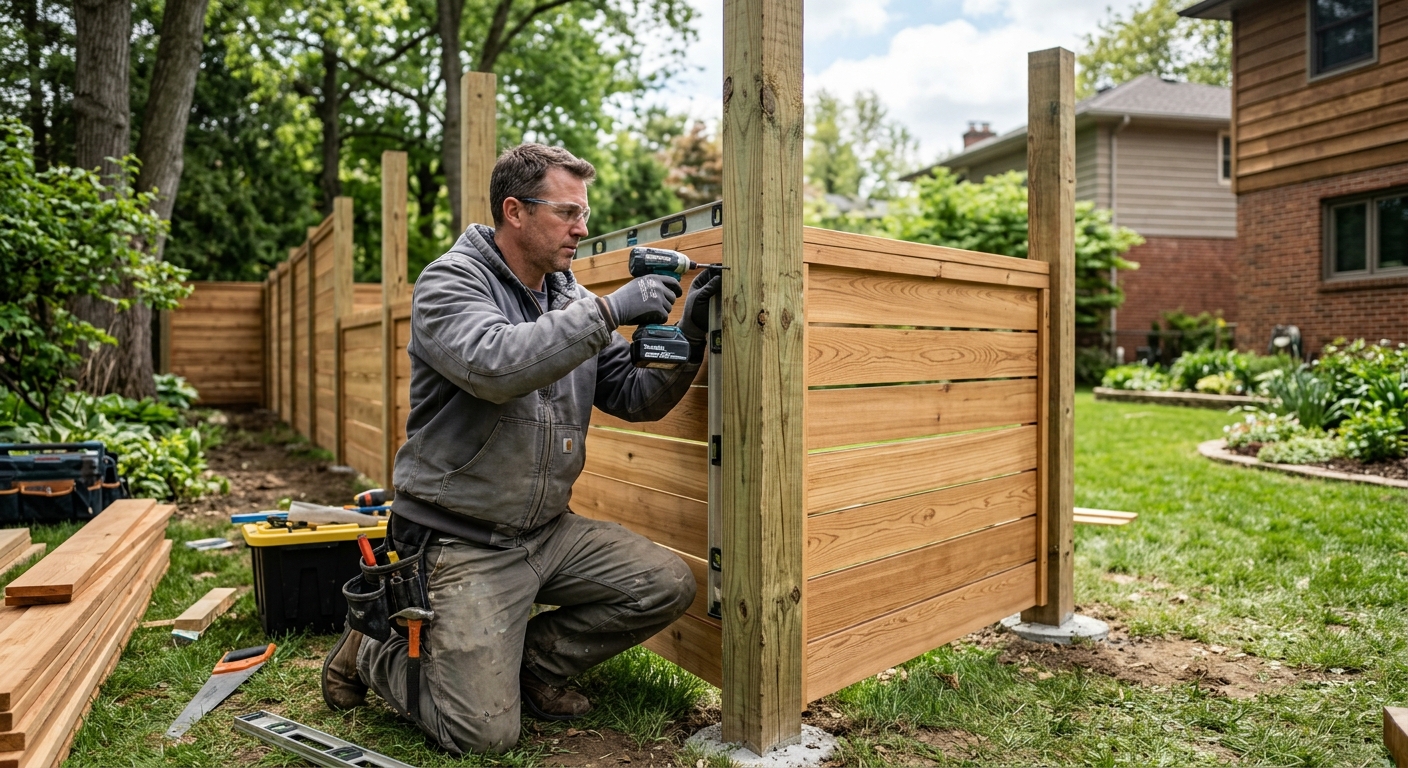
Fencing options and costs in Crescent Heights
In Crescent Heights, fence decisions often start with how you want your yard to feel—private, open, or decorative—while keeping costs under control for a neighbourhood where there are many detached homes. In the Calgary economic region, Crescent Heights sits within a household mix shaped by people who own their homes and invest in upgrades; in fact, 6,240 residents live in the community area profiled (Statistics Canada, 2021 Census). That matters because detached homeowners are the most common customers for boundary fencing, gates, and backyard privacy upgrades.
Pricing here is strongly influenced by Calgary’s Prairie continental climate. Long freeze–thaw cycles and wind exposure mean you can’t “cheap out” on structure: fence posts typically need to be set about 4 ft (≈120 cm) deep to sit below the regional frost line and reduce the risk of heaving. Solid privacy panels (wood or vinyl) also catch wind, so contractors usually use tighter post spacing and fully concreted footings for 6 ft systems and heavier gate hardware. Those site realities tend to push wood/vinyl toward the mid–upper range, while chain-link stays lower because it lets wind pass through.
Contractor availability is also impacted by demand—work is especially busy around the older lanes and side-yard setups near Crescent Heights’ denser residential blocks, where gates and access can be tighter and crews need more time for excavation and disposal.
Below is a practical comparison you can use when reviewing quotes for your lot in Crescent Heights, Alberta.
| Material |
Lifespan |
Maintenance |
Privacy Rating |
Price per Linear Foot |
| Pressure-treated pine (standard wood) |
10–15 years |
Stain/finish every 2–3 years; inspect pickets and rails after winters |
High (typical solid/close-board) |
$40 – $80 |
| Cedar (natural rot resistance) |
15–25 years |
Seal or stain periodically (often every 3–4 years); clean mildew buildup |
High (solid privacy styles) |
$55 – $95 |
| Vinyl / PVC (no-maintenance) |
20–30 years |
Rinse annually; replace cracked sections if impact occurs |
High (solid panels) |
$45 – $90 |
| Chain-link (galvanized steel) |
25–40 years |
Occasional tightening and re-tension; remove debris buildup |
Low (open airflow) |
$25 – $55 |
| Aluminum ornamental |
25–50 years |
Wash as needed; check gate hinges annually |
Medium (ornamental pickets) |
$70 – $120 |
| Composite / recycled material |
20–30 years |
Minimal cleaning; verify warranty coverage for warping/fasteners |
High (solid styles) |
$60 – $110 |
Prices are estimates only and vary by project scope, site access and material selection.
What affects the price of fencing in Crescent Heights
Even when two homeowners in Crescent Heights request “the same fence,” the quotes can differ by 30–50% across Calgary and other parts of Alberta. The biggest drivers aren’t just the boards—they’re the ground conditions, frost-protection requirements, wind-loading needs, and how difficult it is to excavate and dispose of material from your specific yard. In a Prairie market, crews price time and risk: deeper holes, heavier concrete, and sturdier post systems take longer and require more labour and materials than a lighter fence style.
First, frost protection sets post depth. Local guidance for the Calgary area expects posts set about 4 ft (≈120 cm) deep (often around 1.5–2.0 m in practice when accounting for design frost depth and safety margin), which means longer posts and more concrete per section. That’s a key reason Calgary pricing leans higher than regions with shallower frost penetration. Second, open Prairie exposure increases wind loading, so solid wood and vinyl privacy fences typically need closer post spacing and stronger rails to prevent racking. By contrast, chain-link usually costs less because it allows airflow.
Concrete examples for Crescent Heights: a 50 ft back-yard run on a flat lot can be straightforward, but a sloped side yard usually requires stepped panels, extra labour, and additional hardware alignment. If you’re replacing an older fence with concrete footings, demolition time and disposal can add noticeable cost. Conversely, if you already have clearly accessible trenching points and only need to install a chain-link run, the project may land closer to the lower–mid band for chain-link (about $25–$55 per linear foot). If you’re building a 6 ft privacy system with fully concreted posts, costs often track toward the mid–upper range—commonly within wood installation pricing ($40–$80) or vinyl ($45–$90), depending on the board style and gate complexity.
| Price Factor |
Why It Matters |
Cost Impact |
| Fence length in linear feet |
Most components scale directly with total length (posts, rails, panels, fasteners) |
High (primary driver) |
| Post depth required |
Frost line depth determines how long posts need to be and how deep holes must be |
Medium to high |
| Post setting method |
Concrete vs. gravel pack vs. driven posts changes labour time and material volume |
High for privacy fences |
| Material choice |
Vinyl/cedar require different hardware and fabrication; chain-link is lighter and faster to install |
Medium to high |
| Gate count and type |
Walk-through vs. drive-through gates require heavier frames, hinges, and latching |
Medium to high |
| Grade and terrain |
Slopes require stepped posts/panels or raked rails for a consistent look |
Medium |
| Old fence removal and disposal |
Demolition, hauling, and tipping fees add labour and time |
Medium |
| Permit fees and survey / property line locate |
Some fencing heights/locations require permits and accurate boundary confirmation |
Low to medium (project-dependent) |
Permits & regulations in Alberta
In Alberta, fence rules are tied to property lines and municipal setback bylaws, and permits can apply depending on height and location. As a practical rule of thumb, fences above a height threshold—commonly around 2.0 m (6.5 ft) at the rear and about 1.0–1.2 m (3–4 ft) at the front or corner—often trigger a building permit requirement. Whether your fence is a privacy style, a fence for a pool enclosure, or a tall screen around a corner lot, it’s smart to confirm the exact threshold with your city or municipal bylaw before you dig.
Before installing any fence posts, call for utility locates through Alberta One-Call to have buried services marked. Then verify your boundary line. You can use a survey or property line locate (pins) so your posts don’t end up on a neighbour’s land—boundary disputes are far more expensive than a locate.
Shared fence ownership typically follows the province’s line-fences legislation: when a fence is on a shared boundary, both neighbours may have responsibilities for maintenance and costs depending on circumstances. For an install in Crescent Heights, document who requested the work, what portion is shared, and keep the written scope and measurements.
To verify a contractor in Alberta, ask for: (1) their Alberta contractor licence (confirm via the appropriate online public registry for the province), (2) a certificate of insurance showing general liability coverage, and (3) proof of WSIB/WCB coverage (often provided as a clearance letter). A reputable fencing contractor will share these documents before any work starts.
Choosing the right fence material for Crescent Heights
Choosing the right fence material in Crescent Heights comes down to balancing privacy, low maintenance, budget, and lifespan against Calgary’s freeze–thaw cycles and wind. Pressure-treated pine is usually the best upfront value, but it requires staining or finishing about every 2–3 years to limit grey weathering and protect the wood fibres. Cedar looks better for many homeowners and naturally resists rot, yet it still benefits from periodic sealing—especially where snow melt and moisture linger near the bottom rails.
Vinyl/PVC is the go-to for “set it and forget it” homeowners. It doesn’t require staining and typically just needs a yearly rinse. The trade-off is upfront cost and brittleness risk if panels are struck; in extreme cold snaps, proper installation (fasteners and panel alignment) matters more than with wood. Chain-link is the lowest-cost and typically the longest-lived option, and it’s resilient in high wind because it lets air pass through. However, it offers limited privacy unless you pair it with a privacy screen or vines. Aluminum ornamental fencing gives a crisp look, won’t rust, and performs well in winter, but it won’t block sightlines like a solid wood or vinyl privacy fence.
For post depth and structure, Calgary’s frost protection needs mean many 6 ft systems are concrete-set with posts set about 4 ft deep (≈120 cm) so the fence resists heaving over winter. Wind and snow load considerations push heavier rails and tighter spacing for solid privacy styles. As a concrete example, if you compare a chain-link install around the lower–mid band ($25–$55 per linear foot) to a vinyl privacy fence ($45–$90 per linear foot), the higher cost is often justified when you’re seeking real visual screening and wind-stable posts, not just boundary definition.
| Material |
Cold Tolerance |
Lifespan |
Annual Maintenance |
Best For |
Price Band |
| Pressure-treated pine |
Good (with proper grade and sealing) |
10–15 years |
Inspect after winter; seal/stain every 2–3 years |
Budget privacy with a traditional look |
$40 – $80 |
| Cedar |
Good (natural resistance to rot) |
15–25 years |
Seal/stain every 3–4 years; inspect fasteners |
Premium appearance and durable privacy |
$55 – $95 |
| Vinyl / PVC |
Very good with correct installation |
20–30 years |
Rinse annually; check for impact cracks |
Low-maintenance privacy and clean lines |
$45 – $90 |
| Chain-link |
Excellent (non-combustible, flexible) |
25–40 years |
Minimal; tighten and clear debris |
Secure perimeter where privacy isn’t required |
$25 – $55 |
| Aluminum ornamental |
Excellent (won’t rust) |
25–50 years |
Wash as needed; inspect hinges |
Front yards and decorative boundaries |
$70 – $120 |
| Composite / recycled |
Good (depends on fasteners and panel design) |
20–30 years |
Low; periodic cleaning |
Privacy fence with wood-like look |
$60 – $110 |
How to choose a fencing contractor in Crescent Heights
When you’re hiring a fencing contractor in Crescent Heights, Alberta, verifying coverage is as important as comparing pricing. First, confirm Alberta licensing using the applicable online registry and ensure the company name matches the contractor on your paperwork. Next, ask for proof of liability insurance; request a current certificate showing general liability limits. Finally, ensure they have WSIB/WCB coverage for their workers—many contractors provide a clearance letter. If a contractor can’t produce these documents quickly, that’s a serious concern.
Then get 2–3 written quotes that are itemised rather than lump sums. You want a breakdown that separates labour (excavation, setting posts, assembly, gate installation) from materials (rails, posts, panels, hardware, concrete). Also confirm what’s included: permit pull (if required), utility locate coordination, and disposal of old fence material. If you’re keeping the existing posts, make sure the quote states that clearly; if not, it should specify removal, disposal, and replacement scope.
Warranty matters too. Ask for (1) a workmanship warranty length and what it covers (e.g., post movement, alignment, gate sag), (2) the manufacturer warranty on the materials, and (3) whether the warranty transfers to the homeowner after installation. For payments, never pay more than 10–15% upfront; hold back the balance until the job is complete and you’ve received final documentation. Request a start date and completion estimate in writing, with clear language on weather-related delays.
- Provide an itemised quote (labour vs materials, not a single line price)
- Confirm post setting method (concrete-set vs gravel pack vs other)
- List exact material grades (e.g., treated wood type, cedar grade, vinyl system)
- Show gate hardware brand/type and whether it’s rated for wind loading
- Confirm whether utility locates and boundary verification are included
- Detail disposal of old fence, concrete chunks, and jobsite cleanup
- Include a workmanship warranty in writing
- Ask whether the warranty is transferable to you as homeowner
- Request proof of liability insurance (current certificate)
- Request WSIB/WCB coverage clearance letter
- Limit upfront deposit to 10–15% and use a written payment schedule
- Get a written start date and realistic completion window
In Crescent Heights, I often see four red flags: (1) quotes that ignore frost-related post depth or concrete setting; (2) no itemisation for gates, rails, or removal/disposal; (3) reluctance to provide insurance and WSIB/WCB documents; and (4) “verbal warranty only” promises without written terms.
Frequently asked questions — fencing in Crescent Heights
Do I need a permit to build a fence in Alberta?
In Alberta, permits can be required when fencing exceeds certain height thresholds, particularly at the front or corner compared with the rear. A common guideline is that rear fences over about 2.0 m (6.5 ft) and front/corner fences around 1.0–1.2 m (3–4 ft) may require a building permit. Regardless of height, your fence must respect property lines and municipal setback rules. Before digging in Crescent Heights, call Alberta One-Call for utility locates and confirm your boundary with a survey or property line locate (pins). Because bylaws and enforcement details can vary by situation, it’s best to verify your exact measurements and intended placement with the City before construction begins.
How long does a wood fence last in Crescent Heights?
A wood fence in Crescent Heights typically lasts about 10–15 years for standard pressure-treated pine when it’s installed correctly for Calgary’s freeze–thaw cycles and wind exposure, and when maintenance is kept up. The big determinant isn’t just the board—it’s frost stability. Posts should be set deeply enough (often around the regional frost protection target of about 4 ft / 120 cm) to reduce heaving, and rails must be secured for wind racking. If you stain/seal every 2–3 years, you’ll usually slow down weathering and cracking. Many homeowners find cedar gives a longer window (often 15–25 years), but both wood options require periodic attention to stay looking sharp.
Who owns and maintains a shared fence?
For a shared fence on the boundary, ownership and maintenance are commonly handled under Alberta’s line-fences legislation, but the “how” depends on the location and circumstances of the fence. In Crescent Heights, the practical takeaway is to clarify in writing who owns which side of the fence and who is responsible for routine maintenance versus major repairs. If one neighbour is replacing the fence and it sits on the shared line, discussing proportional cost sharing and documenting the agreement helps avoid disputes. Ask your contractor to measure from the boundary pins you confirm and to include a written scope noting which sections are being replaced. Keeping photos and the final layout can be valuable if there’s any future question.
How do I find my property line before fencing?
Before you order materials or start digging in Crescent Heights, confirm your boundary. The cleanest approach is to use your survey or book a property line locate to find the pins and confirm fence placement relative to your lot. If you don’t have a current survey, you can typically obtain one or hire a surveyor to locate boundary corners. This protects you from costly encroachment disputes and also helps your contractor plan post locations and gate swing. After you’ve identified the line, still call Alberta One-Call for utility locates so the crew can dig safely. Many fencing problems come from boundary uncertainty, not from the fence material itself—so spend time here once, and you avoid rework later.
What's the most low-maintenance fence?
For low maintenance in Alberta’s Prairie climate, vinyl/PVC is usually the easiest choice because it doesn’t require staining like wood. In Crescent Heights, vinyl privacy fences are commonly installed with proper post depth and solid bracing for wind loading; once set, homeowners typically rinse annually and check hardware occasionally, rather than re-finishing. Chain-link is also very low maintenance—galvanized steel resists rust and typically just needs periodic tension checks and debris removal—but it won’t provide privacy unless you add a screen or plantings. If you’re comparing budgets, note that vinyl often lands in a mid-range installed band (commonly about $45–$90 per linear foot), while chain-link is usually lower (about $25–$55).
How tall can my fence be in Crescent Heights?
The maximum height depends on where your fence sits (rear vs front vs corner) and your local setback/boundary requirements. A common Alberta guideline is that rear fences around 2.0 m (6.5 ft) may be treated differently than front/corner fences, which are often around 1.0–1.2 m (3–4 ft) before permitting becomes a likely requirement. In Crescent Heights, the safest approach is to measure your intended fence line, identify which side of your property it’s on, and confirm with the applicable municipal bylaw or permit office rules before building. If you’re planning a 6 ft privacy fence, ask your contractor to confirm whether a permit is required in your specific location and whether the contractor’s plan accounts for wind loading and concrete-set posts.