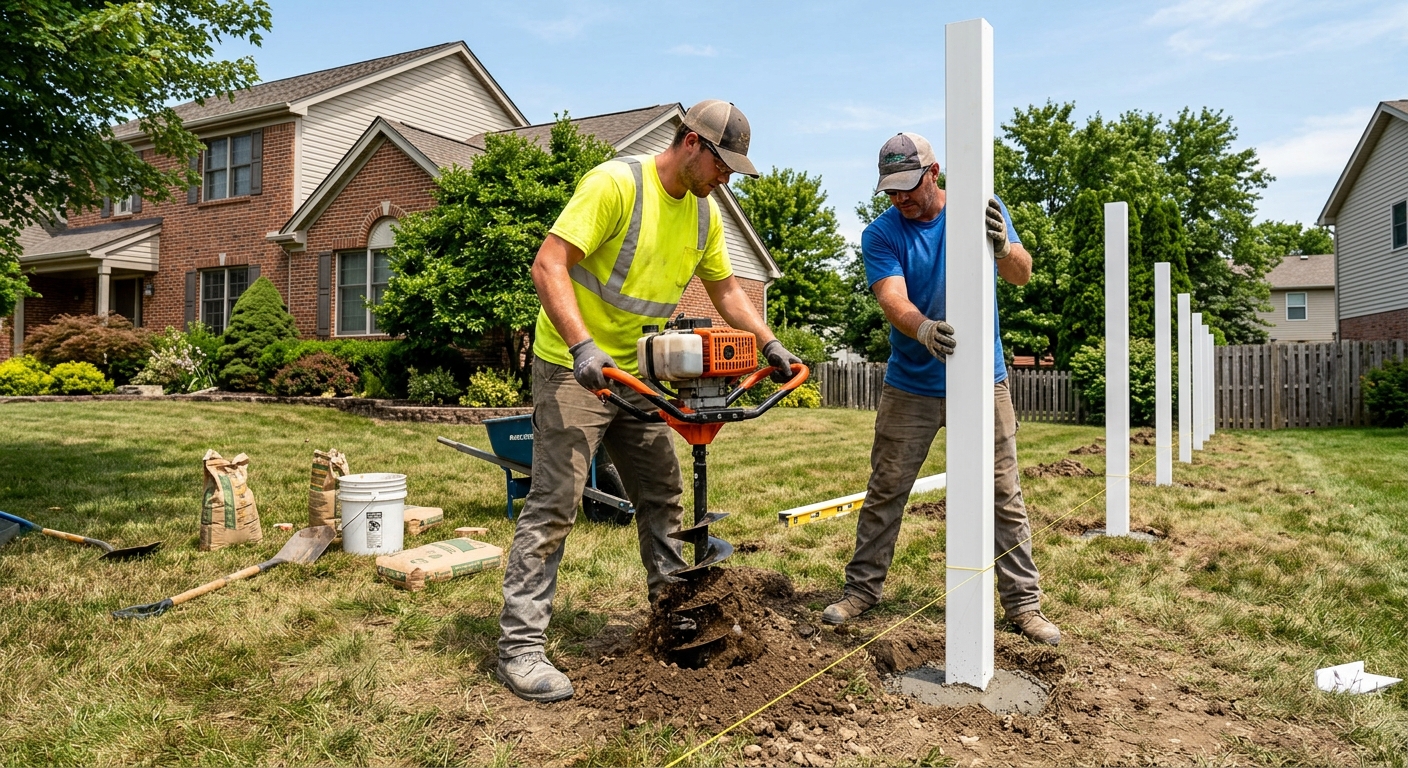
Fencing options and costs in Slave Lake
Fencing in Slave Lake is shaped by both local housing patterns and the realities of northern Alberta winters. With the town sitting at a population of 6,836 (Statistics Canada, 2021 Census), demand is steady but manageable—each single-detached home is essentially a potential fencing customer, and single-detached houses make up 50.9% of dwellings (Statistics Canada, 2021 Census). Homeownership is also a strong indicator of who initiates upgrades: 65.7% of households own, which typically means more backyard privacy, pet control, and winter-proofing projects show up every year.
In the Athabasca–Grande Prairie–Peace River region, pricing is driven heavily by climate exposure. Frost commonly pushes the frost line to about 4–6 feet, so posts often need to be set deep and, in many soils, concreted to resist frost heave and leaning over time. That deeper install adds both labour and materials. On top of that, longer freeze–thaw cycles and hard digging conditions (rock or hardpan pockets) can slow crews and change equipment needs—so your per-foot price can land near the high end of a band even when the fence “looks simple.”
In town, trade demand is especially common in newer and expanding residential pockets such as the West End area, where homeowners frequently add privacy screening and yard definition after purchase or renovations. The easiest way to compare options is to look at expected lifespan, how much upkeep they need, and the installed cost per linear foot.
| Material |
Lifespan |
Maintenance |
Privacy Rating |
Price per Linear Foot |
| Pressure-treated pine (standard wood) |
10–15 years |
Stain/seal every 2–3 years; inspect for warping |
High |
$35 – $70 |
| Cedar (natural rot resistance) |
15–25 years |
Light cleaning; reseal or stain as needed every 3–4 years |
High |
$45 – $85 |
| Vinyl / PVC (no-maintenance) |
20–30 years |
Occasional wash; check gate hardware |
High (solid/privacy styles) |
$40 – $80 |
| Chain-link (galvanized steel) |
25–40 years |
Minimal; rinse salt/debris; tighten hardware |
Low–Medium (privacy slats optional) |
$25 – $50 |
| Aluminum ornamental |
30–40 years |
Low; rinse and inspect for loose fasteners |
Medium (ornamental pickets) |
$45 – $90 |
| Composite / recycled material |
20–30 years |
Low; periodic cleaning; address hardware corrosion |
High |
$60 – $110 |
Prices are estimates only and vary by project scope, site access and material selection.
What affects the price of fencing in Slave Lake
Even when two homeowners ask for “the same” fence in Slave Lake and the broader Athabasca–Grande Prairie–Peace River region, quotes can vary by 30–50%. The main reason is that the install is rarely identical: frost depth controls post lengths and hole depth, soil type affects digging speed, and wind/snow loading influences post spacing and panel weight. Labour and mobilization also matter—rural access, machine access to the lot, and whether crews can work efficiently around trees or rocky edges can shift pricing quickly from a mid-band number to the high end.
Frost line depth is the biggest driver. In Alberta’s cold regions, posts typically must go about 1.5–2.0 m into the ground (roughly 4–6 feet frost line considerations), which means deeper augering, longer posts, and often concrete setting to prevent frost heave and leaning. That’s one reason wood and vinyl fences can end up close to the upper end of their bands when the yard has clay or hardpan. On top of that, winter and spring freeze–thaw cycles can cause extra excavation time and rework if original holes are too shallow.
Wind exposure also plays a role. Although Slave Lake is more sheltered than open Prairie ridges, the broader region still sees strong, gusty conditions—so heavier privacy panels often need tighter post spacing and stronger footings. In BC’s mild but wet conditions, wood rot risk changes the conversation; in Alberta, the “rot timeline” is usually slower, but frost damage becomes the real cost threat.
Concrete examples: (1) If you’re installing a 60–80 ft run with solid privacy panels, spacing changes can increase post count, pushing costs toward the higher end of a wood range (for example, $35–$70 per linear foot). (2) If your yard has rocky pockets, deeper holes can require more time and different auger tooling, which narrows the savings you might expect with chain-link ($25–$50 per linear foot) because labour dominates. (3) Older fences built before 1981—29.1% of homes (Statistics Canada, 2021 Census)—often require careful removal and disposal, which adds hauling time and landfill handling.
| Price Factor |
Why It Matters |
Cost Impact |
| Fence length in linear feet |
Posts, rails, and materials scale directly with total run |
Largest driver (biggest swing in total quote) |
| Post depth required |
Frost line determines the hole depth and required post length |
Higher in cold sites; deeper holes increase labour and materials |
| Post setting method |
Concrete setting stabilizes posts against heave; gravel pack suits some soils |
Concrete can add meaningful per-post cost |
| Material choice |
Vinyl/cedar/chain-link have different hardware, stiffness, and labour intensity |
Shifts the estimate across common band ranges |
| Gate count and type |
Drive-through and double gates require heavier frames and hardware |
More cost than most people expect—hinges, latches, bracing |
| Grade and terrain |
Slope needs stepped panels or raked rails to keep safe clearances |
Extra measuring, cutting and layout time |
| Old fence removal and disposal |
Hauling, disposal fees, and debris handling increase labour |
Can add a noticeable flat-fee component to total project cost |
| Permit fees and survey / property line locate |
Locates prevent encroachment; permits add administrative steps |
Usually smaller than posts, but still impacts final price |
Permits & regulations in Alberta
In Alberta, fences above a height threshold—often 2.0 m (6.5 ft) at the rear and 1.0–1.2 m (3–4 ft) at the front or corner—may require a building permit, depending on where the fence sits on the lot and local bylaw rules. Regardless of height, your fence must respect property lines and any municipal setback requirements. If you’re planning a privacy fence, it’s smart to confirm requirements before ordering materials, because the cost of redoing a fence to address setbacks can be much higher than the permit and verification steps.
Before digging any post hole, call for utility locates (Alberta One-Call). Even if you “know” there are no lines, locate requests prevent dangerous strikes and costly delays. Next, obtain a survey or a property pin locate so you’re building exactly on your boundaries—especially important in neighbourhoods where older survey work may be harder to interpret. Shared fence ownership is governed by Alberta’s line-fences legislation; if you’re updating a shared boundary, clarify who pays for materials, repairs, and upgrades in writing.
To verify a contractor in Slave Lake: (1) check the company’s Alberta licence/registration status through official provincial resources, (2) confirm you receive a current certificate of insurance with liability coverage, and (3) ask for evidence of coverage where applicable (WSIB/WCB). Don’t accept vague “we’re covered” statements—request the certificate and clearance letter wording, then verify dates are current before the first post is set.
Choosing the right fence material for Slave Lake
Choosing a fence material in Slave Lake is mostly about matching your priorities—privacy, low maintenance, budget and lifespan—to a northern climate that challenges posts at the ground line. Pressure-treated pine is the budget-friendly starting point, but it typically needs staining or sealing every 2–3 years to reduce grey weathering and protect the surface. Cedar looks great and resists rot better, so it often holds up longer visually, though it still benefits from periodic sealing. Vinyl/PVC is truly low-maintenance (wash and go), but in extreme cold it can be more brittle at fastener points; careful installation and proper hardware matter. Chain-link is the lowest cost and usually the longest-life option, but it won’t provide privacy unless you add slats or switch to a privacy style.
Because frost commonly reaches 4–6 feet in this region, post-depth requirements are not optional. For most backyard runs, you should plan around deeper post holes and robust bracing; concrete-set posts are commonly recommended where frost heave risk is higher or soil is clayey/hardpan. That said, concrete isn’t always required for every soil type—some sites can work with a properly designed gravel pack—but in Alberta winters, many homeowners choose concrete setting for peace of mind.
Wind and snow load can also change your “best” option. Heavier solid panels (wood privacy, vinyl privacy) act like sails and generally need tighter post spacing, which is one reason a wood privacy fence often trends toward the higher end of the $35–$70 per linear foot band in tougher yards. For privacy, consider where the price difference is truly justified. For instance, switching from chain-link (often $25–$50 per linear foot) to vinyl privacy ($40–$80) can be well worth it if you’re trying to block views year-round—especially if you’ll enjoy the yard more during shoulder seasons.
| Material |
Cold Tolerance |
Lifespan |
Annual Maintenance |
Best For |
Price Band |
| Pressure-treated pine |
Good (needs surface protection) |
10–15 years |
Low to moderate (inspect; stain/seal every 2–3 years) |
Budget privacy with standard performance |
$35 – $70 |
| Cedar |
Good (naturally rot resistant) |
15–25 years |
Low to moderate (reseal/stain every 3–4 years) |
Premium look and long-term appearance |
$45 – $85 |
| Vinyl / PVC |
Very good (proper installation important in deep freeze) |
20–30 years |
Minimal (wash; check hardware) |
Low-maintenance privacy |
$40 – $80 |
| Chain-link |
Excellent |
25–40 years |
Minimal (tighten/inspect) |
Security with visibility, pets, and long life |
$25 – $50 |
| Aluminum ornamental |
Excellent |
30–40 years |
Minimal (rinse; hardware checks) |
Front-yard curb appeal and durability |
$45 – $90 |
| Composite / recycled |
Good (designed for freeze–thaw durability) |
20–30 years |
Low (cleaning; periodic hardware checks) |
Privacy with wood-like look |
$60 – $110 |
How to choose a fencing contractor in Slave Lake
When you hire a fencing contractor in Slave Lake, verify coverage and credentials before you sign—because the biggest cost risks are usually workmanship issues at the ground line (posts leaning, gaps after freeze–thaw, or gate misalignment). In Alberta, confirm the company’s licensing/registration is current and ask for a certificate of insurance with liability coverage. Also request proof of WSIB/WCB coverage where applicable; you should see current dates and the correct legal business name on the paperwork. If they can’t provide documents promptly, that’s often a sign the project scope and safety process aren’t well managed.
Get 2–3 itemised written quotes, not lump sums. You want a line-by-line breakdown showing labour, materials, post setting approach (concrete vs. alternative), hardware type, gate components, and any disposal/removal charges. Read exclusions carefully: does the quote include permit assistance, utility locate coordination, property line locate, or debris haul-away? Many budget bids look good until you discover removal, disposal, or grading steps weren’t included.
Warranty matters too. Ask for the workmanship warranty length and whether it covers post-setting and framing adjustments after the first freeze–thaw cycle. Also ask about product/manufacturer warranty and whether it’s transferable if you sell the property. For payment scheduling, a healthy rule is never to pay more than 10–15% upfront; hold back a portion until completion and final walk-through. Finally, request a written start date and a completion estimate so you understand when the fence will actually be done before winter weather tightens access.
- Provide Alberta business details and confirm licensing/registration is active.
- Request certificate of insurance with liability limits and verify dates.
- Confirm WSIB/WCB coverage (where applicable) and ask for clearance wording.
- Insist on itemised quotes: posts, rails, panels, brackets, and hardware.
- Require a clear post-setting method in writing (concrete vs. approved alternative).
- Ask how they handle rocky ground, clay, and sloped yards (stepped vs. raked).
- Confirm gate specs: frame size, latch type, hinge type, and swing direction.
- Check whether old fence removal and disposal are included (and where it goes).
- Verify whether permit pulling is included or is your responsibility.
- Ask for utility locate responsibility and when the locate request is made.
- Get warranty terms in writing: workmanship scope and duration.
- Use a payment schedule with 10–15% max deposit; hold back until completion.
Red flags I commonly see with fence contractors in Slave Lake include quotes that don’t specify post depth or setting method, promises of “standard” installation without a site inspection, missing insurance/coverage documents, vague warranty language that excludes post-setting, and requests for large upfront payments with no schedule or contract details.
Frequently asked questions — fencing in Slave Lake
Who owns and maintains a shared fence?
In Alberta, shared fence situations are typically handled under line-fences principles, but the practical answer depends on who built the fence first, who benefits from it, and what your agreement says. If the fence is on a boundary and both neighbours benefit, maintenance responsibilities can be shared, but that sharing isn’t always equal—repairs may be split based on condition and reason for replacement. For a homeowner in Slave Lake, the safest approach is to talk with your neighbour early and confirm, in writing, who pays for materials, what “repair” covers, and whether improvements like upgrading from chain-link (often $25–$50 per linear foot) to a privacy fence are fully optional or shared. If the fence is failing due to normal wear, you’ll often split the repair; if one side wants a major aesthetic change, costs may be handled differently. If there’s a dispute, keep documentation (photos, measurements, and any prior agreements) and seek advice on Alberta’s line-fences rules.
How do I find my property line before fencing?
Before you set any posts in Slave Lake, identify your property line accurately—don’t rely on a guess from older fence remnants. If you have survey pins, you can request that a qualified surveyor or locator confirm pin locations; otherwise, schedule a survey or a property pin locate. This matters because even a small encroachment can lead to removal costs later. Also, plan for utility locations before digging: in Alberta you should call for utility locates (Alberta One-Call) before post holes. A good contractor will ask for your survey details up front, show where they plan to set posts, and confirm layout measurements with you onsite. If your yard is sloped or the boundary runs near a driveway, getting the line right also affects rail height and how panels “step” to avoid ugly gaps.
What's the most low-maintenance fence?
For most Alberta homeowners, vinyl/PVC privacy tends to be the lowest-maintenance option because it doesn’t need staining and only requires occasional washing and hardware checks. In Slave Lake’s freeze–thaw climate, maintenance is mostly about fasteners and gate alignment rather than surface protection—so you’ll spend more time monitoring issues that show up after winter than doing routine refinishing. Expect a vinyl privacy fence to price within typical ranges like $40 – $80 per linear foot depending on panel style and installation complexity. Cedar can also be low-maintenance compared with standard pine, but it still needs periodic resealing/staining for best appearance. Chain-link is the lowest overall cost and extremely durable, but it’s not privacy-focused unless you add slats or fabric/privacy screening.
How tall can my fence be in Slave Lake?
Fence height rules in Alberta generally depend on location on the lot (front/corner versus rear) and can trigger permitting. A common threshold used in Alberta is around 2.0 m (6.5 ft) at the rear and about 1.0–1.2 m (3–4 ft) at the front or corner—fences above those levels often require a building permit. In Slave Lake, the safest way to avoid delays is to confirm with the municipal/bylaw requirements before ordering materials, especially if you’re planning a tall privacy fence with solid panels. Tall fences also catch more wind; that can affect post spacing and the need for robust footings, which may move your quote toward the higher end of the chosen material band. If you want maximum privacy without permitting issues, many homeowners opt for a slightly lower height or an open style with screening selectively placed on the property line.
Should fence posts be set in concrete here?
In Slave Lake and the Athabasca–Grande Prairie–Peace River region, concrete-setting is often recommended because frost routinely reaches roughly 4–6 feet, and winter heave can push weakly set posts out of alignment. In practice, posts usually need to be set deep—commonly on the order of 1.5–2.0 m depending on the frost considerations for your exact site—so a proper footing system is critical. Concrete can help stabilize posts against leaning and movement over freeze–thaw cycles, especially in clayey soils or areas with hardpan/rock pockets where augering and compaction are more challenging. That said, some sites may use an approved alternative method (like a properly designed gravel pack) when soil conditions are favourable and the engineering approach is sound. The right answer is site-specific: ask your contractor to explain their post depth and setting method in writing and show you how they adjust for your ground conditions.
What's the best fence for privacy?
For privacy in Slave Lake, the best choices are typically solid privacy styles with close spacing or full panel coverage: wood privacy (often pressure-treated pine or cedar), vinyl/PVC privacy panels, or composite privacy systems. Vinyl privacy is popular because it’s low maintenance—pricing often falls in the $40 – $80 per linear foot band depending on height, panel type, and post spacing. Wood privacy can be a strong value when you want a classic look; installed costs commonly land within $35 – $70 per linear foot, but heavier solid sections may push toward the higher end if post spacing is tightened for stability. Because privacy fences act like wind sails, installers should account for wind exposure and snow load by using appropriate post spacing, bracing and robust footings (especially with Alberta’s freeze–thaw impacts). If your priority is privacy plus durability, I’d usually steer homeowners toward vinyl privacy or cedar (for appearance) when budget allows, and pressure-treated pine when you’re comfortable with periodic staining.