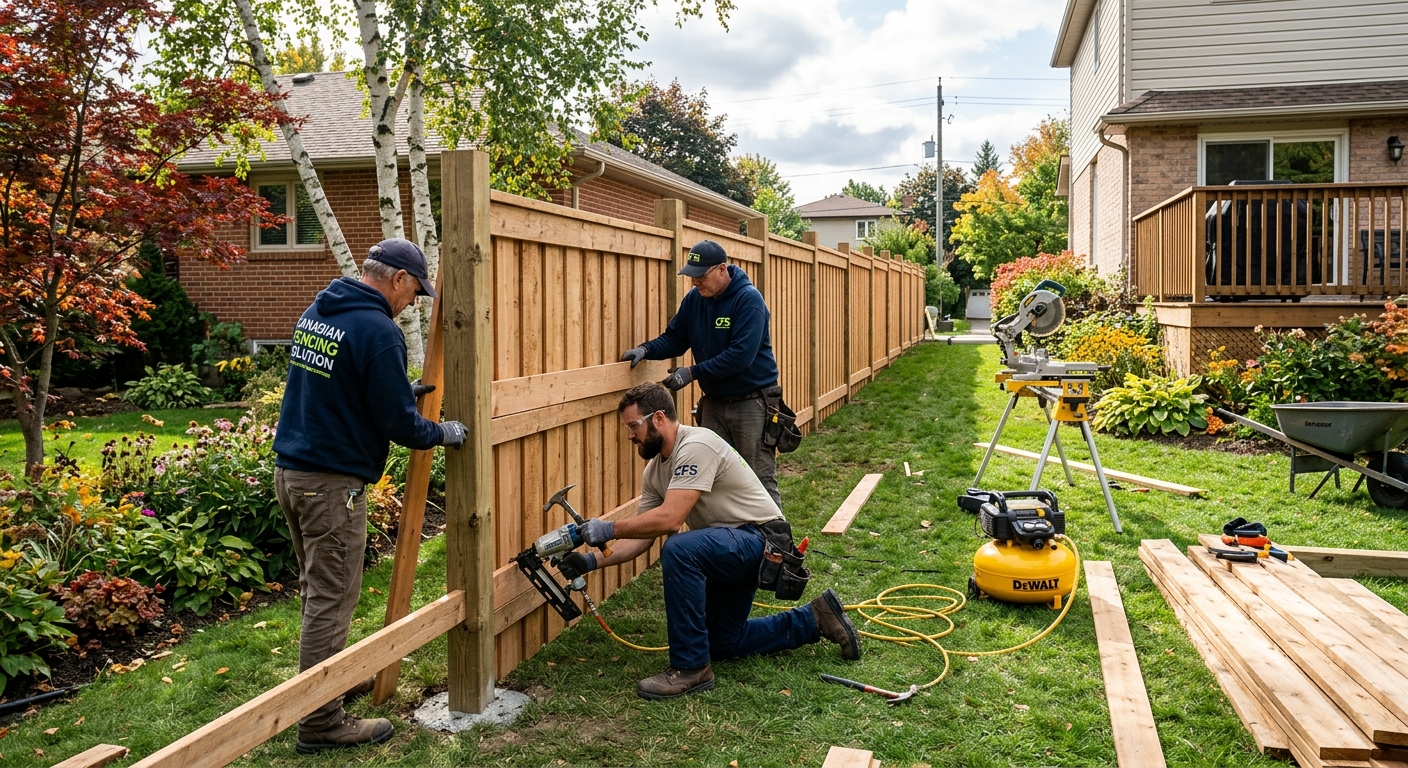
Fencing options and costs in Canmore
Canmore fencing projects start with one simple fact: the town’s built environment creates steady demand. With a population of 15,990 (Statistics Canada, 2021 Census) and a homeowner base where 66.2% of households own (Statistics Canada, 2021 Census), most fenced lots are owned and maintained by people who want durable, good-looking boundaries for decades. That’s especially true when you consider that 37.8% of dwellings are single-detached homes—each detached property typically needs a clear perimeter for safety, pets, and privacy.
In the Banff–Jasper–Rocky Mountain House economic region, costs are shaped more by mountain-foothills exposure than by schedule alone. Frost heave risk means fence posts are typically set at least 4 ft deep, and in exposed pockets deeper can be required. That depth, plus rocky/compact soils that slow augering, increases labour and concrete usage per hole. Wind also matters: many Canmore lots experience stronger gusts between buildings and around treed or sloped sections, which can push crews toward shorter bays, tighter post spacing, and heavier rails—particularly for wood privacy styles.
Contractor availability can vary through the busy season, so neighbourhood access and staging matters. In Canmore’s West Side and along the busier approaches toward the river valley, we often see higher demand because projects compete for similar machine time and because yards can be tight for equipment and spoil hauling. With that context, here are realistic price and performance bands to help you compare options before we talk your site.
| Material |
Lifespan |
Maintenance |
Privacy Rating |
Price per Linear Foot |
| Pressure-treated pine (standard wood) |
10–15 years |
Stain/seal every 2–3 years; inspect rails and pickets annually |
Medium (solid panels higher) |
$45 – $85 |
| Cedar (natural rot resistance) |
15–20 years |
Typically stain every 2–4 years; re-stain as colour greys |
High (solid privacy designs) |
$55 – $95 |
| Vinyl / PVC (no-maintenance) |
20–30 years |
Minimal cleaning; check fittings after extreme cold |
High (privacy/slats) |
$60 – $110 |
| Chain-link (galvanized steel) |
25–40 years |
Rare—occasional rinse; tighten hardware |
Low (open mesh) |
$30 – $55 |
| Aluminum ornamental |
25–35 years |
Occasional cleaning; inspect caps and hardware |
Low to Medium (decorative pickets) |
$70 – $130 |
| Composite / recycled material |
20–30 years |
Low; follow manufacturer wash/clean guidance |
Medium to High (depends on style) |
$90 – $140 |
Prices are estimates only and vary by project scope, site access and material selection.
What affects the price of fencing in Canmore
In Canmore and across the Banff–Jasper–Rocky Mountain House region, the same “fence size” can come in different ways because mountain-foothills installation is more labour-heavy than in milder or more uniform soils. It’s common to see quotes vary by 30–50% when frost-depth requirements, access constraints, and material specifics differ—especially between residential properties on sloped lots and those with easier vehicle access. Your median household income (2020) of $106,000 (Statistics Canada, 2021 Census) also means many homeowners are willing to pay for correct post depth and better longevity, which can shift the quote toward concrete-set, higher-spec systems.
Two big drivers explain much of the spread. First, frost line depth: in colder Alberta winters, posts typically must go about 1.5–2.0 m into the ground to sit safely below freeze–thaw movement. That translates into longer posts and deeper holes (often with concrete setting), raising both material and labour. Second, wind exposure: while coastal climates are wet (and BC wood rot is the headline issue), Canmore’s mountain wind loads encourage tighter post spacing and heavier rails, particularly for solid wood and vinyl privacy fences. That can narrow the “budget advantage” of some materials because the structure must be built to resist racking.
Concrete examples from Canmore: (1) an exposed rear yard on a slope often needs stepped panels, which increases layout time and sometimes rail waste; (2) a rocky, compact glacial soil situation may require slower augering and more spoil removal, which increases labour even if the fence length is unchanged. In dollar terms, a privacy wood run might start near a wood band like $45–$85 per linear foot, while a vinyl privacy run can move to $60–$110 per linear foot once we account for the post count, stronger bracing, and hardware. Chain-link often remains closer to $30–$55 because it’s lighter per bay and open designs handle wind better.
| Price Factor |
Why It Matters |
Cost Impact |
| Fence length in linear feet |
Most components scale directly with length: posts, rails, fabric/panels |
Highest—often the majority of total cost |
| Post depth required |
Frost movement dictates hole depth and post length to prevent heaving |
Can add significant labour and materials per hole |
| Post setting method |
Concrete-set posts resist lateral load and freeze–thaw better than gravel packs |
Concrete and labour add cost vs. lighter methods |
| Material choice |
Vinyl, cedar, and chain-link differ in rigidity, fasteners, and wind performance |
Large swing (vinyl vs chain-link) |
| Gate count and type |
Gates need stronger frames, hinges, and alignment bracing |
Often a meaningful add-on per gate |
| Grade and terrain |
Slopes require stepped/raked layouts, extra labour, and sometimes panel waste |
Moderate to high on sloped lots |
| Old fence removal and disposal |
Hauling and dump fees plus time to dismantle and separate materials |
Can be a sizeable add if posts are concrete-set |
| Permit fees and survey / property line locate |
Ensuring compliance and avoiding property encroachment disputes |
Usually smaller than construction, but important |
Permits & regulations in Alberta
In Alberta, fences can fall under permit requirements depending on height and placement. As a practical starting point, fences above a height threshold—commonly around 2.0 m (6.5 ft) at the rear and roughly 1.0–1.2 m (3–4 ft) at the front or corner—often trigger a building permit requirement. Even when a permit isn’t required for your exact situation, your fence must still respect property lines and local setback rules in Canmore.
Before any digging, arrange utility locates. Alberta One-Call should be used before you drill or auger post holes. Also, if you don’t already know your boundary clearly, obtain a survey or a pin locate and confirm where your property pins are. This reduces the risk of neighbour disputes and costly rework. Shared fence ownership and responsibilities are governed by Alberta’s line-fences framework, but the key for homeowners is documenting what’s on your side and what your neighbour may reasonably expect.
Step-by-step for verifying a contractor in Canmore: (1) Request their Alberta business licence details (where applicable) and confirm they’re operating as a registered contractor; (2) ask for a current certificate of insurance showing liability coverage that matches the job scope; (3) confirm WCB coverage—this is typically listed through the contractor’s WCB account information or documentation. Finally, keep copies of their insurance and coverage documents with your contract.
Choosing the right fence material for Canmore
Choosing a fence in Canmore is mostly about matching the material to your priorities: privacy, low maintenance, budget, and long-term appearance in a cold mountain-foothills climate. Pressure-treated pine is usually the lowest upfront option, but in our freeze–thaw cycles and dry-cold winds it needs staining or sealing every 2–3 years to prevent grey weathering and premature surface cracking. Cedar offers natural rot resistance and often looks better as it ages; however, it still benefits from periodic maintenance to keep colour and protect joints. Vinyl/PVC is popular because it’s essentially low maintenance, but in extreme cold it can become more brittle around fittings if the system isn’t installed correctly.
Chain-link is the best “set it and forget it” perimeter for many homeowners who don’t need privacy. It handles wind well because air passes through the mesh, and it typically costs less—often within the $30–$55 per linear foot band. Aluminum ornamental is mid-range to premium: it resists rust and looks clean year-round, but it doesn’t provide full privacy because the pickets leave gaps.
Regardless of material, frost considerations control the structure. For Canmore, posts typically need to be set around at least 4 ft deep; in exposed or frostier pockets, deeper footings are sometimes required. In practice, concrete-set posts are the safer default because they resist freeze–thaw movement and lateral racking. If you’re comparing costs, a vinyl privacy fence might be higher—often $60–$110 per linear foot—yet the price is easier to justify when you want minimal annual upkeep and long life. By contrast, pressure-treated pine at about $45–$85 per linear foot can make sense if you’re comfortable maintaining it or if the fence is mainly functional rather than “showpiece” privacy.
| Material |
Cold Tolerance |
Lifespan |
Annual Maintenance |
Best For |
Price Band |
| Pressure-treated pine |
Good (surface performance depends on finish) |
10–15 years |
Light annual inspection; stain/seal every 2–3 years |
Budget privacy or utility fencing |
$45 – $85 |
| Cedar |
Good (naturally rot-resistant) |
15–20 years |
Inspect yearly; stain every 2–4 years |
Attractive, more natural-looking privacy |
$55 – $95 |
| Vinyl / PVC |
Good when installed with proper hardware |
20–30 years |
Minimal—wash and hardware checks as needed |
Low-maintenance privacy in exposed yards |
$60 – $110 |
| Chain-link |
Very good (galvanized steel) |
25–40 years |
Rare—rinse and tighten occasionally |
Secure perimeter with airflow |
$30 – $55 |
| Aluminum ornamental |
Very good (no rust) |
25–35 years |
Minimal cleaning; check caps/hardware |
Decorative boundaries with visibility |
$70 – $130 |
| Composite / recycled |
Good (varies by product system) |
20–30 years |
Low—follow manufacturer cleaning |
Privacy with a low-maintenance promise |
$90 – $140 |
How to choose a fencing contractor in Canmore
To choose the right fencing contractor in Canmore, start with the proof. In Alberta, always verify liability insurance and WCB/WCB coverage before work begins. Ask for a certificate of insurance naming the job owner as applicable (or confirming you’re an additional insured if your contract requires it) and confirm the coverage limits are appropriate for an excavation and concrete-set post scope. For WCB/WCB clearance, request their coverage documentation or clearance letter details—reputable crews should provide it without pushing back.
Then get 2–3 itemised written quotes. You want a labour and materials breakdown (posts, rails, panels/fabric, gates, concrete/footings, hardware) rather than a single lump sum. Review what’s excluded: is old fence removal included? Are dump fees and disposal included or billed separately? Is the permit pull included if required? Ask about utility locate responsibility and whether it’s included in their schedule.
Warranty should be written down. Confirm the workmanship warranty length, the manufacturer/product warranty, and whether it’s transferable if you sell the home. Also, agree on payment terms: never pay more than 10–15% upfront, and use a holdback until completion and final walkthrough. Finally, insist on a written timeline with a start date window and an estimated completion date so you’re not left waiting during Canmore’s short weather windows.
- Provide written quote with a clear scope, measurements, and material grades
- Confirm utility locate process is scheduled before augering
- Verify liability insurance and request the certificate before any deposit
- Confirm WCB/WCB coverage or clearance letter documentation
- Insist on an itemised breakdown (labour, materials, concrete/footings, gates)
- Ask who supplies and where concrete trucks can access the site
- Clarify disposal: removal, hauling, and dump fees included or not
- Confirm permit responsibility if fence height triggers a permit
- Get gate hardware details (hinge type, latch, self-closing if requested)
- Review warranty: workmanship term, product warranty, and transferability
- Agree on payment schedule with a holdback until punch-list items are done
- Request engineering/bracing notes for wind-exposed or sloped sections
Red flags to watch for in Canmore: (1) they won’t provide insurance/WCB documentation, (2) they quote without visiting the site or discussing post depth/frost requirements, (3) they refuse to itemise labour vs materials, (4) they want a large upfront payment beyond 10–15%, and (5) they can’t explain how they’ll handle slopes (stepped vs racked) or removal of old concrete-set posts.
Frequently asked questions — fencing in Canmore
What is the cost per linear foot for fencing in Canmore?
In Canmore, fencing costs usually fall into the same local price bands used across the Banff–Jasper–Rocky Mountain House region, but your final number depends on post depth, terrain, and how many gates you’re adding. As a practical guide, chain-link is often the lowest at about $30–$55 per linear foot, while pressure-treated wood privacy fences commonly land around $45–$85 per linear foot. Vinyl/PVC typically runs about $60–$110 per linear foot, and aluminum ornamental is often $70–$130 per linear foot. The biggest reason prices move up in Canmore is that cold-climate footings require deeper, concrete-set posts in exposed conditions to resist freeze–thaw movement.
Should I repair or replace my old fence in Canmore?
Repair is usually worth it when the fence posts are still solid and the damage is limited to rails, pickets, or minor panel sections. In Canmore’s freeze–thaw conditions, however, it’s common to see problems that look small but are structural—loose posts, leaning runs, or rails pulled out of concrete. If posts have shifted or the fence line has racked, replacement typically costs less than repeated patch repairs. A good contractor will check post plumb, footing stability, and hardware corrosion before recommending a full or partial job. If your fence is older (for example, installed decades ago with shallow holes), a replacement may also be the time to correct frost-safe post depth and reduce future leaning.
How do I handle a fence dispute with a neighbour in Alberta?
If you’re dealing with a boundary disagreement in Alberta, start with facts: confirm where your property line is (survey pins or a locate) and document fence location with photos and measurements. Don’t assume the current fence is the legal boundary. Because Alberta’s line-fences rules govern shared fence responsibilities, it’s best to communicate in writing and agree on what portion sits on each property. If a permit or compliance issue is involved, ask your contractor to describe the work planned and how it respects property lines and setbacks. A smart first step is a neutral on-site measurement and, when needed, a surveyor’s confirmation—this prevents costly rework and escalation. Keeping your quote, drawings, and proof of utility locates also helps.
What fence style offers the best wind resistance in Canmore?
For wind resistance in Canmore’s mountain-foothills setting, open designs generally perform better because they let air pass through. Chain-link is usually the most wind-tolerant option, since the mesh reduces sail effect, and it also tends to stay stable when panels are well tensioned. Ornamental aluminum can also hold up well because it’s lightweight and not a full solid wall, though post spacing and bracing still matter. Solid privacy fences (wood or vinyl) can work in Canmore, but they require careful engineering choices: tighter post spacing, heavier rails, proper corner bracing, and deep concrete-set footings to resist racking. If wind is a primary concern, we often recommend shorter bays and stronger framing for solid styles.
How much does a fence cost in Canmore?
The total price depends heavily on the linear footage, gate count, slope, and how deep posts must be set in your specific yard. For budgeting, homeowners often start with the per-linear-foot bands: chain-link may be around $30–$55 per linear foot, wood privacy around $45–$85 per linear foot, vinyl/PVC around $60–$110 per linear foot, and aluminum ornamental around $70–$130 per linear foot. In Canmore, the most common cost jumps come from concrete-set posts for frost protection and from removal/disposal of an old fence—especially if it was set in concrete. If you share your approximate fence length, height, and whether you need one or more gates, we can translate the local bands into a more accurate range for your scope.
How deep should fence posts be for Canmore's frost?
In Canmore, fence post depth should be planned around frost protection and freeze–thaw movement. Locally, that typically means setting posts at least 4 ft deep, with deeper installations often required in exposed pockets or where ground conditions are more frost-prone. In practice, that often works out to roughly 1.5–2.0 m into the ground, and many residential projects use concrete-set posts rather than tamped gravel to keep the fence stable under lateral loads and winter cycles. The exact depth should be confirmed during an on-site assessment because soil type, slope, and exposure can affect frost behaviour. A contractor who discusses frost depth and footing method before quoting is usually aligning with the right approach for Alberta conditions.