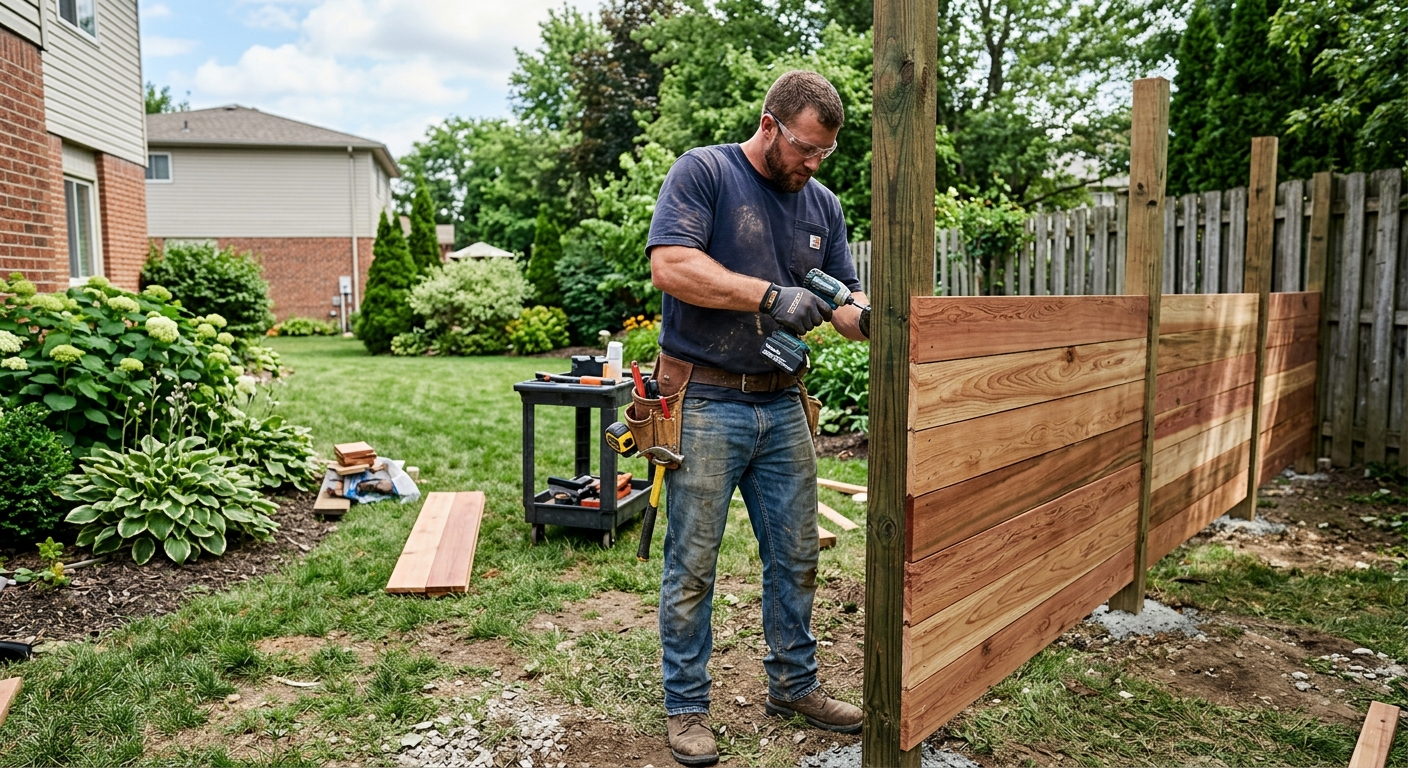
Fencing options and costs in The Hamptons
In The Hamptons, Alberta, choosing a fence usually comes down to three things: how much privacy you want, how much upkeep you can realistically handle, and what your yard experiences during Calgary-region freeze–thaw winters. With a 2021 population of 9,405 in the area (Statistics Canada, 2021 Census), demand stays steady year to year—especially because many neighbourhoods have family homes where rear-lot privacy matters. The local housing mix also creates a strong installer pipeline: each detached property is a potential fence project, and new builds plus landscaping refreshes keep contractors busy.
Calgary’s Prairie continental climate is the cost-shaping factor. Long freeze–thaw cycles and open exposure mean fence posts must be protected against heaving. In practice, that pushes post depth and concrete setting: you’ll often see posts set around 4 ft (≈120 cm) deep in Calgary-area guidance to get below the regional frost line and reduce movement. Wind loading then influences spacing and bracing, particularly for solid wood or vinyl privacy panels, which can rack in high winds.
In The Hamptons, fencing trade demand is especially noticeable around the established residential pockets and service corridors near Hamptons Estates (where backyards commonly have wider spans and gate traffic). As a result, scheduling and access can affect your quote as much as material.
Below is a practical snapshot of common materials and what they typically cost installed in The Hamptons, Alberta, so you can compare apples to apples before you ask for an itemised quote.
| Material |
Lifespan |
Maintenance |
Privacy Rating |
Price per Linear Foot |
| Pressure-treated pine (standard wood) |
12–18 years |
Stain/seal every 2–3 years; occasional rail board replacement |
High (solid panels) |
$40 – $80 |
| Cedar (natural rot resistance) |
18–25 years |
Seal/stain every 2–4 years; inspect for warping |
High (solid or close boards) |
$55 – $95 |
| Vinyl / PVC (no-maintenance) |
20–30 years |
Occasional wash; check hardware after extreme cold |
High (solid privacy styles) |
$45 – $90 |
| Chain-link (galvanized steel) |
25–40 years |
Minimal; rinse as needed, tighten hardware |
Low to medium (see-through) |
$25 – $55 |
| Aluminum ornamental |
30–40 years |
Low; wash and check gate alignment |
Low (decorative pickets) |
$70 – $120 |
| Composite / recycled material |
20–30 years |
Low; periodic cleaning; inspect posts/fasteners |
Medium to high (style-dependent) |
$60 – $110 |
Prices are estimates only and vary by project scope, site access and material selection.
What affects the price of fencing in The Hamptons
In The Hamptons, Alberta, two quotes for the “same” fence can land 30–50% apart because Calgary-area pricing is heavily driven by site conditions and structural requirements, not just material. Even within the Calgary economic region, contractors face different access constraints, excavation difficulty, and wind exposure assumptions—so labour and installation scope can swing fast.
The biggest technical driver is frost protection. Fence posts generally need to be set about 4–6 inches (≈10–15 cm) below the design frost depth to help prevent heaving, which commonly means digging roughly 1.5–2.0 m into the ground. That depth translates into longer posts, more concrete for set footings, and more time per hole. In lighter regions, post depth demands are less aggressive; here, it’s a primary cost driver for both wood and vinyl privacy fences.
Next is wind loading on the Prairies. Open exposure means heavier panels—solid wood or vinyl—need tighter post spacing and stronger hardware to resist racking. Chain-link usually costs less because it’s more breathable; it doesn’t catch wind the same way, so it often sits lower on the budget end. In broad terms, you’ll see chain-link and budget options closer to $25 – $55 per linear foot, while privacy-focused wood or vinyl often move into the mid–upper range around $40 – $80 or $45 – $90.
Concrete examples from typical Hamptons projects: (1) A backyard line with frost-depth post settings plus concrete footings usually increases labour and concrete volume compared with a gravel-set approach. (2) Sloped yards that require stepped or raked panels increase layout time and hardware adjustments. (3) Removing an older fence with buried posts can add disposal costs and extra excavation, even when the new fence footprint is the same length.
| Price Factor |
Why It Matters |
Cost Impact |
| Fence length in linear feet |
Everything scales per foot: materials, labour, and hardware |
Largest driver; small changes in length can noticeably change total |
| Post depth required |
Frost line determines hole depth and post length to reduce heaving |
Can add time and concrete; a major reason Calgary quotes trend higher |
| Post setting method |
Concrete vs. gravel pack vs. driven posts affects stability |
Concrete-set posts typically cost more but perform better in freeze–thaw cycles |
| Material choice |
Vinyl, cedar and pressure-treated wood respond differently to wind and cold |
Material pricing differences plus framing/bracing requirements |
| Gate count and type |
Gates require heavier frames and alignment work |
More labour and hardware; drive-through gates cost more than walk-through |
| Grade and terrain |
Slopes require stepped panels or racking adjustments |
Extra layout time and potential material waste |
| Old fence removal and disposal |
Demo and hauling add labour and dump fees |
Often a meaningful add-on, especially with buried posts |
| Permit fees and survey / property line locate |
Required approvals and accurate layout prevent rework |
Can add administrative and service costs; protects against boundary disputes |
Permits & regulations in Alberta
In Alberta, fence permissions are largely about height and where the fence sits relative to property lines and roadways. For many residential situations, fences above a height threshold—commonly around 2.0 m (6.5 ft) at the rear and about 1.0–1.2 m (3–4 ft) at the front or corner—often trigger a building permit requirement, depending on the municipality’s specific bylaw interpretation. Even if a permit isn’t required for your exact height, you still need to respect your property line and any setback rules.
Before digging any post holes, make utility locates your first step. In Alberta, you should use the province’s one-call system for underground services (Alberta One-Call). If you haven’t already, obtain a survey or locate your property pins before installing—this is one of the fastest ways to avoid expensive encroachment disputes.
Shared fence ownership and responsibilities are typically governed by provincial line-fences legislation. Practically, that means discussing maintenance and repair expectations in writing with the neighbour before you build or replace a dividing fence.
To verify a contractor in The Hamptons: ask for their Alberta licence (if applicable to their work scope), liability insurance, and proof of coverage for worker protection (WSIB/WCB coverage). Then check documentation directly—look for the online registry entry (when available), review the certificate of insurance for active dates and limits, and request a clearance letter or account confirmation where required. A reputable contractor won’t hesitate to provide these up front.
Choosing the right fence material for The Hamptons
Choosing the right fence material for The Hamptons means matching the product to how your yard behaves in Calgary-region winters: freeze–thaw movement, wind exposure, and snow loading. Pressure-treated pine is typically the most budget-friendly path, but it isn’t “set and forget.” To reduce grey weathering and premature checking, you should plan on staining or sealing every 2–3 years. Cedar looks better for longer and resists rot more naturally; however, it still benefits from periodic sealing to hold colour and prevent warping.
Vinyl / PVC offers the lowest ongoing upkeep—wash it a couple of times during the season and you’re usually done—but in Alberta’s cold snaps, you need proper hardware and post anchoring. Vinyl can crack if installed with weak bracing or if post settings don’t account for frost movement. Chain-link is the long-life, lowest-cost option, but it delivers little privacy unless you add slats or grow vegetation alongside it. Aluminum ornamental is rust-resistant and durable, but it’s best for curb appeal rather than privacy because pickets don’t block wind or sightlines.
For Calgary’s frost line, solid privacy fences usually benefit from concrete-set posts to reduce heaving, especially for 6 ft privacy panels and gate posts. Wind can also force closer spacing and stronger rails, which is why privacy materials commonly land in the mid–upper pricing bands: a typical wood fence may track around $40 – $80 per linear foot, while vinyl privacy often sits around $45 – $90. A concrete example: if upgrading from chain-link at roughly $25 – $55 per linear foot to a solid vinyl privacy run, the added cost is usually justified when you’re protecting outdoor living space from wind and visibility—especially in open backyard orientations.
| Material |
Cold Tolerance |
Lifespan |
Annual Maintenance |
Best For |
Price Band |
| Pressure-treated pine |
Good in winter with correct installation and sealing |
12–18 years |
Low–moderate (inspect; clean lightly; stain as needed every 2–3 years) |
Budget privacy where you’re willing to maintain |
$40 – $80 |
| Cedar |
Good; benefits from proper post setting in freeze–thaw |
18–25 years |
Low–moderate (seal/stain every 2–4 years) |
Premium look with better natural rot resistance |
$55 – $95 |
| Vinyl / PVC |
Very good if braced and anchored correctly |
20–30 years |
Very low (wash; inspect fittings after winter) |
Low-maintenance privacy |
$45 – $90 |
| Chain-link |
Excellent; galvanized steel tolerates cold well |
25–40 years |
Very low (tighten hardware; rinse) |
Security/containment on a tighter budget |
$25 – $55 |
| Aluminum ornamental |
Excellent (no rust; tolerates freeze–thaw) |
30–40 years |
Very low (wash; check gate alignment) |
Decorative front or side fencing |
$70 – $120 |
| Composite / recycled |
Good; needs correct substructure and anchoring |
20–30 years |
Low (clean; periodic hardware checks) |
Low-maintenance privacy/appearance |
$60 – $110 |
How to choose a fencing contractor in The Hamptons
When you’re hiring a fencing contractor in The Hamptons, start by checking credentials the right way: Alberta coverage and site safety matter when you’re excavating for frost-depth posts. First, ask for proof of liability insurance (active certificate of insurance) so you’re covered if property damage or a vehicle incident happens during the build. Next, confirm worker protection coverage (WSIB/WCB as applicable) and request the clearance letter or account verification. Then, verify licensing/registration where applicable by checking the relevant online registry and matching company details to the quote and invoice.
Get 2–3 itemised written quotes, not lump sums. You want a breakdown that separates materials from labour and lists key assumptions: post depth, post setting method (concrete vs. gravel pack), panel spacing, gate frames/hardware, and whether removal/disposal of the old fence is included. Ask whether the contractor will pull permits if required and whether survey/property line locating is part of their scope.
Warranty should be specific. Confirm the workmanship warranty length and what it covers (for example, loose rails, post movement, gate sag). Also ask about the manufacturer warranty on boards, pickets, vinyl components or rails, and whether it’s transferable to a new homeowner.
Payment schedule matters in Alberta. Avoid contractors asking for full payment up front; a good rule is no more than 10–15% deposit, with the balance tied to measurable completion milestones. Finally, get a written start date and realistic completion estimate, especially because winter conditions and concrete curing can affect timelines.
- Ask for a certificate of liability insurance and verify policy dates and limits before work starts.
- Confirm WSIB/WCB coverage and request a clearance letter or proof of good standing.
- Require an Alberta licence/registration where applicable to their work scope and confirm it matches the quote.
- Get 2–3 quotes with labour and material line items (not a single total).
- Ensure the quote states post depth and footing method (typically frost-depth excavation and often concrete setting).
- Ask how they handle wind loading—panel bracing, post spacing, and gate reinforcement.
- Confirm whether old fence removal, buried-post extraction, and dump disposal are included.
- Ask whether they will locate property pins/survey reference or if you’re providing a survey.
- Check gate specs: frame type, hinges, latch quality, and whether drive-through gates include double-leaf hardware.
- Review the warranty in writing: workmanship term, product term, and any exclusions.
- Discuss payment terms; limit upfront to 10–15% and request holdback until completion.
- Get start date, material lead time, and completion estimate documented.
In The Hamptons, common red flags include: (1) a quote that doesn’t specify post depth or setting method, (2) no written warranty details for workmanship, (3) asking for most of the payment upfront before digging or layout, (4) vague language like “standard installation” without gate/bracing specs for privacy fences in wind-exposed yards, and (5) refusing to provide insurance/WSIB/WCB documentation during your contractor review.
Frequently asked questions — fencing in The Hamptons
Wood vs vinyl vs aluminum fence — which is best?
In The Hamptons, Alberta, “best” depends on whether your priority is privacy, upkeep, or appearance. Wood (pressure-treated pine) is usually the best value for solid privacy, but you should plan for staining or sealing every 2–3 years to reduce weathering. Vinyl / PVC typically wins if you want a low-maintenance privacy fence; expect it to price mid-range, often aligning with the $45 – $90 per linear foot band for installed privacy styles, and it generally holds up well in Alberta cold when posts are set properly for frost protection. Aluminum ornamental is excellent for durability and curb appeal, but it won’t give privacy because of the picket design.
Do I need a permit to build a fence in Alberta?
It can be required in Alberta when your fence exceeds certain height thresholds and sits in applicable front/corner/rear positions. In many common residential scenarios, a permit is often triggered around 2.0 m (6.5 ft) at the rear and roughly 1.0–1.2 m (3–4 ft) at the front or corner, but the exact requirement depends on the local interpretation of setbacks and height rules. Regardless of permit needs, you must respect property lines and municipal fencing/setback bylaw limits. For The Hamptons homeowners, the safest approach is to ask your contractor to confirm whether permits apply to your planned height, and to ensure utility locates are completed before digging.
How long does a wood fence last in The Hamptons?
A properly built wood fence in The Hamptons, with posts set for frost movement and good fastening/bracing, typically lasts about 12–18 years for pressure-treated pine. If you choose cedar and maintain it, you can often stretch to around 18–25 years. The long freeze–thaw cycles in the Calgary region increase the risk of post heaving and rail movement, which is why installation matters as much as the material. If you skip sealing, you may see faster greying, warping, and board splitting—especially on solid privacy runs that catch wind. When comparing quotes, don’t only compare price per foot; compare how deep posts are set and whether concrete setting is included for 6 ft fence lines and gate posts.
Who owns and maintains a shared fence?
Shared fences are governed by provincial line-fences legislation in Alberta, but the practical details still depend on where the fence sits relative to the boundary and the arrangement between neighbours. In many cases, neighbours share responsibility for maintenance and repairs, particularly for boundary-dividing fences. For homeowners in The Hamptons, it’s smart to confirm ownership and boundary placement before you remove or replace anything, ideally with a survey or property pin locate. If you’re changing the fence height/material beyond what existed, discuss it first—because disagreements are common when one side expects the other to share costs. A written agreement covering maintenance responsibilities and future replacement planning can prevent disputes.
How do I find my property line before fencing?
Before you install posts in The Hamptons, confirm the property line so you don’t build on a neighbour’s land. The most reliable method is getting a survey or having your property pins located and marked by a surveyor or qualified locate service. If pins already exist, ask your contractor to reference them during layout and include that step in the scope. Avoid guessing from landscaping features or old fence footprints—Prairie fences often shift over the years due to freeze–thaw movement, so the “old fence line” isn’t automatically the boundary line. Also complete utility locates before digging, using Alberta’s one-call process, so your post holes don’t damage buried services.
What's the most low-maintenance fence?
For low maintenance in Alberta’s climate, vinyl / PVC is usually the easiest option: it typically needs only occasional washing and hardware checks, and it doesn’t rot like untreated wood. Many homeowners choose vinyl privacy styles because they can keep the appearance year to year with minimal effort. Another very low-maintenance choice is chain-link, which tends to be the lowest cost and offers long service life; it commonly lands in the $25 – $55 per linear foot range installed, but you’ll sacrifice privacy unless you add slats or screening plants. Aluminum ornamental is also low-maintenance and won’t rust, but again it’s generally not a privacy barrier. In The Hamptons, the key to “low maintenance” is still proper post setting for frost protection so the fence doesn’t loosen after winter.