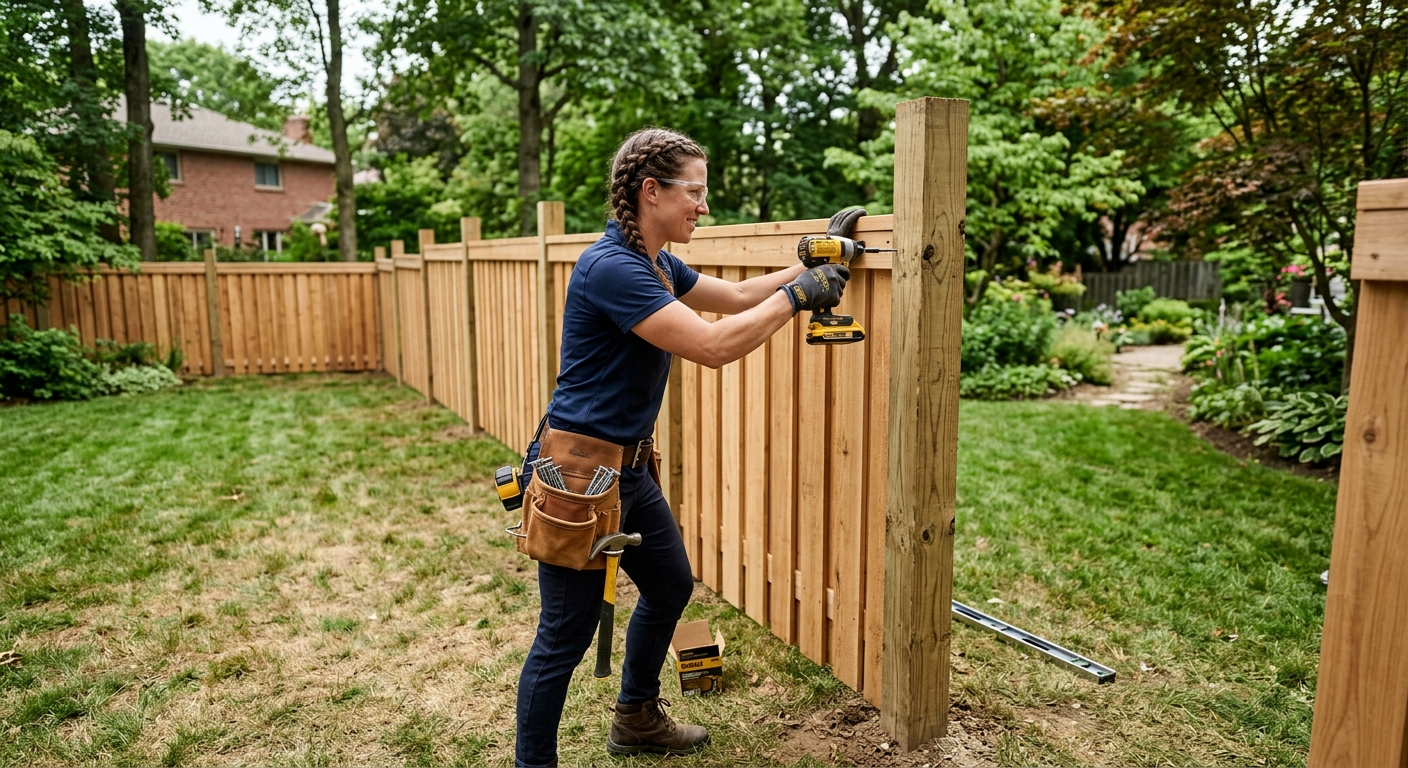
Fencing options and costs in Camrose
Camrose homeowners typically choose fencing based on privacy, wind durability, and how often they want to maintain boards or finishes. With 62.4% of local dwellings being single-detached homes (Statistics Canada, 2021 Census), there’s steady demand for backyard and side-yard fencing because each detached property tends to need a clear boundary, gates, and wind-toughening at corners. Homeownership is also high at 65.9% of households, which often means longer-term investments in materials rather than short-term repairs (Statistics Canada, 2021 Census).
In the Camrose–Drumheller economic region, pricing is shaped by deep Prairie frost and frequent strong winds. Frost depth across much of Alberta is commonly in the 1.5–2.1 m (5–7 ft) range, so posts for permanent residential fencing are typically set about 90 cm or deeper and at least 15 cm below the frost line to reduce frost heave and leaning. Where clay or poorly draining soils are present, crews often need deeper holes and more concrete, increasing labour time per post.
Availability can also influence cost. In town-area builds near major routes, contractors can work efficiently with truck access and shorter material runs, while rural or exposed acreage-style lots near sites like the Big Knife or areas toward the industrial edges often need heavier posts, closer spacing, and more engineered installation. On average, most homeowners in Camrose compare at least two categories: a maintenance-focused option (cedar or pressure-treated pine) versus a low-maintenance build (vinyl/PVC or metal).
Use the table below to compare typical lifespan, maintenance, privacy level, and price range per linear foot before you request an itemised quote.
| Material |
Lifespan |
Maintenance |
Privacy Rating |
Price per Linear Foot |
| Pressure-treated pine (standard wood) |
8–15 years |
Stain/seal every 2–3 years |
7/10 |
$45–$80 |
| Cedar (natural rot resistance) |
15–25 years |
Light staining every 2–4 years |
8–10 |
$60–$95 |
| Vinyl / PVC (no-maintenance) |
20–30 years |
Rinse wash; no staining |
9/10 |
$70–$120 |
| Chain-link (galvanized steel) |
20–35 years |
Occasional tension/spot touch-up |
2–4/10 |
$30–$60 |
| Aluminum ornamental |
25–40 years |
Occasional wash; no rust |
3–6/10 |
$65–$110 |
| Composite / recycled material |
20–30 years |
Minimal cleaning; avoid harsh abrasives |
8–10 |
$85–$130 |
Prices are estimates only and vary by project scope, site access and material selection.
What affects the price of fencing in Camrose
In Camrose, two quotes for what looks like the same fence can still land 30–50% apart because the “hidden” drivers—post engineering, wind design, soil conditions, and removal/disposal—change labour and material quantities. Even within the broader Alberta market, teams price differently depending on whether they plan for deep, concrete-set footings or lighter methods, and whether they’re building to handle Prairie wind exposure with heavier corner posts and tighter spacing.
The biggest lever is frost. Local frost depth is commonly in the 1.5–2.1 m (5–7 ft) range, and proper installation often means setting posts about 90 cm or deeper and keeping concrete and post bottoms at least 15 cm below the frost line. That typically means longer posts, deeper holes, more concrete per post, and slower production—pushing wood projects toward the upper end of the $45–$80 band and moving vinyl and metal toward the $70–$120 band when engineered spacing and heavier hardware are used.
Wind also matters. On open Prairie lots, privacy fences (especially vinyl and wood) need stronger framing and closer post spacing so panels don’t rack or blow out. In town-lot locations with some shelter, crews can sometimes follow standard spacing, but gate areas still require reinforced posts.
Concrete examples from Camrose jobs: (1) a clay-leaning backyard with poor drainage usually needs deeper hole prep and more concrete, adding time and increasing per-post cost; (2) a sloped yard toward the edges of town commonly requires stepped or raked panels, which increases layout labour and material waste; (3) removal of an old fence plus hauling to the proper disposal site can add a noticeable line item because dismantling and transport are slower than new-build assembly.
| Price Factor |
Why It Matters |
Cost Impact |
| Fence length in linear feet |
The more footage, the more posts, rails and fasteners needed. |
Highest driver; typically scales directly with total cost. |
| Post depth required |
Frost line determines hole depth and post length. |
Deeper/frost-protected installs add concrete and labour time. |
| Post setting method |
Concrete vs. gravel pack vs. driven posts affects stability. |
Concrete-set posts are usually higher but reduce leaning risk. |
| Material choice |
Vinyl, cedar, and chain-link have different rail thickness and hardware needs. |
Vinyl/metal typically costs more than basic wood/chain-link. |
| Gate count and type |
Gates require heavier hinges, latches, and reinforced posts. |
Drive-through and double gates can add significant cost. |
| Grade and terrain |
Slopes require stepping/racking and can change panel quantities. |
More layout time and possible extra materials/waste. |
| Old fence removal and disposal |
Dismantling and hauling add labour and dump fees. |
Can add a noticeable fixed charge plus labour hours. |
| Permit fees and survey / property line locate |
Setbacks and exact lines can require locating services. |
May add cost depending on your lot complexity and height. |
Permits & regulations in Alberta
In Alberta, fencing rules are typically tied to height and location. As a homeowner in Camrose, you should expect that fences above a height threshold—commonly around 2.0 m (6.5 ft) at the rear and about 1.0–1.2 m (3–4 ft) at the front or corner—often require a building permit. Regardless of height, your fence must respect property lines and municipal setback bylaws, so the exact placement matters as much as the material.
Before any post holes are dug, call for utility locates through Alberta One-Call. This step prevents costly utility hits and protects you from delays. If there’s any doubt about the line, get a survey or at least a property-pin locate before you install—this is one of the most common causes of disputes after the fact.
Shared fence ownership and boundary responsibilities are guided by provincial line-fences legislation, which means it’s smart to document who owns which side and how costs are handled, especially for taller privacy fences.
Contractor verification checklist (do this before signing): (1) ask for their Alberta business licence details (and confirm the company is registered/active in the correct jurisdiction), (2) request a Certificate of Insurance showing liability coverage, (3) verify WCB coverage/clearance for fence crews, and (4) keep copies of both the certificate and clearance letter for your records. A reputable crew won’t hesitate—they should treat it as routine documentation, not a favour.
Choosing the right fence material for Camrose
Choosing the right fence in Camrose is really about matching material behaviour to our cycles of deep frost, freeze-thaw, and Prairie wind. Pressure-treated pine is usually the most budget-friendly option, but it needs staining or sealing every 2–3 years to prevent grey weathering and keep boards from cupping. Cedar has better natural rot resistance and typically looks more premium, but you still want periodic staining and proper top and bottom sealing. Vinyl/PVC is popular because it’s low maintenance, yet in extreme cold it can become brittle if installed poorly or if panels are under-supported—so correct post depth and spacing matter as much as the material itself. Chain-link is the lowest upfront cost and can last decades, but it won’t give privacy without additional screening. Aluminum ornamental provides a clean, no-rust look and mid-range costs, while composite/recycled options aim for privacy with less upkeep, though they cost more per linear foot.
For Camrose–Drumheller, post depth is the foundation. With frost often in the 1.5–2.1 m (5–7 ft) range, permanent residential fences typically need posts set roughly 90 cm or deeper and at least 15 cm below the frost line. In exposed wind zones, we also tighten post spacing and use heavier corner and gate posts so the fence doesn’t rack during winter winds and spring thaw. Where clay or poor drainage is present, expect more concrete per post and slower installation, because stable footings reduce future leaning.
Dollar example: if you’re comparing standard pressure-treated wood versus vinyl privacy, wood may land near the lower end of the $45–$80 band, while vinyl privacy often sits closer to the $70–$120 band. That difference is frequently justified by deeper engineered posts, heavier framing for wind, and the fact that you won’t be restaining boards every couple of years—an important consideration for homeowners when the housing stock includes many properties built before 1981 (47.7% built before 1981), where surrounding grounds and drainage can vary widely from lot to lot.
| Material |
Cold Tolerance |
Lifespan |
Annual Maintenance |
Best For |
Price Band |
| Pressure-treated pine |
Good with proper installation |
8–15 years |
Low to moderate (2–3 year staining cycle) |
Budget privacy with manageable upkeep |
$45–$80 |
| Cedar |
Good (naturally rot-resistant) |
15–25 years |
Low to moderate (2–4 year staining) |
Better appearance and longer service life |
$60–$95 |
| Vinyl / PVC |
Very good if supported correctly |
20–30 years |
Very low (rinse/wash as needed) |
Low maintenance and strong privacy panels |
$70–$120 |
| Chain-link |
Excellent |
20–35 years |
Very low (tension/spot checks) |
Security and durability on a tight budget |
$30–$60 |
| Aluminum ornamental |
Excellent |
25–40 years |
Very low (occasional wash) |
Front-yard curb appeal and longevity |
$65–$110 |
| Composite / recycled |
Good (avoid harsh impact) |
20–30 years |
Low (periodic cleaning) |
Privacy look with reduced upkeep |
$85–$130 |
How to choose a fencing contractor in Camrose
When you hire a fencing contractor in Camrose, verify three things before money changes hands: licensing/business registration, liability insurance, and WCB/WCB-equivalent coverage for workers. Ask for documentation and check it against the dates on the certificates. For insurance, request a Certificate of Insurance showing general liability and confirm it lists your property address as the job site (or at least the insured party clearly). For workers’ compensation, ask for a clearance letter or proof of coverage for the fencing crews doing the work—then keep a copy with your contract.
Get 2–3 itemised written quotes that break out labour and materials separately (posts/rails/panels, concrete, hardware, gates, and any fencing removal). A lump-sum quote with vague wording is hard to compare, especially when post depth and setting method can shift cost materially in Alberta’s frost conditions. Carefully review what’s excluded: permit pulls, locating/survey costs, concrete disposal, cleanup, and whether the quote includes removing your old fence and hauling it away.
Warranty matters too. Confirm the workmanship warranty length and what it covers (for example, post leaning or panel fastening issues). Also note the manufacturer warranty on materials and whether it’s transferable to a new homeowner. Finally, payment schedules should be conservative: never pay more than 10–15% upfront, and use a holdback until the fence is complete and measured for line and grade.
Request a written start date and a completion estimate that accounts for frost scheduling, site access, and how many crews will be on site.
- Ask for proof of Alberta insurance and workers’ compensation coverage before signing.
- Confirm they specify post depth and setting method (concrete-set vs. gravel pack vs. alternatives).
- Require an itemised quote with labour, materials, concrete, hardware, and gate upgrades broken out.
- Check whether old fence removal and disposal are included (and if disposal fees are covered).
- Confirm permit pull responsibility for fences near or above common height thresholds.
- Make sure utility locates and any locate/survey allowance are addressed in writing.
- Verify warranty terms: workmanship duration and manufacturer coverage details.
- Request a timeline with key steps: layout, post install, panel build, gate install, cleanup.
- Look for a clear plan for sloped yards (stepped vs. raked panels) and how heights will be matched.
- Ensure gate hardware is specified (latch type, hinges rating, and reinforced posts).
- Confirm the crew’s approach to Prairie wind loads (heavier corners/end posts, spacing).
- Avoid contractors who pressure you for large deposits or won’t provide documentation.
Red flags to watch for: a quote that doesn’t specify post depth or says “standard posts” without frost context; refusing to provide an insurance certificate or workers’ compensation proof; quoting only panel prices while leaving concrete, gates, or disposal vague; and starting without utility locates or a clear line-and-grade plan.
Frequently asked questions — fencing in Camrose
How do I find my property line before fencing?
In Camrose, the safest approach is to confirm your pins or get a survey before any post holes are dug. Start by checking your property documents (plans of subdivision and any previous fence agreements), then order a pin locate or hire a surveyor to mark the corners and line. If you’re unsure, don’t “approximate” from neighbouring fences—wind-toughened fences still need correct placement. Also call Alberta One-Call for utility locates so your contractor can dig safely near services. If your fence will be near a shared boundary, review provincial line-fences principles and keep communication respectful and documented. A good contractor should offer a clear layout plan for line and grade before installation begins.
What's the most low-maintenance fence?
For many homeowners in Alberta prairie conditions, vinyl/PVC is the most low-maintenance option because it doesn’t require staining and is resistant to rot. It’s typically priced in the $70–$120 band, but it can reduce the recurring hassle of board finishes. Aluminum ornamental is also low maintenance and won’t rust, though it’s not usually a privacy fence. Chain-link is very durable and easy to keep up, but it doesn’t provide privacy on its own. With wood (pressure-treated pine or cedar), you’ll usually plan for maintenance cycles—staining every 2–3 years for pine and roughly every 2–4 years for cedar. The “low maintenance” decision should also factor in correct post depth for frost, so you don’t end up replacing tilted sections later.
How tall can my fence be in Camrose?
Height limits depend on where the fence sits on your lot (front/corner vs. rear) and local setback bylaws. A common Alberta guideline used in permitting discussions is around 2.0 m (6.5 ft) at the rear and about 1.0–1.2 m (3–4 ft) at the front or corner—fences above those thresholds often require a building permit. Because rules can be detailed for specific sites, confirm with the City of Camrose permitting process and ask your contractor to include whether a permit pull is required for your design. If you’re planning a taller privacy fence, it’s also worth planning gate locations carefully to avoid placing reinforced posts in awkward spots that complicate setbacks. Your contractor should tell you early, not after you’ve purchased materials.
Should fence posts be set in concrete here?
For most permanent residential fencing in Camrose, concrete-set posts are commonly recommended because Alberta’s frost depth can be in the 1.5–2.1 m (5–7 ft) range. Proper installation usually places the post bottom roughly 15 cm below the design frost line, which often translates to setting posts about 90 cm or deeper. Concrete helps stabilize posts against frost heave and reduces leaning over time—especially in colder micro-climates or where clay/poor drainage makes tamped gravel less reliable. That said, whether concrete is required can vary by soil and product system, so insist your quote specifies the post setting method and post depth. A credible contractor will explain how they address frost protection and wind load, rather than offering a one-size-fits-all approach.
What's the best fence for privacy?
For privacy in Camrose, you generally want a solid or closely spaced panel system with adequate height and strong framing for Prairie winds. Vinyl/PVC privacy fences are a top choice because they provide full-coverage look with minimal upkeep, and they’re often in the $70–$120 range depending on height, post spacing, and gate complexity. Cedar privacy fences offer excellent appearance and rot resistance, typically landing in the mid-to-upper wood pricing range (often overlapping the $45–$80 band, but closer to the high end when using longer-lasting cedar and deeper engineered posts). Pressure-treated pine can work for privacy too, but plan for periodic staining and board care. No matter the material, wind-proofing—heavier corner/end posts and correct spacing—is what keeps privacy panels from racking over time.
How do I compare fencing quotes?
To compare quotes in Camrose fairly, make sure each one covers the same scope: total linear feet, fence height, panel type, gate count (and whether it’s walk-through or drive-through/double), and the post depth and setting method. Ask for an itemised breakdown of labour, concrete, hardware, and disposal/cleanup. Look for whether permit pulls and property line locating are included, especially if your fence height may cross the common permitting thresholds (rear vs. front/corner). Also check warranty terms for workmanship and manufacturer materials—short or unclear warranties can be a hidden cost later. A good quote will read like a build plan, not a guess. If one contractor is cheaper, ask exactly what they’re doing differently—often it’s post engineering, wind spacing, or whether removal/disposal is included.