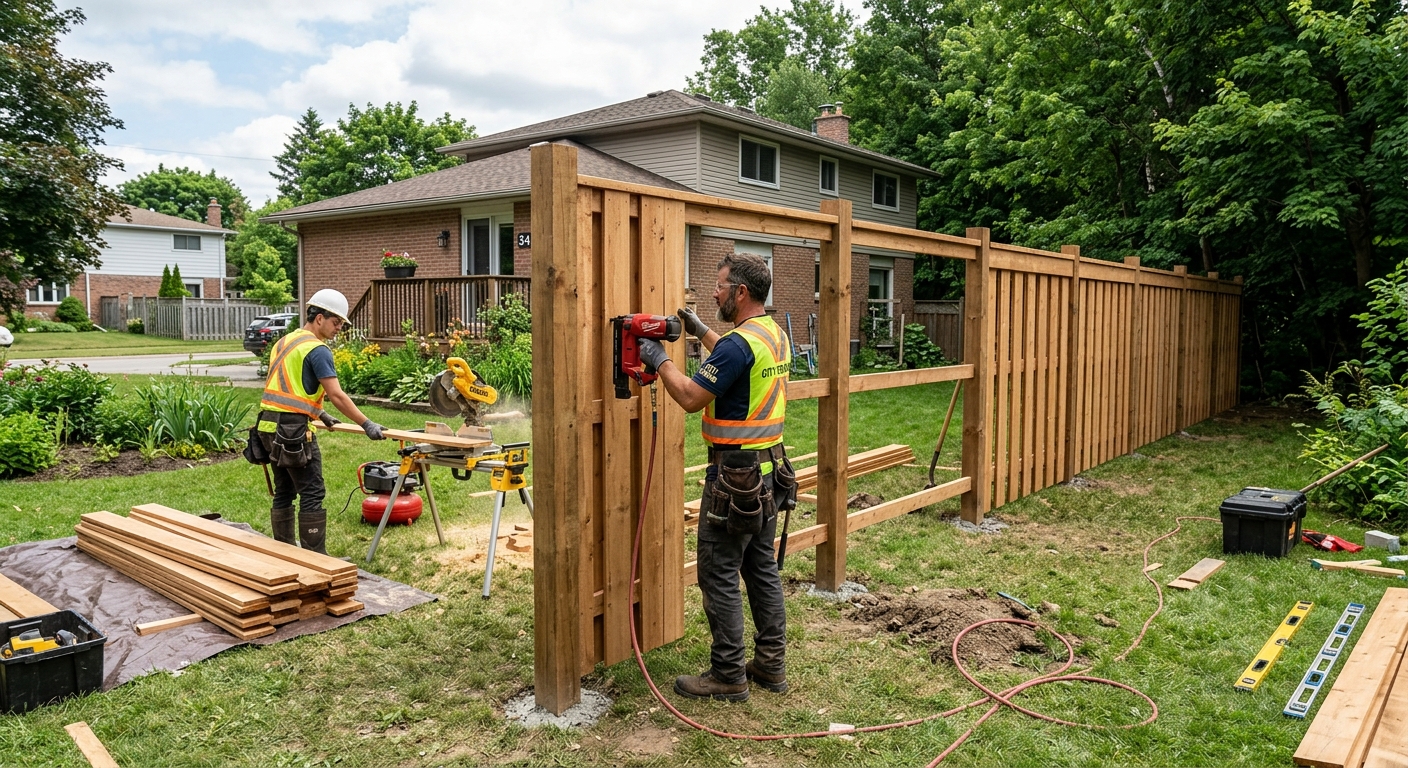
Fencing options and costs in Banff
Fencing in Banff is different from fencing in the rest of Alberta because you’re building in a cold-climate, mountain-foothills setting where ground freezing, wind exposure, and winter driving conditions quickly reveal poor layout or weak posts. Banff’s housing mix also matters: with 8,305 people (Statistics Canada, 2021 Census) and a comparatively high share of owner households (42.0%), there’s steady local demand from permanent homeowners rather than short-term rentals. Add that 11.8% of local dwellings are single-detached homes (Statistics Canada, 2021 Census), and each detached property is a potential fencing customer—especially along edges of lots where privacy and snow/wind control are high priorities.
In the Banff–Jasper–Rocky Mountain House economic region, frost heave is a real cost driver. Typical residential installs require posts set at least 4 ft deep, and sometimes deeper in exposed pockets, to keep fences from lifting or racking. That means machine augering, more concrete per hole, and heavier rails for solid privacy systems. Wind also pushes many homeowners toward shorter bays and tighter spacing, particularly for vinyl privacy and solid wood. Contractor availability can affect timing too: when snowpack and frozen ground limit access on sloped or treed lots, scheduling becomes tighter and labour costs trend toward the high end of the regional bands.
If you live around the Bow Valley corridor or the older established areas near Banff’s core (including neighbourhoods like Banff townsite), fencing tend to be especially active because access is constrained, property lines are frequently adjacent to trails/roads, and residents want durable, low-maintenance solutions that can handle freeze–thaw cycles.
Below is a practical comparison of common materials used in Banff, with realistic lifespan and maintenance expectations before you review individual scopes in your estimate.
| Material |
Lifespan |
Maintenance |
Privacy Rating |
Price per Linear Foot |
Price Range |
| Pressure-treated pine (standard wood) |
10–15 years |
Stain/seal every 2–3 years to reduce grey weathering and surface cracking |
High (solid panels) |
$45–$85 |
$45 – $85 |
| Cedar (natural rot resistance) |
15–25 years |
Re-stain every 2–4 years; quick spot repairs as needed |
High (solid panels) |
$55–$95 |
$55 – $95 |
| Vinyl / PVC (no-maintenance) |
20–30 years |
Minimal—rinse as needed; inspect posts/rails after harsh winters |
High (privacy styles) |
$60–$110 |
$60 – $110 |
| Chain-link (galvanized steel) |
25–35 years |
Low—occasional tension/repairs; keep gates aligned |
Low (open visibility) |
$30–$55 |
$30 – $55 |
| Aluminum ornamental |
25–40 years |
Very low—wash; check hardware after freeze–thaw cycles |
Medium (decorative pickets) |
$70–$130 |
$70 – $130 |
| Composite / recycled material |
20–30 years |
Low—periodic cleaning; watch for post/rail alignment |
High (solid looks) |
$65–$120 |
$65 – $120 |
Prices are estimates only and vary by project scope, site access and material selection.
What affects the price of fencing in Banff
In Banff and the Banff–Jasper–Rocky Mountain House region, it’s common to see the same fence idea swing by 30–50% from one quote to another, even when the material looks identical. The variation usually comes down to what’s hidden in the site work: post depth, concrete volume, how the crew handles rocky ground, and whether wind-exposed conditions require denser bracing. In colder Alberta winters and in mountain foothills, posts are typically set 4–6 inches below the design frost depth so the ground can freeze without lifting or racking the fence. In many places, that translates to roughly 1.5–2.0 m into the ground, longer posts, deeper augering, and more labour time per hole—costs that rarely appear in “quick” bids.
Wind exposure is another difference-maker across Alberta. The Prairies push contractors toward tighter spacing and heavier rails; in Banff, many Bow Valley locations are partially sheltered, but open pockets and edges of properties toward the park approaches can be very exposed. Solid wood and vinyl privacy fences usually need more structural support than chain-link, which is why a privacy installation often lands near the upper portion of the wood and vinyl bands (for example, wood installs often start around $45/linear foot and climb toward $85, while vinyl commonly sits in the $60–$110 range depending on rails and post spacing).
Local examples that raise costs in Banff include: (1) glacial till or compacted rocky soil that slows auger production and forces deeper holes with extra concrete; (2) sloped yards near driveways and patios where fence lines must be raked or stepped, increasing post count; and (3) existing fence removal where weathered boards are stuck, creating extra disposal and salvage handling. Homes built before 1981 are still common (38.1% of homes built before 1981 in the profile), and older lots often have older utilities, inconsistent grading, or boundary uncertainty—each can add hours. If access is tight and machine augering isn’t possible, labour can quickly shift a “mid-band” quote to the high end.
| Price Factor |
Why It Matters |
Cost Impact |
| Fence length in linear feet — the primary cost driver |
Every extra foot adds posts, rails, and hardware; linear footage dictates crew time |
High (often the biggest swing) |
| Post depth required — frost line determines post length and hole depth |
Deeper holes mean more augering time, longer posts, and more concrete per installation |
Medium–High |
| Post setting method — concrete vs. gravel pack vs. driven posts |
Concrete-set posts resist freeze–thaw and lateral load; gravel packs can shift in heavy winter cycles |
Medium–High |
| Material choice — vinyl vs. cedar vs. chain-link |
Different rail systems, picket density, and hardware requirements change labour and material cost |
High |
| Gate count and type — walk-through vs. drive-through (double) |
Gates need stronger hinges, bracing, and often different post sizes |
Medium–High |
| Grade and terrain — sloped yards require stepped or raked panels |
Slopes increase post count, fitting time, and special rail adjustments |
Medium |
| Old fence removal and disposal |
Demolition, nail salvage, hauling, and landfill fees vary with how much is left to remove |
Medium |
| Permit fees and survey / property line locate |
Where required, documentation and locating prevent rework and boundary disputes |
Low–Medium (but can be critical) |
Permits & regulations in Alberta
In Alberta, fencing rules are often tied to height thresholds and local setback bylaws, so it’s important to treat “fence height” as a regulated item—not just an aesthetic choice. As a general Alberta rule of thumb used in many residential scenarios, fences above a threshold—commonly around 2.0 m (6.5 ft) at the rear and about 1.0–1.2 m (3–4 ft) at the front or corner—may trigger a building permit requirement. Even when a permit isn’t required, fences must respect property lines and municipal setback requirements, which can be especially relevant in Banff where lot shapes and access points are often constrained.
Before digging any post holes, arrange utility locates through Alberta One-Call. That step is essential because buried services can exist near driveways and sidewalks, and repairs after you’ve set posts are expensive. Next, verify your property boundary: if you don’t know where your pins are (or if your boundary is unclear), get a survey or property line locate before installation to avoid encroachment disputes.
Shared fence ownership and line-fence responsibilities are handled under provincial line-fences legislation, so it’s wise to confirm who maintains the fence and which side is responsible if the fence sits near a shared boundary.
To verify your contractor in Banff, ask for: (1) an Alberta business licence/registration number where applicable; (2) liability insurance—request the Certificate of Insurance; and (3) proof of coverage for workers (WSIB/WCB). Where to look: check the contractor’s official business listing online for registration details, and review the COI for coverage amounts. For project documentation, ask whether they’ll provide a written clearance letter or proof package before work starts.
Choosing the right fence material for Banff
Choosing a fence in Banff is about matching your priorities to a harsh winter reality: freeze–thaw cycles, wind-driven snow, and ground movement. Pressure-treated pine is usually the most budget-friendly option, but you should plan on staining or sealing about every 2–3 years to keep the wood looking good and to reduce weathering. Cedar looks better longer and resists rot naturally, but it still needs maintenance—typically re-staining every 2–4 years to keep colour and reduce surface cracking.
Vinyl/PVC is popular because it’s “set and forget,” but in extreme cold it can become brittle at thin sections if the system isn’t installed correctly. That’s why post-depth and rail/bracing quality matter as much as the material: Banff–Jasper–Rocky Mountain House conditions often require concrete-set posts and consistent spacing so the fence can survive winter racking. Chain-link is the lowest cost and among the longest-lived options, but it provides limited privacy unless you add slats or plant screening. Aluminum ornamental offers rust-free hardware and a clean look, but it’s not a privacy fence—more security and curb appeal than full screening.
For frost and frost-heave control, concrete-set posts are strongly recommended in Banff. With typical cold-climate requirements, posts need to be set roughly at least 4 ft deep (often deeper in exposed pockets) so the fence doesn’t lift and twist over successive winters. Wind and snow load also favour tighter post spacing and sturdier rails for solid panels, particularly for vinyl privacy and solid wood.
Where the price difference is justified: if you compare a wood privacy fence on the lower band ($45–$85) against vinyl privacy on the $60–$110 band, vinyl can be worth the extra upfront cost when you want lower ongoing effort—especially if you’re tired of frequent re-staining in Banff’s outdoor conditions. But if budget is tight and you’re willing to maintain, cedar can be a “sweet spot” for appearance and rot resistance without pushing you into the highest vinyl pricing.
| Material |
Cold Tolerance |
Lifespan |
Annual Maintenance |
Best For |
Price Band |
| Pressure-treated pine |
Good with proper post depth and sealing; wood can grey in winter sun/wind |
10–15 years |
Light—plan 2–3 year staining cycles; occasional fastener/rail checks |
Budget privacy with willingness to maintain |
$45 – $85 |
| Cedar |
Very good; natural rot resistance helps in freeze–thaw cycles |
15–25 years |
Moderate—re-stain every 2–4 years; spot repairs as needed |
Longer-lasting privacy and better curb appeal |
$55 – $95 |
| Vinyl / PVC |
Good when installed correctly; benefits from deep, solid footings |
20–30 years |
Very low—rinse/wash; inspect after severe winters |
Low-maintenance privacy in exposed cold zones |
$60 – $110 |
| Chain-link |
Excellent; metal tolerates cold well |
25–35 years |
Low—periodic tension and hardware checks |
Security and boundary definition without privacy |
$30 – $55 |
| Aluminum ornamental |
Excellent; non-rusting hardware and coatings |
25–40 years |
Very low—wash and check gate alignment |
Security plus decorative look |
$70 – $130 |
| Composite / recycled |
Good; performs well with stable posts and correct rail alignment |
20–30 years |
Low—cleaning and occasional checks |
Privacy with low upkeep |
$65 – $120 |
How to choose a fencing contractor in Banff
To choose the right fencing contractor in Banff, start by confirming they’re properly covered for both you and their crew. In Alberta, you should ask for proof of liability insurance (review the Certificate of Insurance for coverage limits and effective dates) and verify worker coverage under WSIB/WCB where applicable. You can usually check licensing/registration details through the contractor’s online business presence and request their formal documentation in writing before signing anything—don’t rely on verbal assurances.
Next, get 2–3 itemised written quotes rather than lump sums. A good quote breaks labour and materials down: fence material, posts/rails, gate hardware, concrete/setting method, removal/disposal, and any permit or survey line-locate costs. Scope clarity matters in Banff because site conditions (rocky soil, slope, tight access, and snow/ice staging) change the labour effort. Confirm what’s excluded: for example, is stump/rock removal included? Are utility locate fees included? Is old fence removal hauled away, or is it “owner to dispose”? In cold climates, even small omissions can create expensive change orders.
Warranty should be straightforward: ask for the workmanship warranty length, the product/manufacturer warranty, and whether it’s transferable if you sell the home. Payment should be staged—never more than about 10–15% upfront. Hold back the remainder until the job is complete and gates are properly aligned. Finally, insist on a written start date and a realistic completion estimate; in Banff, frozen ground and snow windows affect scheduling, so timelines should reflect seasonal access constraints.
- Ask for itemised labour + material pricing (posts, rails, concrete, hardware).
- Confirm post depth and post-setting method in writing (concrete-set for frost resistance).
- Require proof of liability insurance (COI) before they start.
- Verify WSIB/WCB coverage documentation for workers.
- Request workmanship warranty details (length, what it covers, response time).
- Clarify product warranty and whether it transfers to you.
- Confirm permit responsibility: who pulls it, if required.
- Verify utility locate steps: do they coordinate Alberta One-Call or do you?
- Ask whether old fence removal and disposal is included and how debris is handled.
- Review gate hardware: hinge type, latch quality, and bracing for drive-through gates.
- Check how they handle slopes (stepped vs. raked panels) and who provides layout.
- Agree on payment milestones; keep a holdback until final walkthrough.
Red flags I see in Banff include: quotes that don’t state post depth or setting method, “cheap” bids that omit concrete volume and hardware/bracing, contractors who won’t provide a written scope or warranty, requests for large upfront payments (beyond 10–15%), and vague timelines that ignore snow/ground conditions for scheduling.
Frequently asked questions — fencing in Banff
Should fence posts be set in concrete here?
In Banff, concrete-set posts are the safer default because freeze–thaw cycles and mountain-foothills ground conditions can cause movement over time. Most residential projects in the Banff–Jasper–Rocky Mountain House region require posts to be set at least 4 ft deep (and sometimes deeper in exposed pockets) to reduce frost heave and racking. Setting in concrete helps resist both lateral load from wind and vertical movement from winter ground freezing. If a quote doesn’t clearly explain post depth, concrete vs. gravel pack, and rail bracing, it’s hard to compare fairly. If you’re building a privacy fence near the $60–$110 vinyl band or even a wood fence in the $45–$85 range, the foundation details largely determine whether it still looks straight after multiple winters.
What's the best fence for privacy?
For privacy in Alberta’s cold zones, solid-panel fences usually perform best: vinyl/PVC privacy, cedar privacy, and pressure-treated wood privacy all create the highest screening effect. In Banff specifically, your “privacy fence” cost isn’t just material—it’s also structural choices like tighter post spacing and heavier rails so wind doesn’t rack the panels. Vinyl privacy often lands in the $60–$110 range, while wood commonly sits around $45–$85 depending on rail/hardware and site difficulty. Cedar can be a strong middle ground for appearance and rot resistance, but it still requires periodic staining. If your priority is privacy plus low upkeep, vinyl or cedar privacy with concrete-set posts is typically the most homeowner-friendly combination for long winters.
How do I compare fencing quotes?
Compare quotes like-for-like: ask for itemised quantities and scope language, not just totals. In Banff, make sure each quote states post depth, the post-setting method (concrete vs. other), spacing/bay length, and gate count/type. Confirm whether labour includes fence line prep on slopes (stepped/raked layout) and whether old fence removal/disposal is included. Look for material specs too—rail sizes, post sizes, and hardware grades—because “vinyl fence” can vary significantly in thickness and stiffness. Finally, check pricing bands: for example, wood often runs around $45–$85/linear foot and vinyl around $60–$110/linear foot. If one bid is far below that without explaining different post depth or material specs, it may be missing core frost-heave or wind-bracing requirements.
How long does fence installation take in Banff?
Timing in Banff depends on ground conditions and access. During winter freeze and heavy snow periods, post-hole excavation may slow down, and crews often need to work around thaw windows. For a typical residential run with standard access, installation commonly takes a few days, but gates, sloped layouts, and old fence removal can extend it. Rocky or compacted soil can also slow augering and increase concrete-setting time per hole, which pushes the job longer even if the linear footage seems modest. When you request a quote, ask for a start date and completion estimate in writing, and confirm whether they schedule concrete pours/curing within the crew plan. A well-scoped job may finish faster than an incomplete one—because fewer change orders usually means fewer delays.
Can I install a fence on a slope in Banff?
Yes, you can install a fence on a slope in Banff, but you’ll want the design approach to be planned rather than improvised. Common solutions are stepped panels (posts remain at consistent depth while rails step with grade) or raked panels (rails follow the slope with adjusted brackets). The key is maintaining structural integrity: posts still need to be set deep enough for frost-heave resistance, and the fence must be braced so wind can’t rack it. Sloped yards often increase post count and fitting time, which can move pricing toward the higher end of the bands (for instance, wood installations near $85/linear foot rather than closer to $45, depending on how complex the grade is). If you have retaining walls, patios, or uneven bedrock, clarify how layout will be done in the quote.
What is the most weather-resistant fence for Banff's climate?
For Banff’s cold winters, deep frost and wind exposure, the “most weather-resistant” choice is often one that’s structurally stout with stable footings. Practically, aluminum ornamental and chain-link tend to resist rot and corrosion extremely well and can remain serviceable for decades when posts are set correctly. For full privacy, vinyl/PVC with proper concrete-set posts and correct rail bracing performs very well in cold cycles because there’s no wood rot to manage; its main requirement is quality installation so it doesn’t rack. Cedar and pressure-treated wood are also durable when maintained, but they require more ongoing care (staining/sealing cycles) to keep surfaces protected. If you want a clear price reference for planning, aluminum often sits around $70–$130/linear foot, while chain-link is commonly $30–$55; the “best” option depends on whether you need privacy or just weatherproof boundary definition.