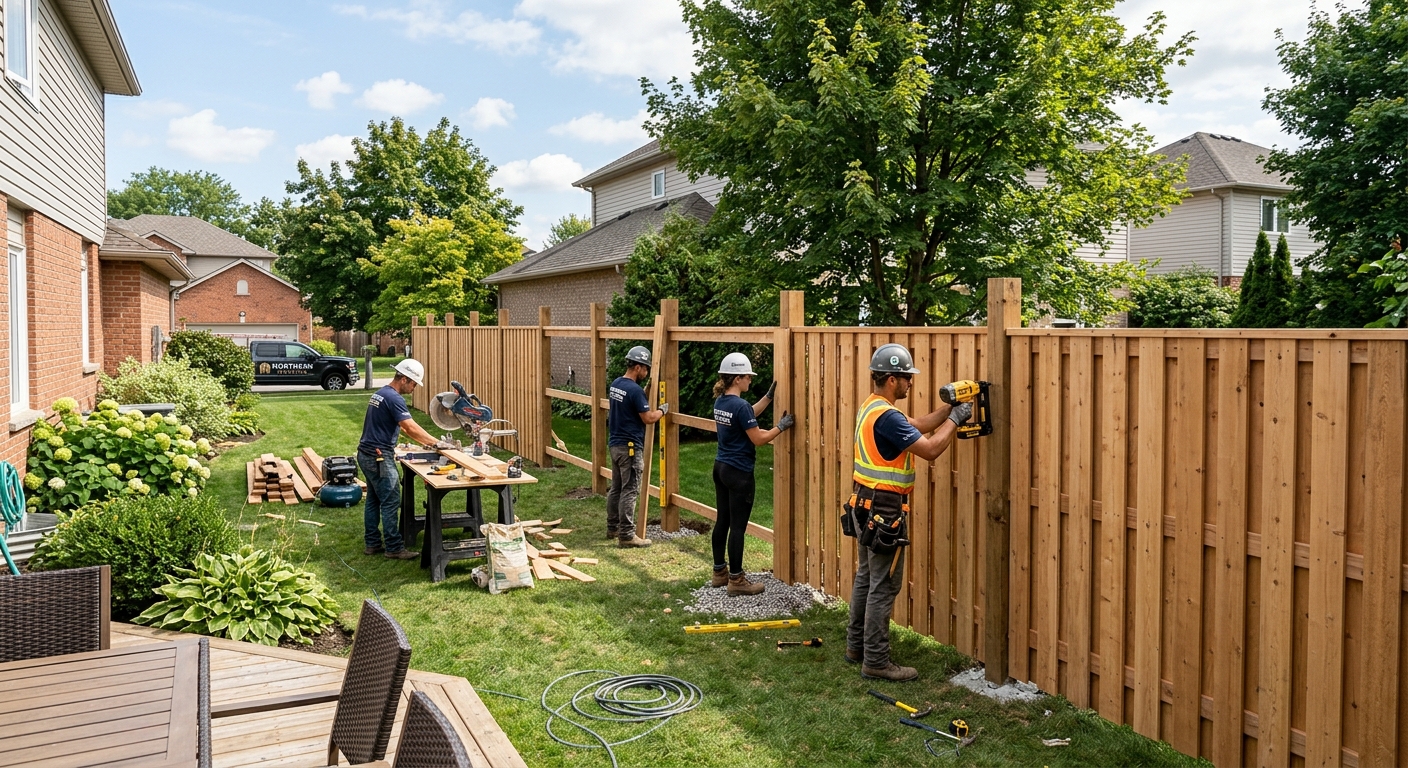
Fencing options and costs in Downtown West End
In Downtown West End, Alberta, choosing a fence is one of the fastest ways to define space and privacy, especially for households that sit close to busy streets. With a Downtown West End population of 2,825 (Statistics Canada, 2021 Census), demand is steady and often concentrated around the many residential pockets where properties change hands and yards are refreshed. In this area, detached homes are a major driver of fencing jobs because many homeowners treat backyards and side yards as living space—so fence work tends to follow landscaping, patio, and deck upgrades.
Calgary’s Prairie continental climate heavily influences both material selection and installation cost. Freeze–thaw cycles mean frost protection is a primary cost driver: contractors typically set posts about 4 ft (≈120 cm) deep to get below the regional frost line and reduce heaving, especially for 6 ft privacy fences and gate posts. At the same time, open Prairie exposure increases wind loading; solid wood or vinyl panels often need tighter post spacing and fully concreted footings to prevent racking. Labour availability also matters—busy spring install windows can tighten schedules, and crews may charge more when excavation and concrete setting take longer due to access limits in established neighbourhoods.
In Downtown West End, fence installs are especially common around neighbourhoods near the west-side residential pockets and rear-lot backyards, where privacy and yard definition are top priorities. If you’re comparing options, start with the table below for realistic ranges on common fence types, then we can narrow it down based on height, layout, and whether you’re replacing an older run.
| Material |
Lifespan |
Maintenance |
Privacy Rating |
Price per Linear Foot |
| Pressure-treated pine (standard wood) |
10–15 years |
Stain/seal every 2–3 years; inspect for loose rails |
High (solid/board-on-board) |
$40 – $80 |
| Cedar (natural rot resistance) |
15–20 years |
Seal or stain every 2–4 years; periodic fastener checks |
High (solid/board-on-board) |
$55 – $95 |
| Vinyl / PVC (no-maintenance) |
20–30 years |
Occasional wash; check posts/rails after freeze–thaw seasons |
High (solid panels) |
$45 – $90 |
| Chain-link (galvanized steel) |
25–35 years |
Minimal; rinse, tighten tension/wire as needed |
Low–Medium (open airflow) |
$25 – $55 |
| Aluminum ornamental |
20–35 years |
Minimal; clean annually and inspect gate hardware |
Low–Medium (decorative pickets) |
$70 – $120 |
| Composite / recycled material |
20–30 years |
Low; rare cleaning and occasional hardware inspection |
Medium–High (panel dependent) |
$75 – $115 |
Prices are estimates only and vary by project scope, site access and material selection.
What affects the price of fencing in Downtown West End
Homeowners in Downtown West End often see quote differences of 30–50% for what looks like the same fence, and it usually comes down to installation logistics—not just the material. In Calgary’s Prairie region, contractors price more defensively because long freeze–thaw cycles and open wind exposure raise the risk of future leaning, racking and post heaving if the foundation isn’t built to last. That means two crews can both offer a “6 ft privacy fence,” but one quote may include deeper post holes, more concrete, and tighter post spacing for wind loads, while another uses faster methods that cost less upfront but fail sooner.
Frost protection is the biggest technical driver. Post holes are typically excavated about 4–6 inches below the design frost depth to prevent heaving, which in Alberta usually means roughly 1.5–2.0 m into the ground. That translates into longer posts, more excavation time, and higher concrete volume—so a wood or vinyl privacy run often lands closer to the mid–upper portion of the local wood and vinyl bands (for example, $40–$80 for wood and $45–$90 for vinyl/PVC). By contrast, chain-link tends to cost less because open airflow reduces racking forces, and it often uses less material-intensive panel design within the same property constraints—typically aligning with the lower band ($25–$55).
Concrete examples from Downtown West End jobs: (1) if you have a sloped backyard requiring stepped rails, labour rises because crews must build to level rather than “gap and hope,” often adding time and fittings; (2) tight rear-lot access where equipment can’t reach increases manual digging and concrete handling, even when the fence length is the same; (3) replacing an older solid fence usually adds disposal and haul-away—so “demo included” can be the difference between two quotes that otherwise look similar.
| Price Factor |
Why It Matters |
Cost Impact |
| Fence length in linear feet |
Every extra foot multiplies labour, posts, rails and hardware |
Major (often the biggest driver) |
| Post depth required |
Frost line determines hole depth and post length to prevent heaving |
Major in Alberta winters |
| Post setting method |
Concrete vs. gravel pack vs. driven posts changes material and cure time |
Moderate to major |
| Material choice |
Vinyl, cedar and privacy panels need different spacing and fastening |
Moderate (can flip the quote range) |
| Gate count and type |
Drive-through/double gates need stronger frames and heavier hardware |
Moderate (higher for double gates) |
| Grade and terrain |
Slope requires stepped design, raked rails, and more layout time |
Moderate |
| Old fence removal and disposal |
Demolition, hauling and landfill fees add time and logistics |
Often moderate |
| Permit fees and survey / property line locate |
Paperwork and locating pins prevent setbacks and encroachment issues |
Low to moderate |
Permits & regulations in Alberta
In Alberta, fence height and location are what usually trigger permit requirements. As a general rule, fences above a height threshold—often about 2.0 m (6.5 ft) at the rear and roughly 1.0–1.2 m (3–4 ft) at the front or corner—may require a building permit. Even when a permit isn’t required, your fence must respect property lines and any municipal setback requirements.
Before digging any post hole, you must call for utility locates. In Alberta that’s handled through Alberta One-Call to mark buried services and protect you from accidental hits. Also strongly consider getting a survey or at least a property line locate so you install on the correct line; this avoids costly encroachment disputes with neighbours.
Shared fence rules are governed by provincial line-fences legislation: if a fence is shared, maintenance responsibilities and cost-sharing are typically negotiated based on the legislation and the specific agreement/history between adjoining owners.
Homeowners should verify contractor readiness before work starts. Ask for proof of: (1) a valid Alberta business licence/contractor standing if applicable for the scope; (2) liability insurance showing fencing/project coverage; and (3) WCB/coverage documentation (often referenced through WCB clearance). Where to look: the contractor registry online (for business standing), and the certificate of insurance (request a COI showing your project address if available). A clearance letter or coverage confirmation can usually be provided directly by the contractor or referenced through WCB account verification.
Choosing the right fence material for Downtown West End
Choosing the right fence material in Downtown West End is mostly about matching your priorities—privacy, low maintenance, budget, and lifespan—to a climate that’s hard on foundations. Calgary’s long freeze–thaw cycles mean your fence is only as good as its post setting: for most solid privacy designs, posts are typically set about 4 ft (≈120 cm) deep using concrete footings to reduce heaving. That foundation work is common across materials, but the “panel” choice affects wind performance, appearance, and upkeep.
Pressure-treated pine is the budget-friendly option, but to keep it looking good you’re usually staining/sealing every 2–3 years to prevent grey weathering and moisture damage. Cedar looks better and resists rot naturally, yet it still benefits from sealing every few years. Vinyl/PVC offers no-paint maintenance, which appeals to busy homeowners; however, it can become brittle in extreme cold if installed with inadequate fastening or poor panel support—so proper rail design and post spacing still matter in Alberta. Chain-link is the lowest cost and tends to last a long time because airflow reduces wind stress, but it doesn’t give meaningful privacy without additions. Aluminum ornamental resists rust and gives curb appeal, but it’s also less private.
For a concrete example: if you want a 6 ft privacy run, moving from chain-link (often in the $25–$55 band) to wood or vinyl privacy (often $40–$80 for wood and $45–$90 for vinyl/PVC) is justified when privacy and wind-stable solid panels are the goal. If you only need boundary marking and airflow, chain-link can be dramatically more cost-effective.
| Material |
Cold Tolerance |
Lifespan |
Annual Maintenance |
Best For |
Price Band |
| Pressure-treated pine |
Good (with correct sealing) |
10–15 years |
Light inspection; stain/seal 2–3 years (not strictly annual) |
Budget privacy with a natural look |
$40 – $80 |
| Cedar |
Good (best with proper fasteners) |
15–20 years |
Seal/stain every 2–4 years; check rails yearly |
Premium appearance and rot resistance |
$55 – $95 |
| Vinyl / PVC |
Good (depends on installation and panel support) |
20–30 years |
Occasional wash; inspect after storms/wind |
Low maintenance privacy |
$45 – $90 |
| Chain-link |
Very good (high flexibility) |
25–35 years |
Minimal; tighten/tension checks as needed |
Security boundary with airflow |
$25 – $55 |
| Aluminum ornamental |
Excellent |
20–35 years |
Clean annually; check gate hardware |
Curb appeal with light visibility |
$70 – $120 |
| Composite / recycled |
Good (depends on product spec) |
20–30 years |
Low; rare cleaning and hardware checks |
Balanced privacy with low upkeep |
$75 – $115 |
How to choose a fencing contractor in Downtown West End
Choosing the right fencing contractor in Downtown West End is less about a slogan and more about documentation. Start by verifying Alberta coverage and standing. Ask for their liability insurance—you should receive a certificate of insurance (COI) showing the insurer, policy term, and limits. Next, confirm WCB coverage (often provided as clearance information or confirmation of coverage status). Finally, verify their business standing/licensing as applicable by checking the relevant online registry entry for the company.
Then get 2–3 written, itemised quotes—not a lump sum. A good fencing quote breaks down labour and materials: post count and spacing, concrete quantities (or post setting method), gate hardware, rail assemblies, and the cost to remove and dispose of the old fence if included. Carefully read what’s excluded: tree removal, property line locate, permit pull, survey fees, and landscaping restoration after excavation are common exclusions.
Warranty matters too. Look for a written workmanship warranty (commonly covering posts and installation defects for a set period) and separate clarification of the product/manufacturer warranty. Ask whether the warranty is transferable to future owners if you sell.
Payment schedules should be conservative: never pay more than about 10–15% upfront, and hold back the remainder until the fence is complete and the punch list is addressed. Also request a written start date and a completion estimate—busy Calgary seasons can shift timelines, but reputable contractors document dates.
- Ask for COI showing liability insurance and policy dates.
- Confirm WCB clearance/coverage before work begins.
- Request an itemised quote showing posts, rails, and gate hardware.
- Verify post setting method (concrete-set vs gravel pack vs driven).
- Confirm whether permit pull is included (if required by height/location).
- Ask if old fence removal and disposal are included.
- Ensure quote includes site layout: property line locate/survey assumptions.
- Check warranty duration for workmanship and product separately.
- Get a timeline in writing: start date and completion target.
- Confirm who handles utility locates and how they mark services on-site.
- Clarify grading treatment: stepped vs raked panels on slopes.
- Agree on payment schedule and holdback amount in writing.
Red flags in Downtown West End: (1) quotes that won’t specify post depth or setting method; (2) “cash-only” or refusal to provide a COI/WCB confirmation; (3) lump-sum pricing with no fence layout or post count; (4) a warranty stated only verbally; (5) demanding a large upfront payment (beyond 10–15%) before any excavation or material delivery.
Frequently asked questions — fencing in Downtown West End
How much does a fence cost in Downtown West End?
In Downtown West End, fencing pricing typically follows Calgary’s installed ranges and depends heavily on height, material, gate count, and how much post setting/excavation is needed for winter stability. As a baseline, chain-link often lands in the lower band of about $25 – $55 per linear foot because it uses lighter panel structures and airflow reduces wind stress. If you want a solid wood or vinyl privacy fence, most projects land higher—wood often falls around $40 – $80 per linear foot and vinyl/PVC around $45 – $90 per linear foot. If your layout includes multiple gates, sloped grade, or removal of an older fence, expect the installed cost to climb within the same material band.
How deep should fence posts be for Downtown West End's frost?
For fences in Alberta (including Downtown West End), post depth is designed to sit below the heaving risk zone from freeze–thaw cycles. In the Calgary area, a common expectation is to set posts about 4 ft (≈120 cm) deep, especially for 6 ft privacy fences and gate posts. Contractors typically drill/excavate about 4–6 inches below the design frost depth to reduce the chance of heaving. Practically, that means longer posts, deeper holes, and usually concrete footings for privacy systems that resist wind loading. If you’re installing near a walkway, driveway edge, or where the ground stays cold longer, concrete-set posts are even more important.
Wood vs vinyl vs aluminum fence — which is best?
“Best” depends on what you value most. Wood (pressure-treated or cedar) can look natural and delivers strong privacy, but it usually requires periodic staining/sealing—often every 2–3 years for pressure-treated pine to minimize weathering. Vinyl/PVC is popular for low maintenance and privacy; in Alberta it still needs correct post spacing and solid mounting so it doesn’t get stressed in extreme cold, but you typically won’t stain it. Aluminum ornamental fences are the best fit for curb appeal and rust resistance, yet they don’t provide the same privacy as solid wood/vinyl because they’re picketed. For many Downtown West End homeowners who want privacy and fewer maintenance tasks, vinyl often makes sense even if it costs more upfront than chain-link.
Do I need a permit to build a fence in Alberta?
In Alberta, permits depend on fence height and placement. As a general guideline, fences above about 2.0 m (6.5 ft) at the rear and roughly 1.0–1.2 m (3–4 ft) at the front or corner may require a building permit. Regardless, your fence must follow property line and setback rules. A key step before digging is calling for utility locates through Alberta One-Call so buried services are marked on-site. Homeowners should also consider a survey/property pin locate to avoid encroachment. If your contractor says a permit is required or not required, ensure that assumption is documented in the quote and scope.
How long does a wood fence last in Downtown West End?
A properly installed wood fence can last 10–15 years for pressure-treated pine and about 15–20 years for cedar in Calgary-area conditions, assuming correct post setting and maintenance. The bigger lifespan driver is foundation: posts set too shallow can shift during freeze–thaw cycles, leading to loose rails and eventual board failure. Also, surface care matters—without staining/sealing, wood can grey and check faster from Alberta’s dry freeze periods and moisture swings. A reasonable expectation is to plan maintenance on a schedule, not “eventually,” especially if you want to preserve appearance and reduce early rot around fasteners and bottom rails.
Who owns and maintains a shared fence?
In Alberta, shared fence situations are typically governed by provincial line-fences legislation, with responsibilities based on the shared use/ownership between adjoining property owners. Practically, that means you and your neighbour may need to agree on upkeep, repairs, and cost-sharing depending on who uses the fence and how it was established historically. For Downtown West End homeowners, disputes often start when one side replaces sections without confirmation of the boundary and maintenance agreement. The safest approach is to confirm the property line (survey/locate) before replacing, then put a written agreement in place for scope and cost. If a fence is truly shared, maintenance can’t be assumed—clarify it up front.