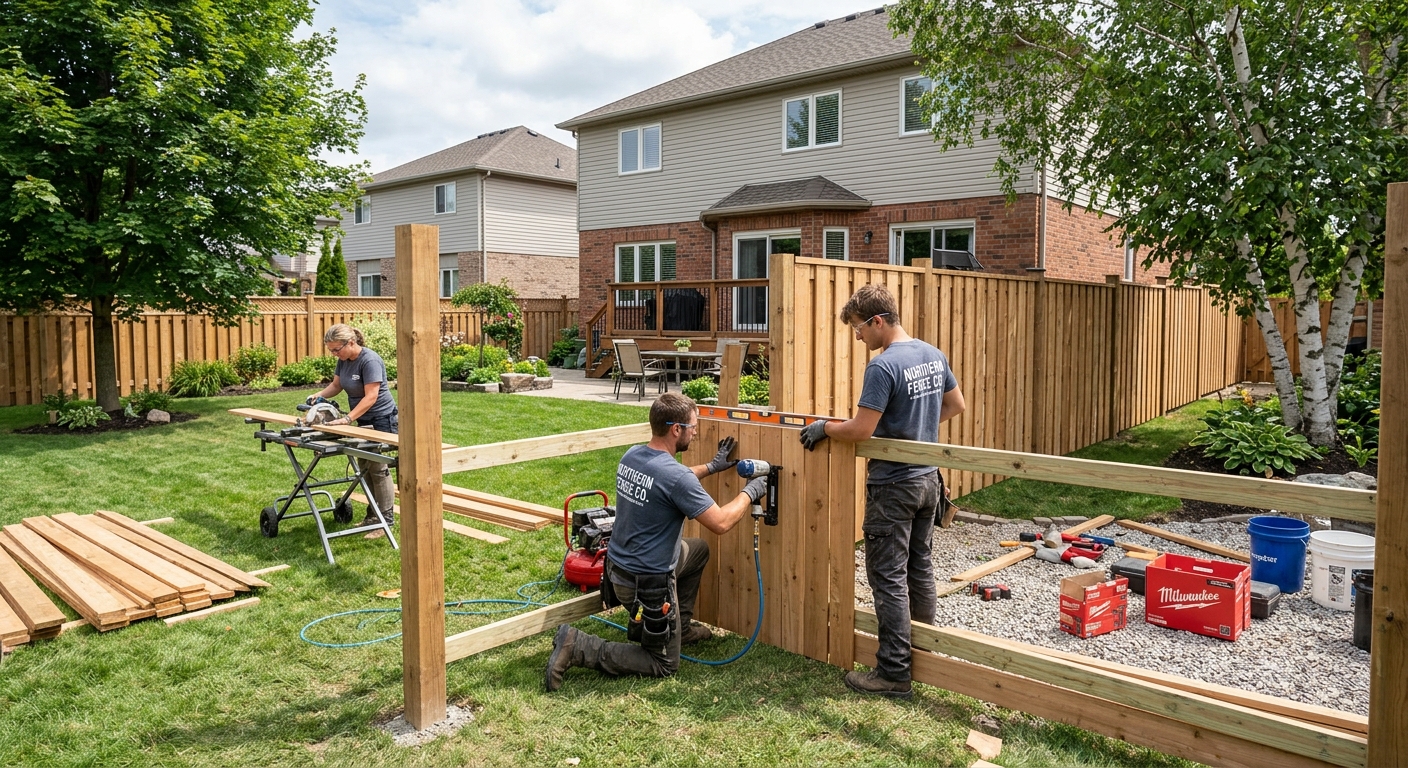
Fencing options and costs in Killarney
Killarney homeowners typically choose their fences based on privacy needs, wind exposure, and how long they can go without maintenance. With a population of 3,990 in 2021 (Statistics Canada, 2021 Census), local demand is steady, and every additional detached home can mean more replacement work for existing runs. Single-family areas also create predictable traffic for contractors during the short spring-to-fall build window, especially around busy corridors and edges of larger lots. In Killarney, the trade is especially in demand along neighbourhood lanes and back-lot lines where privacy panels and gate replacements are common as families refresh older yards.
In the Calgary economic region, fence pricing is shaped by a Prairie continental climate—meaning long freeze–thaw cycles and strong open-wind conditions. That combination matters because contractors usually set posts about 4 ft (≈120 cm) deep to stay below the regional frost line and reduce the risk of heaving. Solid wood and vinyl privacy sections also need robust posts and closer spacing to resist racking in wind, so those options generally cost more than more breathable systems like chain-link.
Labour availability can also affect your final number in Killarney: if crews are booked for other freeze-line projects (6 ft privacy fences and gate posts are frequent), scheduling shifts can change mobilisation costs. Still, most homeowners in the Calgary market see installed costs within roughly the mid-to-upper bands for wood/vinyl and the lower-to-mid band for chain-link, depending on access and grading. Use the table below to compare material options and what you can expect per linear foot, then you can match the right style to your budget and yard conditions.
| Material |
Lifespan |
Maintenance |
Privacy Rating |
Price per Linear Foot |
| Pressure-treated pine (standard wood) |
12–20 years |
Stain/paint every 2–3 years to slow greying and cracking |
High (solid panels) |
$40–$80 |
| Cedar (natural rot resistance) |
15–25 years |
Light staining/finishing every 2–3 years; inspect annually |
High (solid panels) |
$55–$95 |
| Vinyl / PVC (no-maintenance) |
20–30 years |
Rinse as needed; occasional panel replacements if impacted |
High (privacy styles) |
$45–$90 |
| Chain-link (galvanized steel) |
25–35 years |
Minimal; occasional tension and coating touch-ups |
Low to medium (airflow open) |
$25–$55 |
| Aluminum ornamental |
25–40 years |
Minimal; wash yearly, check gate hardware |
Low to medium (open pickets) |
$70–$120 |
| Composite / recycled material |
20–30 years |
Low; clean and replace occasional boards after impact |
High (solid board styles) |
$70–$115 |
Prices are estimates only and vary by project scope, site access and material selection.
What affects the price of fencing in Killarney
Even when two neighbours ask for “the same fence,” quotes in Killarney can vary by 30–50% across Calgary and Alberta because the price drivers aren’t just materials—they’re the ground conditions, wind exposure, and how crews have to build to survive freeze–thaw cycles. In the Prairies, frost protection and wind loading control everything from post length to panel stiffness. That’s why a 6 ft privacy fence often lands in a mid-to-upper wood or vinyl band (for example, wood commonly shows $40–$80 per linear foot), while a chain-link run with more airflow may stay closer to the lower end ($25–$55).
Frost line depth is a major reason for the spread. Local guidance generally expects posts set about 4 ft (≈120 cm) deep to reduce heaving risk, which typically means longer posts, deeper holes, and more concrete on solid privacy systems. In practical terms, crews may be working with significantly more excavation and concrete per post than they would in milder regions where frost penetrates less. Wind also matters: Prairie exposure can rack solid panels, so stronger posts, tighter post spacing, and solid gate bracing can push costs upward.
In Killarney, cost can rise when your yard has clay-heavy soil that clumps in auger holes, or when your fence line crosses uneven grade, requiring stepped panels. Costs can also drop if your existing line has good access for a skid steer and the new fence follows the same footprint with minimal removal. As a rough illustration, removing an old 6 ft fence plus setting new concreted posts can add significant labour and disposal time compared with a “like-for-like” replacement where rails and hardware are reused—so it’s common to see the same material choice swing by dollars per foot once post setting and demo are included.
| Price Factor |
Why It Matters |
Cost Impact |
| Fence length in linear feet |
The base material and labour scale directly with linear footage. |
Largest driver (often sets the overall range) |
| Post depth required |
Frost line determines post length and hole depth to prevent heaving. |
Higher for deeper concrete-set installs |
| Post setting method |
Concrete vs. gravel pack vs. driven posts changes labour, materials, and stability. |
Concrete-set generally costs more |
| Material choice |
Vinyl/cedar/pressure-treated respond differently to wind and freeze–thaw. |
Can move you from low-mid to mid-upper bands |
| Gate count and type |
Gates require heavier framing, hardware, and alignment. |
Drive-through gates typically add cost fastest |
| Grade and terrain |
Slopes require stepped or raked panels and more layout labour. |
More cutting and extra fittings |
| Old fence removal and disposal |
Demos add crew time and landfill/haulage costs. |
Often meaningfully increases total job cost |
| Permit fees and survey / property line locate |
Required documentation prevents encroachment and rework. |
Small but can add measurable overhead |
Permits & regulations in Alberta
In Alberta, fence permits are commonly triggered by height thresholds—typically about 2.0 m (6.5 ft) at the rear and roughly 1.0–1.2 m (3–4 ft) at the front or corner—so it’s important to confirm the specific rule for your lot’s location and orientation in Killarney. Even when a permit is not required, all fences still must respect property lines and local setback requirements. If you’re unsure where the boundary sits, get a survey or a property line locate before any post holes are dug.
Before digging post holes, arrange utility locates through Alberta One-Call so crews don’t hit buried services. The practical sequence most homeowners should follow is: (1) confirm property lines and setbacks, (2) get locates, (3) decide on fence height and material, and (4) ask the contractor to confirm whether your design crosses the permit trigger.
What usually DOES require a permit: installing a tall fence at or above the common 2.0 m rear threshold, building new fencing in a way that alters the front/corner height configuration, or projects involving significant changes to location/footprint. What typically does NOT: smaller fence sections under the height thresholds that match an existing permitted line, assuming they still meet setback and property line rules.
To verify a fencing contractor in Alberta, check three items. First, confirm their licence/registration through the provincial contractor registry or relevant licensing pathway. Second, request a current certificate of liability insurance showing coverage amounts suitable for your job. Third, verify coverage for workers by asking for WSIB/WCB clearance (or equivalent proof of coverage) and keep the certificate on file—don’t rely on verbal assurances.
Choosing the right fence material for Killarney
Choosing the right fence material in Killarney is mostly about matching your priorities—privacy, low maintenance, budget, and lifespan—to Calgary’s freeze–thaw cycles and open wind exposure. Pressure-treated pine is often the best entry option for a solid privacy look, but it usually needs staining or painting every 2–3 years to avoid grey weathering and surface checking. Cedar resists rot better and can age more gracefully, but it still benefits from periodic finishing to keep it looking sharp. Vinyl/PVC is popular for homeowners who want low day-to-day work; however, extreme cold can make some panels more brittle if they’re not properly installed and flexed with correct post spacing. Chain-link is the lowest cost and stands up well to wind because airflow reduces racking, but it doesn’t provide privacy unless paired with slats or screening.
Post depth matters regardless of material because Calgary projects commonly require posts set below the frost line (often around 4 ft / 120 cm). That generally means using longer posts and, for 6 ft systems and gate posts, many contractors use concrete-set footings to keep everything plumb through freeze–thaw. With heavier solid panels, wind and snow load can increase stress on rails and hardware, so tighter spacing and sturdier posts usually make the difference between “looks great for a season” and “stays straight for years.”
For a dollar example: if a chain-link run is around $25–$55 per linear foot but you upgrade to a privacy wood or vinyl system at roughly $40–$80 (wood) or $45–$90 (vinyl), you’re paying for privacy and strength—but you’re also taking on the need for proper concrete setting and stronger bracing. If your yard is very exposed, that upfront cost is often justified because less flexible fencing can rack quickly.
| Material |
Cold Tolerance |
Lifespan |
Annual Maintenance |
Best For |
Price Band |
| Pressure-treated pine |
Good with proper spacing and finishing |
12–20 years |
Inspect annually; stain/finish every 2–3 years |
Budget privacy with classic look |
$40–$80 |
| Cedar |
Good; performs well in freeze–thaw when kept sealed |
15–25 years |
Inspect annually; finish every 2–3 years |
Premium appearance and natural rot resistance |
$55–$95 |
| Vinyl / PVC |
Very good if installed with correct hardware and spacing |
20–30 years |
Minimal; rinse/wash as needed |
Low-maintenance privacy |
$45–$90 |
| Chain-link |
Excellent; galvanized steel handles cold well |
25–35 years |
Minimal; check tension and hardware yearly |
Security on a budget with airflow |
$25–$55 |
| Aluminum ornamental |
Excellent; doesn’t rust and tolerates cold cycles |
25–40 years |
Minimal; wash yearly |
Front-yard curb appeal and long service life |
$70–$120 |
| Composite / recycled |
Good; depends on system design and anchoring |
20–30 years |
Low; occasional board replacements after impact |
Solid privacy with reduced upkeep |
$70–$115 |
How to choose a fencing contractor in Killarney
When you hire a fencing contractor in Killarney, start by verifying Alberta coverage and legitimacy before you compare price. Ask for their Alberta licence/registration details and confirm the status through the appropriate online registry pathway. Next, request a certificate of liability insurance with coverage limits that make sense for a project involving excavation and gates. Finally, verify workers’ compensation coverage by asking for current WSIB/WCB clearance or proof of coverage; a reputable crew will provide it without hesitation and will match it to the job’s timeframe.
Price matters, but compare quotes the right way. Get 2–3 itemised written quotes that separate labour from materials and list key line items like posts, concrete, rails, pickets/panels, gate hardware, and fasteners. Avoid “lump sum” only estimates—fence costs can change quickly when the quote doesn’t include post depth, concrete volume, or disposal. Carefully review what’s excluded: utility locates are often arranged by the homeowner or added as a line item, and disposal of demo materials should be explicit.
Warranty should cover both workmanship and product performance. Ask how long the workmanship warranty lasts, whether it’s transferable to future owners, and whether the manufacturer warranty covers materials or just finishes. For payment schedule, don’t pay more than about 10–15% upfront; hold a portion back until the job is completed, inspected, and any punch-list items are done. Also lock in timing: get a start date and a completion estimate in writing so you aren’t left waiting during weather windows.
- Confirm Alberta licence/registration and ask for the reference number.
- Verify liability insurance certificate is current and covers the job period.
- Ask for WSIB/WCB clearance/proof of coverage before work begins.
- Get 2–3 itemised quotes (labour + materials + gate hardware).
- Make sure the quote states post depth and whether holes are concrete-set.
- Confirm how they handle wind exposure (post spacing and bracing).
- Ask what permits are included and who pulls them (if applicable).
- Clarify utility locate responsibility and scheduling.
- Check whether old fence removal and disposal are included.
- Verify warranty terms for workmanship and product, and whether it transfers.
- Set payment milestones: max 10–15% upfront; holdback on completion.
- Get start/completion dates in the contract, not only in emails.
Concrete red flags I often see in Killarney: contractors who won’t provide insurance or WCB/WSIB proof in writing; quotes that don’t specify post depth or setting method (concrete vs. gravel pack); “same price no matter what” offers that ignore grade changes or gate bracing; pressure to pay a large deposit upfront; and vague scopes that omit disposal, property line locate, or permit responsibility when the height triggers a permit.
Frequently asked questions — fencing in Killarney
How do I handle a fence dispute with a neighbour in Alberta?
In Alberta, fence disputes usually come down to property lines, shared responsibility, and whether the fence location and height comply with local rules. Start by gathering evidence: your property line locate or survey, photos of the fence and boundary markers, and the dates of when work started or changed. If you can, pause further work and ask your contractor to confirm the measured layout against the pins. Communicate in writing and propose a practical fix—often relocating fence sections to the correct line is cheaper than replacing the whole run. If the fence is a boundary/shared fence, provincial line-fences legislation can guide who pays and how shared costs are split. In Killarney, the most common cause is incorrect placement during busy replacement seasons, so having the locate before digging is the best prevention.
What fence style offers the best wind resistance in Killarney?
In Killarney (Calgary region), wind resistance usually favours designs that can “work” with airflow and don’t catch the full force like a solid wall. Chain-link generally performs well because it lets wind pass through, reducing racking stress. For privacy, a solid wood or vinyl fence can still be very durable, but it needs correct post depth (commonly around 4 ft / 120 cm) and strong bracing, plus tighter post spacing and properly engineered gate hardware. If you’re comparing costs, a chain-link system often sits in the $25–$55 per linear foot range, while wood privacy commonly lands around $40–$80 per linear foot. For the best wind results, choose the right panel style and ensure post setting and spacing are built for the Prairie freeze–thaw cycle.
How much does a fence cost in Killarney?
Fence cost in Killarney typically depends on material, fence height, length, gate count, and how much excavation is required. Because the Calgary economic region has long freeze–thaw cycles, many installations use deeper post holes and concrete-set footings, which increases labour and materials compared with milder areas. As a planning range, homeowners often see installed fencing around the provincial market bands: wood privacy roughly $40–$80 per linear foot and vinyl/PVC around $45–$90 per linear foot, while chain-link often comes in around $25–$55 per linear foot. If you have multiple gates, sloped grade, or need old fence removal, the total can move toward the upper end of those ranges. For budgeting, get an itemised quote so you can see the cost of post depth, concrete, and disposal—not just the material price.
How deep should fence posts be for Killarney's frost?
For Killarney in the Calgary region, post depth should be planned to sit below the frost line to prevent heaving during freeze–thaw cycles. Practical local expectations generally put posts about 4 ft (≈120 cm) deep for many residential fence types, especially for privacy fences and gate posts. Depending on your exact frost depth determination and soil, that may translate to setting posts roughly 1.5–2.0 m into the ground. The safe approach is: the contractor should design post length and hole depth based on frost protection, use correct concrete setting where required, and confirm spacing for wind loading. If a quote doesn’t specify post depth and setting method, treat it as incomplete—getting that wrong can lead to leaning, gaps, or premature repairs.
Wood vs vinyl vs aluminum fence — which is best?
“Best” depends on what you value most in Killarney. Wood pressure-treated pine is often the best budget way to get privacy, but it needs staining or finishing every 2–3 years to stay attractive in Alberta weather. Cedar looks great and resists rot better, though it still benefits from periodic maintenance. Vinyl/PVC is a low-maintenance option and typically costs in the $45–$90 per linear foot range, but it requires careful installation in extreme cold to avoid brittleness issues and should be braced appropriately for wind. Aluminum ornamental is strong and doesn’t rust, but it usually provides less privacy because it’s typically open pickets; it’s commonly priced higher, around $70–$120 per linear foot. For exposed yards where privacy matters, wood or vinyl with proper post depth and bracing is usually the best balance.
Do I need a permit to build a fence in Alberta?
Often, yes—depending on height and location on your property in Alberta. A common guideline is that fences above about 2.0 m (6.5 ft) at the rear and around 1.0–1.2 m (3–4 ft) at the front or corner may require a building permit. Even when a permit is not required, your fence still must comply with property line requirements and local setback rules. For any fence project, also remember utility locates: call Alberta One-Call before digging so underground services are marked. In Killarney, permit requirements can catch homeowners off guard when replacing an older privacy fence with a taller new one, so confirm the height and placement before materials arrive. A reliable contractor will tell you whether the design triggers a permit and who is responsible for pulling it.