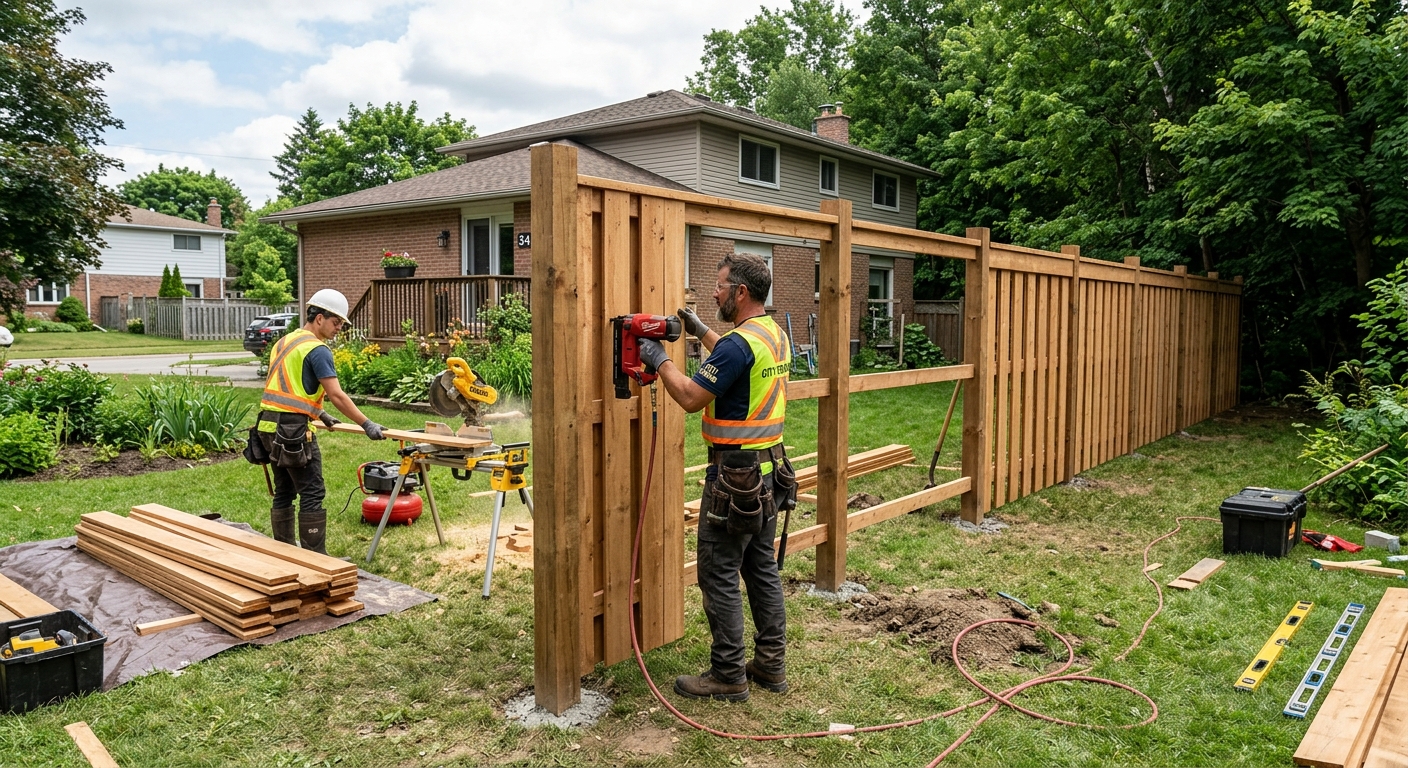
Fencing options and costs in Abbeydale
In Abbeydale, Alberta, choosing the right fence usually comes down to balancing privacy, wind performance and how often you’re willing to maintain the finish. With a population of 5,925 (Statistics Canada, 2021 Census), demand is steady for residential yard upgrades—especially for homeowners who want to define property space as gardens and outdoor living areas grow. That steady need is also supported by the local housing pattern: Abbeydale is part of a broader Calgary area where single-detached homes remain a common fit for fencing projects, and each detached property is essentially a potential customer for boundary fencing, gates and backyard privacy.
In the Calgary economic region, fencing pricing is shaped by the Prairie continental climate: long freeze–thaw cycles and open exposure create both frost heave risk and heavy wind loading. That means contractors plan for proper frost protection (typically posts set about 4 ft (≈120 cm) deep) and for stronger framing, closer post spacing and fully concreted footings—particularly on 6 ft privacy fences and on gate posts. The same fence can quote higher in Abbeydale than in milder parts of Canada because excavation and concrete setting take longer at frost-protected depths.
If you’re in the busier pocket of the neighbourhood near Abbeydale Boulevard and nearby cross streets, expect more scheduling activity because fence installs often coincide with deck builds and yard landscaping. From there, the clearest way to compare options is a quick look at typical lifespan, maintenance and cost per linear foot.
| Material |
Lifespan |
Maintenance |
Privacy Rating |
Price per Linear Foot |
| Pressure-treated pine (standard wood) |
10–18 years |
Stain or seal every 2–3 years; periodic fastener checks |
High (solid boards) |
$40–$80 |
| Cedar (natural rot resistance) |
15–25 years |
Light staining as needed; inspect after winters |
High (solid boards) |
$55–$95 |
| Vinyl / PVC (no-maintenance) |
20–30 years |
Rinse/clean as needed; check for expansion gaps |
High (privacy panels) |
$45–$90 |
| Chain-link (galvanized steel) |
20–35 years |
Occasional tension and coating touch-ups |
Low–Medium (airflow; limited privacy) |
$25–$55 |
| Aluminum ornamental |
25–40 years |
Wash down; rare hardware checks |
Low (visual permeability) |
$70–$120 |
| Composite / recycled material |
20–35 years |
Minimal cleaning; check posts/fasteners |
High (for solid styles) |
$70–$105 |
Prices are estimates only and vary by project scope, site access and material selection.
What affects the price of fencing in Abbeydale
In Abbeydale, the same fence style can land in meaningfully different quote ranges across the Calgary area because fencing is labour- and site-dependent. It’s not unusual to see variation of about 30–50% for comparable lengths once crews account for excavation difficulty, access constraints, wind exposure engineering and how far posts must be set below frost. In practice, contractors also price risk differently: a vinyl privacy run with tight airflow requirements and heavier framing is costed differently than a lighter chain-link line.
Two big drivers are frost protection and wind loading. For frost, crews typically set posts about 4–6 inches below the design frost depth to prevent heaving. In cold Prairie regions, that commonly means pushing posts about 1.5–2.0 m into the ground with concrete setting and longer posts—so you pay for deeper excavation, more concrete and higher material use. For wind, open exposure across the Calgary region pushes fences to resist racking and wave action; solid wood or vinyl panels usually need tighter post spacing and fully concreted footings, while chain-link allows more airflow and can stay lower-cost.
Concrete examples from Abbeydale project work: (1) A straight 50 ft chain-link line on a flat lot often comes in lower because post holes are simpler and airflow reduces bracing demands; (2) a 50 ft, 6 ft privacy wood or vinyl run usually costs more because each post is concreted deeper and the framework needs reinforcement for gusts; (3) gate areas can spike costs—double gates and longer spans require stronger posts and hinges. Weathering and housing timelines matter too: older yards with settled grading can require stepped installation, which adds labour and hardware, while new builds often start with cleaner access, reducing excavation time.
When you compare options, it helps to think in local price bands: wood and vinyl privacy commonly land mid-to-upper ranges (often aligning with $40–$80 for wood installation and roughly $45–$90 for vinyl/PVC), while chain-link typically sits lower (often around $25–$55) because less structural heavy-lifting is required.
| Price Factor |
Why It Matters |
Cost Impact |
| Fence length in linear feet |
The primary driver of labour, posts, rails, and materials |
High (directly proportional to overall cost) |
| Post depth required |
Frost line determines post length and hole depth to reduce heaving |
Medium–High (more excavation and concrete) |
| Post setting method |
Concrete vs. gravel pack vs. driven posts changes stability in freeze–thaw |
Medium (concrete increases material and labour) |
| Material choice |
Vinyl/cedar/wood require different framing, spacing and weather considerations |
Medium–High (material pricing plus framing differences) |
| Gate count and type |
Walk-through is simpler; drive-through double gates need stronger posts/hinges |
High (hardware, reinforcement, alignment labour) |
| Grade and terrain |
Sloped yards require stepped or raked panels to maintain privacy and line |
Medium (extra labour and more material cuts) |
| Old fence removal and disposal |
Hauling and disposal adds time; demolition varies by material |
Low–Medium (can become High if heavily embedded) |
| Permit fees and survey / property line locate |
Some heights and sites trigger permit needs; locating avoids encroachment disputes |
Low–Medium (administration and documentation) |
Permits & regulations in Alberta
In Alberta, fence rules can vary by situation, but the key practical point for Abbeydale homeowners is this: fences above typical height thresholds often require a building permit. In many municipal contexts across the province, heights around 2.0 m (6.5 ft) at the rear and about 1.0–1.2 m (3–4 ft) at the front or corner commonly trigger permit requirements, especially when the fence affects visibility or aligns with property frontage. Regardless of permit needs, all fences must respect property lines and municipal setback bylaws.
Before any post hole digging, arrange utility locates. Call Alberta One-Call (the Alberta utility locate process) so crews know where gas, power and communications lines sit. Then confirm property lines: obtain a survey or a locate of your pins before installing to avoid disputes with neighbours (and to keep your fence truly on your land).
Shared fence matters too. In Alberta, shared boundary responsibilities are governed by provincial line-fences legislation, which is the framework used when deciding maintenance and cost-sharing for shared fencing.
What typically requires a permit: new fence construction above height thresholds (commonly near those ranges), and certain front/corner configurations where the fence could affect sight lines. What typically does not: minor repairs to existing fences, like replacing a few boards or reattaching rails within an existing approved footprint and height (confirm with your contractor and municipal requirements).
To verify a contractor’s credentials in Abbeydale, check (1) an Alberta contractor licence listing (online registry search), (2) liability insurance—ask for a current certificate of insurance, (3) WCB coverage (WSIB/WCB-equivalent coverage in Alberta)—request clearance documentation or proof of coverage directly from the insurer/provider. A legitimate fence company should provide these quickly and in writing.
Choosing the right fence material for Abbeydale
To pick the right fence material in Abbeydale, match the product to how you use your yard: privacy, wind protection, maintenance tolerance and lifespan expectations. With Calgary’s Prairie freeze–thaw cycles and strong gusts, the fence’s ability to stay straight matters as much as the material itself—so post depth and bracing are non-negotiable. For most privacy styles, crews typically set posts to frost-protected depth (often around 4 ft / ≈120 cm deep) with concrete footings, especially at gate openings and along exposed runs.
Pressure-treated pine is the budget-friendly choice, but it usually needs staining/sealing every 2–3 years to slow grey weathering and keep boards looking uniform. Cedar offers better natural rot resistance and often holds its appearance longer, but it still benefits from periodic maintenance and inspection. Vinyl/PVC is low-maintenance, yet in Alberta cold snaps it must be installed with proper expansion allowance—otherwise panels can stress or warp. Chain-link is the longest-life value option in many cases and handles wind well, but it won’t deliver real privacy unless you add slats or screening. Aluminum ornamental is rust-resistant and clean-looking, typically no-rust, with a mid-range feel; however, it’s usually not the best choice if privacy is your goal.
Here’s a practical dollar example: if you price a wood privacy fence versus vinyl, wood may start lower in the $40–$80 installation band while vinyl often lands in the $45–$90 band. The higher vinyl upfront cost can be justified if you want to avoid repeat staining and you’re budgeting for the long run—especially when winters in the Calgary region accelerate cosmetic wear on untreated surfaces.
| Material |
Cold Tolerance |
Lifespan |
Annual Maintenance |
Best For |
Price Band |
| Pressure-treated pine |
Good (with proper posts and sealing) |
10–18 years |
Light inspection; plan staining/sealing every 2–3 years |
Budget privacy with traditional look |
$40–$80 |
| Cedar |
Good (naturally rot resistant) |
15–25 years |
Inspect after storms; stain as needed |
Longer-lasting privacy with better appearance |
$55–$95 |
| Vinyl / PVC |
Good (requires correct expansion gaps) |
20–30 years |
Low: rinse/clean as needed |
Low-maintenance privacy in exposed areas |
$45–$90 |
| Chain-link |
Very good (stable in freeze–thaw) |
20–35 years |
Low: tension check; occasional patching |
Security + airflow, minimal wind resistance |
$25–$55 |
| Aluminum ornamental |
Excellent (no rust) |
25–40 years |
Low: wash and inspect hardware |
Front-yard curb appeal with durability |
$70–$120 |
| Composite / recycled |
Good (stable panels; still needs correct mounting) |
20–35 years |
Low: periodic cleaning |
Privacy with long-term look retention |
$70–$105 |
How to choose a fencing contractor in Abbeydale
Choosing a fencing contractor in Abbeydale starts with proof, not promises. In Alberta, verify the company has the right licence for the work they’re proposing, carries liability insurance and is properly covered by WCB for jobsite injuries. How to check: (1) look up the contractor licence in the appropriate online registry; (2) request a certificate of insurance showing active coverage and the correct legal business name; and (3) ask for WCB clearance or proof of coverage documentation. Don’t accept screenshots without contact details or a clear policy start/end date—your goal is to ensure you’re protected if something goes wrong.
Next, get 2–3 itemised written quotes. You want a breakdown that lists labour, materials, number of posts, post depth and whether concrete setting is included—plus line items for gates and rails. Avoid vague “all-in” pricing that doesn’t show how they’re handling frost depth, wind bracing and grading.
Read scope carefully: what’s excluded (landscaping restoration, rock excavation, snow removal, removal of buried debris)? Is the permit pull included if required? Who disposes of old fence materials? Warranty matters too: confirm workmanship warranty length and whether product warranties are included for materials, and ask if warranties are transferable to future owners. For payment, never pay more than about 10–15% upfront; hold back a portion until the job is complete and the fence is inspected. Get the start date and expected completion estimate in writing, and ensure the crew plan accounts for inspection/locate timing.
- Confirm licence and that the name on the quote matches the insured business name.
- Request a current liability certificate of insurance before scheduling excavation.
- Ask for WCB proof/clearance documentation for the specific contractor/team.
- Verify post specifications: depth (frost-protected) and whether posts are concreted.
- Require an itemised quote showing posts, rails, panels, fasteners and gate hardware.
- Clarify if concrete delivery/tie-in labour is included for deeper holes.
- Check whether removal and disposal of the old fence is included (or extra).
- Confirm whether property line locating/survey support is included in scope.
- Ask how they handle sloped yards (stepped vs raked) and what gets measured.
- Get permit responsibility in writing: who pulls it, when, and who pays fees.
- Review warranty terms: workmanship duration, product warranty, and transferability.
- Set payment schedule clearly: small deposit, progress payments, final after completion.
Common red flags in Abbeydale: contractors who won’t provide insurance or WCB proof, quotes that ignore frost-depth post setting, “cheap” gate hardware that doesn’t match expected loads, vague scopes that omit permit/survey responsibilities, and requests for large upfront payments or cash-only instalments.
Frequently asked questions — fencing in Abbeydale
How deep should fence posts be for Abbeydale's frost?
For Abbeydale and the wider Calgary region, the rule of thumb is to set posts below the design frost depth to reduce heaving—typically about 4 ft (≈120 cm) deep for many residential installs, and sometimes slightly deeper based on the site and fence design. In cold freeze–thaw conditions, crews often place posts roughly 4–6 inches below the design frost line, using concrete footings for privacy fences and gate posts. This is one of the biggest reasons fence quotes differ: deeper holes take longer to excavate and increase concrete use. If a quote doesn’t specify post depth and setting method (concrete vs gravel pack), ask for clarification before signing—especially for 6 ft privacy fences that must resist racking in high winds.
Wood vs vinyl vs aluminum fence — which is best?
“Best” depends on whether you want privacy, low maintenance or curb appeal. In Abbeydale, wood and vinyl are usually the go-to for privacy: wood typically aligns with the $40–$80 installation band, while vinyl commonly falls around the $45–$90 range. Wood gives you a classic look but generally needs staining or sealing every 2–3 years to limit weathering. Vinyl is low maintenance but must be installed with correct expansion allowances in Alberta cold snaps. Aluminum ornamental is durable and rust-resistant, with a mid-to-upper range (often $70–$120), but it’s not ideal for privacy because panels are open. For exposed yards, make sure whichever option you choose includes frost-protected, concreted posts and adequate bracing for wind and snow loads.
Do I need a permit to build a fence in Alberta?
Many fence projects in Alberta don’t need a permit, but permit requirements commonly apply when fence height exceeds local thresholds—often around 2.0 m (6.5 ft) at the rear and roughly 1.0–1.2 m (3–4 ft) at the front or corner. In Abbeydale, the safest approach is to assume a permit may be needed for taller privacy fences, and to confirm with your contractor and municipal requirements before construction. Regardless of permits, your fence must respect property lines and setbacks. Also, call for utility locates before digging post holes (Alberta One-Call process). Finally, if you’re replacing an existing fence, repairs within the same approved footprint may be simpler, but any height changes or new construction should be checked to avoid rework.
How long does a wood fence last in Abbeydale?
With proper installation for Calgary-area conditions—especially frost-protected post depth and correct rail/fastener detailing—pressure-treated wood fences in Abbeydale commonly last about 10–18 years. Cedar often runs longer, roughly 15–25 years, because of its natural rot resistance. What shortens lifespan most often isn’t the wood species alone—it’s poor post setting (too shallow, no concrete where needed), fasteners that corrode, or lack of maintenance. If you want to keep a consistent look through Alberta winters, plan to stain/seal pressure-treated wood about every 2–3 years. If your yard is very exposed to wind, expect higher stress on panels, so choose sturdy framing and confirm post spacing in your quote.
Who owns and maintains a shared fence?
In Alberta, shared fence ownership and responsibilities are handled under provincial line-fences legislation. Practically, that usually means each property owner is responsible for their portion where a fence is treated as a boundary structure, and cost-sharing and maintenance obligations are determined according to the shared nature of the fence and what’s agreed or required. For Abbeydale neighbours, the best approach is to clarify expectations in writing before work starts: who pays for materials, who schedules installation, and how repairs and future maintenance will be handled. If you’re replacing a shared fence, confirm your property line or pin location first so the fence isn’t inadvertently moved onto a neighbour’s land. A good contractor can also document the work being done and measurements taken.
How do I find my property line before fencing?
Before fencing in Abbeydale, don’t rely on guesswork. Start by locating your property pins or getting a survey/property line locate so the fence is placed correctly relative to your boundary. If you don’t have recent survey documentation, ask your contractor whether they coordinate a locate or can support you in arranging a pin identification. This matters because even small encroachments can become disputes and may force removal. Also, before post holes, make sure you’ve done utility locates through the Alberta One-Call process. When you compare quotes, ask what the contractor includes for property line confirmation and whether measurements are taken from marked boundaries. That scope detail is often reflected in why one fence quote can be higher than another.