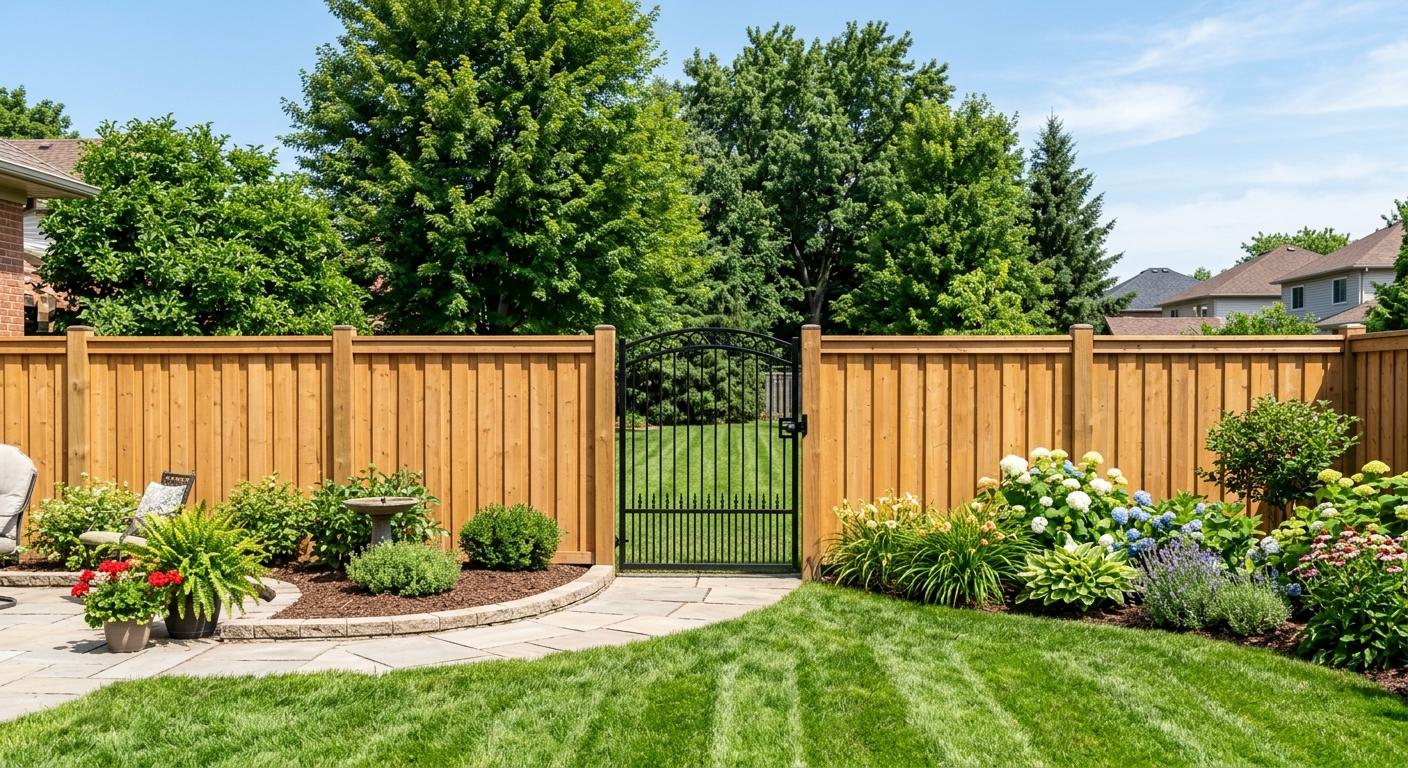
Fencing options and costs in North Haven
In North Haven, Alberta, choosing the right fence usually comes down to balancing privacy, maintenance, and how much the Prairie wind and freeze–thaw cycling will test the structure. With a small local population of 2,365 people (Statistics Canada, 2021 Census), you may notice fewer contractors on the books at peak season—but the demand is steady because detached homes are a strong driver of yard perimeter projects. That’s especially noticeable in neighbourhood pockets where lots have more open exposure to wind, and where residents value sound and visual screening.
In the Calgary economic region, pricing is pushed up by post-depth requirements. Frost protection is a primary cost driver here: contractors typically set posts about 4 ft (≈120 cm) deep to get below the regional frost line and reduce heaving risk. For solid privacy fences—wood and vinyl—wind loading also matters, which usually means closer post spacing and fully concreted footings for heavier panels. Chain-link installs remain more affordable because airflow reduces wind pressure, while aluminum ornamental often lands at the higher end due to material and bracing needs.
Work is especially in demand around the north edge residential corridors where yards are more exposed and wind breaks are a common request. If you’re planning a fence this year, the next step is comparing common materials side-by-side so you can budget confidently before we talk about what’s driving the quote differences in North Haven.
| Material |
Lifespan |
Maintenance |
Privacy Rating |
Price per Linear Foot |
| Pressure-treated pine (standard wood) |
10–20 years (typical) |
Stain/seal every 2–3 years |
High (solid panels) |
$40–$80 |
| Cedar (natural rot resistance) |
15–25 years |
Light staining every 2–4 years |
High (solid panels) |
$55–$95 |
| Vinyl / PVC (no-maintenance) |
20–30 years |
Rinse as needed; no staining |
High (solid or semi-solid) |
$45–$90 |
| Chain-link (galvanized steel) |
20–35 years |
Occasional tension check and rinse |
Low (open mesh) |
$25–$55 |
| Aluminum ornamental |
25–40 years |
Minimal cleaning; inspect for hardware |
Low to Medium |
$70–$120 |
| Composite / recycled material |
20–30 years |
Low; occasional wash |
Medium to High (panel dependent) |
$70–$110 |
Prices are estimates only and vary by project scope, site access and material selection.
What affects the price of fencing in North Haven
In North Haven, you can see the same fence concept priced 30–50% differently across Calgary and the surrounding market because the “hidden” structural requirements change with frost depth, wind exposure, and how difficult the site is to build on. The Calgary economic region has long freeze–thaw cycles, so contractors plan for frost protection by setting posts well below the regional frost line. That typically means excavation and concrete work are more substantial than in milder parts of Canada—especially for 6 ft privacy fences and gate posts where racking forces are higher.
Post depth is the big lever. In cold regions, posts often need to go about 1.5–2.0 m into the ground so the base stays below frost movement, which increases labour, hole size, and sometimes the need for longer posts and additional concrete. Prairie wind exposure also drives tighter post spacing and sturdier construction for solid wood or vinyl panels; chain-link tends to be less expensive because it allows airflow, reducing lateral loads. Coastal BC’s wet climate (for comparison) accelerates rot risk for wood unless treatment and detailing are correct, which is why materials and maintenance schedules differ—but in Alberta, the frost and wind control the cost.
In North Haven specifically, examples that raise cost include: (1) extra excavation where frozen soil slows down augering, (2) steeper yards that require stepped panels, which increases labour, and (3) gate sections that need stronger framing for latching and alignment. Conversely, costs can be lower when your run is straight, access for a skid steer is good, and you choose an airflow-friendly system such as chain-link (often closer to the lower–mid band of $25–$55 per linear foot), rather than a solid privacy build that commonly lands mid–upper wood/vinyl ranges like $40–$80 or $45–$90.
| Price Factor |
Why It Matters |
Cost Impact |
| Fence length in linear feet |
The most direct driver of labour, posts, rails, and hardware. |
Higher length usually increases total cost proportionally; mobilization spreads across the run. |
| Post depth required |
Frost line determines how deep holes must be and therefore post length. |
Deeper frost-safe installs raise excavation time and concrete volume. |
| Post setting method |
Concrete vs. gravel pack vs. driven posts changes stability in freeze–thaw cycles. |
Concrete-set posts generally cost more but reduce heaving and loosened anchors. |
| Material choice |
Different materials have different wind tolerance, bracketry, and install complexity. |
Wood/vinyl often mid–upper; chain-link lower–mid; aluminum ornamental often top-end. |
| Gate count and type |
Gates require heavier framing, hinges, latches, and alignment work. |
Adding a double drive-through gate usually increases costs significantly vs. a walk-through gate. |
| Grade and terrain |
Sloped yards may need stepped heights or raked panels to maintain proper clearance. |
More layout time and extra materials for transitions. |
| Old fence removal and disposal |
Demo takes time and may include hauling and off-site tipping fees. |
Can add a noticeable amount, especially for large runs or concrete-set posts. |
| Permit fees and survey / property line locate |
Boundary verification reduces disputes and ensures the fence aligns with bylaws. |
May add direct costs and scheduling time; varies by project scope. |
Permits & regulations in Alberta
In Alberta, fence projects can require a building permit depending on fence height and location. A common rule of thumb is that fences above about 2.0 m (6.5 ft) at the rear and 1.0–1.2 m (3–4 ft) at the front or corner often trigger permit requirements. Regardless of permit needs, your fence must follow property line rules and municipal setback bylaws, and it must be installed with safe clearances around utilities and services.
Before any post hole is dug in North Haven, call for utility locates through Alberta One-Call. This is essential even if you’ve fenced there before—service lines and upgrades can exist without obvious surface indicators. Then, obtain a survey or a property pin locate so you can measure from the correct boundary. Shared fence ownership is handled under Alberta line-fence principles, so it’s smart to confirm expectations with neighbours early—especially where you’re replacing an older dividing fence.
What typically DOES require a permit: taller fences (especially those meeting or exceeding the common thresholds above) and projects with complex siting near a corner or property line constraints.
What typically does NOT: most standard-height residential perimeter fences that clearly fall under local height thresholds and don’t require special setbacks—though the final call depends on your exact siting.
To verify an Alberta contractor: check their licence status through the appropriate provincial trade registry where applicable, ask for a certificate of insurance showing liability coverage, and confirm WCB/WSIB-equivalent coverage (Workplace safety coverage under Alberta requirements). Request documents in writing and keep them with your contract. Also ask whether permits (if needed) are pulled by the contractor or by you.
Choosing the right fence material for North Haven
Choosing a fence material in North Haven is less about what looks good in summer and more about what stands up to Alberta’s freeze–thaw cycling, wind-driven snow, and strong Prairie gusts. Pressure-treated pine is the best budget starting point, but it typically needs staining or sealing every 2–3 years to reduce grey weathering and keep the surface uniform. Cedar offers better natural rot resistance and usually looks richer longer, but it still benefits from periodic finishing. Vinyl/PVC is the low-maintenance favourite—no staining, just rinse—but extreme cold and wind can make alignment and post anchoring more important, so proper post depth and bracing matter. Chain-link is the long-life, lowest-cost option, yet it doesn’t provide true privacy unless you add a privacy slat or separate screening. Aluminum ornamental provides a rust-resistant, clean look with minimal upkeep, but it won’t give the privacy many homeowners want.
Because Calgary-area frost protection is critical, post depth requirements usually favour concrete-set footings for solid privacy panels. For many projects, installers set posts to about 4 ft (≈120 cm) deep or deeper to work below frost movement—especially at gate points and 6 ft fence lines. That means your material choice should pair with a structural approach that resists racking. If you’re comparing costs: moving from chain-link (often $25–$55 per linear foot) to vinyl privacy (often $45–$90) is usually justified when you actually need visual and sound screening, not just boundary definition.
In practice, a typical “value” match for North Haven is solid wood or vinyl for privacy, chain-link for perimeter security on exposed runs, and aluminum for a decorative boundary where airflow and low maintenance are priorities.
| Material |
Cold Tolerance |
Lifespan |
Annual Maintenance |
Best For |
Price Band |
| Pressure-treated pine |
Good when posts are deep and sealed properly |
10–20 years |
Inspect annually; stain/seal every 2–3 years |
Budget-friendly privacy and classic look |
$40–$80 |
| Cedar |
Very good; handles cold when installed with correct airflow gaps |
15–25 years |
Inspect; stain every 2–4 years |
Premium appearance with rot resistance |
$55–$95 |
| Vinyl / PVC |
Good to very good; benefits from anchored posts and correct panel spacing |
20–30 years |
Minimal (wash/rinse as needed) |
Low maintenance privacy |
$45–$90 |
| Chain-link |
Excellent; galvanized steel tolerates freezes well |
20–35 years |
Minimal (check tension and coatings) |
Security with airflow |
$25–$55 |
| Aluminum ornamental |
Excellent; no rust in freeze–thaw cycles |
25–40 years |
Minimal cleaning; check hardware |
Decorative boundary with visibility |
$70–$120 |
| Composite / recycled |
Good; depends on panel system and fastener choice |
20–30 years |
Low; occasional wash |
Weather-resistant privacy with less upkeep |
$70–$110 |
How to choose a fencing contractor in North Haven
When you’re hiring a fencing contractor in North Haven, the fastest way to avoid headaches is to verify coverage and paperwork before you compare prices. In Alberta, ask for proof of liability insurance (certificate of insurance), and confirm workplace safety coverage for the crew under the province’s workplace compensation requirements. For licensing, request the contractor’s business details and any trade/contractor registration information available for their fencing work—then verify it through the appropriate online registry links the contractor should provide. If they can’t produce these documents quickly, treat that as a warning sign.
Next, get 2–3 itemised written quotes that break labour and materials apart (not a single lump sum). Look for specific line items like post excavation depth, concrete volume/footings, rail and bracing components, gate hardware, and any surface restoration. Carefully read the exclusions: will they pull the permit if one is required, and who pays? Is old fence removal and disposal included? Are you paying extra if they hit rock or frozen soil? Ask for a clear scope so you’re not surprised during install.
Warranty should be separate for workmanship and product. Ask how long the workmanship warranty lasts, whether it’s transferable if you sell, and what manufacturer warranty covers. For payment, never agree to pay more than about 10–15% upfront; hold back a portion until the job is complete and final measurements confirm straight lines and gate operation. Finally, require a start date and completion estimate in writing—fencing timelines can shift in Alberta when deep frost and heavy snow delays excavation.
- Verify liability insurance certificate and that it lists the worksite location.
- Confirm workplace coverage for installers and ask who is responsible if a worker is injured on-site.
- Request proof of contractor registration/licensing details and confirm via the relevant registry.
- Get itemised pricing: posts, rails, fasteners, concrete/footings, labour, gates, and removal.
- Ask the post depth specification in writing (frost-safe set depth) for your exact runs.
- Confirm whether concrete is included for all posts and for gate posts.
- Clarify disposal: hauling included or are you paying tipping fees?
- Ask what happens if they discover buried obstacles or you have unlocated utilities—what’s the add-on process?
- Check warranty separately for workmanship vs. product, and whether it’s transferable.
- Keep payment schedule conservative; avoid large upfront deposits.
- Require a written timeline with a start date and projected completion window.
- Confirm gate hardware specs (hinge type, latch quality, and post reinforcement).
Red flags I see with fencing contractors in North Haven include: quoting without stating post depth/concrete requirements; refusing to provide insurance or coverage documents; giving only lump-sum numbers with no scope details; promising “same-day” installs that ignore frost-safe excavation; and avoiding written warranties or shifting responsibilities for permits and disposal after the quote is accepted.
Frequently asked questions — fencing in North Haven
Should fence posts be set in concrete here?
In North Haven and the Calgary-area region, concrete setting is usually the safest choice for privacy fences and gate posts because of freeze–thaw movement. The Prairie climate is hard on posts: frost protection is a primary cost driver, and posts need to be set below frost movement (often around 4 ft / ≈120 cm or deeper depending on the design frost depth) to prevent heaving. A concrete footing also helps resist wind racking on solid wood or vinyl panels, which are more vulnerable than airflow-friendly chain-link. If a contractor proposes gravel-only for a 6 ft privacy fence on an exposed lot, ask how they’re managing frost protection and lateral wind load. For reference, solid wood pricing commonly starts in the mid-range (around $40–$80 per linear foot) because this structural groundwork is included.
What's the best fence for privacy?
For privacy in North Haven, a solid-panel wood or vinyl/PVC fence is the most reliable option. If your goal is to block sightlines and reduce the “line of sight” across open Prairie exposure, you’ll generally want close panel spacing and strong framing plus frost-safe post depth. Vinyl tends to win for low maintenance—no staining—but it still depends on good anchoring, especially in wind. Cedar looks great and has natural rot resistance, but it still benefits from periodic maintenance to keep its finish even. If budget is your top priority and you’re comfortable with maintenance, pressure-treated pine is often the most cost-effective route, commonly reflected in installation pricing in the $40–$80 per linear foot range. For a long, exposed run where privacy matters, the extra structure is usually worth the upfront cost.
How do I compare fencing quotes?
Start by comparing apples to apples. Ask each contractor for an itemised quote that separates labour from materials and specifies post depth, post spacing, whether concrete footings are included, and what happens with gate hardware. The most common reason quotes differ by 30–50% in the Calgary region is structural scope: frost-safe installation depth and wind load resistance can change how many posts you need and how much concrete you’ll use. Also compare allowances for terrain: stepped panels on slopes can increase labour. Make sure removal and disposal are included (or clearly excluded), and confirm whether permits are handled if the fence height exceeds typical thresholds (often around 2.0 m rear and 1.0–1.2 m front/corner). Finally, verify warranty terms and payment schedules; the cheapest quote that skips key items can cost more in repairs later.
How long does fence installation take in North Haven?
Timeline varies with frost conditions, yard access, and fence length, but most residential installs in North Haven are measured in days rather than weeks once excavation begins. Straight runs with good access and simple gates typically move faster; sloped terrain, extra bracing, and multiple gates add layout time. If old fence removal is included, expect more time for demo and hauling. In freeze–thaw season, contractors may schedule around harder ground, which can affect excavation speed—this is why you’ll hear more planning talk in winter or early spring. A practical approach is to ask for a written start date and completion window. Use the written scope to confirm what’s included (utilities locate coordination, removal, and disposal) so your timeline reflects real site conditions.
Can I install a fence on a slope in North Haven?
Yes—you can install a fence on a slope in North Haven, and it’s common on Prairie lots. The key is how the fence is stepped or raked while maintaining proper height and clearance. Most installers will either step panels (stair-step approach) to keep a consistent post spacing along the slope, or use a raked system where the rails angle to match the grade. Stepped construction is often preferred for solid privacy panels because it holds appearance and structural consistency in wind. Be sure your contractor specifies the method in writing, including whether your bottom rail follows grade or stays above a clearance line. Slopes can affect material usage and labour, which can shift pricing compared with a flat yard—especially for 6 ft privacy builds where bracing and post anchoring matter.
What is the most weather-resistant fence for North Haven's climate?
For North Haven’s freeze–thaw cycling and wind exposure, “most weather-resistant” depends on what you prioritise. Chain-link (galvanized steel) is typically excellent for long-term durability because it’s less affected by wind racking thanks to airflow, and the material tolerates Alberta cold very well. If you need true privacy, solid wood or vinyl can be very resilient when posts are set deep and the fence is built to handle lateral loads; in that case, vinyl often feels the most maintenance-resistant because it doesn’t need staining, while cedar has strong natural rot resistance. Aluminum is also highly weather-resistant and rust-free, but it’s generally lower privacy. In practical pricing terms, many homeowners choose chain-link closer to $25–$55 per linear foot for maximum durability per dollar, then add privacy screening if needed.