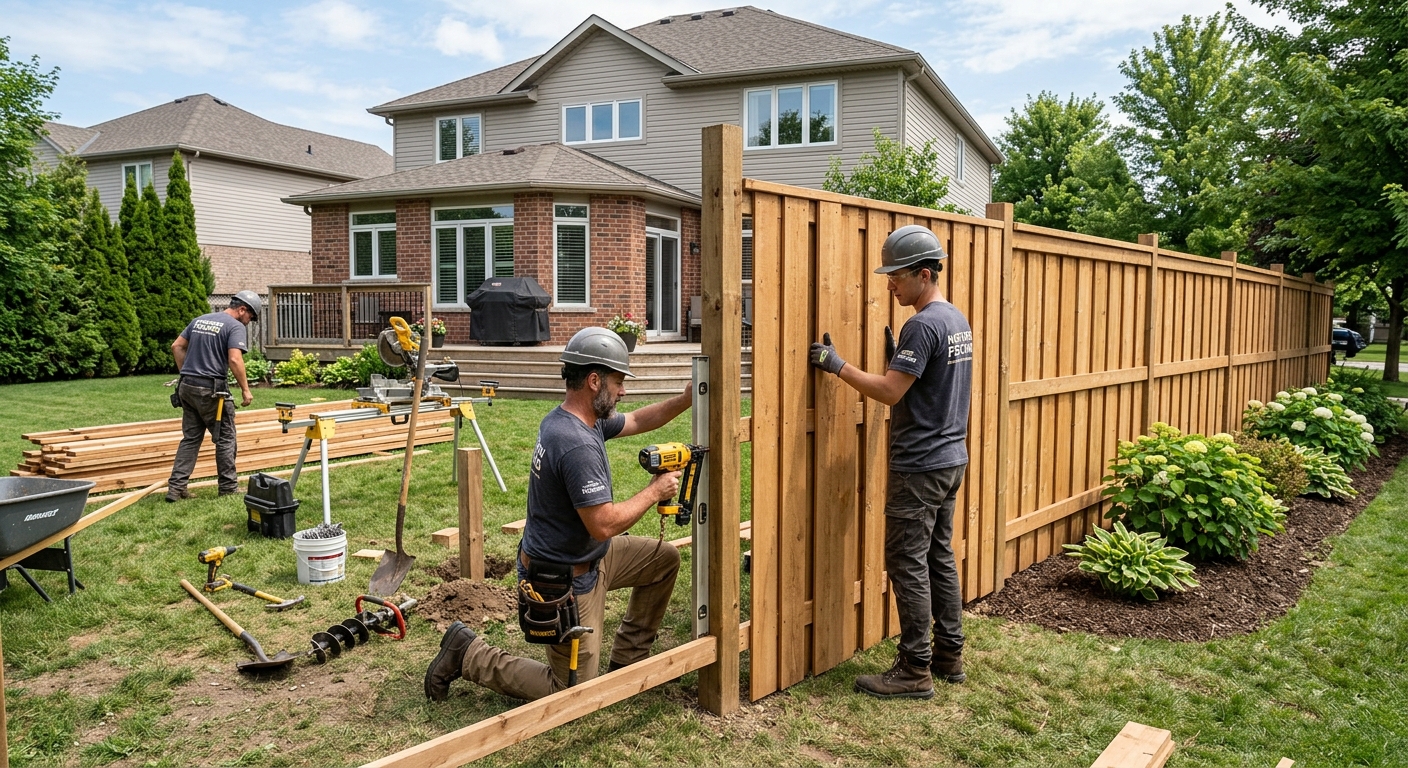
Fencing options and costs in Killam
In Killam, the right fence starts with matching materials to how your yard sits in Prairie wind, frost, and snow. With just 918 residents (Statistics Canada, 2021 Census), the trades market is small, so availability can affect timing—and sometimes the installed price—especially on spring and early-summer installs. Demand also stays consistently strong because 83.8% of dwellings are single-detached homes, meaning many properties have uninterrupted side and backyard runs that need reliable enclosure. If you’re budgeting for a new boundary or privacy upgrade, it helps to expect that Camrose–Drumheller pricing is driven less by “panel cost” and more by engineered post depth, heavy-duty corner hardware, and labour to set posts in Alberta’s frost conditions.
In Killam’s part of Alberta, frost depth commonly falls around 1.5–2.1 m (5–7 ft), so permanent residential fencing typically needs posts set about 90 cm or deeper (and often slightly below the frost line) to reduce frost heave and long-term leaning. Prairie wind exposure can also push contractors to tighter post spacing for privacy fences, especially for vinyl and wood slat designs that can rack. Where homeowners have clay-heavy, poorly draining soil, the excavation and concrete per post can add labour time and material cost. For many properties along the town’s busier residential streets—where wind can’t be sheltered by larger acreage trees—privacy fences are particularly in demand, especially around yard edges that face open approaches.
Below are typical installed cost ranges for common options in Killam, Ontario-style “basic materials shopping” doesn’t reflect the real drivers—so use these bands as a starting point before you compare quotes.
| Material |
Lifespan |
Maintenance |
Privacy Rating |
Price per Linear Foot |
| Pressure-treated pine (standard wood) |
10–15 years |
Stain/seal every 2–3 years; fastener checks |
High (solid panels) |
$45–$80 |
| Cedar (natural rot resistance) |
15–20 years |
Seal/stain every 2–4 years |
High (solid panels) |
$60–$95 |
| Vinyl / PVC (no-maintenance) |
20–30 years |
Minimal (wash as needed); inspect posts at hardware |
High (with solid infill) |
$70–$120 |
| Chain-link (galvanized steel) |
20–30 years |
Occasional tightening/rust spot checks |
Low (visibility remains) |
$30–$60 |
| Aluminum ornamental |
25–40 years |
Wash; tighten hardware |
Medium (open pickets) |
$65–$110 |
| Composite / recycled material |
20–30 years |
Low (periodic wash); follow manufacturer fasteners |
High (solid styles) |
$85–$135 |
Prices are estimates only and vary by project scope, site access and material selection.
What affects the price of fencing in Killam
In Killam, two homeowners can receive quotes that differ by 30–50% for what sounds like the “same fence” because Alberta pricing is shaped by foundation engineering, wind-load detailing, and jobsite labour—not just the fence material. On the Prairies, frost depth is deep enough that contractors can’t rely on shallow holes or light-duty bracing for permanent residential fencing. Typically, posts must be set roughly 4–6 inches (10–15 cm) below the design frost depth to reduce heaving, which often means drilling longer holes and using longer, heavier posts. That adds material weight and concrete (or engineered backfill) and increases installation time, which is why installed vinyl and metal solutions often land in the $70–$120 style bands compared with chain-link options that commonly come in around $30–$60.
Wind exposure is another major driver. Prairie gusts can rack taller panels, so contractors often tighten post spacing and upgrade corner/end bracing. In more sheltered town lots you might be able to use standard spacing, but gates and long runs still usually require oversized hardware. By contrast, a milder and wetter climate—like coastal regions—tends to accelerate wood rot if treatment and coatings aren’t done correctly; in Alberta, your biggest wood risk is less “always-wet rot” and more freeze-thaw movement and moisture control at the base.
Concrete examples from Killam-like conditions: (1) If your soil is clay and holds water, you may need deeper, more controlled excavation and additional concrete per post, pushing both labour and concrete cost upward. (2) If your fence line crosses compacted or frozen ground in spring, excavation time increases and can move a “mid-band” job into a higher installed range. (3) Older homes—70.9% built before 1981 (Statistics Canada, 2021 Census)—often come with older fence remnants or denser landscaping, which can add removal/disposal time and re-staking the line.
| Price Factor |
Why It Matters |
Cost Impact |
| Fence length in linear feet |
Most costs scale directly with run length and number of posts |
Major driver; can change total by thousands |
| Post depth required |
Frost line determines hole depth and post length to prevent heaving |
Increases concrete and excavation labour |
| Post setting method |
Concrete-set posts resist movement better than tamped gravel in freeze-thaw cycles |
Concrete and mixing/placement add cost |
| Material choice |
Vinyl and engineered metal need stronger anchoring in wind; cedar requires coating |
Shifts you into different price bands |
| Gate count and type |
Walk-through vs. double-drive gates change framing, hinges, and bracing |
Gates often add disproportionate cost |
| Grade and terrain |
Slopes require stepping or racking to keep privacy and alignment |
Extra labour and possibly special rails |
| Old fence removal and disposal |
Salvageable sections reduce disposal; buried posts add time |
Can be a significant add-on |
| Permit fees and survey / property line locate |
Accurate boundaries prevent rework and neighbour disputes |
Small-to-moderate cost, but high value for accuracy |
Permits & regulations in Alberta
In Alberta, fences typically fall under permit rules when they exceed certain height thresholds—commonly around 2.0 m (6.5 ft) at the rear and about 1.0–1.2 m (3–4 ft) at the front or corner—though the exact trigger can vary by municipality and location. In Killam, treat the front and corner lines more conservatively and confirm the height measurement plan before work starts. In any case, your fence must respect property lines and any local setback bylaws that apply to your street frontage.
Before digging post holes, arrange utility locates by calling Alberta One-Call (utility tracing is the safest first step). Also, obtain a survey or locate your property pins—especially on older lots—so you avoid encroaching onto a neighbour’s land or crossing a registered easement. Alberta line-fences arrangements are generally handled through provincial rules for shared fencing, which can affect who pays and where the fence should sit when it’s truly a boundary fence.
What usually DOES require a permit: installing a high fence that exceeds the typical height thresholds, and any fencing that may affect sightlines or involves special site conditions (like major structural elements). What typically does NOT require a permit: replacing an existing fence in the same approximate location and height where it stays below the height threshold (still verify with your local office).
To verify a contractor is legitimate in Killam, check: (1) Alberta business licence/registration status (via the provincial online registry), (2) certificate of insurance showing general liability and the right insured party, and (3) WSIB/WCB clearance coverage evidence if the contractor’s work is captured under those systems. Ask for copies before you sign, and confirm the dates align with your project start date.
Choosing the right fence material for Killam
Choosing a fence for Killam comes down to balancing privacy, maintenance, and how the material handles frost movement and Prairie wind. Pressure-treated pine is usually the most budget-friendly option, but it needs coating work to prevent early grey weathering and moisture absorption at the boards. In practice, many homeowners who choose wood plan on staining or sealing every 2–3 years to keep it looking good and slowing surface breakdown. Cedar gives better natural rot resistance and a higher-end appearance, but it still benefits from periodic sealing to protect against freeze-thaw cracking and surface fade.
Vinyl/PVC is popular in Alberta because it’s low maintenance and typically lasts 20–30 years, but extreme cold can make some styles more brittle at panel edges if hardware and posts aren’t installed to spec. That’s why the engineered part—proper post depth and strong corner/gate bracing—matters as much as the material itself. Chain-link is usually the least expensive and very durable, but it offers little privacy unless you add slats, lattice, or a privacy screen that can catch wind. Aluminum ornamental fencing provides a clean, rust-resistant look with mid-range cost, but it won’t deliver “true privacy” like solid panels. Composite/recycled options can offer solid privacy with low maintenance, though they cost more upfront than wood or chain-link.
On frost depth: in Camrose–Drumheller conditions, expect concrete-set posts for permanent fencing—especially for privacy fences, gates, and end runs—because posts must reach roughly 90 cm or deeper to reduce heave risk. For wind and snow load, heavier rails and tighter post spacing help prevent rack on tall designs. A practical example: upgrading from treated pine in the $45–$80 band to vinyl in the $70–$120 band is often justified when you want fewer maintenance trips for coating and you’re planning to stay in the home long enough to spread the higher upfront cost over the fence’s lifespan.
| Material |
Cold Tolerance |
Lifespan |
Annual Maintenance |
Best For |
Price Band |
| Pressure-treated pine |
Good with proper sealing and correct post depth |
10–15 years |
Light inspection; stain/seal every 2–3 years |
Lower upfront cost, solid privacy panels |
$45–$80 |
| Cedar |
Good; resists rot better through freeze-thaw cycles |
15–20 years |
Wash/inspect; seal every 2–4 years |
Appearance + privacy with moderate maintenance |
$60–$95 |
| Vinyl / PVC |
Very good; requires correct hardware and spacing |
20–30 years |
Minimal; occasional wash and hardware check |
Low maintenance privacy in windy yards |
$70–$120 |
| Chain-link |
Excellent; galvanized steel handles temperature swings |
20–30 years |
Low; periodic tightening and inspection |
Security with lowest cost, pet containment |
$30–$60 |
| Aluminum ornamental |
Very good; powder coating supports cold conditions |
25–40 years |
Low; rinse/wash as needed |
Attractive front fences with light privacy |
$65–$110 |
| Composite / recycled |
Very good; stable boards when installed properly |
20–30 years |
Low; occasional wash |
Solid privacy with minimal upkeep |
$85–$135 |
How to choose a fencing contractor in Killam
When you’re hiring a fence contractor in Killam, start by verifying Alberta coverage and accountability. First, ask for their Alberta business registration/licence and confirm the business exists and matches the quote. Second, request a current certificate of insurance (general liability) naming the correct insured and showing the coverage dates. Third, confirm WSIB/WCB clearance or applicable coverage documentation—contractors should be able to provide clearance letters or evidence that their work is properly covered.
Then get 2–3 written, itemised quotes. You want the breakdown to show labour (excavation/post setting, rail installation, bracing and hardware, gate build), materials, and allowances for site conditions like clay excavation or removal/disposal. A lump-sum number without details makes it hard to compare apples to apples when frost depth and post setting methods differ.
Read the scope carefully. Does the quote include permit handling (where applicable), utility locate scheduling, and property line locate/survey costs? Is removal included, including hauling away old fence and buried posts? Confirm whether the contractor will repair disturbed turf and how they handle restoration after drilling in frozen or compacted ground.
Warranty matters too: ask for the workmanship warranty length and whether it covers posts and bracing under wind load and frost movement for a defined period. Also confirm the product manufacturer warranty and whether it’s transferable to subsequent homeowners if you sell.
For payment scheduling, never pay more than 10–15% upfront. Use a holdback until completion and final inspection, especially for fence line alignment and gate operation. Insist on a start date and estimated completion timeline in writing.
- Provide Alberta business details and proof of insurance before you sign.
- Show WSIB/WCB clearance documentation (or applicable coverage evidence).
- Use written, itemised quotes (labour + materials, not lump sum only).
- Clarify post depth, setting method (concrete vs. gravel pack), and post size.
- Confirm wind-rated bracing plans for corners, ends, and gates.
- Specify gate type, swing direction, latch hardware, and clearance from the ground.
- Confirm disposal and hauling of old fencing and concrete footings, if applicable.
- Include utility locate responsibility and scheduling in the scope.
- State whether permit pulling is included (where height thresholds trigger it).
- Define restoration: topsoil, seeding/sodding, and debris cleanup standard.
- Ask for photos of similar work and post-install inspection approach.
- Use a payment schedule with a holdback until final walk-through.
In Killam, red flags I watch for include: (1) quotes that don’t specify post depth or setting method, (2) “cheap” driven-post promises with no engineered bracing for wind, (3) missing or outdated insurance/coverage documents, (4) vague warranties that exclude labour, and (5) pressure to pay the majority upfront before any concrete work starts.
Frequently asked questions — fencing in Killam
Can I install a fence on a slope in Killam?
Yes, you can install a fence on a slope in Killam, but the design approach matters. On sloped yards, contractors typically use stepped rails (each panel section is level, but the overall height changes) or a racked layout where panels follow the grade. The goal is to keep privacy consistent while avoiding large gaps that can collect snow and increase wind load on the rails. Because frost depth in this part of Alberta is commonly around 1.5–2.1 m, the post holes still need to be set to resist heaving—even on slopes—so you can’t simply “shorten” posts on the downhill side. A good plan will also address how you’ll keep gates level so they latch properly. If you’re pricing, slope work often raises labour time, which is one reason installed costs may land toward the higher side of a $45–$80 wood band or the low-to-mid range of vinyl pricing.
What is the most weather-resistant fence for Killam's climate?
For Killam’s freeze-thaw cycles and Prairie wind, the most weather-resistant options are usually vinyl/PVC and properly installed galvanized steel chain-link, assuming engineered post depth and strong end/corner bracing. Vinyl can perform well because it won’t rot like untreated wood, and it’s generally stable when posts are set correctly below the frost line. Chain-link is also highly durable in cold weather because galvanized steel handles temperature swings and moisture better than many wood assemblies. That said, the “best” choice depends on your priorities: chain-link offers security but limited privacy. If you want maximum privacy with low maintenance, vinyl often wins in Alberta; if budget is top priority, chain-link can be hard to beat, with typical installed pricing around $30–$60 per linear foot. For privacy-first homeowners, cedar can be very good aesthetically, but it still needs regular maintenance to protect surfaces. The real differentiator in Killam is the post foundation work—materials alone don’t overcome poor footing.
How do I prevent wood fence rot in Killam?
Wood rot prevention in Killam is mostly about controlling moisture at the base and keeping the wood protected through freeze-thaw cycles. Start with properly pressure-treated or cedar boards, then ensure the design includes adequate air flow (no trapped soil against the bottom rails) and secure top covers where appropriate. Most failures come from boards sitting in contact with wet ground, or from fasteners and rails holding water where the coating has worn away. Plan on inspecting annually for coating break points, loose boards, and any signs of dark staining along post bases. Practically, many homeowners budget to stain or seal pressure-treated pine every 2–3 years; if you skip it, grey weathering and surface breakdown can speed up. Cedar also benefits from sealing even though it resists rot better. If you’re comparing budgets, remember that wood in the $45–$80 range can still be a smart value if you’re willing to maintain it; if you want fewer maintenance seasons, vinyl in the $70–$120 band often reduces long-term effort.
What is the cost per linear foot for fencing in Killam?
In Killam, fencing cost per linear foot depends on the material and—most importantly—the foundation work required for Alberta frost and wind. As a general planning guide, chain-link often comes in around $30–$60 per linear foot, wood typically falls around $45–$80, aluminum/ornamental is commonly around $65–$110, and vinyl/PVC typically lands around $70–$120. Actual totals change based on fence length, number of posts, gate quantity and size, soil conditions, and whether old fence removal and disposal are included. Clay or poorly draining soil can increase excavation and concrete volume, while tall privacy fences may require tighter spacing and heavier bracing to resist wind racking. If you have a property line with older fences or unclear stakes, surveying or locate work can also add to the quote.
Should I repair or replace my old fence in Killam?
Often, you can repair instead of replacing if the fence posts are still solid, the rails aren’t significantly warped, and the damage is limited to a few panels or failing fasteners. In Killam’s climate, the biggest decision point is post stability: if posts have leaned due to frost movement or rot at ground contact, repairs usually just delay the bigger replacement. If the fence has surface coating failure but the framing is sound, re-staining boards and swapping a few boards can be worthwhile. If you see widespread board splitting, loose posts, and sagging sections over long runs, replacement is usually more cost-effective and provides a better lifetime outcome. A related factor is how close you are to property line issues—if the boundary has shifted due to old stakes or previous installations, replacement may include proper locate work and upgraded bracing. Budget-wise, repairs may keep you near lower band pricing, but once you move into full replacement territory, you should expect installed costs more consistent with material bands such as $45–$80 for wood or $70–$120 for vinyl, depending on what’s needed for solid post foundations and wind-load stability.
How do I handle a fence dispute with a neighbour in Alberta?
If you have a fence dispute in Alberta, the safest approach in Killam is to slow down and document everything before you act. First, confirm the boundary: obtain a survey or locate your property pins to verify where the fence should sit and whether any easements are involved. Next, communicate in writing with your neighbour about what you believe is incorrect—date the photos, note fence offsets and heights, and describe any movement or safety concerns. If the disagreement relates to a shared boundary fence, line-fence ownership rules generally depend on provincial legislation and the specifics of whether it’s truly on the boundary. Before repairs or replacement, ensure the plan respects property lines and any height/setback requirements that could trigger permit considerations. Finally, if you’re using a contractor, ask them to clearly state in writing where posts will be set and reference any locate/survey documents used. Avoid “temporary” fixes that shift the fence—once concrete is set, disputes become much more expensive.