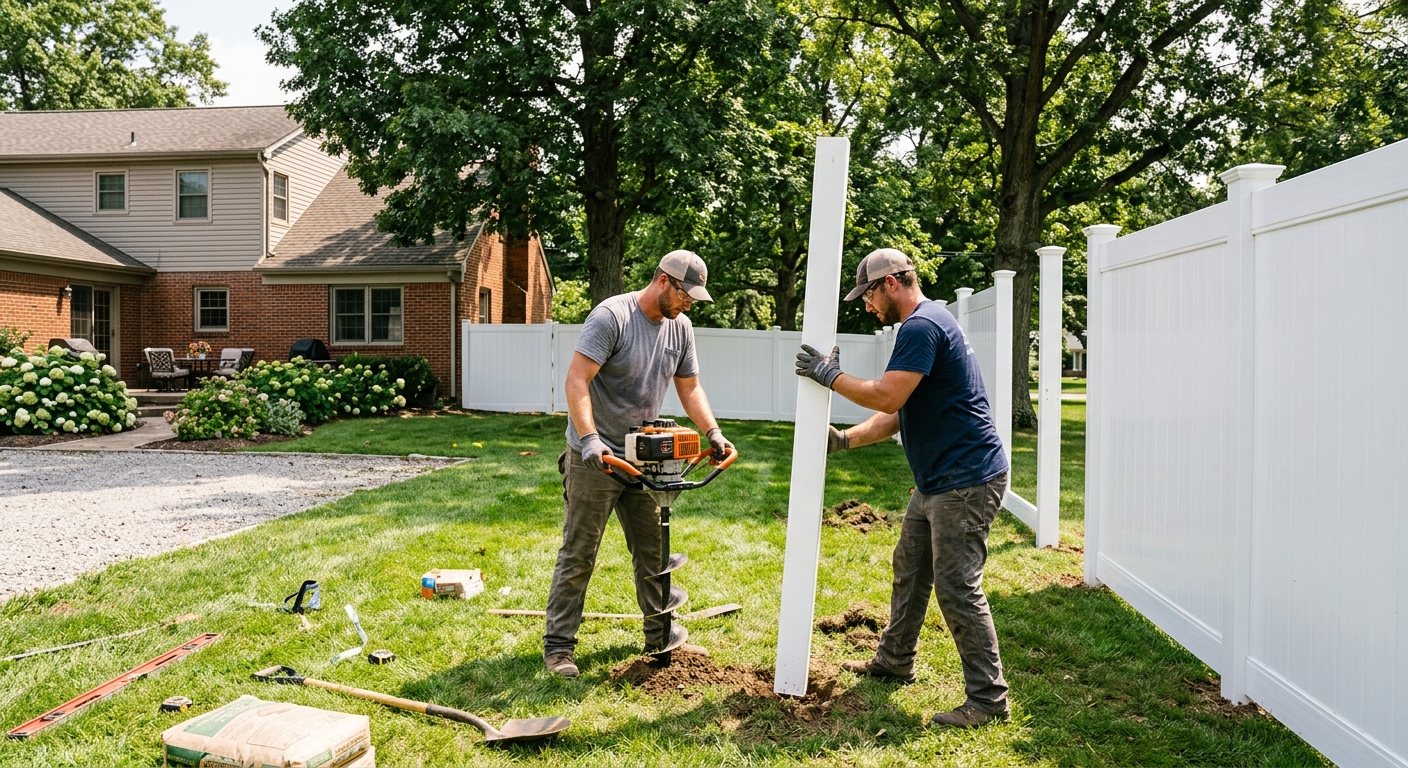
Fencing options and costs in Provost
In Provost, the right fence choice is largely about matching your yard’s wind exposure and winter freeze behaviour with the material’s long-term stability. With Provost’s housing stock skewed heavily toward single-detached homes (79.6% of dwellings), fencing demand is consistent across the town, because each detached property typically needs a perimeter, gates, and corner bracing. It also helps that the community includes a meaningful share of older homes; 59.9% of dwellings were built before 1981, which often means existing fence lines may be uneven, off-grade, or require removal and re-alignment before a new installation.
In the Camrose–Drumheller economic region, fencing costs are shaped by the Prairie environment: frost depth commonly sits around 1.5–2.1 m, so permanent fences generally need deeper engineered post footings to limit frost heave and gradual leaning. Strong winds on exposed lots push contractors to use closer post spacing and heavier posts for tall privacy fences. In more sheltered town areas, standard spacing can work, but end, gate, and corner posts still need to be oversized and firmly set.
Where the trade is especially active is around the more open, edge-of-town settings such as Highway 36 / south Provost approaches, where many yards have wider setbacks and visible wind. That’s also where you’ll see homeowners choosing sturdier materials like vinyl, cedar, or metal with deeper post work. Use the guide below to compare typical options and pricing before you request a detailed site quote.
| Material |
Lifespan |
Maintenance |
Privacy Rating |
Price per Linear Foot |
| Pressure-treated pine (standard wood) |
10–15 years |
Stain/seal every 2–3 years (and inspect boards annually) |
Good (solid board panels) |
$45–$80 |
| Cedar (natural rot resistance) |
15–25 years |
Seal or stain every 2–4 years |
Good to very good (solid pickets/boards) |
$60–$95 |
| Vinyl / PVC (no-maintenance) |
20–30 years |
Wash as needed (no staining) |
Very good (solid privacy styles) |
$70–$120 |
| Chain-link (galvanized steel) |
20–35 years |
Rinse/spot-fix bent sections |
Low (visibility through mesh) |
$30–$60 |
| Aluminum ornamental |
25–40 years |
Occasional rinse; no rust |
Low to medium (decorative pickets) |
$65–$110 |
| Composite / recycled |
20–30 years |
Rinse/clean; occasional repairs to boards |
Good (solid panel systems) |
$80–$130 |
Prices are estimates only and vary by project scope, site access and material selection.
What affects the price of fencing in Provost
Two homeowners can receive quotes that differ by 30–50% for the same fence length in Provost because the “hidden drivers” in the Camrose–Drumheller region change how many materials and how much labour are required. Even when the panel price looks similar on paper, the build details—post depth, concrete volume, wind-rated spacing, gate hardware, and excavation difficulty—can swing the final total. That’s why one quote may land near a chain-link band (around $30–$60 per linear foot), while a sturdier vinyl privacy build ends up closer to the $70–$120 range.
Frost is the biggest factor. In much of Alberta, permanent residential posts typically need to be set roughly 4–6 inches below the design frost depth to help prevent frost heave and gradual leaning. With common frost lines in the 1.5–2.1 m range, that translates to deep postholes and longer posts. Longer posts increase purchase cost, and deeper holes increase excavation time and concrete setting/placement labour.
Wind exposure also matters. Prairie gusts can rack lighter panels, so tall privacy fences often need closer post spacing and heavier gauge components—more steel hardware per run, and more installation time. For cold-weather material performance, snow and ice loads can add stress at the top rails, especially on windy, open lots.
Local examples in Provost that raise costs include: (1) clay or poorly draining soil—more concrete and more careful backfill to keep posts plumb; (2) yards with uneven grade from older subdivisions—requires raked/stepped rails and additional layout time; and (3) removing a decades-old fence—disposal and repairing damaged yard edging can add hours. Conversely, costs can be lower when sites are accessible for a skid steer or when you choose a simpler design like chain-link with standard tensioning and fewer rails.
| Price Factor |
Why It Matters |
Cost Impact |
| Fence length in linear feet |
Most materials and labour scale directly with total run length. |
Major (often the largest single line item) |
| Post depth required |
Frost depth determines how deep holes must be and how long posts must be. |
Major (more excavation and more concrete) |
| Post setting method |
Concrete-set posts resist frost movement and wind better than tamped gravel. |
Moderate to major (concrete + labour + cure/placement time) |
| Material choice |
Vinyl/metal require different rail/post systems than wood; chain-link uses tension hardware. |
Moderate to major (band differences of tens of dollars per foot) |
| Gate count and type |
Gates add bracing, hinges, latches, and sometimes heavier frames. |
Moderate (often noticeable add-ons per gate) |
| Grade and terrain |
Slopes require stepped or raked sections and more layout time. |
Moderate (extra hardware and labour) |
| Old fence removal and disposal |
Debris hauling, unfastening, and site clearing take time. |
Moderate (varies widely by condition) |
| Permit fees and survey / property line locate |
High fences, corner disputes, or unknown boundaries can trigger extra steps. |
Low to moderate (project-dependent) |
Permits & regulations in Alberta
In Alberta, fence rules are tied to both property boundaries and (in many cases) permit requirements. While exact thresholds can vary by municipality, a common guideline homeowners run into in practice is that fences above about 2.0 m (6.5 ft) in the rear and 1.0–1.2 m (3–4 ft) in the front or at corners often require a building permit. Regardless of height, all fences must respect property lines and comply with local setback and zoning requirements.
Before you dig any postholes in Provost, arrange utility locates using Alberta One-Call. This should be done before ground work so crews avoid damaging buried services. It’s also wise to obtain a survey or at minimum a property pin locate—this reduces the risk of encroachment disputes that can stall a project after excavation has already started.
Shared fence ownership is governed by Alberta’s line-fences legislation, so if your fence is on or near a boundary, confirm expectations with the neighbour. For contractor verification, homeowners should: (1) confirm the contractor’s Alberta licence status via the appropriate provincial listings; (2) request a current certificate of insurance showing general liability with adequate coverage; and (3) verify WSIB/WCB coverage credentials/clearance letter (ask for it in writing). A legitimate fencing contractor won’t hesitate to provide these before starting.
Choosing the right fence material for Provost
Choosing fencing for Provost is easiest when you start with your priorities—privacy, low maintenance, budget, and lifespan—then match the material to Prairie freeze-thaw and wind. Pressure-treated pine is the budget-friendly option, but to avoid grey weathering and uneven wear you’ll typically stain or seal every 2–3 years. Cedar offers a nicer finish and natural rot resistance, but it still needs periodic sealing to keep it looking uniform.
Vinyl/PVC is the low-maintenance favourite in town because it doesn’t require staining, and it’s durable through winter. That said, extreme cold can make some panels less flexible, so the installation details matter: proper post depth and spacing help prevent cracking from movement. Chain-link is usually the lowest upfront cost and lasts a long time, but it provides little privacy—unless you add screening like fencing mesh slats, trellising, or plantings. Aluminum ornamental fencing won’t rust and stays neat, but it’s primarily decorative, with privacy limited by open pickets. Composite/recycled boards can mimic privacy styles and typically offer stable performance, though they cost more up front.
On post depth: because frost in Alberta commonly sits around 1.5–2.1 m, fencing posts for a permanent residential install are generally set deep—often with concrete-set footings—to help prevent heave and leaning. On exposed lots, stronger wind performance usually means closer spacing and heavier corner/gate posts, regardless of whether you choose wood, vinyl, or metal.
A practical dollar example: if your goal is privacy and you’re weighing wood vs vinyl, a vinyl privacy fence that lands near the $70–$120 band can be justified when you want fewer upkeep visits. A pressure-treated privacy job may start closer to $45–$80, but the recurring staining and more frequent board replacements due to Alberta weathering can narrow that cost advantage over time—especially on wind-exposed runs.
| Material |
Cold Tolerance |
Lifespan |
Annual Maintenance |
Best For |
Price Band |
| Pressure-treated pine |
Good (install with proper bracing and drainage) |
10–15 years |
Low-medium: quick inspections; plan staining every 2–3 years |
Lower upfront cost with solid privacy panels |
$45–$80 |
| Cedar |
Good (sealing helps in freeze-thaw) |
15–25 years |
Medium: seal/stain every 2–4 years |
Natural look and rot resistance |
$60–$95 |
| Vinyl / PVC |
Good to very good with correct installation |
20–30 years |
Very low: rinse as needed; check posts/gates |
Low maintenance privacy in exposed wind |
$70–$120 |
| Chain-link |
Very good (galvanized holds up) |
20–35 years |
Low: tighten hardware; spot fixes |
Security with budget focus |
$30–$60 |
| Aluminum ornamental |
Very good (powder-coated) |
25–40 years |
Low: occasional rinse |
Decorative boundary with durability |
$65–$110 |
| Composite / recycled |
Good (depends on board system and fastening) |
20–30 years |
Low-medium: clean/inspect; replace damaged boards if needed |
Privacy look without traditional wood rot concerns |
$80–$130 |
How to choose a fencing contractor in Provost
When you hire a fencing contractor in Provost, don’t rely on “we’ve been doing this for years” alone. Start by verifying Alberta coverage and paperwork. Ask for their current WSIB/WCB clearance letter or coverage proof—if an injured worker can’t be covered, that risk lands on the homeowner. Request a certificate of insurance showing general liability with appropriate limits and ensure it lists your project/address or provides confirmation it covers service work in your area. Also confirm their Alberta business/labour licensing standing using the relevant online registries, and keep copies for your records.
Then get 2–3 itemised written quotes that break out labour and materials separately. You want line items like posts, rails, concrete, hardware, gate components, excavation, disposal, and any permit/survey allowances. A lump-sum number makes it easy for scope gaps to become cost increases later.
Read exclusions carefully: is fence removal included? Is topsoil reinstatement included? Is disposal hauled away? If your property line is uncertain, does the contractor include the steps for a locate and layout? Warranty should be clear: the workmanship warranty length and the manufacturer warranty on panels and components. Confirm whether warranties are transferable to you if ownership changes.
For payment, a safe schedule is typically 10–15% maximum upfront, then progress payments tied to milestones, with a holdback until completion and final walk-through. Ask for a start date and completion estimate in writing so winter weather delays don’t turn into open-ended timelines.
- Ask for WSIB/WCB clearance proof (or equivalent coverage letter) before work starts
- Request a current certificate of general liability insurance
- Confirm their Alberta licence/business registration status via the official online registry
- Get 2–3 quotes with labour + materials itemised (not one lump)
- Ensure post depth, post spacing, and whether posts are concrete-set are stated
- Confirm gate type, swing direction, and hardware brand/model
- Ask if permit pull is included where required by fence height
- Clarify whether old fence removal and disposal are included
- Confirm whether site protection is included (driveway/grass safeguarding)
- Require a written timeline with an estimated completion window
- Check warranty: workmanship duration and manufacturer warranty details
- Keep payments aligned to milestones; hold back until final inspection
In Provost, four fencing red flags I often see are: (1) a quote that doesn’t specify post depth or how frost movement will be addressed; (2) refusing to show insurance/coverage documents; (3) asking for large upfront payments (well beyond 10–15%); and (4) “allowance-only” language for concrete, gates, or gate hardware without real quantities. If the scope is vague on removal/disposal or permits, treat that as a second red flag.
Frequently asked questions — fencing in Provost
How do I find my property line before fencing?
In Provost, start with any survey paperwork you already have, but don’t rely on older sketch maps. If pins are available, request a property pin locate (or re-establish pins) before layout. This matters because prairie fencing can shift only slightly at first, and then encroachments become expensive to correct once posts are set. If your contractor plans the fence without confirming boundaries, ask how they will mark the line on-site and who is responsible if lines are disputed. For utilities, place a locate call before digging so you can avoid buried services. Boundary disputes are especially common on older lots, and Provost’s housing stock includes a large share built before 1981 (59.9% of dwellings), which sometimes correlates with less-clear historical fencing records. (Statistics Canada, 2021 Census)
What's the most low-maintenance fence?
For most homeowners in Alberta, vinyl/PVC is the closest thing to “set it and forget it,” because it doesn’t need staining and typically only needs a periodic rinse and inspection of posts and gate hardware. In the Camrose–Drumheller region, that can be a good fit for exposed yards where you want fewer maintenance trips in winter and shoulder seasons. The trade-off is upfront cost: vinyl/PVC installs commonly land in the $70–$120 per linear foot range depending on height, wind-rated post spacing, and gate complexity. Pressure-treated pine can be lower at roughly $45–$80, but it usually requires staining every 2–3 years and more frequent board checks in freeze-thaw. If you want low maintenance but also want maximum privacy, vinyl privacy styles are usually the easiest match.
How tall can my fence be in Provost?
Fence height limits depend on where the fence sits (front/corner vs rear) and local zoning expectations. In Alberta, permits are commonly triggered when fences exceed about 2.0 m (6.5 ft) in the rear and around 1.0–1.2 m (3–4 ft) in the front or corner area, though the exact threshold can vary by municipality. For Provost, the practical approach is to tell your contractor your intended height and where it will be located, then ask whether a permit is required before installation. This prevents rework after posts are already set. Also remember you must stay within property lines and any applicable setback bylaws. If you’re installing near a corner, the visibility and setback rules tend to be stricter.
Should fence posts be set in concrete here?
For most permanent residential fencing in Provost, concrete-set posts are the safest way to reduce frost movement and keep the fence plumb over time. Camrose–Drumheller frost behaviour is the key reason: frost depth is often in the 1.5–2.1 m (5–7 ft) range, so posts are usually set roughly 4–6 inches below the design frost line to help prevent heaving. That deeper hole often uses more concrete and longer posts, but it protects your investment—especially on exposed properties where wind loads can rack lighter installations. In sheltered yards, some contractors may use gravel pack techniques, but you’ll still want the end, gate, and corner posts treated as structural and set more securely. If you’re comparing quotes, insist the post-setting method (concrete vs alternative) is written into the scope.
What's the best fence for privacy?
In Provost, the best privacy fences are typically solid-panel systems with tight post spacing and sturdy corner/gate bracing to withstand Prairie winds and snow load stress. Vinyl privacy fences and cedar (or pressure-treated wood) solid board/ranch-style setups are common choices because they block sightlines effectively. Vinyl is usually the lowest maintenance path, but it often sits in the $70–$120 per linear foot band. Pressure-treated privacy may start around $45–$80, but expect staining every 2–3 years and more maintenance as boards weather. Chain-link is usually not a true privacy solution by itself (it’s more security-focused), unless you add privacy slats or plant screening. If your yard is on an exposed approach—such as more open areas leading in from highway corridors—plan for heavier posts and closer spacing regardless of material.
How do I compare fencing quotes?
When you compare fencing quotes in Provost, compare the scope, not just the total. Ask each contractor for an itemised breakdown of labour and materials: posts (length and depth), rails, concrete quantity/method, panel type, gate hardware, excavation, and disposal. Confirm whether permit pull is included if your fence height likely triggers a permit and whether property line locating is part of the service. Look for written details on how they’ll handle grade (stepped vs raked panels) and wind exposure. Finally, check protection and warranty: workmanship warranty length, manufacturer warranty coverage, and whether warranties transfer to you. If one quote is far cheaper, it often means shallower or different post setting, fewer structural posts, or exclusions like removal/disposal. (Statistics Canada, 2021 Census)