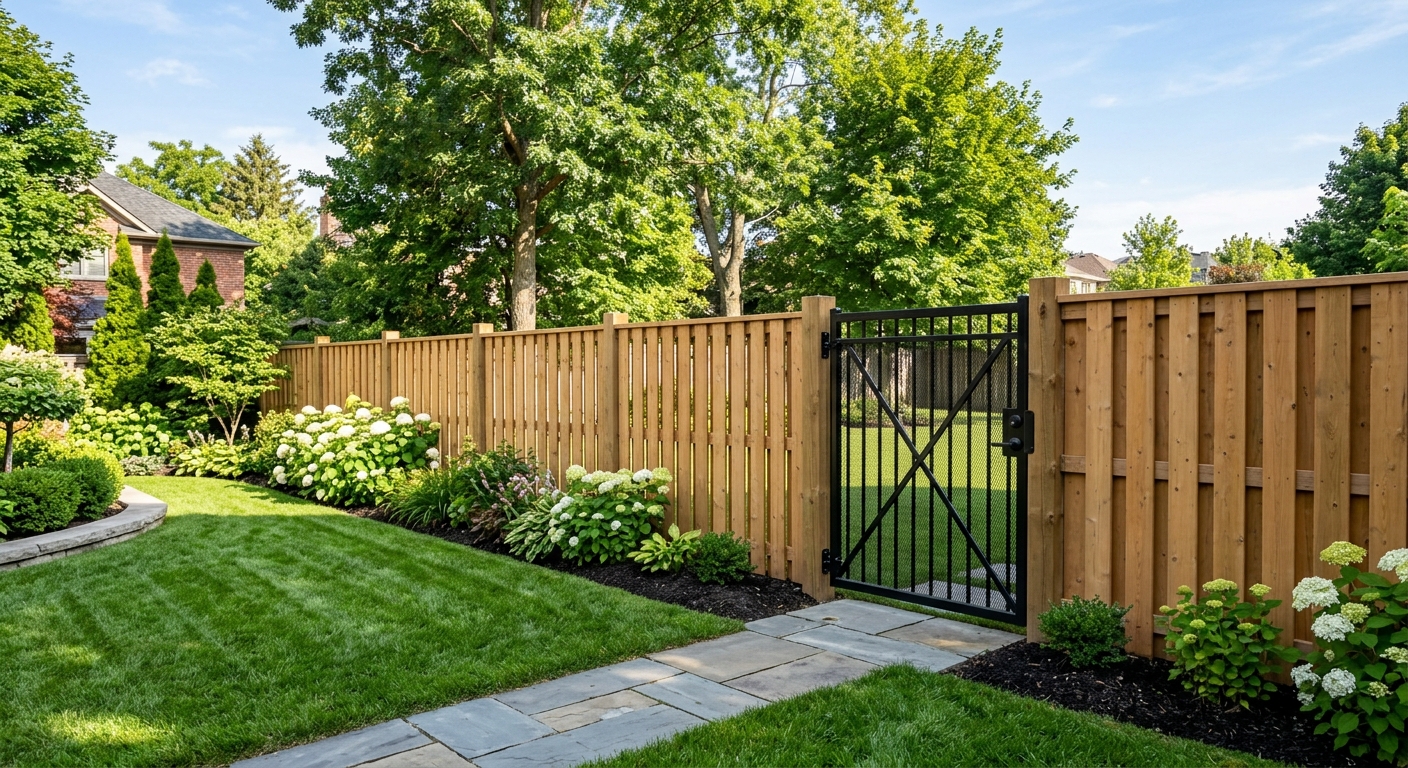
Fencing options and costs in Bearspaw
In Bearspaw, Alberta, choosing a fence is often less about looks alone and more about performance in a Prairie climate. Bearspaw’s population is 5,567 (Statistics Canada, 2021 Census), and the Calgary area’s mix of family housing creates steady demand for backyard privacy and pet-friendly perimeter fencing. Every detached home is a potential fencing customer, and Calgary’s broader growth pattern means contractors are busiest when weather cooperates—typically late spring through early fall.
Cost in this area is shaped by freeze–thaw cycles and the open Prairie wind exposure that can rack panels and push posts sideways. For most fences in the Calgary economic region, contractors plan for posts to be set about 4 ft (approximately 120 cm) deep to sit below the regional frost line and reduce heaving risk. For taller privacy fences and gate posts, you’ll commonly see concrete footings because they resist both frost movement and wind loading more reliably. That depth and structural approach is a major reason wood and vinyl privacy installations generally sit in the mid-to-upper portion of local price ranges.
If you’re in the parts of Bearspaw where lots back onto wider open acreage views—often along the outskirts of the community toward Ravenswood-area acreage—solid panels are especially popular, because they block wind-driven dust and define boundaries more clearly. From there, it’s easiest to compare materials side-by-side before you request a project-specific quote.
| Material |
Lifespan |
Maintenance |
Privacy Rating |
Price per Linear Foot |
| Pressure-treated pine (standard wood) |
15–25 years |
Stain/seal every 2–3 years |
High (solid boards) |
$40,00 – $80,00 |
| Cedar (natural rot resistance) |
20–30 years |
Light staining every 2–4 years |
High (solid boards) |
$55,00 – $95,00 |
| Vinyl / PVC (no-maintenance) |
25–35 years |
Occasional wash only |
High (privacy styles) |
$45,00 – $90,00 |
| Chain-link (galvanized steel) |
30–45 years |
Minimal (check tension/coatings) |
Low–Medium |
$25,00 – $55,00 |
| Aluminum ornamental |
25–40 years |
Occasional wash |
Low–Medium |
$70,00 – $120,00 |
| Composite / recycled material |
20–35 years |
Wash; rarely reseal |
Medium–High (panel dependent) |
$60,00 – $110,00 |
Prices are estimates only and vary by project scope, site access and material selection.
What affects the price of fencing in Bearspaw
Even when you show the same drawing, Bearspaw fencing quotes can vary by 30–50% across the Calgary region and Alberta because the “invisible” work changes: post depth, concrete requirements, panel bracing, and crew time on excavation. In a Prairie continental climate, frost protection and wind loading drive much of the real labour cost. In most cases, posts must be set about 4–6 inches below the design frost depth, which means deeper holes, longer posts, and more concrete for stable installs—especially for 6 ft privacy fences and heavier gate hardware.
Wind exposure also matters. On the Prairies, solid wood or vinyl privacy panels catch the wind and can rack, so contractors often reduce post spacing and add stronger rails and bracing. By contrast, chain-link allows airflow, so it’s structurally easier (and usually lower cost) even though you may still need solid post footings.
Cold climates like Ontario and Alberta can further increase material and labour cost versus milder regions because deeper setting is needed to prevent heaving. In coastal British Columbia, the climate is typically milder but wetter, so untreated wood can rot faster without proper treatment—creating different maintenance and replacement timelines.
In Bearspaw specifically, costs often rise when: (1) your fence line is long and requires consistent concrete footings at post locations, (2) you have gate openings with double hinges and latch reinforcement, and (3) your ground is difficult to excavate near existing landscaping or drainage swales. Costs can drop when you’re installing chain-link (often $25–$55 per linear foot locally) over a simpler grade with fewer gates, while privacy wood or vinyl commonly lands mid-to-upper range (often $40–$90 per linear foot) due to deeper, concreted posts and sturdier framing.
| Price Factor |
Why It Matters |
Cost Impact |
| Fence length in linear feet |
The longer the run, the more posts, rails and materials you need |
High (primary driver) |
| Post depth required |
Frost line depth dictates post length and hole depth to prevent heaving |
High (more excavation + material) |
| Post setting method |
Concrete vs. gravel pack vs. driven posts affects stability and labour time |
Medium–High (often +$5–$20/ft for concreted posts) |
| Material choice |
Vinyl/cedar/wood differ in framing weight and expected wind performance |
Medium (e.g., wood/vinyl mid-range vs chain-link lower) |
| Gate count and type |
Double drive-through gates need heavier posts, hinges and bracing |
Medium–High (gate hardware and labour add up) |
| Grade and terrain |
Sloped yards require stepped/raked panels or additional framing adjustments |
Medium (extra labour and sometimes custom heights) |
| Old fence removal and disposal |
Hauling and rework increases time; buried posts can complicate removal |
Medium (can meaningfully change total project cost) |
| Permit fees and survey / property line locate |
Some fence heights trigger permitting; locating reduces boundary disputes |
Low–Medium (depends on scope and municipality requirements) |
Permits & regulations in Alberta
In Alberta, fence permits are commonly tied to height and location, and Bearspaw homeowners typically see the most attention at front corners, street-facing runs and properties with tall backyard privacy plans. A practical rule of thumb contractors use is that fences above about 2.0 m (6.5 ft) at the rear and roughly 1.0–1.2 m (3–4 ft) at the front or corner often require a building permit, depending on the site and where the fence sits relative to municipal rules. Regardless of permit requirements, you still must respect property lines and any municipal setback bylaws that apply to your address.
Before any digging, call for utility locates. In Alberta, use Alberta One-Call so locators can mark buried lines. Also consider getting a survey or a property-pin locate before installing—this is one of the best ways to avoid encroachment disputes with neighbours (and it’s especially important if your lot has older survey history or irregular boundaries). Shared fence ownership disputes are handled through provincial line-fences legislation, so it’s smart to document where the fence will sit and what both sides agree to.
What usually does require a permit: taller privacy fences (around the 2.0 m range and up) and any fence plan that exceeds typical front/corner height allowances. What typically does not require a permit: shorter, standard-height backyard sections within normal local limits. If you’re unsure, ask your contractor to confirm in writing.
Finally, verify your contractor: check their Alberta business/labour authorization details through an official online registry, request a current certificate of liability insurance showing fencing coverage, and confirm WSIB/WCB coverage status (clearance letter or proof). If they can’t provide it promptly, treat it as a scheduling and risk red flag.
Choosing the right fence material for Bearspaw
In Bearspaw’s Prairie climate, your best material choice depends on how much privacy you want, how much maintenance you can handle, and how you expect wind and winter to behave on your fence line. Pressure-treated pine is the budget-friendly route, but it needs staining or sealing every 2–3 years to limit grey weathering and protect the surface where freeze–thaw cycles can open hairline cracks. Cedar offers better natural rot resistance and a warmer look, but it still benefits from maintenance to keep it uniform and extend service life.
Vinyl/PVC is the “low hassle” option: it’s usually no-sand and no-stain, but very cold snaps can make some panels more brittle if the system wasn’t designed for proper post spacing and rail support. Chain-link is the lowest cost and longest-lasting in harsh weather because wind passes through it; however, it provides limited privacy unless you add privacy slats or plants. Aluminum ornamental fencing is rust-resistant and looks crisp, but it’s typically not a privacy system—more of a boundary/appearance fence.
For most privacy projects in Calgary’s freeze–thaw conditions, concrete-set posts are typically recommended (especially for 6 ft fences and gate posts) because deeper posts resist heaving and wind racking. A properly engineered base matters as much as the material: if the post depth is shallow, even cedar or vinyl can fail early.
Here’s a concrete example: if a chain-link solution comes in near the lower end (often $25–$55 per linear foot), switching to a wood or vinyl privacy fence might move you into the mid-range (often $40–$90 per linear foot) mainly because you’re buying stronger framing, tighter post spacing, and deeper, concreted footings. If privacy is your priority, that difference is usually justified; if you mainly want pet containment, chain-link often delivers better value.
| Material |
Cold Tolerance |
Lifespan |
Annual Maintenance |
Best For |
Price Band |
| Pressure-treated pine |
Good with proper sealing; protect end-grain |
15–25 years |
2–3 year stain/seal cycle (light prep as needed) |
Budget privacy with regular upkeep |
$40–$80 per linear foot |
| Cedar |
Very good; performs well through winter cycles |
20–30 years |
2–4 year stain/brighten as needed |
Longer-life privacy with better appearance |
$55–$95 per linear foot |
| Vinyl / PVC |
Good when installed with correct spacing/support |
25–35 years |
Occasional wash (no staining) |
Low maintenance privacy |
$45–$90 per linear foot |
| Chain-link |
Excellent (steel + coating) |
30–45 years |
Minimal; inspect tension/coating yearly |
Perimeter security and airflow |
$25–$55 per linear foot |
| Aluminum ornamental |
Excellent (no rust) |
25–40 years |
Occasional wash |
Appearance boundary with low rust risk |
$70–$120 per linear foot |
| Composite / recycled |
Good; resists rot better than untreated wood |
20–35 years |
Wash; follow manufacturer cleaning guidance |
Privacy look with reduced decay risk |
$60–$110 per linear foot |
How to choose a fencing contractor in Bearspaw
For Bearspaw homeowners, the fastest way to separate a reliable fencing contractor from a “weekend crew” is to verify credentials and insist on itemised paperwork. First, ask for proof of Alberta licensing/business registration if applicable to their trade scope, and request a current certificate of liability insurance that names you and lists fencing work. Next, confirm WSIB/WCB coverage: in practice, contractors should provide a clearance letter or proof of coverage. If they can’t produce documents or they only offer verbal assurances, the risk lands on you if a worker is injured or if there’s property damage during excavation.
Then get 2–3 written quotes that break labour and materials separately—post material, rails, concrete volume, gate hardware, installation labour, and any site prep. Avoid a vague lump sum that doesn’t show whether post holes will be concreted or set with a different method. Read the scope line-by-line: is permit pulling included (if required for height/location)? Is fence removal and disposal included, or is it an extra charge after the crew arrives? Are you paying for gravel pack, or concrete backfill, and how deep?
Warranty matters too. Ask for (1) a workmanship warranty length (how long they stand behind installation), (2) product/manufacturer warranty (materials), and (3) whether the warranty is transferable if you sell your home. On payment terms, never pay more than 10–15% upfront. Use a holdback tied to completion—especially after fence line inspection and final gate adjustments. Finally, insist on a start date and a completion estimate in writing so weather-related delays don’t turn into indefinite timelines.
- Confirm liability insurance certificate is current and specific to fencing work.
- Verify WSIB/WCB clearance/proof before excavation starts.
- Ask who will pull any required permits and whether it’s included in the quote.
- Require post depth and setting method in writing (concrete vs gravel pack).
- Request an itemised breakdown of materials, labour, and hardware.
- Confirm gate type (walk-through vs double) and hardware spec (hinges/latches).
- Ask how they handle slopes (stepped vs raked panels) and whether it changes cost.
- Check whether they include old fence removal and hauling/disposal fees.
- Verify warranty: workmanship length and manufacturer product coverage.
- Use a payment schedule with only 10–15% upfront, plus holdback until completion.
- Get a written start date and completion estimate, including weather contingency.
- Review the site plan for property line locate/survey assumptions.
In Bearspaw, a few concrete red flags to watch for: (1) contractors who won’t discuss frost-depth post setting or concrete footing expectations, (2) quotes that don’t specify how deep holes will be or what material is used for backfill, (3) missing or outdated insurance/WSIB/WCB proof, (4) refusal to itemise labour vs materials, and (5) pressure to pay the bulk upfront before posts are set and gates are tested.
Frequently asked questions — fencing in Bearspaw
How long does fence installation take in Bearspaw?
In Bearspaw and the wider Calgary region, install time usually depends on fence length, number of corners, and how many gates you’re adding—plus how hard excavation is for deeper post holes. For typical residential runs, a crew often completes a shorter backyard section faster, while longer perimeter jobs take multiple days, especially when concrete-set footings are required for stability under freeze–thaw and wind loading. If you’re replacing an old fence, removal and disposal can add an extra day or more depending on how accessible buried posts are. Weather also matters: late spring and early fall installs proceed quickest, while heavy snowmelt or frozen ground slows excavation. When quotes mention per-linear-foot pricing (for example, chain-link can land near $25–$55/ft and privacy wood/vinyl often mid-to-upper), that’s usually reflecting both material and the expected labour window. Always confirm a written start date and completion estimate in your contract.
Can I install a fence on a slope in Bearspaw?
Yes, you can install a fence on a slope in Bearspaw, but you’ll need the right layout method. The two common approaches are stepped panels (each section “steps” to follow grade) or raked panels (a consistent angle across sections). In Prairie conditions with frost movement, stepped installs are often the more forgiving option because each post line sits more predictably. Raked fences can work well, but you must ensure consistent post depth and proper rail alignment so the panels don’t rack in high wind. Your quote should spell out whether the crew will step or rake, since that can change labour and sometimes materials. Also, if you’re aiming for privacy with solid boards, wind exposure makes proper bracing important on sloped runs. If your design pushes toward taller heights—near 6.5 ft rear privacy, for example—permit requirements may apply, so confirm height/location before excavation begins.
What is the most weather-resistant fence for Bearspaw's climate?
For Bearspaw’s long freeze–thaw cycles and windy Prairie exposure, the most “set and forget” options are usually chain-link (galvanized steel) and quality vinyl systems with correct post spacing and secure footing. Chain-link performs exceptionally because airflow reduces wind pressure that would otherwise rack solid panels. Vinyl can also do very well because it doesn’t rot, and it avoids the annual staining cycle wood typically needs. However, vinyl performance depends heavily on installation: posts need to be set deep enough (often around the regional frost-protection approach) and supported correctly so cold snaps don’t amplify panel stress. Cedar is also strong for cold tolerance and rot resistance, but it typically still benefits from periodic maintenance to keep it looking its best through Alberta winters. If your priority is durability, compare local pricing bands: chain-link frequently sits lower, often around $25–$55 per linear foot, while wood/vinyl privacy typically costs more (often about $40–$90 per linear foot) largely due to stronger frames and concreted post bases.
How do I prevent wood fence rot in Bearspaw?
Preventing rot in Bearspaw comes down to moisture management and protecting the wood where it’s most vulnerable. First, insist on proper pressure-treated material and correct installation details: keep boards off the ground where possible, and ensure end-grain isn’t left exposed to constant wetting. Second, ask about staining/sealing schedules—many homeowners in Alberta find a 2–3 year maintenance cycle helps prevent early grey weathering and surface breakdown. Third, concrete-set posts (or properly detailed post bases) reduce contact with standing water at the base, which is a common rot trigger. Also, don’t skip good bracing and panel alignment: poor tension can trap moisture and accelerate deterioration at rails and fastener points. Finally, choose a contractor who understands Prairie freeze–thaw: if posts heave, water can pool in disturbed areas. If you’re comparing materials, cedar often starts with better natural rot resistance than standard pine, but it still rewards consistent upkeep.
What is the cost per linear foot for fencing in Bearspaw?
In Bearspaw, you can generally budget using local Calgary-region installation bands, but your exact price will depend on height, gates, terrain, and whether posts are concreted to handle frost and wind. As a practical reference, chain-link is commonly the lowest, often around $25–$55 per linear foot. Wood and vinyl privacy typically fall mid-to-upper, often about $40–$80 for standard wood installation and roughly $45–$90 for vinyl/PVC, depending on height, post spacing and how many gates you have. Aluminum ornamental fencing usually costs more, often around $70–$120 per linear foot, mainly because of the materials and framing requirements. If you’re replacing an old fence, removal and disposal can add to the per-foot effective cost. Ask for an itemised quote that shows labour, materials, and post setting method—because two “6 ft privacy” fences can vary a lot when one uses deeper concreted footings and the other doesn’t. That difference is what makes quotes diverge by 30–50% across Alberta.
Should I repair or replace my old fence in Bearspaw?
In Bearspaw, repair can be a good choice when the structure is sound—meaning line posts are stable (not leaning), rails are solid, and the majority of fasteners are still secure. Replacement is usually the better path when you’re dealing with multiple failing posts, widespread rot at bottom rails, severe warping, or a fence line that has heaved because it wasn’t set with adequate frost protection. Wind exposure on the Prairies can turn small issues (loose hardware, one failing corner post, sagging sections) into bigger problems by increasing panel racking stress. A practical approach is to ask for an inspection that estimates what percentage of posts and rails must be replaced. If you’d be paying near the same labour cost to fix many sections, replacing can be more cost-effective long-term. Also consider material life: chain-link often survives much longer (commonly 30+ years) than wood privacy systems, so repairing a fence that’s mostly intact may save money. If your quote comparison is showing privacy wood/vinyl in the $40–$90 per linear foot range, ask whether repairs would keep you within a similar budget—or whether replacement prevents repeat maintenance next season.