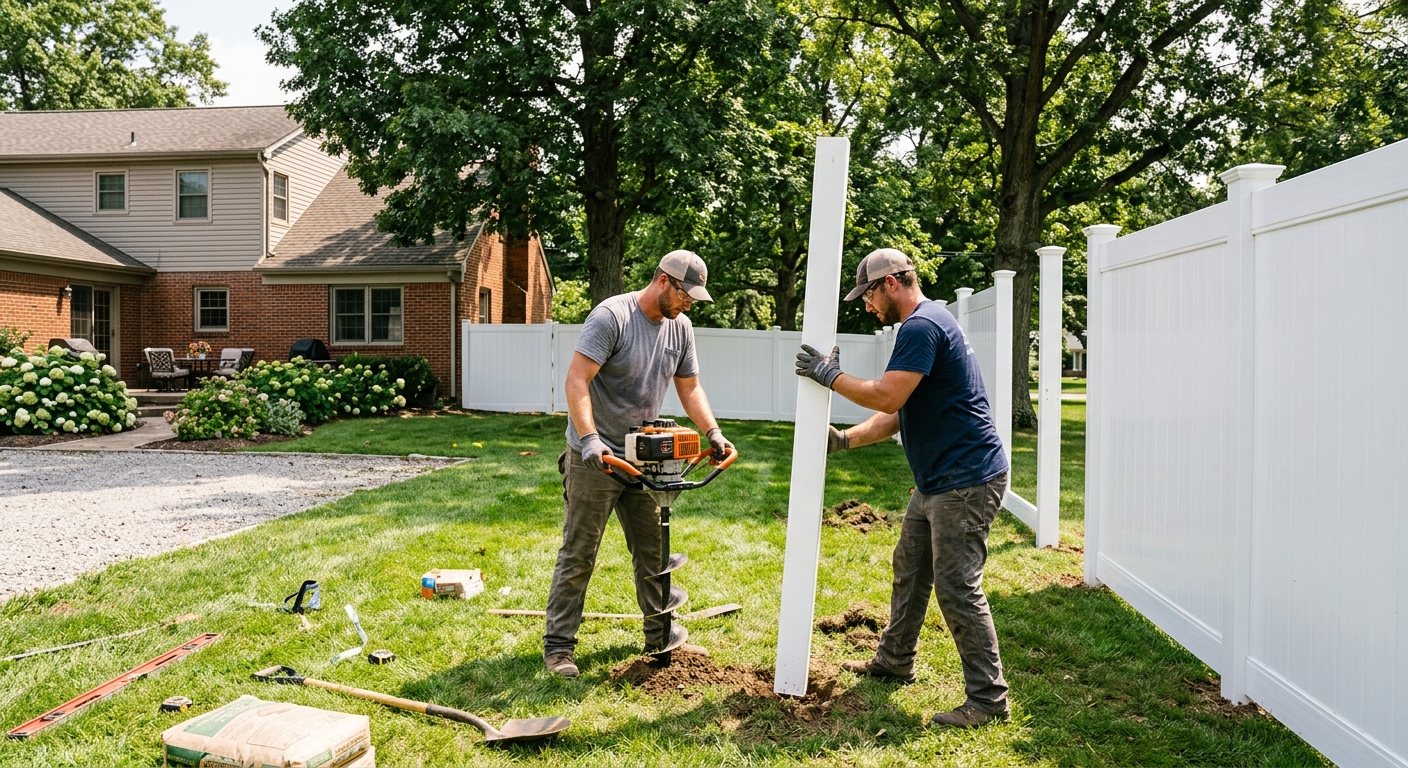
Fencing options and costs in Bowden
Bowden homeowners typically have several good fencing paths, and the right choice starts with understanding local demand. With 62.1% of dwellings being single-detached homes and a homeowner rate of 75.0% of households (Statistics Canada, 2021 Census), there are plenty of front and backyard projects where a new fence can improve privacy, define property lines, and hold up through winter freeze–thaw cycles. In the Red Deer economic region, contractor pricing also reflects Prairie exposure: frost depth and wind load work together, so posts often need to be set deeper (and sometimes concrete-set) to reduce heaving and racking. That deeper installation labour can push wood and composite options higher compared with sheltered urban yards.
Trade activity is especially steady around family-oriented residential pockets such as Downtown Bowden, where many yards have older fence lines that are due for replacement rather than a simple patch. Bowden’s housing stock includes a large share of older homes—57.8% were built before 1981 (Statistics Canada, 2021 Census). That often means older fence footprints, sometimes with settled posts and less predictable ground conditions, which affects excavation time and material waste. If you’re comparing options, the biggest swings usually come from fence height, gate count, access for a trailer or skid steer, and whether the estimate includes tear-out and disposal.
Below are typical local cost ranges for common materials and performance expectations in Bowden. Use the table as a planning baseline, then we’ll tighten the price once we confirm layout, post depth, and site conditions.
| Material |
Lifespan |
Maintenance |
Privacy Rating |
Price per Linear Foot |
| Pressure-treated pine (standard wood) |
10–15 years |
Stain/seal every 2–3 years |
High (solid pickets) |
$45–$85 |
| Cedar (natural rot resistance) |
15–25 years |
Light stain every 2–4 years |
High (solid or close spacing) |
$55–$110 |
| Vinyl / PVC (no-maintenance) |
25–35 years |
Occasional wash |
Medium–High |
$60–$115 |
| Chain-link (galvanized steel) |
20–30 years |
Minimal (check tension) |
Low–Medium |
$35–$70 |
| Aluminum ornamental |
25–40 years |
Occasional wash |
Low–Medium (decorative) |
$70–$140 |
| Composite / recycled material |
20–30 years |
Low (no staining) |
High (solid panels) |
$75–$130 |
Prices are estimates only and vary by project scope, site access and material selection.
What affects the price of fencing in Bowden
In Bowden and across the Red Deer region, it’s common to see two quotes for what looks like the same fence land 30–50% apart. The difference is rarely “labour gouging”—it’s usually scope details and the way winter conditions force contractors to build stronger than a bare-minimum design. In Alberta, frost depth drives post-hole depth to reduce heaving, and in practice that typically means posts set deeper than the simplest rule of thumb—often about 4–6 inches below the design frost depth. On many Bowden jobs, that pushes excavation and increases the amount of lumber or metal per post, plus labour time for deeper holes and heavier concrete-set methods.
Wind exposure on the Prairies is the other big driver. Where yards are more open, crews may use tighter post spacing, heavier rails, and less “sail area” in panel design to resist racking and blowouts. That can raise both materials and installation labour. Meanwhile, colder Alberta winters can accelerate issues for wood that isn’t properly treated or stained; it’s why a “cheapest wood option” can cost more over time if you don’t plan maintenance.
Concrete examples from Bowden: (1) A full-length, solid privacy fence with two gates will cost more than an open-style fence because gates require stronger frames and additional hardware, not just extra pickets. (2) A fence line that crosses heavier clay or has spring standing water often needs extra drainage and deeper, steadier post installation, increasing excavation and concrete use. (3) In some yard layouts—especially near older properties with settled lines—tear-out and post retrieval adds time, sometimes changing the foundation approach. If you’re targeting a budget band like $45–$85 for wood installation, those site realities can move you toward the upper end, while choosing lower-privacy chain-link at $35–$70 can keep costs controlled.
The table below breaks down the factors that most often explain why your fence price changes so much between contractors.
| Price Factor |
Why It Matters |
Cost Impact |
| Fence length in linear feet |
The primary measurement used for materials, posts, rails, and labour |
High |
| Post depth required |
Frost line determines hole depth and post length to prevent heaving |
High |
| Post setting method |
Concrete vs. gravel pack vs. driven posts affects stability, curing time, and labour |
Medium–High |
| Material choice |
Vinyl, cedar and chain-link have different costs, rail needs, and weather performance |
High |
| Gate count and type |
Walk-through vs. drive-through (double) changes hardware, frames, and reinforcement |
Medium–High |
| Grade and terrain |
Sloped yards require stepped or raked panels and more cutting/fit time |
Medium |
| Old fence removal and disposal |
Tear-out includes hauling and disposal; hidden post depth can add time |
Medium |
| Permit fees and survey / property line locate |
Locates and permits prevent encroachment disputes and ensure compliance for taller runs |
Low–Medium |
Permits & regulations in Alberta
In Alberta, the rule-of-thumb homeowners should plan around is that taller fences can require a building permit. Fences above a height threshold—often cited as around 2.0 m (6.5 ft) at the rear and about 1.0–1.2 m (3–4 ft) at the front or corner—commonly trigger permitting, but the exact threshold depends on location, visibility lines, and the municipal bylaw for your area. In Bowden, you should assume that any front/corner height increases will draw extra scrutiny and that permit steps may be required before digging.
Regardless of height, fences must respect property lines and any setback requirements the municipality has in place. Before you dig any post holes, arrange utility locates through Alberta One-Call so you don’t hit buried services. Also, if there’s any doubt about boundaries—common when older properties have fence lines that don’t match modern surveys—get a survey or property pins located to avoid neighbour disputes and costly rework. Shared fence ownership rules are governed by Alberta line-fences legislation, so keep documentation if a fence is meant to be shared.
To verify a contractor properly: (1) check they have an Alberta business licence/registration where required, (2) request a certificate of insurance showing liability coverage, and (3) confirm appropriate workers’ compensation coverage (WCB/WCB clearance letter). Ask for the certificate directly and ensure the named insured matches the company installing your fence.
If a contractor starts digging before locates are done, or can’t explain whether a permit is required for your height and location, that’s a major process red flag.
Choosing the right fence material for Bowden
Choosing a fence material in Bowden is really choosing a maintenance plan that still performs through winter. Red Deer region conditions mean frost movement and strong wind days are part of normal life, so your material has to pair with correct post depth and bracing. Pressure-treated pine is usually the most budget-friendly path, but it’s also the one that benefits most from consistent staining—expect to re-stain or seal roughly every 2–3 years to prevent grey weathering and premature breakdown. Cedar costs more upfront, yet it offers better rot resistance and a warmer look; it still benefits from maintenance, but the appearance tends to hold better. Vinyl/PVC is popular with homeowners who want no staining and minimal upkeep; in extreme cold, it can become brittle if the wrong grade is used or if posts aren’t installed to reduce flex. Chain-link provides the longest life per dollar and doesn’t mind Alberta cold, but it won’t give privacy unless you add slats or plants. Aluminum ornamental sits in the middle-to-higher price range and stays rust-resistant, but it’s primarily a decorative boundary rather than a privacy solution.
On post depth: because frost depth drives heaving risk, many Bowden installs use concrete-set posts or a sturdier post-setting method, especially for solid privacy panels and gate openings. The deeper holes and heavier posts help resist both lifting and wind racking. If you’re building in an exposed area, panel design and post spacing matter as much as the board material.
A practical example: if you compare wood privacy fencing around the $45–$85 band to vinyl in the $55–$100 range, the additional material cost can be justified if you truly want to avoid periodic staining and you’re planning to stay put long enough to spread that difference across years. But if your priority is maximum privacy for the least upfront cash, pressure-treated pine with a proper seal/stain schedule often wins.
The table below matches materials to Bowden’s cold tolerance, expected lifespan, and typical maintenance needs.
| Material |
Cold Tolerance |
Lifespan |
Annual Maintenance |
Best For |
Price Band |
| Pressure-treated pine |
Good (with proper staining/fasteners) |
10–15 years |
Minor inspection; stain every 2–3 years |
Budget privacy |
$45–$85 |
| Cedar |
Very good (naturally rot-resistant) |
15–25 years |
Wash/inspect; light stain every 2–4 years |
Longer-lasting privacy with better look |
$55–$110 |
| Vinyl / PVC |
Good (needs proper installation to limit flex) |
25–35 years |
Occasional rinse/soap wash |
Low-maintenance boundaries |
$55–$100 |
| Chain-link |
Excellent |
20–30 years |
Very minimal |
Security/containment |
$35–$70 |
| Aluminum ornamental |
Excellent (won’t rust) |
25–40 years |
Occasional wash |
Decorative front fencing |
$70–$140 |
| Composite / recycled |
Good (stays stable if installed correctly) |
20–30 years |
Low; periodic cleaning |
Solid look with minimal upkeep |
$75–$130 |
How to choose a fencing contractor in Bowden
When you hire a fencing contractor in Bowden, verify three basics before you sign anything: licence/registration, liability insurance, and workers’ compensation coverage. Start with a written request for their liability insurance certificate; the certificate should show the installer/company name matching the quote and the coverage is current. Next, confirm their workers’ compensation coverage (WCB/WCB clearance letter) so you’re not left holding the risk if someone is injured during excavation or post-setting. If they employ subcontractors, ask for confirmation the subcontractors are covered as well.
Get 2–3 itemised written quotes where labour and materials are clearly separated—don’t accept a single lump-sum with vague language. Good quotes list linear footage, number of posts, post depth assumptions, rail count, hardware type (hinges/latches/latches for gates), and whether concrete is included for frost stability. Confirm what’s excluded: soil hauling, permit pulls, survey/locate costs, and disposal of the old fence.
Pay attention to warranties. You want both a workmanship warranty (how long the company stands behind post setting, straightness, and gate alignment) and the product/manufacturer warranty for the material itself. Ask whether the warranty is transferable if you sell your home.
For payment, never pay more than 10–15% upfront. If anyone pressures you for a big deposit, that’s usually a sign of weak job control. Use a holdback until the fence is fully completed and gates/lines are adjusted. Finally, ensure the timeline includes a start date and a completion estimate in writing.
- Request a certificate of liability insurance and confirm dates and named insured.
- Ask for WSIB/WCB clearance proof (and coverage for subcontractors if used).
- Verify they list post setting depth approach consistent with frost stability.
- Get an itemised quote: posts, rails, pickets/panels, hardware, and gates.
- Confirm whether labour includes tear-out and disposal of the old fence.
- Ask who pulls permits (if required) and whether that cost is included.
- Confirm utility locates: who books Alberta One-Call and when.
- Ensure the quote states assumptions about ground conditions (clay, standing water).
- Check if they use concrete where needed or specify gravel pack alternatives.
- Confirm gate type, swing direction, latch style, and any reinforcement.
- Ask how they handle slopes: raked vs stepped panels and how it’s measured.
- Review warranty length in writing and whether it’s transferable.
Red flags in Bowden: (1) no insurance or the certificate doesn’t match the installing company, (2) vague quotes that don’t state post depth/post spacing or gate reinforcement, (3) promises to “just match the old fence” without accounting for heaving and wind racking, (4) asking for large deposits beyond 10–15%, and (5) refusing to put timeline and scope exclusions in writing.
Frequently asked questions — fencing in Bowden
Should I repair or replace my old fence in Bowden?
In Bowden, the decision usually comes down to how much of the fence’s structure has shifted. Repairs make sense when posts are still solid, rails are straight, and only a few boards/pickets are failing. If you’re seeing wobble at the base, leaning from racking, or repeated failures at the same spots after thaw cycles, it’s often time to replace—especially for solid privacy fences where wind load acts like a lever. Many older fences were installed before modern frost-aware practices and may have been set too shallow. As a rough planning reference, new wood installation is commonly in the $45–$85 range, while replacing with stronger privacy materials can move higher. A contractor should inspect post stability, not just replace damaged boards.
How do I handle a fence dispute with neighbour in Alberta?
If a disagreement starts about property lines or shared fencing, keep it calm and documentation-focused in Alberta. First, gather your evidence: your property survey (or ask for pins located), photos showing the fence line over time, and any written agreement if the fence was previously shared. Second, confirm whether the issue is a boundary problem or purely maintenance/repair. In many cases, line-fences legislation and local setback rules guide next steps, and a survey helps clarify what’s yours to maintain. Avoid moving fence sections or removing boundary features before you have clarity. If your contractor is involved, ask them to show the planned layout and measurements in writing. For disputes, the “cheapest” move is often rework—so verifying the line before digging posts in winter reduces the risk of ongoing conflict and cost.
What fence style offers the best wind resistance in Bowden?
In Bowden and the Red Deer region, wind racking is a real factor because the Prairies can be exposed and snow/wind can load the fence. For best wind performance, choose designs that reduce sail area and ensure strong anchoring: solid privacy fences with properly reinforced rails and correct post spacing, or sturdy semi-privacy layouts with less “blanket” effect. Tight post spacing and heavier posts (often with concrete-set installation depending on conditions) help prevent lifting and lateral movement. Aluminum ornamental can handle weather well, but many ornamental styles are open by design, so wind mostly passes through rather than pushing; they can be stable if bracing is correct. Chain-link is durable and resists wind penetration, but it can still swing if not properly tensioned and anchored at corners and gate locations.
How much does a fence cost in Bowden?
Bowden fence costs depend mostly on linear feet, material, post depth (frost stability), gate count, and whether you include tear-out and disposal. For planning, wood installation commonly falls around the $45–$85 band, while chain-link is often the budget option around $35–$70. Vinyl/PVC typically lands in the $55–$100 range, and aluminum ornamental often runs $70–$140. If your yard is sloped or access is tight, labour may rise. If permits or a survey locate are needed for taller runs or boundary clarity, those can add to the overall job. A proper quote should break down length, posts, gates, and post-setting method—especially in Alberta frost.
How deep should fence posts be for Bowden's frost?
In Bowden, post depth should be planned around frost depth to reduce heaving. A common contractor approach is to set posts about 4–6 inches below the design frost depth, which often translates to roughly 1.5–2.0 m into the ground depending on soil, exposure, and local frost conditions. That’s why many Alberta fences use concrete-set posts: the concrete helps stabilize the post in moving soil and provides a stronger hold for wind-loaded panels and gates. If you tell your contractor you want “as shallow as possible,” you may get a fence that shifts after freeze–thaw cycles. The quote should specify post depth assumptions and the post-setting method so you can compare bids responsibly.
Wood vs vinyl vs aluminum fence — which is best?
“Best” depends on your priorities. Wood (often pressure-treated pine) usually offers the lowest upfront cost—commonly within the $45–$85 installation band—but it requires a maintenance plan (stain/seal typically every 2–3 years) to avoid weathering and to keep it looking good in Alberta winters. Vinyl/PVC generally gives low-maintenance ownership with a higher upfront price (often $55–$100), but you still need proper installation so panels don’t flex excessively in extreme cold. Aluminum ornamental runs higher (often $70–$140) and is ideal for decorative front boundaries where you want rust resistance and a clean look, but it won’t provide privacy like solid wood or vinyl unless you add privacy screening. If you want privacy plus wind stability, focus on correct post depth and bracing first, then pick the material that matches your maintenance comfort.