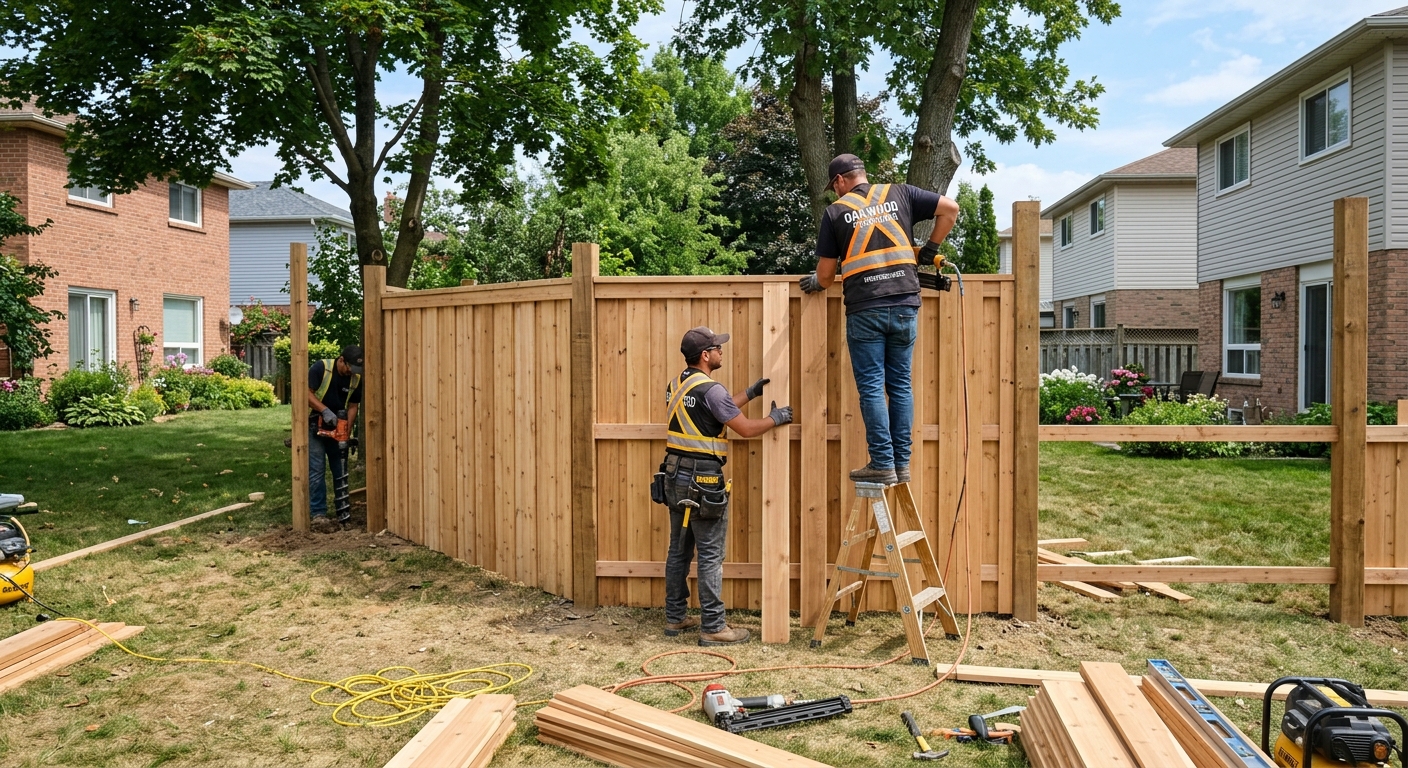
Fencing options and costs in Okotoks
Okotoks homeowners typically choose fencing that can handle long Prairie freeze–thaw cycles and open wind exposure on the Calgary side. With 77.7% of area dwellings being single-detached homes (Statistics Canada, 2021 Census), there’s steady demand for back-yard privacy fences, gate openings, and pet-friendly runs. Okotoks also has a high homeowner share—8,980 homeowner households, or 85.7% of all households (Statistics Canada, 2021 Census)—so most projects are replacement and “upgrade” jobs rather than temporary boundaries.
In this part of southern Alberta, frost protection is a major cost driver. For most fence layouts we plan around setting posts about 4 ft (≈120 cm) deep to reach below the regional frost line, especially for 6 ft privacy fences and heavier gate posts. That requirement increases excavation time, concrete volume, and labour compared with milder regions. At the same time, the Calgary economic region’s wind loading means solid panels (wood and vinyl) often need closer post spacing and fully concreted footings to reduce racking. Meanwhile, chain-link systems allow airflow, so they typically sit in a lower-cost range, all else equal.
Fencing trade demand is especially strong around family neighbourhoods with lots of mature lots and frequent perimeter updates, such as the Okotoks real-estate corridor near Heritage Heights and the older established blocks close to the downtown area. If you’re shopping this summer, the quickest way to compare value is to line up your priorities (privacy vs. maintenance vs. lifespan) against realistic installed pricing—see the comparison table below.
| Material |
Lifespan |
Maintenance |
Privacy Rating |
Price per Linear Foot |
| Pressure-treated pine (standard wood) |
12–18 years |
Stain/seal every 2–3 years; periodic fastener checks |
High (solid board) |
$40–$80 |
| Cedar (natural rot resistance) |
18–25 years |
Light stain refresh every 2–4 years |
High (solid board) |
$55–$95 |
| Vinyl / PVC (no-maintenance) |
20–30 years |
Rinse as needed; inspect latches and gate hardware |
High (solid/slat depending on style) |
$45–$90 |
| Chain-link (galvanized steel) |
25–35 years |
Occasional tension/repair; keep bottom rail clear |
Low–Medium (airflow panels) |
$25–$55 |
| Aluminum ornamental |
30+ years |
Rinse and spot-check fasteners |
Low (open pickets) |
$70–$120 |
| Composite / recycled material |
20–30 years |
Minimal; occasional cleaning and hardware checks |
Medium–High (style-dependent) |
$60–$105 |
Prices are estimates only and vary by project scope, site access and material selection.
What affects the price of fencing in Okotoks
In Okotoks and the wider Calgary region, two quotes for what looks like the “same” fence can swing by 30–50% because the real drivers are structural (post depth, spacing, and wind resistance) and logistical (excavation, gates, terrain, and removal). Even in one neighbourhood, a crew dealing with rocky soil, tight gates for equipment, or multiple corners will price differently than a straightforward run with easy access.
The biggest structural difference comes from frost line depth. In cold Alberta winters, fence posts typically must be set around 1.5–2.0 m into the ground (often planned as roughly 4 ft / 120 cm) to prevent heaving. That means longer posts, larger holes, and concrete footings, which pushes labour and materials up. Wind exposure on the Prairies also matters: solid wood and vinyl privacy panels usually require sturdier posts, tighter spacing, and fully concreted footings to reduce racking. By contrast, chain-link often costs less because airflow reduces wind load on the fence.
Concrete examples from Okotoks: (1) If you’re installing a 6 ft privacy run, the extra excavation for deeper, concreted posts can add noticeable cost versus a 4 ft picket-style fence that needs less rigidity. (2) A rear yard on a slight grade near the newer edges of town can require stepped panels or raked rails, which increases labour time and can add waste boards. (3) Removing an existing fence can add hauling/disposal time—especially when boards are weathered and bulkier than expected.
For budgeting, it helps to anchor in local price bands: wood privacy work commonly lands between $40,000 – $80,000 per project length depending on scope, and vinyl/PVC tends to sit mid-range to upper-range within the local $45,000 – $90,000 band for many comparable installs. Add gate complexity and deeper post-setting, and you’ll see why the same “linear foot” estimate can widen quickly.
| Price Factor |
Why It Matters |
Cost Impact |
| Fence length in linear feet |
Most costs scale directly with total run length |
Highest driver (can account for 60–75% of total) |
| Post depth required |
Frost protection determines hole depth and post length |
Deeper posts increase labour + concrete significantly |
| Post setting method |
Concrete setting improves stability in freeze–thaw cycles |
Concrete footings raise cost vs. gravel pack/driven options |
| Material choice |
Vinyl/cedar/wood require different framing and hardware specs |
Typically moves you across $25–$120 per linear foot band |
| Gate count and type |
Gates add bracing, hinges, latches, and often heavier posts |
Each gate can materially increase the per-foot average |
| Grade and terrain |
Slopes require stepping or racking rails and extra labour |
More waste and more fitting time |
| Old fence removal and disposal |
Debris handling, hauling, and sometimes partial demo |
Can add several hundred to over a thousand depending on volume |
| Permit fees and survey / property line locate |
Setbacks and property pins affect layout accuracy |
Often modest but can prevent costly rework |
Permits & regulations in Alberta
In Alberta, fence permits often depend on height and location on your property. As a practical rule, fences above a typical threshold—often around 2.0 m (6.5 ft) at the rear and about 1.0–1.2 m (3–4 ft) at the front or corner—may require a building permit. Okotoks also expects fences to respect property lines and municipal setback requirements.
Before any digging, you should arrange utility locates through Alberta One-Call so crews can mark underground services. This matters even for “simple” post holes because a single missed service can derail the schedule and create safety issues. It’s also smart to confirm your boundary and pin locations; getting a survey or property-locate helps avoid encroachment disputes—especially in yards that were subdivided, regraded, or have older boundary markers.
Shared fence ownership is addressed under provincial line-fences legislation, so if you’re dealing with a shared boundary, confirm responsibilities and any shared maintenance expectations before work begins. For permits, the work that typically does require a permit is installing higher fences above local thresholds and any fence work that may trigger zoning/setback review. Work that typically does NOT require a permit includes lower-height upgrades, like replacing like-for-like on your own property within the allowed height and setbacks (confirm with the City or your contractor).
To verify your contractor: ask for their Alberta licence details (if applicable to their trade), request current liability insurance, and confirm WCB/WCB clearance (coverage status) before the crew arrives. Look for a certificate of insurance showing your project address and ask for a recent clearance letter (or equivalent documentation) directly from the contractor.
Choosing the right fence material for Okotoks
Choosing the right fencing for Okotoks comes down to matching material to your priorities: privacy, low maintenance, and lifespan—while accounting for southern Alberta’s freeze–thaw swings and wind-driven debris. With many single-detached homes (Statistics Canada, 2021 Census), backyard boundaries are a high-visibility feature, so aesthetics and durability both matter.
Pressure-treated pine is the budget-friendly route, but plan to maintain it: staining or sealing every 2–3 years is key to reduce grey weathering and early surface cracking. Cedar is a step up—naturally resistant to rot and often looks better longer—but it still benefits from periodic staining to maintain colour and protect end grain. Vinyl/PVC is the “set it and forget it” choice: it requires minimal upkeep and typically holds up well, but extreme cold can make some components more brittle—so fit-up, hardware, and expansion considerations matter. Chain-link offers the longest life per dollar and the best airflow against wind, yet it won’t give you privacy unless you add slats or privacy screening. Aluminum ornamental is rust-resistant and low-maintenance, but it’s primarily decorative/security rather than privacy.
Because Calgary’s frost line drives post depth, even the best materials can fail if posts aren’t set correctly. For most privacy styles, crews should plan concreted footings and correct post spacing to resist racking in high wind—especially for 6 ft panels and gate openings. Snow load and drifting can also stress rails, so we build bracing for gates and corners rather than treating them as “afterthought” sections.
Cost-wise, the difference can be justified. For instance, if a vinyl privacy run quotes around the mid-to-upper band ($45–$90 per linear foot), you may choose it if you want fewer maintenance trips compared with wood at roughly $40–$80 per linear foot. If you’re already planning to re-stain regularly and prefer traditional appearance, cedar or pressure-treated wood can deliver strong value.
| Material |
Cold Tolerance |
Lifespan |
Annual Maintenance |
Best For |
Price Band |
| Pressure-treated pine |
Good (with proper post setting and staining) |
12–18 years |
2–3 year stain cycle; yearly hardware/rail check |
Budget privacy with active maintenance preference |
$40–$80 |
| Cedar |
Good (naturally rot-resistant) |
18–25 years |
Light stain refresh every 2–4 years |
Better look and rot resistance for similar height fences |
$55–$95 |
| Vinyl / PVC |
Good (avoid poor hardware fit; plan for cold brittleness) |
20–30 years |
Low: occasional rinse and gate hardware checks |
Low-maintenance privacy in wind and winter freeze–thaw |
$45–$90 |
| Chain-link |
Excellent (metal framing handles cycles well) |
25–35 years |
Minimal: inspect tension, straighten rails as needed |
Secure perimeter with maximum airflow |
$25–$55 |
| Aluminum ornamental |
Excellent (no rust; handles cold well) |
30+ years |
Very low: rinse and spot-check |
Decorative/security fencing with tidy curb appeal |
$70–$120 |
| Composite / recycled |
Good (depends on brand and installation details) |
20–30 years |
Low: clean as needed; hardware checks |
Privacy with reduced maintenance versus wood |
$60–$105 |
How to choose a fencing contractor in Okotoks
Start by verifying the contractor’s ability to do the work safely and legally in Alberta. Ask for their liability insurance certificate and make sure the coverage is current and appropriate for fencing installation (including property damage). For worker protection, request proof of WSIB/WCB coverage or a clearance letter; this is especially important if they’ll be excavating post holes and installing heavier gate hardware. Where to look: most reputable contractors carry insurance documentation and WCB clearance in their proposal package; if not, ask for it before signing anything.
Next, get 2–3 itemised written quotes that break down labour and materials separately—not just a lump-sum number. The quote should specify fence height, post spacing, post-setting method (concrete vs. gravel pack), gate type/quantity, hardware, rail requirements, and whether disposal and haul-away are included. Also confirm what’s excluded: permit fees, utility locate, survey/locate, rocky-soil extra excavation, concrete removal, or unforeseen grading changes.
Warranty matters. Look for a workmanship warranty (how long your installation is covered), plus the manufacturer/product warranty for materials. Ask whether warranties are transferable if you sell your home. For payment, never pay more than 10–15% upfront; use progress payments tied to milestones and keep a holdback until the job is complete and cleaned up. Finally, request a start date and a completion estimate in writing so your fence isn’t left half-built through the season.
- Confirms planned post depth and frost-protection approach for Okotoks (concreted footings where required)
- Provides itemised quote (materials + labour + gates + removal/disposal)
- Shows fence height, style, and spec details (including post spacing)
- Includes utility-locate responsibility (and how they’ll coordinate before digging)
- Lists whether they will pull permits (if required) and who pays the fees
- States warranty length for workmanship and manufacturer coverage
- Provides a WCB clearance letter and confirms it’s current
- Provides current liability insurance certificate (with coverage dates)
- Uses a written schedule: start date and completion timeframe
- Explains how they handle slopes (stepped vs. raked panels)
- Defines payment schedule and holdback amount in the contract
- Documents site protection (drives, lawns, and cleanup)
Concrete red flags I see in Okotoks: contractors who won’t confirm post depth or post-setting method; quotes that omit gate bracing details; vague “all-in” pricing without disposal/haul-away or permit scope; payment demands above 10–15% upfront; and no proof of insurance or WCB clearance when asked.
Frequently asked questions — fencing in Okotoks
How do I compare fencing quotes?
In Okotoks, compare quotes like-for-like: the same fence height, the same post spacing, and the same post-setting method (concrete depth matters for freeze–thaw). Ask each contractor to itemise labour and materials, and confirm whether gates are priced with proper bracing and hardware, not treated as “extra boards.” If one quote is much lower, check whether it’s using driven/gravel-set posts instead of concreted footings, which can affect frost stability. Also confirm whether removal and disposal are included. Finally, look at installed pricing consistency with local ranges—for example, wood privacy often lands around the $40–$80 per linear foot band, while chain-link typically sits closer to $25–$55 per linear foot depending on grade and access.
How long does fence installation take in Okotoks?
Most fence installs in Okotoks can be completed in a few days once materials are on site, but timing depends heavily on excavation needs and access. Deeper post holes for frost protection (commonly around 4 ft / 120 cm planning depth) usually take longer than milder regions, especially with concrete footings. A straightforward 40–60 ft run might be a day or two, while projects with multiple corners, gate builds, or fence removal can stretch longer. Weather matters too: heavy snow cover or frozen ground can slow excavation, and crews may reschedule to avoid damaging lawns or getting poor footing results. Ask for a written start date and completion estimate, and confirm how they plan around winter conditions.
Can I install a fence on a slope in Okotoks?
Yes, but you need the right layout method. On sloped yards in Okotoks, contractors typically use stepped fencing or raked rails so the fence stays level (or visually consistent) without leaving large gaps. Proper grading also protects post stability because the hole depth and concrete profile can change along the run. In winter, uneven support is more likely to contribute to shifting, so it’s important that the contractor follows correct post depth planning and sets each post properly rather than “stretching” fence sections. During quoting, ask how the proposal accounts for slope: stepped vs. raked panels, extra rails/posts, and any additional labour or material waste.
What is the most weather-resistant fence for Okotoks's climate?
For southern Alberta freeze–thaw and wind, the most weather-resistant options are typically chain-link with proper tensioning and galvanized framing, or well-built wood/cedar privacy fences with concreted footings and correct post depth. Vinyl can be very durable too, especially for homeowners who want minimal upkeep, but installation details and hardware quality matter in extreme cold. The “best” depends on what you mean by weather-resistant: wind load stability favours heavier bracing and solid-panel construction with concrete-set posts, while long-term corrosion resistance strongly favours galvanized or aluminum systems. In many Okotoks yards, the longevity sweet spot is either chain-link (low privacy but high resilience) or cedar/pressure-treated privacy fences built with frost-safe post setting.
How do I prevent wood fence rot in Okotoks?
Wood rot prevention in Okotoks starts below ground and at the board ends. Ensure posts are set to frost-safe depth and are correctly concreted so the post base stays stable during heaving cycles. Keep soil contact minimal: a good design reduces water pooling at the bottom of rails and ensures proper drainage. Use quality pressure-treated or cedar, and coat/stain on a schedule—pressure-treated pine generally needs staining every 2–3 years to slow grey weathering and protect fibres. Also ask about using corrosion-resistant fasteners and proper spacing so boards can dry between wet periods. Finally, inspect annually: if you catch loose hardware early, you prevent sagging that traps moisture and accelerates rot.
What is the cost per linear foot for fencing in Okotoks?
Local pricing in the Okotoks/Calgary area commonly falls within these installed per-linear-foot bands, depending on terrain, height, access, and gate count: chain-link at about $25–$55, pressure-treated wood typically around $40–$80, and vinyl/PVC often around $45–$90. Cedar and composite/added-premium styles usually push higher, while aluminum ornamental is frequently at the top end (often $70–$120). Remember that post depth requirements for frost protection and wind loading can increase the labour portion of any quote, especially for 6 ft privacy fences and gate posts.