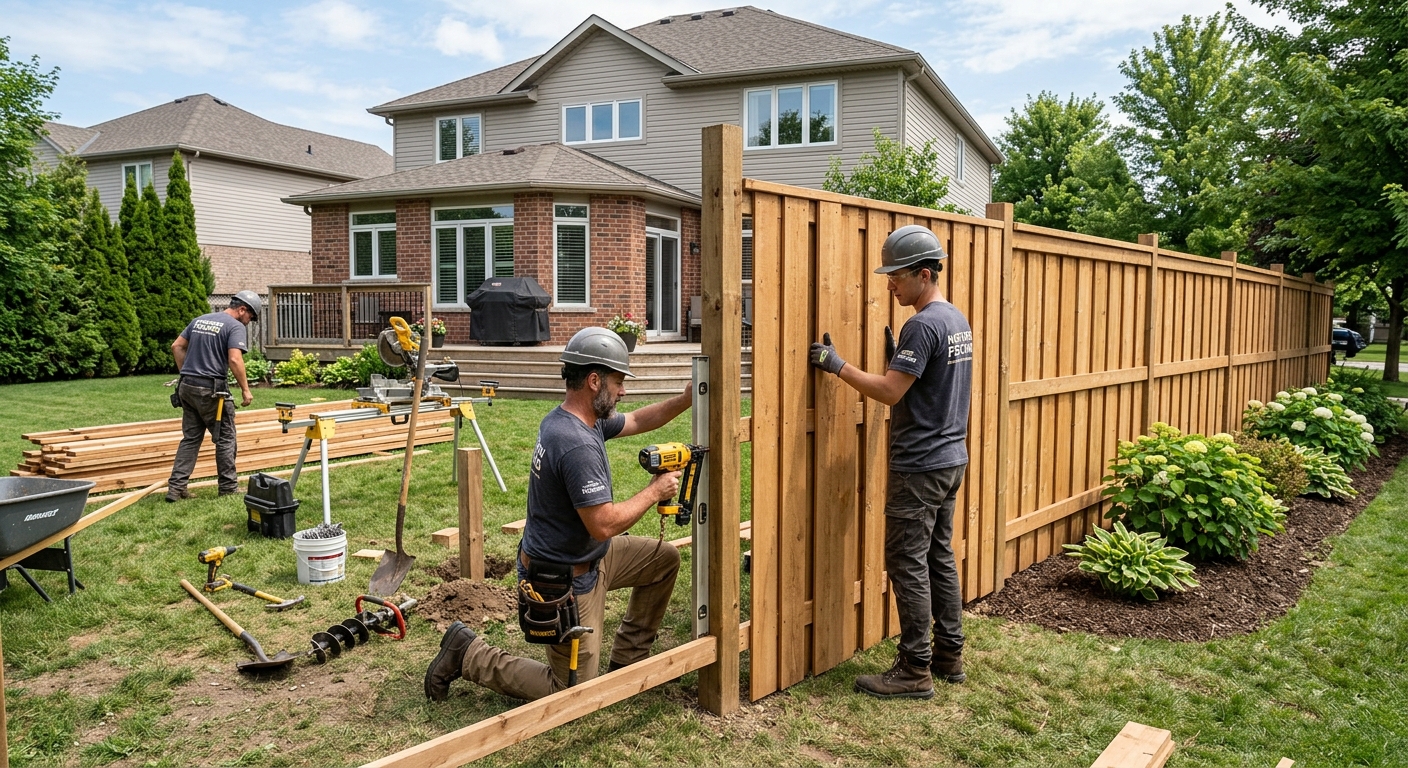
Fencing options and costs in Pineridge
Pineridge is a neighbourhood where homeowners often think about their fencing early—especially when yards back onto open exposure where wind can get right under a panel. With a population of 9,850 (Statistics Canada, 2021 Census), demand is steady rather than booming, but detached homes still create consistent work because each property line is a potential boundary project. Many residents also value practical backyards for summer use, which makes privacy fencing more common than you’d see in denser urban blocks (Statistics Canada, 2021 Census).
In the Calgary economic region, pricing is shaped by the Prairie continental climate: long freeze–thaw cycles and strong wind loading increase labour and material requirements. Contractors typically set fence posts about 4 ft (≈120 cm) deep to reach below the regional frost line and reduce heaving. For 6 ft privacy fences and gate posts, that depth usually means concrete footings, which raises installed cost versus lighter, more open systems. Availability of experienced fence installers can tighten in peak months, too, which is why getting a booked date can affect price.
In Pineridge, trade activity is especially noticeable around residential streets with wider lots and backyard access points where crews can stage materials—often the areas close to the main arterials where vehicle access helps with hauling posts, gravel, and concrete. With those realities in mind, here’s a practical comparison of common materials and what you’ll typically budget per linear foot before we dig into price drivers.
| Material |
Lifespan |
Maintenance |
Privacy Rating |
Price per Linear Foot |
| Pressure-treated pine (standard wood) |
10–15 years |
Stain/seal every 2–3 years |
Good (solid panels, 6 ft commonly) |
$40 – $80 |
| Cedar (natural rot resistance) |
15–20 years |
Light stain every 2–4 years (to slow greying) |
Good to very good |
$55 – $95 |
| Vinyl / PVC (no-maintenance) |
20–30 years |
Wash as needed; inspect for impact damage |
Very good (solid pickets/boards) |
$45 – $90 |
| Chain-link (galvanized steel) |
20–35 years |
Minimal; tighten/repair if bent |
Low (airflow passes through) |
$25 – $55 |
| Aluminum ornamental |
25–40 years |
No rust; occasional cleaning |
Low to moderate (decorative gaps) |
$70 – $120 |
| Composite / recycled material |
20–30 years |
Low; wash and check fasteners |
Moderate to very good (board style) |
$70 – $110 |
Prices are estimates only and vary by project scope, site access and material selection.
What affects the price of fencing in Pineridge
Even when two neighbours request “the same 6 ft privacy fence,” Pineridge quotes can swing by 30–50% across Calgary and Alberta. The biggest reasons aren’t just brand names—they’re what the contractor has to do for frost protection, wind structure, and site constraints. In the Calgary market, labour rates and the need for deeper, sturdier post foundations push wood and vinyl toward the mid–upper part of typical ranges, while chain-link tends to price lower because it’s lighter and more breathable under wind load.
First, frost line depth sets how deep posts must be set. In colder Canadian regions like Alberta, posts often need to go about 1.5–2.0 m into the ground (or roughly 4 ft, depending on design and local frost conditions) to reduce heaving risk. That usually means longer posts, more excavation, and more concrete volume. Second, wind exposure across the Prairies drives tighter post spacing and heavier panels for solid systems. By contrast, coastal BC’s mild but wet climate tends to accelerate wood rot when treatment isn’t done well, so contractors there lean more toward rot-resistant materials and sealing—different cost drivers than Pineridge, where freeze–thaw and racking are the threat.
In Pineridge specifically, three common “cost movers” are: (1) sloped yards that require stepped panels, adding labour for measurement and material waste; (2) sandy or rocky soils that increase excavation time and change the foundation approach; and (3) fence removal where old posts are concreted in and must be broken out—often turning a “simple swap” into a heavier demo job. If you’re comparing options, a chain-link perimeter might land closer to the lower-mid band (around $25 – $55), while a privacy wood or vinyl install often lands in the mid–upper band (around $40 – $90), because solid panels need stronger post foundations and bracing.
| Price Factor |
Why It Matters |
Cost Impact |
| Fence length in linear feet |
More panels and posts = more excavation, hardware, and labour time |
Typically the #1 driver; scales directly |
| Post depth required |
Frost protection dictates post length and hole depth to prevent heaving |
Deeper holes increase both labour and material cost |
| Post setting method |
Concrete footing vs gravel pack vs driven posts changes foundation effort and longevity |
Concrete-set generally raises total cost |
| Material choice |
Vinyl/wood need stronger support for solid panels; chain-link is lighter |
Can shift you from lower-mid to mid–upper bands |
| Gate count and type |
Gates require heavier hardware, reinforced posts, and precise alignment |
Each gate can add noticeable labour and extra bracing |
| Grade and terrain |
Slopes require raked/stepped rails and careful layout to keep fence level |
More layout time and more trim/waste |
| Old fence removal and disposal |
Concrete posts and buried sections make demo harder; hauling adds costs |
Can significantly increase the quote if removal is extensive |
| Permit fees and survey / property line locate |
Some fence heights trigger permits and locate work prevents encroachment issues |
Often a smaller line item, but can change schedule and scope |
Permits & regulations in Alberta
In Alberta, fences above a height threshold typically need a building permit—commonly around 2.0 m (6.5 ft) at the rear, and about 1.0–1.2 m (3–4 ft) at the front or corner (where applicable). Beyond permits, every fence has to respect property lines and municipal setback bylaws. Before you dig any post holes, you also need utility locates by contacting Alberta One-Call so crews don’t hit buried power, gas, or communication lines. If you don’t already know where your property pins are, obtain a survey or a property line locate to reduce the risk of encroaching on a neighbour’s land—an expensive mistake that’s hard to reverse.
Shared fence ownership is governed by provincial line-fences legislation, so it’s smart to confirm whether the fence is considered shared and what each party expects for costs and maintenance.
What usually requires a permit: new fences (or raising existing fences) that fall into the height ranges above the typical thresholds, and any work tied to structures that affect safety or siting. What typically does not require a permit: replacing like-for-like in the same footprint and within typical non-threshold heights, but confirm with your municipality because local bylaws can be specific.
To verify a contractor for a Pineridge project, ask for: (1) their Alberta licence details (use the contractor registry/permit info where applicable), (2) a certificate of insurance showing general liability, (3) proof of WCB coverage/clearance letter for workers, and (4) the scope in writing. Don’t accept “we’re covered” verbally—request documents and review the dates.
Choosing the right fence material for Pineridge
Picking the right fence in Pineridge is mostly about matching material performance to Alberta’s freeze–thaw cycles, wind exposure, and your tolerance for upkeep. Pressure-treated pine is a budget-friendly choice at the start, but it commonly needs staining every 2–3 years to prevent grey weathering and to keep surface protection intact. Cedar offers better natural rot resistance and usually looks better for longer, but it still benefits from periodic maintenance—especially if wind-driven snow and moisture reach the same areas repeatedly.
Vinyl/PVC is often the “set-and-forget” option homeowners like, but extreme cold impacts can show up as brittleness if panels are mishandled during installation or if posts aren’t set correctly for wind loading. For that reason, your post depth and spacing matter as much as the material. Chain-link is typically the lowest-cost and longest-life option (it’s breathable), but it offers limited privacy unless you add slats or screening. Aluminum ornamental looks sharp and won’t rust, yet it usually won’t meet “privacy” expectations because of the open design.
In the Calgary region, privacy fences generally benefit from concrete-set posts at frost-protective depths. For a solid 6 ft fence, that helps resist racking and heaving. If you’re choosing between options, a realistic example is comparing chain-link (often about $25 – $55 per linear foot installed) against vinyl privacy (often about $45 – $90). If privacy is your priority and your yard faces heavy wind, spending the extra is usually justified because solid panels demand stronger foundations, not just different pickets.
| Material |
Cold Tolerance |
Lifespan |
Annual Maintenance |
Best For |
Price Band |
| Pressure-treated pine |
Good with proper sealing and correct post depth |
10–15 years |
Minor touch-ups; stain cycle every 2–3 years |
Budget privacy with a traditional look |
$40 – $80 |
| Cedar |
Very good; handles freeze–thaw well when well-fastened |
15–20 years |
Seasonal inspection; stain every 2–4 years |
Attractive privacy with natural character |
$55 – $95 |
| Vinyl / PVC |
Good; needs correct installation practices in deep cold |
20–30 years |
Wash as needed; check for impact damage |
Low maintenance privacy |
$45 – $90 |
| Chain-link |
Excellent |
20–35 years |
Minimal; periodic inspection/tension |
Security and boundary definition |
$25 – $55 |
| Aluminum ornamental |
Excellent; designed for freeze conditions |
25–40 years |
Wash/spot-clean as needed |
Clean curb appeal with semi-open visibility |
$70 – $120 |
| Composite / recycled |
Good; performance depends on fastener and installation |
20–30 years |
Low; periodic cleaning |
Modern privacy with reduced upkeep |
$70 – $110 |
How to choose a fencing contractor in Pineridge
Choosing a fencing contractor in Pineridge should start with proof, not promises. In Alberta, verify they have the right Alberta authorization to do the work, then confirm liability insurance and WCB/WCB coverage (workers’ compensation). Practically, ask for their WCB clearance letter and a current certificate of insurance; the certificate should show the insured business name and coverage dates, and it should clearly list general liability for your project type. If they can’t provide these documents quickly, that’s a red flag.
Next, get 2–3 itemised written quotes. A proper fence quote separates labour and materials (posts, rails, panels, concrete, gravel, hardware) and lists assumptions like linear feet, gate count, post spacing, height, and whether removal is included. Make sure the quote states what’s excluded: permit pulls (if required), utility locate fees, private survey/locate costs, disposal/hauling, and any landscaping restoration.
Warranty matters. Ask for the workmanship warranty length, the product/manufacturer warranty (and what it covers), and whether warranties are transferable if you sell your home. For payment scheduling, never pay more than about 10–15% upfront; keep a holdback until the job is fully complete and graded cleanly. Finally, request a written start date and a completion estimate. In Calgary-area seasonality, vague timelines can mean delays—so lock it down.
- Ask for Alberta licence/authorization details and confirm the name matches the contract.
- Request a certificate of insurance (general liability) and verify coverage dates.
- Get a WCB clearance letter before work starts.
- Ensure quotes show linear feet, height, and gate count explicitly.
- Confirm post depth approach and whether posts are concrete-set for privacy and gates.
- Check whether your quote includes utility locates and who pays the locates fee.
- Verify removal scope: old fence demolition, post extraction method, and disposal hauling.
- Look for racking/stepped-panel language if the yard is sloped.
- Ensure gates include hardware specs (hinges, latches, reinforcement posts).
- Ask if rails/posts are pressure-treated and whether cedar/vinyl has grading/grade details.
- Confirm warranty terms in writing (workmanship and product) and what triggers claim denial.
- Agree on payment schedule with a holdback until final walkthrough and cleanup.
Common Pineridge red flags: a quote that only lists one “all-in” number without itemised scope, avoidance of post-depth specifics (especially around frost protection), “we don’t need permits” language despite fence heights, refusing to provide insurance/WCB documents, and starting without written start/completion dates or without confirming property line layout.
Frequently asked questions — fencing in Pineridge
How do I find my property line before fencing?
In Pineridge, the safest way is to locate your property pins using a survey or property line locate before any postholes are dug. If you have boundary markers from a recent purchase, photograph them and measure carefully, but don’t rely on guesses or “it looks about right.” For Alberta projects, property lines and setbacks matter, and encroachment disputes can be costly to fix. I recommend ordering a locate (or using your survey if it’s current and clear). Then share the marked line with your contractor so layout stakes match your pins. Also confirm the fence route with your contractor in writing—especially near corners and any shared boundary sections governed by provincial line-fences rules.
What's the most low-maintenance fence?
For many Alberta homeowners, vinyl/PVC is the most low-maintenance choice because it generally doesn’t require staining or regular sealing. With correct installation, it can hold up well through Calgary’s freeze–thaw cycles and wind exposure. Typical installed pricing sits around $45 – $90 per linear foot depending on height, panel style, and gate complexity. Chain-link is also very low-maintenance and often priced around $25 – $55, but it won’t provide privacy unless you add slats/screening. The true “low-maintenance” factor is also your foundation—proper post depth and secure post setting prevent early leaning, which is what usually creates extra repair work.
How tall can my fence be in Pineridge?
Fence height limits can vary by where the fence sits (front/corner vs rear) and by local bylaw rules, but in Alberta a common threshold is around 2.0 m (6.5 ft) for rear fences and about 1.0–1.2 m (3–4 ft) for front/corner areas where height restrictions tighten. When you go above those typical thresholds, a building permit is often required. Because Pineridge is part of the broader Calgary area, don’t rely on neighbour memories—ask your contractor to confirm the exact requirement for your location and planned height. If your plan is for a solid 6 ft (≈1.8 m) privacy fence, it’s still wise to verify if it triggers a permit based on the site and alignment.
Should fence posts be set in concrete here?
In Pineridge and the Calgary region, concrete setting is commonly recommended for solid privacy fences and gate posts because of frost protection and wind loading. The area experiences long freeze–thaw cycles, so posts generally need to be set to reach below the regional frost line—often around 4 ft (≈120 cm) deep or deeper depending on design. Concrete helps stabilize the post and reduces heaving risk that leads to leaning panels. That said, the best method depends on your soil and fence type. Chain-link sometimes uses different post setting approaches because it’s more open and breathable under wind. If you want a solid panel fence, ask your contractor to explain their frost-depth and post-setting plan in writing so you’re not paying for a fence that shifts after the first winter.
What's the best fence for privacy?
For privacy in Pineridge, the best choices are typically solid-panel wood (pressure-treated pine or cedar), vinyl/PVC privacy styles, or composite board-style systems. Chain-link is usually not considered private unless you add slats, screen inserts, or an attached privacy fabric. Vinyl privacy and cedar privacy both perform well when posts are set correctly for Calgary’s freeze–thaw cycles and wind exposure; pricing often lands in the mid-to-upper band, commonly around $45 – $90 for vinyl/PVC and $40 – $80 for standard wood setups. Cedar can cost more but offers a premium look and natural rot resistance. The “best” option depends on whether you want low maintenance (vinyl) or a traditional, repairable style (wood).
How do I compare fencing quotes?
To compare quotes fairly in Alberta, look past the bottom-line number and compare the scope. You want quotes that itemise labour and materials, list exact linear feet, the fence height, the number of gates, and post spacing. Confirm post depth and setting method (concrete vs gravel pack) because that’s a major cost driver in Calgary’s frost conditions. Check whether removal and disposal are included, whether utility locates are included, and whether any permits are included or billed separately. Also compare warranty terms: workmanship coverage length and manufacturer warranty details. If one quote is dramatically lower (for example, closer to chain-link pricing at $25 – $55) but you’re expecting a solid privacy fence, it may be missing key items like reinforced gate posts or sufficient panel/bracing.