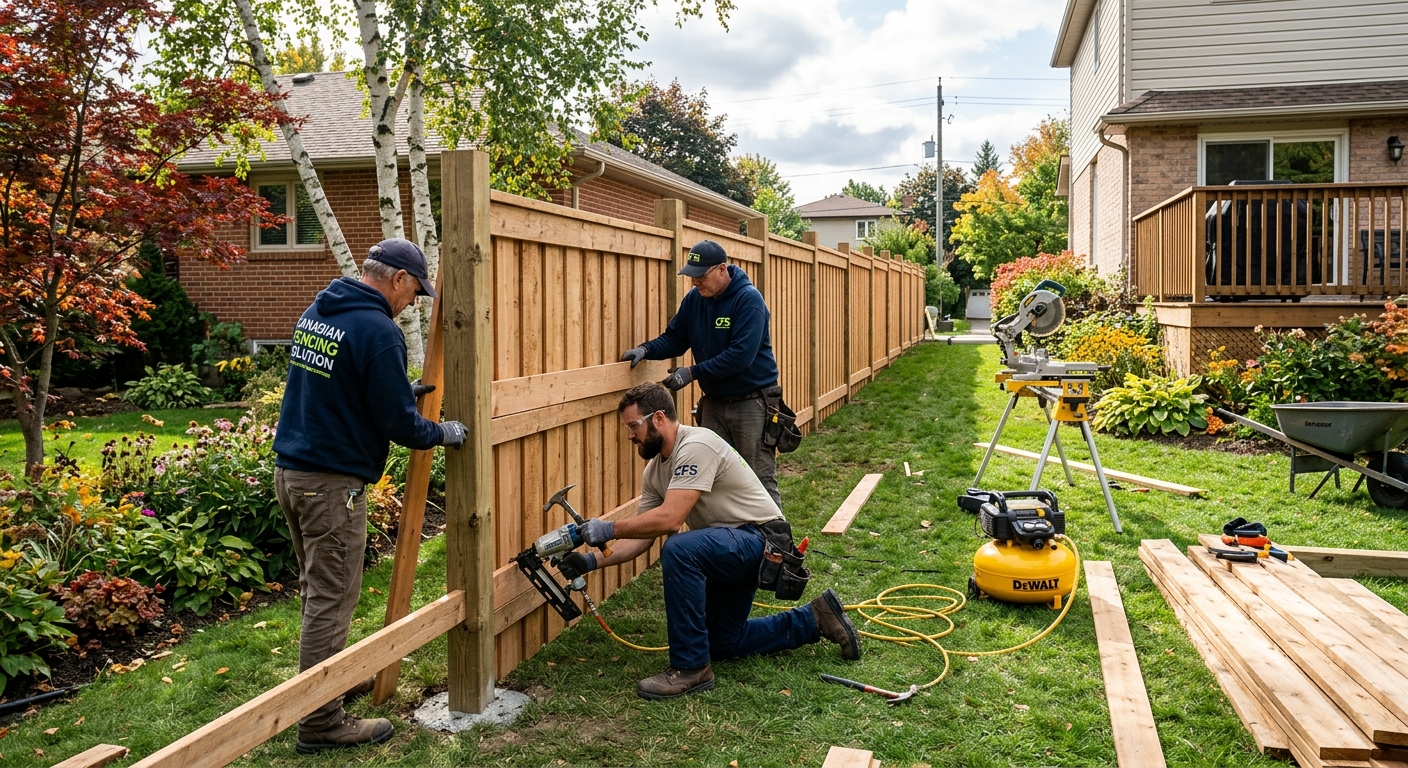
Fencing options and costs in Temple
In Temple, Alberta, choosing the right fence is a balance of budget, privacy needs and how you want it to perform through long freeze–thaw swings. Temple’s population was 10,525 in 2021 (Statistics Canada, 2021 Census), and demand stays steady because fencing ties directly to day-to-day security and pets for homeowners. Detached houses remain a strong driver of fence sales; each detached property is a potential fencing customer, which makes owner-occupancy and yard layout important predictors of local trade volume. In the Calgary economic region, contractors also see ongoing work as neighbourhoods mature and homeowners upgrade older rails and privacy panels.
Pricing in Temple tends to be shaped by Prairie exposure: wind loads can rack lighter panels, so crews commonly tighten post spacing and reinforce gate hardware. Frost protection is another major cost driver. Local guidance in the Calgary area generally expects fence posts to be set about 4 ft (≈120 cm) deep to help avoid heaving, especially for 6 ft privacy fences and gate posts. That depth increases excavation time, concrete volume and labour versus milder regions. Access and terrain matter too—sloped lots near the edges of town often require stepped sections, which increases layout and material waste.
For a quick comparison across the most common materials, use the table below as a starting point before you request itemised quotes.
| Material |
Lifespan |
Maintenance |
Privacy Rating |
Price per Linear Foot |
| Pressure-treated pine (standard wood) |
10–15 years |
Stain/paint every 2–3 years; replace warped boards as needed |
Good (solid sections; typically 80–90%) |
$40 – $80 |
| Cedar (natural rot resistance) |
15–25 years |
Still benefits from oil stain every 2–4 years to prevent greying |
Good to very good (solid; typically 85–95%) |
$55 – $95 |
| Vinyl / PVC (no-maintenance) |
20–30 years |
Occasional rinse; inspect gates for latch alignment in winter |
Very good (solid; typically 90–100%) |
$55 – $90 |
| Chain-link (galvanized steel) |
20–40 years |
Minimal; hose off and check tension on corners |
Low to fair (about 20–40% depending on height/mesh) |
$25 – $55 |
| Aluminum ornamental |
25–40 years |
Wash annually; tighten hardware as needed |
Low (open pickets; about 10–30%) |
$70 – $120 |
| Composite / recycled material |
20–30 years |
Low; occasional cleaning; limited board replacement |
Very good (solid styles; typically 85–95%) |
$65 – $110 |
Prices are estimates only and vary by project scope, site access and material selection.
What affects the price of fencing in Temple
Even when two homeowners describe the same fence line in Temple, bids in the Calgary region can differ by 30–50% due to installation variables. Labour costs swing with crew availability, excavation access, and how much rework is required for uneven grades. Material pricing also shifts depending on panel thickness, rail configuration and gate hardware. The good news is that most of those differences come from measurable factors—post depth, wind bracing, gate complexity and whether your contractor is concreting properly for frost protection.
In Temple’s Prairie continental climate, frost protection is a top driver. Frost line depth typically means posts must be set about 4–6 inches below the design frost depth to help prevent heaving. That usually translates into approximately 1.5–2.0 m into the ground in colder Alberta conditions, with concrete setting for many privacy and gate posts. Longer posts, deeper holes and increased concrete volume raise both material and labour. Wind exposure also matters: prairie exposure increases lateral load, so wood and vinyl privacy fences usually need closer post spacing and sturdier bracing than chain-link, which allows airflow and racks less.
Local examples you’ll see in Temple: (1) a fence around a corner lot with strong prevailing winds often requires extra reinforcement and sturdier gate posts, nudging the project toward the upper wood or vinyl range (for example, closer to the $40–$80 wood band or $45–$90 vinyl band). (2) a backyard with a sloped grade may need stepped panels, which increases layout time and waste. (3) removing an old, concrete-set fence can cost more than the new chain-link itself because extra labour is required to break and haul out concrete.
Use these factors as you compare quotes—especially if one contractor offers chain-link pricing closer to the $25–$55 band while another assumes a solid privacy design with fully concreted posts.
| Price Factor |
Why It Matters |
Cost Impact |
| Fence length in linear feet |
Most materials and labour scale directly with linear footage. |
High (primary driver; a longer run can overwhelm other choices) |
| Post depth required |
Frost protection determines post length and hole depth. |
High (deeper holes increase excavation time and concrete) |
| Post setting method |
Concrete vs. gravel pack vs. driven posts changes stability in freeze–thaw. |
Medium to high (concrete-set posts cost more but reduce heaving risk) |
| Material choice |
Vinyl and cedar typically require more initial material cost than chain-link. |
Medium (shifts price band—chain-link usually lowest) |
| Gate count and type |
Gates need stronger posts, hinges, latches and often diagonal bracing. |
Medium (one drive-through gate can add significant labour/material) |
| Grade and terrain |
Slope requires stepped/raked panels and additional layout work. |
Medium (often increases labour and waste) |
| Old fence removal and disposal |
Demolition is labour-intensive, especially with concrete footings. |
Medium (can add days depending on access and debris) |
| Permit fees and survey / property line locate |
Required documentation prevents encroachment and aligns fence placement. |
Low to medium (varies by site; locate costs can be significant) |
Permits & regulations in Alberta
In Alberta, fence permit requirements are often triggered by height, location and proximity to property lines. As a practical homeowner reference in many communities, fences above about 2.0 m (6.5 ft) at the rear and roughly 1.0–1.2 m (3–4 ft) at the front or corner commonly require a building permit. Regardless of permit needs, all fences must respect property lines and municipal setback bylaws. Because fencing disputes can get expensive, it’s smart to confirm the exact property pins and line before you dig.
Before installing posts, call for utility locates—Alberta One-Call—so your contractor marks buried services. If you plan to run a fence along an existing line, get a survey or a property pin locate first. This step helps prevent encroachment and “on-paper” corrections that delay projects.
Shared fence ownership rules are governed by provincial line-fences legislation, so if you’re replacing or upgrading a fence that neighbours rely on, confirm responsibilities early. Typically, a like-for-like fence replacement below the permit-trigger height is less likely to require additional approvals, but a new tall privacy fence, additions of gates/major structural changes, or anything exceeding height thresholds generally does require a permit.
Step-by-step to verify your contractor in Temple: (1) ask for their Alberta licence number and confirm it via the appropriate online registry; (2) request a certificate of liability insurance showing adequate coverage; (3) confirm WCB/WSIB coverage (in Alberta this is WCB) for the crew that will be on-site; (4) if applicable to the job scope, request clearance letters and keep copies with your contract.
Choosing the right fence material for Temple
Choosing fence material in Temple comes down to matching your priorities—privacy, low maintenance, budget and lifespan—to Alberta’s freeze–thaw conditions and Calgary-area wind. Pressure-treated pine is usually the lowest upfront option, but it needs staining or sealing every 2–3 years to prevent greying and surface wear. Cedar offers better natural rot resistance and a nicer look, and it generally holds up well in Prairie winters, but it still benefits from periodic oil staining. Vinyl/PVC is attractive for homeowners who want minimal upkeep: you mostly rinse it and keep an eye on gate alignment in cold snaps, though extreme cold can cause brittleness if the installation tolerances aren’t right.
Chain-link is the budget-friendly, long-life choice—often the lowest total installed cost—but it won’t provide privacy unless you add privacy slats or a separate screen system. Aluminum ornamental fencing gives a clean, rust-resistant appearance with long service life, but it’s typically more “visible boundary” than privacy barrier.
On frost performance, the material doesn’t replace correct post design. Because Calgary-area frost protection often expects posts set about 4 ft deep, concrete-set posts are commonly used for 6 ft privacy fences and gate posts to reduce heaving and racking risk. In practice, that means you should compare quotes on installation details, not only the material price.
Concrete example: if you’re comparing chain-link (often within the $25–$55 per linear foot band) to a 6 ft wood privacy fence (often $40–$80), the extra investment is justified when you need real privacy and wind-resistance—especially for yards exposed to prairie wind. If you mainly want boundary definition and security for pets, chain-link can make far more sense.
| Material |
Cold Tolerance |
Lifespan |
Annual Maintenance |
Best For |
Price Band |
| Pressure-treated pine |
Good (with correct finishing and ventilation) |
10–15 years |
1–2 minor checks; plan staining every 2–3 years |
Budget privacy and traditional look |
$40 – $80 |
| Cedar |
Good (naturally rot-resistant) |
15–25 years |
Inspect annually; oil stain often every 2–4 years |
Value-focused “nicer” privacy |
$55 – $95 |
| Vinyl / PVC |
Moderate to good (install with proper spacing and hardware) |
20–30 years |
Minimal (rinse/clean; inspect gates after freeze periods) |
Low-maintenance privacy |
$55 – $90 |
| Chain-link |
Excellent |
20–40 years |
Low (check tension at corners; occasional wash) |
Security and boundary definition |
$25 – $55 |
| Aluminum ornamental |
Excellent (no rust) |
25–40 years |
Low (wash and tighten hardware) |
Appearance-focused fencing |
$70 – $120 |
| Composite / recycled |
Good (check product temperature rating) |
20–30 years |
Low (cleaning; occasional board alignment) |
Solid look with low upkeep |
$65 – $110 |
How to choose a fencing contractor in Temple
In Temple, Alberta, a good contractor should be easy to verify and transparent about how your fence will perform in winter. Start with licensing: ask for their Alberta licence number and confirm it through the appropriate online registry before you sign anything. Next, request proof of liability insurance (certificate of insurance) and make sure the policy covers work at your address. Finally, confirm WCB coverage for the fencing crew—this is where many homeowners get caught out if a contractor relies on uninsured labour.
When you request quotes, insist on 2–3 itemised written estimates. You want a breakdown that separates labour and materials, and clearly states what’s included: post depth, concrete volume if applicable, gate hardware, bracing and rail/hinge upgrades for wind resistance. Avoid lump-sum quotes that don’t specify whether removal and disposal are covered, whether a permit pull (if needed for height/location) is included, or whether your contractor is including property line locating/survey add-ons.
Warranty matters too. Ask for (1) workmanship warranty length and what it covers, (2) the manufacturer’s product warranty, and (3) whether the warranty is transferable if you sell the home. For payment scheduling, a safe rule is to keep upfront payments to no more than 10–15%, with a holdback until the fence is complete and debris is cleared. Also get the start date and completion estimate in writing so you can plan around material delivery and excavation.
- Confirm Alberta licence number and match it to the company name on the quote.
- Request a certificate of liability insurance and verify coverage limits.
- Ask for proof of WCB coverage for the specific crew/work type.
- Require itemised labour/materials breakdown (not a single lump sum).
- Ensure post depth and frost-set method are stated (e.g., concrete-set for privacy/gates).
- Confirm whether gate posts are braced and reinforced for Prairie wind.
- Ask if permit pull is included if your fence exceeds typical height triggers.
- Verify whether site cleanup and disposal are included (old fence removal, concrete debris).
- Check grading plan: stepped panels or raked panels for sloped yards.
- Confirm warranty details: workmanship term, product warranty and transferability.
- Review payment schedule—avoid large upfront deposits and insist on a holdback.
- Get start/completion dates and a materials delivery timeline in writing.
Red flags I commonly see in Temple: vague quotes that don’t mention post depth or setting method; “we’ll get to it” timelines with no written schedule; contractors who won’t provide WCB/insurance paperwork up front; minimal scope language that omits disposal or permit responsibilities; and proposals that use lighter hardware for gates that must resist racking in Calgary-area wind.
Frequently asked questions — fencing in Temple
What's the most low-maintenance fence?
In Temple, Alberta, the lowest-maintenance options are usually vinyl/PVC and aluminum. Vinyl typically avoids the frequent sanding and staining that wood requires, and you’re mostly looking at rinse-down cleaning plus periodic hardware checks at the gate. Aluminum is also easy to maintain because it doesn’t rust like steel can—just wash it and keep an eye on latch alignment. If you compare costs, vinyl privacy often lands in the mid-range (for example, budgets commonly fall around the $55–$90 per linear foot band), while chain-link can be even cheaper (often $25–$55) but provides little privacy. For true “set it and forget it,” vinyl or aluminum with properly concreted posts in a frost-protected layout is the usual homeowner preference.
How tall can my fence be in Temple?
Fence height limits are usually tied to whether the fence is in a front/corner area or the rear yard, plus local setback rules. In Alberta, fences that exceed common thresholds—often about 2.0 m (6.5 ft) in the rear and roughly 1.0–1.2 m (3–4 ft) in the front or corners—often require a building permit. Even when you’re not required to pull a permit, the fence still needs to sit within allowable property line and setback requirements set by the municipality. Because rules can differ by location on your lot, the best step in Temple is to confirm the exact fence location on your property pins before ordering materials. Your contractor should be able to explain whether your proposed height triggers a permit.
Should fence posts be set in concrete here?
Often, yes—especially for privacy fences and gate posts in the Calgary region where freeze–thaw cycles are hard on fence footings. Local guidance commonly expects posts to be set about 4 ft (≈120 cm) deep to help stay below the regional frost line and avoid heaving. For 6 ft fences and gates, that typically means concrete-set posts because it improves stability and reduces racking under wind loading. That said, the “right” method depends on your site: soil conditions, fence length, gate weight and how exposed your backyard is. A quote should specify the post depth and setting method clearly. If one bid proposes shallow holes or only gravel packs for a solid privacy run in a wind-exposed area, it may look cheaper short-term but can cost more in repairs.
What's the best fence for privacy?
For privacy in Temple, solid panel fences with closer post spacing generally perform best—wood (pressure-treated or cedar) and vinyl are the usual choices. Wood privacy commonly fits the $40–$80 per linear foot band depending on height, board style and how concreted the posts are. Vinyl privacy typically sits around $45–$90 per linear foot for installed projects, and it’s popular because it stays low-maintenance once installed correctly. The key isn’t only material—it’s the structural setup for wind. Prairie exposure can rack lighter fences, so your contractor should reinforce rails, brace gate posts and maintain appropriate post spacing. If you have a sloped yard, stepped panels or raked sections also help maintain privacy height consistently.
How do I compare fencing quotes?
Compare quotes the way you’d compare construction bids: like-for-like scope, not just total price. In Temple, require itemised breakdowns that separate labour from materials, and make sure both quotes specify post depth, setting method (concrete vs gravel), and whether gate posts are reinforced. Check if the quote includes removal and disposal of an old fence, and whether the contractor accounts for uneven grade (stepped panels) and access constraints. Also confirm whether a permit pull is included if your fence height/placement likely triggers it. Finally, verify warranties and payment schedules—never accept a vague quote with unclear inclusions. If one quote is significantly lower, ask what they’re omitting; it may drift toward chain-link pricing in a scenario that’s actually a solid privacy install.
How long does fence installation take in Temple?
For most typical backyards in Temple, installation time often depends on fence length, gate count, and site conditions like access and grade. A shorter run might take a day or two for a crew; a full perimeter privacy fence is more commonly a multi-day job. Concrete-setting posts can also influence scheduling because crews want stable footing before finishing rails and installing gates. Weather matters less than you might think for planning, but winter freeze affects excavation timing and curing. If an old fence needs removal with concrete footings, add time for demolition and hauling. When comparing contractors, ask for the start date and a written completion estimate—reliable teams will give a range based on linear footage and gate type, not a guess.