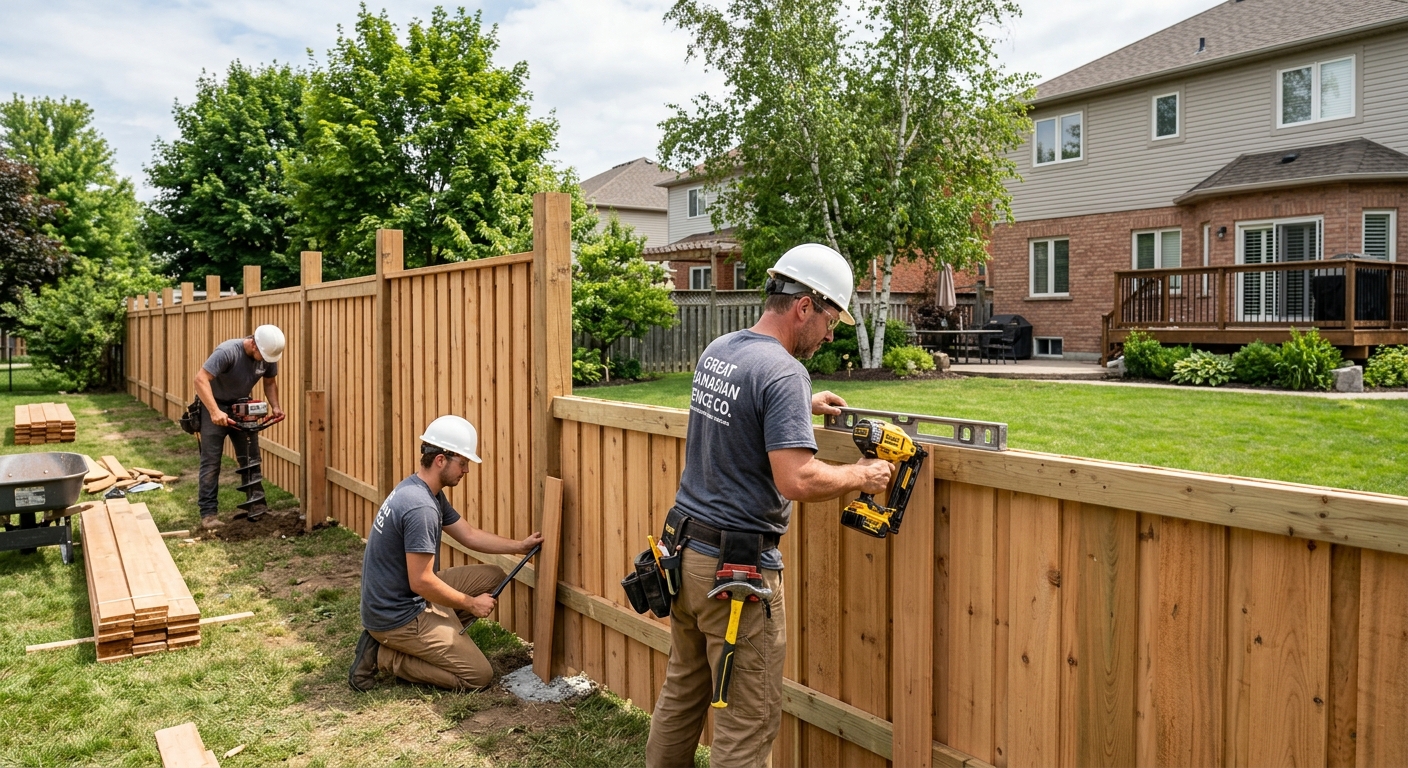
Fencing options and costs in Claresholm
Claresholm homeowners are shopping for fences in a town where detached housing is the norm: single-detached houses account for 72.8% of dwellings, and homeowner households make up 76.6% of all households (Statistics Canada, 2021 Census). That mix matters because detached yards are where most privacy fencing, pool/safety panels, and perimeter upgrades happen, and demand tends to be steady year-round. Another local reality is that many homes are older—61.4% were built before 1981—so you’ll often see fence replacements tied to aging rails, out-of-square layouts, and property-line refinements during remodels.
In the Lethbridge–Medicine Hat economic region, fence pricing is strongly shaped by freeze–thaw cycles and prairie wind. Southern Alberta frost lines typically run around 4 feet, so contractor installs frequently require posts set deep enough to sit below frost to reduce winter heave and long-term leaning. Prairie wind exposure also increases lateral load, which often means tighter post spacing and sturdier rails for solid privacy wood and vinyl. Access affects labour time too—if you’re fencing around established landscaping, hauling materials can take longer, pushing labour into the upper end of the regional installer range.
In Claresholm, upgrades are especially common in older residential pockets near the downtown core where lots are mature and fence lines are frequently being re-aligned. From there, your next step is comparing materials side-by-side, because the “best” choice depends on both lifespan goals and maintenance tolerance.
| Material |
Lifespan |
Maintenance |
Privacy Rating |
Price per Linear Foot |
| Pressure-treated pine (standard wood) |
10–15 years |
Stain/paint every 2–3 years; replace warped pickets/rails |
High (solid privacy boards) |
$35–$65 |
| Cedar (natural rot resistance) |
15–20 years |
Seal/stain every 2–4 years; minor board replacement |
High (board-on-board or close-spacing) |
$45–$75 |
| Vinyl / PVC (no-maintenance) |
20–30 years |
Occasional wash; inspect for impact damage |
High (solid or semi-solid styles) |
$40–$80 |
| Chain-link (galvanized steel) |
25–40 years |
Minimal; rinse as needed; tighten hardware |
Low–Medium (privacy slats optional) |
$25–$45 |
| Aluminum ornamental |
25–40 years |
Minimal; repaint only if you choose a color change |
Low–Medium (ornamental pickets) |
$50–$110 |
| Composite / recycled material |
20–30 years |
Minimal; clean and check fasteners |
High (solid privacy boards) |
$55–$95 |
Prices are estimates only and vary by project scope, site access and material selection.
What affects the price of fencing in Claresholm
In Claresholm and across the Lethbridge–Medicine Hat region, two fencing quotes that look similar can still differ by 30–50% because the true drivers aren’t just the material—it’s how deep posts must be set, how much wind loading the design handles, and how difficult the yard conditions make installation. Even within Alberta, labour, equipment time, and concrete/pickup hauling can vary, which is why “same height, same length” can turn into a notably different final invoice.
The biggest technical cost variable is frost depth. In southern Alberta, posts typically need to be set about 4–6 inches below the design frost depth to reduce winter heave and leaning. That often translates to roughly 1.5–2.0 m into the ground for many residential fence runs, which increases labour time, raises the total concrete volume, and usually forces crews to use longer posts. On windy prairie lots, contractors also tighten post spacing and may upgrade rails, particularly with solid privacy wood and vinyl to reduce sail effect. If your yard is open and exposed to prevailing winds, you’ll often feel the cost increase even when the material is the same.
Local conditions that commonly raise costs in Claresholm include: rocky or clay-heavy subsoil that slows machine digging, mature trees that force hand-excavation around roots, and sloped lots where panels must be stepped or raked to maintain a straight top line. Costs can be lower when the fence line is unobstructed, access is easy for skid-steer/machine work, and the run is a simple perimeter with few gates. As a benchmark, pressure-treated wood installs often land in the $35–$70 range per linear foot, while vinyl / PVC typically starts a bit higher in the $40–$80 range due to the higher material cost and reinforcement requirements for wind.
| Price Factor |
Why It Matters |
Cost Impact |
| Fence length in linear feet |
Most costs scale directly with total run length |
Primary driver; longer runs add posts, rails and labour time |
| Post depth required |
Frost-line requirements dictate hole depth and post length |
Can significantly increase concrete, excavation time, and material |
| Post setting method |
Concrete-set posts resist heave and leaning better than shallow installs |
Concrete typically adds labour and material compared with gravel packing |
| Material choice |
Vinyl, cedar, and chain-link differ in product cost and wind performance |
Moves you between typical bands (e.g., wood vs. aluminum at the high end) |
| Gate count and type |
Gates require heavier frames, hinges, latches and more precise alignment |
Double drive-through gates and specialty hardware raise cost quickly |
| Grade and terrain |
Slope requires stepped or raked panels to keep a consistent top line |
Adds labour time and may require custom cuts |
| Old fence removal and disposal |
Demolition, haul-away and potential re-work of footing lines |
Often adds a noticeable fee, especially if concrete footings are involved |
| Permit fees and survey / property line locate |
Some higher fences and any boundary uncertainty require paperwork |
Could add a fixed set of costs depending on the project |
Prices are estimates only and vary by project scope, site access and material selection.
Permits & regulations in Alberta
In Alberta, fence permit requirements generally depend on the fence height and its location (rear yard versus front or corner). As a practical homeowner rule of thumb, fences above a height threshold—often around 2.0 m (6.5 ft) at the rear and 1.0–1.2 m (3–4 ft) at the front or corner—may require a building permit. Even when a permit isn’t required, you still must respect property lines and municipal setback bylaws. If you’re planning a privacy fence close to a corner lot or a boundary shared with a neighbour, it’s worth confirming requirements before you order materials.
Before digging any post hole, call for utility locates. In Alberta that’s done through Alberta One-Call so contractors can mark buried services. Also, get a survey or at least a property-pin locate before you build—this helps avoid encroachment disputes, especially on older lots where fence lines were sometimes installed “off” and later shifted. Shared fence ownership and responsibilities are typically handled through line-fence rules under provincial legislation, so if it’s a boundary fence, clarify who maintains it and what “repair” means before work starts.
To verify a contractor for a Claresholm job, ask for: (1) proof of Alberta business licensing (if applicable for their work scope), (2) a current certificate of insurance naming you as the additional insured where requested, and (3) workers’ compensation coverage—WSIB/WCB-style coverage—so you’re not left exposed if a worker is injured. For licence and insurance, look for the contractor’s registry details online (where provided), and confirm the certificate dates before the first post is set. Require the documentation before signing, not after.
Choosing the right fence material for Claresholm
Choosing a fence in Claresholm is mostly about matching your priorities—privacy, low maintenance, budget, and lifespan—to materials that can handle southern Alberta’s freeze–thaw swings and prairie winds. Pressure-treated pine is the budget-friendly option, but it needs staining or sealing every 2–3 years to limit grey weathering and keep boards looking sharp. Cedar has better natural rot resistance and generally looks nicer for longer; it still benefits from periodic sealing to maintain colour and reduce splitting. Vinyl / PVC is popular for “set it and forget it” installs—no routine painting, just occasional washing—though extremely cold snaps and impacts can crack or chip panels if the structure isn’t reinforced well. Chain-link is the lowest-cost way to secure a yard and can last decades, but it won’t provide privacy unless you add slats. Aluminum ornamental is rust-resistant and mid-range to premium priced, offering a clean look with lower privacy.
Because frost lines in the Lethbridge–Medicine Hat region run roughly around 4 feet, post-depth matters more than most people expect. For most residential perimeter fences, concrete-set posts are the safer choice when posts must sit below frost to reduce heaving and leaning over time. That means your “material savings” won’t help much if the structure is under-built—wind will exaggerate any weakness, especially for solid privacy styles.
Where the price difference is justified: if you’re paying closer to the vinyl / PVC band (roughly $40–$80 per linear foot) instead of pressure-treated pine (roughly $35–$70), you’re usually buying time—less staining labour and more stable appearance across seasons. If you want maximum privacy and minimal annual upkeep in a windy yard, vinyl or cedar often makes sense; if you’re budget-focused and okay with maintenance, pressure-treated pine can work well with properly set posts and good rails.
| Material |
Cold Tolerance |
Lifespan |
Annual Maintenance |
Best For |
Price Band |
| Pressure-treated pine |
Good (when properly treated and fastened) |
10–15 years |
Light inspection; stain/paint every 2–3 years |
Budget privacy with willingness to refinish |
$35–$70 |
| Cedar |
Very good (natural durability) |
15–20 years |
Seal/stain every 2–4 years; replace any split boards |
Premium look with durable privacy |
$45–$75 |
| Vinyl / PVC |
Good (impacts matter; reinforcement helps) |
20–30 years |
Usually none beyond occasional washing |
Low-maintenance privacy in windy yards |
$40–$80 |
| Chain-link |
Excellent (galvanized components resist weathering) |
25–40 years |
Minimal; tighten hardware and rinse |
Security where privacy isn’t required |
$25–$50 |
| Aluminum ornamental |
Excellent (powder-coated performance) |
25–40 years |
Minimal; repaint only if you change colour |
Front-yard curb appeal without rust issues |
$50–$110 |
| Composite / recycled |
Good (designed for freeze–thaw stability) |
20–30 years |
Minimal; check fasteners and clean as needed |
Privacy with reduced maintenance |
$55–$95 |
Prices are estimates only and vary by project scope, site access and material selection.
How to choose a fencing contractor in Claresholm
For fencing in Alberta, your contractor should be able to prove they’re operating properly and will protect you if something goes wrong. Start with licensing (for the business entity and the scope they’re performing). Request a certificate of liability insurance and confirm coverage dates before work starts. For worker coverage, make sure they carry Alberta workers’ compensation coverage (WCB-style coverage) so you’re not financially responsible if an injury happens on site. In practice, you should be able to receive these documents as PDFs or official certificates—don’t accept “we have it” without seeing expiry dates.
Next, get 2–3 itemised written quotes, ideally broken into labour and materials. The best quotes spell out post depth strategy (below frost), post setting method (typically concrete-set in southern Alberta), rail sizes, the exact panel style, and how corners and gates are handled. Avoid lump-sum estimates that don’t mention what’s included: permit pull support, utility locating coordination, topsoil reinstatement, and disposal of old fence materials.
Warranty matters too. Ask for: (1) workmanship warranty length, (2) manufacturer product warranty terms, and (3) whether warranties transfer if you sell your property. Finally, payment schedule: never pay more than 10–15% upfront; hold back funds until the fence is complete, straight, and materials are installed to spec. Get a start date and completion window in writing so you can plan around Claresholm weather—wind events and freeze–thaw periods can extend timelines.
- Confirm liability insurance and workers’ compensation coverage; check expiry dates.
- Ask for an itemised quote with post count, rail layout, and gate hardware details.
- Verify their post depth approach for southern Alberta frost conditions.
- Require clarity on concrete vs. gravel pack and where each is used.
- Confirm who orders/handles utility locates through Alberta One-Call.
- Check that disposal/removal of old fencing is included (or priced separately).
- Review warranty: workmanship term and manufacturer coverage specifics.
- Ask if the warranty is voided by changes you make later (e.g., staining timeline).
- Ensure the quote states permit responsibility if a permit is needed for height/location.
- Keep payment within 10–15% deposit; use a holdback until final inspection.
- Get start and completion timelines in writing, with weather contingency language.
- Request references/photos from similar wind-exposed yards in the region.
Concrete red flags I see in Claresholm include: contractors refusing to provide insurance/WCB proof in advance; quotes that don’t specify how deep posts will be set below frost; “cheap” gate pricing that doesn’t list hardware quality or alignment plan; vague scope language that excludes old fence removal; and insisting on a large upfront payment (beyond 10–15%) without milestones.
Frequently asked questions — fencing in Claresholm
Do I need a permit to build a fence in Alberta?
In Alberta, some fences do require permits depending on height and placement. A common rule of thumb is that fences over about 2.0 m (6.5 ft) in the rear and around 1.0–1.2 m (3–4 ft) at the front or corner may trigger permit requirements. Even if a permit isn’t required, you still need to respect property lines and municipal setback bylaws, which can be especially important on corner lots in Claresholm. Before you dig, also call Alberta One-Call for utility locates. If you’re unsure, ask your contractor to confirm whether permit pull support is included in their quote and provide documentation for your specific fence layout and height.
How long does a wood fence last in Claresholm?
A well-built wood fence in Claresholm typically lasts about 10–15 years for pressure-treated pine and can reach 15–20 years with cedar, assuming posts are set below frost to reduce winter heave and leaning. Longevity is less about the board alone and more about the structure: correct post depth, solid rail connections, and good drainage around the base all matter in southern Alberta’s freeze–thaw cycles. Maintenance also plays a big role—pressure-treated pine usually needs staining or sealing every 2–3 years, which homeowners should plan for. If you want lower upkeep, vinyl or PVC often trades higher upfront cost for fewer maintenance tasks, with many installs landing around the $40–$80 per linear foot band depending on height and gate count.
Who owns and maintains a shared fence?
For a shared fence (a boundary fence), ownership and maintenance responsibilities are governed by Alberta line-fence legislation and any agreements between neighbours. Practically, that means you and your neighbour should clarify: who maintains the fence, who pays for repairs, and what “repairs” covers versus full replacement. In Claresholm, this is especially important on older lots where fence locations may have shifted over time and where neighbours may disagree about the exact line. Before installing or replacing, ask your contractor to help you document the proposed line (using survey pins/locates) and get written agreement on responsibilities. If you’re planning a taller privacy upgrade, it’s also smart to confirm permit triggers and who will handle them.
How do I find my property line before fencing?
The best approach is to get a survey or have property pins located before you install any posts. Older Claresholm properties can have historic fence lines that don’t match the current boundary, so don’t rely on “where the fence looks right.” Once pins are identified, mark your proposed fence line and ensure gates and corners fit within the boundary setbacks. Before any digging, call Alberta One-Call to get utility locates marked—this protects you and your contractor from damaging underground services. If your contractor suggests skipping survey work, that’s usually a risk: an encroachment dispute can turn a routine fence replacement into a costly redo. A careful property line start also helps keep your quote accurate and your final layout straight.
What's the most low-maintenance fence?
For most Claresholm homeowners, vinyl / PVC is the most low-maintenance “set and wash” option. It doesn’t require staining like wood, and with solid installation it can perform well through Alberta winters and spring freeze–thaw. Budget-wise, vinyl commonly sits around the $40–$80 per linear foot range depending on height, design and gate hardware. Aluminum ornamental is also low-maintenance and rust-resistant, but it usually offers less privacy than solid board styles. Chain-link is low maintenance for longevity and security, but it typically doesn’t provide privacy unless you add slats, which adds upkeep if you want visibility control. The key is pairing low maintenance materials with proper post depth and wind-rated bracing so the fence stays true without labour-intensive repairs.
How tall can my fence be in Claresholm?
Fence height limits depend on where the fence sits on your property (rear vs. front vs. corner) and can affect whether a permit is needed. As a practical guideline in Alberta, rear fences often have a higher threshold (commonly around 2.0 m/6.5 ft) while front/corner fencing is often lower (commonly around 1.0–1.2 m/3–4 ft). Claresholm homeowners should confirm the specific municipal bylaw thresholds for their lot and proposed fence location. Height also changes how the fence performs in wind: taller solid privacy panels catch more wind load, so contractors may recommend tighter post spacing and stronger rails. If your quote includes solid privacy at higher elevations, ask how they’re engineering for wind and whether the install uses concrete-set posts below frost.