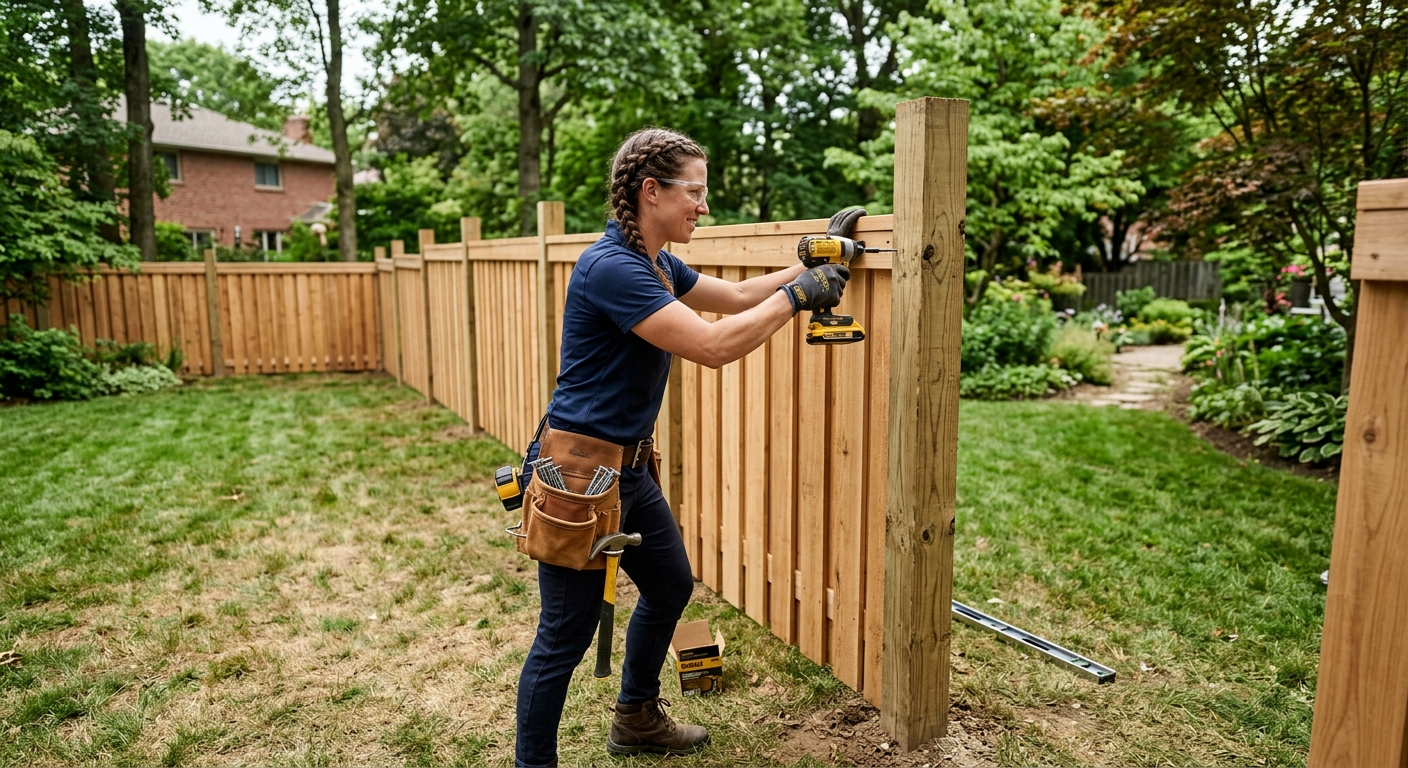
Fencing options and costs in High River
High River homeowners have a lot of choice when it comes to fencing, but the right option depends on privacy needs, wind exposure, and how well your fence is built for Prairie freeze–thaw conditions. In High River, there are 14,324 residents (Statistics Canada, 2021 Census), and the demand for fencing is closely tied to who owns the home—75.4% of households are homeowner households (Statistics Canada, 2021 Census). That ownership base matters because fences aren’t “installed once and forgotten” here; they’re maintained and upgraded as yards mature.
In the Calgary economic region, long freeze–thaw cycles are a cost driver. Fence posts typically need to be set about 4 ft (≈120 cm) deep to sit below the frost line, which increases excavation time, concrete volume, and labour—especially for 6 ft privacy fences and gate posts. Open Prairie exposure also increases wind loading, so solid wood or vinyl privacy panels usually require tighter post spacing and fully concreted footings to prevent racking. Chain-link can cost less because it allows airflow, which reduces wind pressure on the structure.
Contractors are often busiest in areas with lots of established single-detached homes, including neighbourhoods like Riverstone and Westmount. If you’re planning a new privacy fence or upgrading an older perimeter fence, it’s best to compare materials side-by-side before you request your estimate.
Below are realistic installed ranges that match the local market for High River, using typical material lifespans and maintenance expectations, and aligning with the regional cost band of installed fencing in Calgary-area communities.
| Material |
Lifespan |
Maintenance |
Privacy Rating |
Price per Linear Foot |
| Pressure-treated pine (standard wood) |
15–20 years |
Stain/seal every 2–3 years; inspect for warping and fastener corrosion |
Medium–High (solid boards) |
$40 – $80 |
| Cedar (natural rot resistance) |
20–30 years |
Light staining or oiling every 3–4 years; still needs periodic upkeep |
High (solid boards) |
$55 – $95 |
| Vinyl / PVC (no-maintenance) |
25–35 years |
Rinse annually; check posts after severe winters |
High (solid privacy panels) |
$45 – $90 |
| Chain-link (galvanized steel) |
25–40 years |
Occasional tension checks; rinse to reduce surface build-up |
Low–Medium (airflow through mesh) |
$25 – $55 |
| Aluminum ornamental |
30–50 years |
No rusting; occasional wash and hardware checks |
Low–Medium (open pickets) |
$70 – $120 |
| Composite / recycled material |
20–30 years |
Minimal; wash as needed and inspect for swelling at fasteners |
Medium–High (solid styles) |
$60 – $105 |
Prices are estimates only and vary by project scope, site access and material selection.
What affects the price of fencing in High River
In High River, two quotes for “the same fence” can differ by 30–50% because the scope behind the scenes changes: post depth, footing type, gate complexity, slope handling, and whether old material is removed and hauled away. Even within the same Calgary-area pricing band, labour availability and jobsite constraints—like narrow side yards, heavy snow cover at start time, or difficult access for a concrete mixer—can shift costs fast.
The biggest technical driver is frost protection. In Alberta, posts generally must be set about 1.5–2.0 m into the ground (commonly achieved by targeting roughly 4 ft ≈ 120 cm below grade after excavation for footing), so the fence doesn’t heave during spring thaw. That deeper excavation requires longer posts, more concrete, and more time per hole. For a typical run, that’s how a “mid-range” wood fence can move into the upper end of the $40 – $80 band—especially where 6 ft privacy panels and double gates are involved.
Wind exposure is another Prairie reality. Open areas create strong wind loads, so privacy materials (solid wood or vinyl) often need sturdier posts and closer spacing, which raises labour and hardware. By contrast, chain-link at $25 – $55 can remain lower because airflow through the mesh reduces racking forces.
Concrete examples from High River jobs:
- Replacing a 30 ft run with concrete-set 6 ft privacy posts usually costs more than a shorter chain-link run on the same property because each post needs deeper holes and concrete.
- On sloped lots, stepping panels can require more labour and additional rail adjustments, pushing the project upward even when fence material is similar.
- Where you remove an aging fence built before 1981—23.8% of homes in the city were built before 1981 (Statistics Canada, 2021 Census)—you often find mixed wood species, older fasteners, and buried hardware that slow demolition and disposal.
| Price Factor |
Why It Matters |
Cost Impact |
| Fence length in linear feet — the primary cost driver |
More linear feet means more posts, rails, and materials |
Large impact; length is the main driver of total cost |
| Post depth required — frost line determines post length and hole depth |
Deeper holes require more excavation and longer posts |
Medium–High impact in Alberta due to frost protection |
| Post setting method — concrete vs. gravel pack vs. driven posts |
Concrete-set posts resist heaving and improve wind stability |
Concrete increases cost but reduces risk of early failure |
| Material choice — vinyl vs. cedar vs. chain-link |
Different material strength and wind resistance change framing and spacing |
Medium impact; privacy materials typically cost more |
| Gate count and type — walk-through vs. drive-through (double) |
Gates need stronger posts, hinges, latches, and sometimes bracing |
High impact because gates are labour-intensive |
| Grade and terrain — sloped yards require stepped or raked panels |
Slopes require layout changes and extra labour for alignment |
Medium impact; can increase material use and labour |
| Old fence removal and disposal |
Demolition, hauling, and disposal add time and equipment needs |
Medium impact; varies by volume and condition |
| Permit fees and survey / property line locate |
Accurate boundary work prevents rework and disputes |
Low–Medium impact; becomes higher if locating is complex |
Permits & regulations in Alberta
In Alberta, fence rules commonly hinge on height and location, and in many cases a permit is triggered at higher backyard heights—often around 2.0 m (6.5 ft) for rear installations, with lower thresholds for front yards or corner lots, commonly about 1.0–1.2 m (3–4 ft). Even when a permit is not required, the fence must respect property lines and follow municipal setback bylaws. If you plan a privacy fence over a typical height or you’re near a corner visibility area, treat it as a permit-first project in High River to avoid rebuild costs.
Before you dig any post holes, call for utility locates through Alberta One-Call (utility marking is required practice to reduce risk). Also, confirm your property line—either by obtaining a survey or by locating pins—because fencing disputes often start with “half on my land” assumptions. In Alberta, shared fence ownership and line-fence responsibilities are addressed under provincial line-fences legislation, so document agreements with your neighbour in writing if you share a boundary fence.
What usually requires a permit: fences above the local height threshold (especially rear walls near or above ~2.0 m) and certain corner/front visibility scenarios, along with projects needing additional review.
What typically does not require a permit: standard back-yard fences under the local height threshold, smaller accessory fencing, and like-for-like replacements where dimensions and locations stay within bylaw limits (still verify with the City’s requirements).
To verify a contractor in High River, ask for: (1) proof of Alberta business licensing where applicable (and correct trade credentials), (2) liability insurance certificate showing fencing as an insured activity, and (3) WSIB/WCB coverage clearance. Where to look: request a certificate of insurance directly (and confirm policy limits and effective dates), and use the applicable online registry/clearance process for WCB status. Don’t rely on verbal assurance—get the documents before work starts.
Choosing the right fence material for High River
Choosing the right fence material in High River is mostly about balancing privacy, maintenance, and how the material handles Alberta’s freeze–thaw and wind loads. Pressure-treated pine is usually the budget-friendly entry point, but it often needs staining or sealing every 2–3 years to prevent grey weathering and surface wear. Cedar has better natural rot resistance and looks great for longer, but it still benefits from periodic maintenance to keep boards looking uniform. Vinyl/PVC offers the “wash-and-forget” advantage, yet very cold snaps can make some grades more prone to cracking if posts aren’t set square and stable—so structure and installation quality matter as much as the product.
Chain-link is typically the lowest-cost way to secure a yard and it lasts well because airflow reduces wind stress; however, it provides little privacy without adding slats or plantings. Aluminum ornamental gives strong curb appeal and won’t rust, but it’s not a privacy fence unless you accept open visibility. For most Prairie properties with open exposure, solid privacy styles need proper post depth and wind-sturdy framing. In the Calgary region, frost protection is the rule: post depth is commonly designed around frost line requirements (often achieved by setting posts roughly 4 ft ≈ 120 cm deep with concrete), and that makes the “in-ground” portion of the job a major cost component regardless of material.
A local decision example: if you compare a cedar privacy fence versus vinyl for a similar 6 ft run, the price gap can be modest once footings and labour are included. In many Calgary-area installs, vinyl may land within the $45 – $90 range while cedar often moves toward the $55 – $95 range. That extra cost is justified when you want lower maintenance for 20+ years and you’re paying for consistent installation quality that resists heaving and racking.
| Material |
Cold Tolerance |
Lifespan |
Annual Maintenance |
Best For |
Price Band |
| Pressure-treated pine |
Good when posts are properly set below frost depth |
15–20 years |
Low to moderate (inspect + re-stain every 2–3 years) |
Budget privacy, traditional look |
$40 – $80 |
| Cedar |
Good; handles Alberta winters well with correct fasteners |
20–30 years |
Low to moderate (typically stain/oil every 3–4 years) |
Longer-lasting natural appearance with privacy |
$55 – $95 |
| Vinyl / PVC |
Very good in cold when installed on solid, square framing |
25–35 years |
Very low (wash/rinse; occasional hardware checks) |
Low maintenance privacy |
$45 – $90 |
| Chain-link |
Excellent; flexible mesh tolerates temperature changes |
25–40 years |
Low (tension check and occasional wash) |
Security with minimal cost |
$25 – $55 |
| Aluminum ornamental |
Excellent; coatings resist freeze effects and corrosion |
30–50 years |
Very low (wash and check fittings) |
Appearance-focused, open perimeter fencing |
$70 – $120 |
| Composite / recycled |
Good; performance depends on board brand and installation details |
20–30 years |
Low (wash; monitor fasteners and spacing) |
Solid look with reduced maintenance vs. wood |
$60 – $105 |
How to choose a fencing contractor in High River
In High River, the difference between a fence that lasts and one that “needs attention next spring” is usually the contractor’s install process and paperwork. Start by verifying Alberta business licensing where applicable, and confirm liability insurance and WSIB/WCB coverage. How to check: ask for a current certificate of insurance (with effective dates and adequate liability limits) naming your project owner as the appropriate certificate holder if required, and request WCB/WSIB clearance documentation or a clearance letter number. If they won’t provide documents, pause the conversation.
Next, get 2–3 itemised written quotes—labour and materials broken out, not one lump sum. The best quotes list post count, post depth plan, whether concrete is used for every post or only corners/gates, rail style, fencing height, gate hardware, and who supplies/hauls away debris. Read the scope for exclusions: is the permit pull included (if required), does disposal include old fence removal, and are utility locates included or your responsibility?
Warranty should be explicit. Ask for the workmanship warranty length (for post setting, alignment, and rail fastening), the product/manufacturer warranty, and whether the warranty is transferable if you sell your home. Payment scheduling matters: never pay more than 10–15% upfront. Hold back the balance until the job is complete, cleaned, and gates latch properly.
Finally, require a start date and completion estimate in writing. In Alberta winters, delays are common, but a clear plan for how they’ll protect installed fencing (especially concrete-set posts) shows professionalism.
- Provide their Alberta business details and proof of coverage before you sign.
- Confirm liability insurance limits and project-specific certificate wording.
- Ask for WSIB/WCB clearance documents (or clearance letter) and verify dates.
- Require an itemised quote: posts, rails, picket/panel material, hardware, and labour.
- Confirm post depth plan for frost protection and whether holes are excavated to spec.
- Specify post setting method (concrete set vs. gravel pack) in the contract.
- Check if gates are quoted with proper bracing and hardware upgrades.
- Verify slope handling method (stepped panels vs. raked) for your yard grade.
- Ask who performs utility locates and where the marks are verified on site.
- Confirm property line/location responsibility: survey vs. pin locate.
- Clarify disposal: trailer haul away, dump fees, and clean-up scope.
- Set payment schedule: max 10–15% deposit, then staged payments on milestones.
Red flags to watch for in High River: (1) quotes that don’t mention post depth or footing method, (2) offers to “just drive posts” for a solid privacy fence in freeze–thaw conditions, (3) no written scope for gate hardware adjustments and alignment, (4) no proof of insurance/WCB clearance, and (5) a willingness to take a large deposit up front without a signed contract and schedule.
Frequently asked questions — fencing in High River
Should I repair or replace my old fence in High River?
In High River, it’s often worth repairing if the posts are still solid and properly set below frost depth—especially if the fence is mainly cosmetic (e.g., a few warped boards or loose rails). However, if you’re seeing leaning sections, gaps that opened after winter, or multiple posts that move when pushed, replacement is usually the safer option because freeze–thaw can keep pushing weak foundations out of alignment. If your fence is older (and many homes were built before 1981—23.8% of dwellings in the area), hardware may be compromised and boards may not sit square anymore.
Budget-wise, repair costs can look attractive, but repeated patching can equal the price of a new run. For reference, a new chain-link fence often falls around $25 – $55 per linear foot installed, while privacy materials like wood or vinyl typically land mid-range to higher. A local contractor can do a quick post-by-post assessment and show you whether you’re paying for a true structural fix or just surface work.
How do I handle a fence dispute with a neighbour in Alberta?
Fence disputes are common in Alberta when boundary lines aren’t clearly established. In High River, start by verifying the property line using survey pins or a recent survey—don’t rely on rough measurements or “everyone’s always done it this way.” Next, document everything: photos, dates of when the issue started, and any correspondence. If the fence is on or near the property line, Alberta’s line-fences framework guides shared responsibilities, but practical solutions still require neighbour communication.
Before spending on repairs, agree on a site visit and get a written assessment from a fencing contractor. If the dispute is about the fence location, consider a professional locate/survey rather than rebuilding. For the tone of communication, keep it factual: reference measurements, bylaw expectations, and what each party is proposing. If you end up in a formal process, having written estimates and documented boundary verification usually strengthens your position.
What fence style offers the best wind resistance in High River?
With the Prairie exposure around High River, wind loads matter a lot, especially for solid privacy panels. The most wind-tolerant options tend to be those that allow airflow, like chain-link (and styles with partial openings) because they reduce racking forces on rails and posts. Solid wood and vinyl privacy fences can perform extremely well too—but only when they’re built for Alberta conditions: posts set below frost depth, concrete footings, properly braced corner sections, and appropriate post spacing.
If your yard is open and you’ve had issues with leaning gates or racked panels, a contractor may recommend chain-link for durability or a solid privacy design with heavier framing. Price-wise, chain-link commonly sits around $25 – $55 per linear foot installed, while a 6 ft privacy fence in wood or vinyl often costs more (mid-range to higher). The “best” choice is the one matched to your exposure and the way it’s engineered for wind, not just the material name.
How much does a fence cost in High River?
In High River, installed fence pricing typically tracks the broader Calgary-area cost ranges, but your exact total depends on length, height, gate count, post depth, and site access. As a ballpark, chain-link is often the lowest-cost option at about $25 – $55 per linear foot installed. Wood and vinyl privacy fences usually sit higher, commonly around $40 – $80 for standard wood and about $45 – $90 for vinyl/PVC depending on height and detailing.
Aluminum ornamental tends to be the top tier—often $70 – $120 per linear foot installed—because of materials and framing. For a real estimate, expect major cost swings when you include concrete-set posts for frost protection, slope grading adjustments, and old fence removal/disposal. If you share your approximate linear footage and whether you need one or two gates, you can usually narrow a budget range quickly.
How deep should fence posts be for High River's frost?
For fences in High River and the broader Alberta Prairies, frost protection is critical. In the Calgary region, a common practical standard is setting posts about 4 ft (≈120 cm) deep to place them below the regional frost line and reduce the risk of heaving. In many designs, this translates to digging deeper holes based on ground conditions and fence type, often targeting the equivalent of roughly 1.5–2.0 m into the ground depending on where frost is expected.
In cold climates, that depth affects both labour and materials: you’ll typically use longer posts, dig larger holes, and often set posts in concrete for stability—especially for 6 ft privacy fences and any gate posts. If someone proposes a shallow install for a solid wood or vinyl fence, that’s a red flag. A proper installation plan should explicitly state post depth and setting method in the contract, not just “we’ll set posts below frost.”
Wood vs vinyl vs aluminum fence — which is best?
The “best” fence in High River depends on your priority: privacy, maintenance, budget, or curb appeal. Wood privacy fences (pressure-treated pine or cedar) offer strong privacy and a traditional look, with pricing often landing around $40 – $80 for wood installations depending on materials and height. Cedar can cost more but resists rot better and looks great longer. Vinyl/PVC is typically lower maintenance once installed correctly; it’s often priced around $45 – $90, but cold performance hinges on solid framing and correctly set posts.
Aluminum ornamental fencing is best if you want an attractive, rust-resistant perimeter with low upkeep—commonly $70 – $120 installed—but it doesn’t provide much privacy because of open pickets. For wind resistance, solid privacy styles must be structurally engineered for Prairie loads, while aluminum is naturally sturdy but remains visually open. If privacy is your goal, vinyl or wood usually wins; if appearance and durability with openness matter most, aluminum is often the better match.