Fencing options and costs in Meyonohk
Meyonohk homeowners choose fences for privacy, curb appeal and property definition, and the local demand is strongly tied to detached-home ownership—each detached property typically needs its own fencing plan. In the Calgary economic region, the area’s housing base includes 2,923 residents (Statistics Canada, 2021 Census), which translates into a steady mix of repairs, replacements and new perimeter builds each season. For many households, the fencing project is also shaped by the Prairie continental climate: long freeze–thaw cycles and open exposure mean wind forces and frost protection are the real cost drivers, not just the visual style.
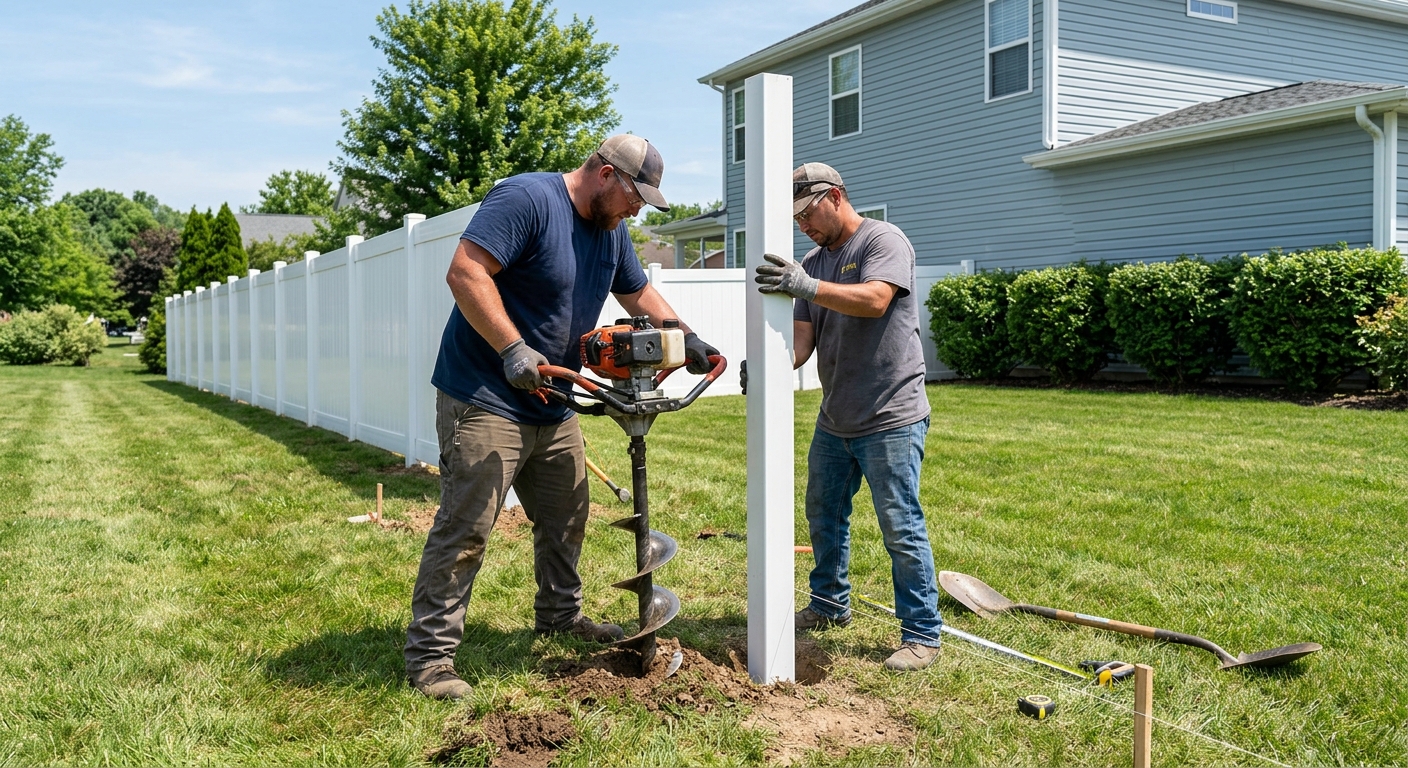
In Calgary-area conditions, fence posts are commonly set about 4 ft (≈120 cm) deep to get below the regional frost line and reduce heaving. For taller privacy fences and gates, crews often use concrete footings and sturdier hardware so panels don’t rack in gusts. That combination raises labour time (excavation, post setting, bracing) and material needs (longer posts, larger bags of concrete), which is why pricing often lands in the mid-range to upper-range for wood and vinyl systems. Access and terrain matter too—steep yards and rocky soils around neighbourhoods such as Walden often require extra excavation effort and careful panel alignment.
Below is a practical comparison of common materials you’ll see quoted in Meyonohk, with realistic lifespan and maintenance expectations to help you benchmark your contractor’s estimate before you book a site visit.
| Material |
Lifespan |
Maintenance |
Privacy Rating |
Price per Linear Foot |
| Pressure-treated pine (standard wood) |
10–15 years |
Stain/seal every 2–3 years |
High (solid pickets/boards) |
$40–$80 |
| Cedar (natural rot resistance) |
15–25 years |
Light sealing/staining every 3–4 years |
High (solid boards) |
$55–$90 |
| Vinyl / PVC (no-maintenance) |
20–30 years |
Rinse as needed; occasional panel alignment |
High (solid privacy panels) |
$45–$90 |
| Chain-link (galvanized steel) |
25–40 years |
Minimal; keep gates aligned |
Low–Medium (airflow/open) |
$25–$55 |
| Aluminum ornamental |
25–50 years |
Wash annually; touch-up rarely |
Low (decorative spacing) |
$70–$120 |
| Composite / recycled material |
20–30 years |
Wash; avoid abrasive scraping |
High (board or panel systems) |
$85–$130 |
Prices are estimates only and vary by project scope, site access and material selection.
What affects the price of fencing in Meyonohk
In Meyonohk, two quotes for the “same” fence can easily differ by 30–50% because fencing pricing bundles several variables together: excavation conditions, frost-safe post setting, wind-load engineering, and how much labour time your site actually needs. In the Calgary economic region, crews plan for Alberta’s freeze–thaw behaviour by setting posts deeper—typically 4–6 inches (≈10–15 cm) below the design frost depth—so the ground doesn’t heave and break alignment. That means longer posts, deeper holes and more concrete for many privacy fences and gate installations. In contrast, lighter systems like chain-link can use less massive framing because the airflow reduces racking forces.
Wind exposure on the Prairies also pushes contractors toward closer post spacing and sturdier rails for solid wood or vinyl privacy panels. In milder or wetter regions (for example, coastal climates), costs can skew toward moisture-driven rot repair and faster timber degradation; here, the dominant failure mode is heaving and structural strain during winter cycles and high gusts. Those differences are why local bands land wood and vinyl toward mid–upper ranges (often around $40–$80 for wood and $45–$90 for vinyl), while chain-link frequently shows up lower because it’s more forgiving under wind loading (often around $25–$55).
Concrete examples: (1) Rocky soil can turn “standard post holes” into time-consuming drilling and larger disposal costs; (2) a yard with snow storage near the fence often requires panel height and bracing adjustments, affecting hardware and labour; (3) if your fence line is on the edge of an older lot where property pins are unclear, locating can add time and reduce scheduling efficiency. Newer builds in Meyonohk can be quicker to access and measure, but older yards sometimes need more prep before posts can be set properly for the frost line.
| Price Factor |
Why It Matters |
Cost Impact |
| Fence length in linear feet |
Material and labour scale directly with total run |
High (primary driver) |
| Post depth required |
Frost line determines hole depth and post length |
High in Calgary-area freeze–thaw |
| Post setting method |
Concrete footings improve stability in heaving-prone ground |
Medium–High (concrete adds labour/volume) |
| Material choice |
Different rigidity and framing requirements under wind loads |
Medium–High (vinyl/wood > chain-link) |
| Gate count and type |
Drive-through double gates require heavier hinges and bracing |
Medium–High per gate |
| Grade and terrain |
Slopes require stepped or raked panels to maintain alignment |
Medium (extra layout time and materials) |
| Old fence removal and disposal |
Haul-away, salvaging decisions and additional protection |
Medium (can add a full day) |
| Permit fees and survey / property line locate |
Verification work prevents encroachment and redesign |
Low–Medium (but critical for compliance) |
Permits & regulations in Alberta
In Alberta, fence permits depend largely on height and location. As a practical rule of thumb, fences above a height threshold—often around 2.0 m (6.5 ft) at the rear and about 1.0–1.2 m (3–4 ft) at the front or corner—may require a building permit. Even when a permit isn’t required, your fence must still respect property lines and municipal setback requirements. Because zoning can vary by site and placement, don’t rely on neighbour examples; verify your fence location and planned height before digging.
Before you start any post-hole excavation, call for utility locates through Alberta One-Call. Also, obtain a survey or locate property pins before installing to avoid encroachment disputes—this is especially important on older lots where pin records may have shifted over time. Shared fence ownership and cost splits are typically addressed through provincial line-fences legislation, but the practical takeaway for homeowners is to document agreements in writing before construction begins.
What usually requires a permit: taller privacy fences (commonly around 2.0 m and up, depending on placement) and projects where local setback/zoning triggers additional review. What typically does NOT: replacing like-for-like fencing at similar height and within established property lines (still confirm with your municipality). To verify your contractor in Meyonohk, ask for (1) an Alberta contractor licence/registration details where applicable, (2) a current certificate of liability insurance naming you as additional insured (if offered), and (3) proof of WCB coverage (WSIB/WCB coverage is the standard requirement in Alberta). You should be able to check credentials online, then request written copies before the crew arrives—no exceptions for post-hole work.
Choosing the right fence material for Meyonohk
Choosing the right fence material in Meyonohk comes down to matching your priorities—privacy, low maintenance, budget and lifespan—to a climate that cycles through deep freezes and thaw periods. Pressure-treated pine is usually the lowest upfront option, but Alberta’s wind and winter dryness can “grey” wood and open the door to premature surface wear; plan on staining or sealing about every 2–3 years. Cedar looks better longer and resists rot naturally, which helps in freeze–thaw conditions where water exposure can accelerate deterioration; it still benefits from periodic maintenance to preserve appearance and reduce cracking. Vinyl/PVC offers low maintenance and good privacy when installed properly, but extreme cold can make panels more prone to cracking if the framing spacing and post setting aren’t frost-safe. Chain-link is the most economical and typically performs well long-term in wind, but it provides little privacy unless you add slats or a screening layer. Aluminum ornamental is rust-resistant and long-lived, but it won’t give privacy like a solid privacy board fence.
For Calgary-area frost protection, contractors generally set posts deep enough to remain stable through heaving cycles; in practice that means concrete-set posts are commonly used for privacy panels and gate structures, especially for solid boards that resist wind loads. When budget is tight, chain-link can be a sound “lifetime value” choice, while wood or vinyl makes more sense when privacy is a must.
A typical budgeting example: if you’re comparing a privacy wood fence at roughly $40–$80 per linear foot versus a vinyl privacy fence around $45–$90, the extra $5–$10/ft often becomes justified when you want fewer maintenance visits and cleaner aesthetics through the winter season—provided the contractor uses frost-safe post depth and robust rails. If you’re planning to stain anyway or you enjoy maintenance, pressure-treated pine can still be the best value.
| Material |
Cold Tolerance |
Lifespan |
Annual Maintenance |
Best For |
Price Band |
| Pressure-treated pine |
Good (plan for freeze–thaw surface wear) |
10–15 years |
Low–Moderate (inspection + staining every 2–3 years) |
Budget privacy with manageable upkeep |
$40–$80 |
| Cedar |
Very good (naturally rot-resistant) |
15–25 years |
Low–Moderate (sealing/staining about every 3–4 years) |
Premium look with better durability |
$55–$90 |
| Vinyl / PVC |
Good (requires correct spacing and rigid framing) |
20–30 years |
Very low (rinse; check hardware after storms) |
Low-maintenance privacy |
$45–$90 |
| Chain-link |
Excellent (well-suited to wind airflow) |
25–40 years |
Very low (periodic gate alignment) |
Security with airflow (add screening if needed) |
$25–$55 |
| Aluminum ornamental |
Excellent (non-rusting) |
25–50 years |
Very low (wash annually) |
Appearance + longevity (limited privacy) |
$70–$120 |
| Composite / recycled |
Good (stable in cold when installed correctly) |
20–30 years |
Low (wash; avoid abrasive cleaning) |
Privacy with less weathering concern |
$85–$130 |
How to choose a fencing contractor in Meyonohk
When you hire a contractor for fencing in Meyonohk, start by verifying Alberta coverage and credibility—because post-hole work and wind-rated installation quality are where problems get expensive. Ask for your contractor’s Alberta licensing/registration information (as applicable), then request a certificate of liability insurance and confirm WCB coverage in Alberta. You can check credentials through official online registries where the province maintains contractor-related information. For insurance documents, look for current expiry dates, the correct business name, and coverage limits appropriate for construction work. For WCB/WCB-like coverage, ask for a clearance letter or proof of account status and keep a copy with your contract paperwork.
Next, get 2–3 itemised written quotes. “Itemised” means you can see labour line items separately from materials: posts/rails, panels/pickets, concrete or gravel, hardware, gates, and disposal. Confirm what’s excluded: permit pull responsibility, utility locate costs, and whether grading/stepping is included on slopes. Ask about warranty terms in plain language—workmanship warranty length, manufacturer warranty on materials, and whether the warranty is transferable if you sell your home. For payment scheduling, don’t move money beyond 10–15% upfront; a practical holdback (remaining balance) should be released only after the fence is complete, straight, gates operate properly, and debris is removed. Finally, insist on a written start date and completion estimate that reflect typical winter access constraints and curing time for concrete-set posts.
- Request proof of Alberta WCB coverage (clearance letter or documented account status).
- Confirm liability insurance is current and ask who is named on the certificate (you/owner if offered).
- Verify licence/registration details for the fencing company before any excavation.
- Get 2–3 itemised quotes (labour, materials, concrete/gravel, gates, disposal separately).
- Ask whether post depth follows Calgary-area frost-protection practice (around 4 ft deep in many cases).
- Confirm gate hardware is rated for solid-panel wind loading (hinges, latches, bracing).
- Clarify grading work: stepped vs. raked sections and who supplies/sets the string line.
- Check whether they include utility locates and how they mark the dig line.
- Make sure property line verification/survey locate is included or explicitly excluded.
- Demand a written timeline with concrete curing and fence alignment checkpoints.
- Use a payment schedule with a holdback until final walkthrough and cleanup.
- Review warranty: workmanship duration, product warranty coverage, and transferability.
Red flags we see in Meyonohk: contractors who won’t provide insurance/WCB paperwork, quotes that only list a lump-sum without post-depth/concrete details, “too-good-to-be-true” pricing that omits gate bracing for privacy fences, crews starting excavation without utility locates, and contracts that don’t clearly state what’s included for debris removal and any permit responsibilities.
Frequently asked questions — fencing in Meyonohk
How do I prevent wood fence rot in Meyonohk?
In Meyonohk and the wider Calgary area, wood rot prevention is mostly about keeping water from staying in the wrong places during freeze–thaw. Use pressure-treated pine or cedar, and make sure the bottoms of posts are protected with proper concrete setting and stable post depth (often around the 4 ft range locally) so posts don’t heave and crack joints. Keep ground contact minimal: avoid burying unsealed wood in soil and ensure rails and pickets are installed with airflow. The biggest upgrade is a contractor that uses correct hardware and tight spacing while still allowing panel movement in wind. Budget for maintenance—stain or seal pressure-treated wood about every 2–3 years—to slow grey weathering and surface splitting.
What is the cost per linear foot for fencing in Meyonohk?
In Meyonohk, fencing typically lands within the Calgary regional bands driven by frost-protected post setting and wind loading. Many homeowners see wood fencing installations around $40–$80 per linear foot and vinyl/PVC privacy around $45–$90. If you’re comparing to a more open security fence, chain-link often appears lower at about $25–$55 per linear foot because it needs less rigid framing to resist racking. Aluminum ornamental is usually the higher-end option at roughly $70–$120 per linear foot. Your exact number depends on length, gate count, terrain, and whether concrete footings are included.
Should I repair or replace my old fence in Meyonohk?
Repair is usually worth it when the posts are still solid and straight, rails aren’t heavily warped, and damage is limited to a few pickets or a panel section. In Meyonohk’s freeze–thaw conditions, rot and heaving often show up first at post bottoms and gate corners—if those areas are failing, replacement is commonly more cost-effective than patchwork. A practical approach is to request a walk-through where the contractor checks post movement, base rot, and hardware looseness, then quotes repairs as a separate option from full replacement. If you’re seeing multiple leaning sections or repeated fastener pull-out, replacement typically stops recurring labour. For a budget anchor, wood and vinyl replacement commonly sit in the mid-range bands ($40–$80 for wood; $45–$90 for vinyl).
How do I handle a fence dispute with a neighbour in Alberta?
Fence disputes in Alberta usually start with unclear property boundaries or disagreement on which side is responsible for upkeep and replacement. Begin by locating your property pins (or getting a survey/locate if pins are missing or unreliable) and document existing fence alignment with photos and measurements. Keep communication calm and factual, and put any agreement in writing before work starts. Alberta’s line-fences rules govern shared fence ownership and cost-sharing in many situations, but the best practical step is to show evidence: who built, when, and where the fence sits relative to the property line. If the dispute persists, consider mediation or formal options, but don’t start digging until you’ve confirmed utility locates (Alberta One-Call) and you’re confident the fence line is correctly placed.
What fence style offers the best wind resistance in Meyonohk?
In Meyonohk’s Prairie exposure, wind resistance depends more on structure than looks. Open styles like chain-link (and fences with airflow) generally handle gusts better because less wind pressure builds on the panel face. Solid wood or vinyl privacy fences can perform well too, but they require tighter post spacing, heavier rails, and frost-safe post depth with proper concrete setting—otherwise panels rack during winter storms and high spring winds. For a homeowner who wants privacy without sacrificing too much performance, consider solid panels with engineered bracing and correct gate hardware, or choose a privacy system designed for wind loads. A contractor should show how they’re spacing posts and using bracing, not just what material you’re buying.
How much does a fence cost in Meyonohk?
Most Meyonohk fence projects are priced by linear foot, then adjusted for gates, terrain, removal, and post setting requirements. Based on Calgary-region installation bands, typical per-foot ranges are about $40–$80 for wood, $45–$90 for vinyl/PVC, and $25–$55 for chain-link. Final totals can swing noticeably because Calgary-area freeze–thaw makes deeper, concrete-set post installation more common—especially for 6 ft privacy fences and gate posts—adding excavation time and concrete volume. Your total also depends on how much of the fence line is uneven, whether old fence disposal is needed, and whether a permit is required based on height and placement. For the most accurate number, request an itemised quote with labour, materials, and post settings clearly listed.