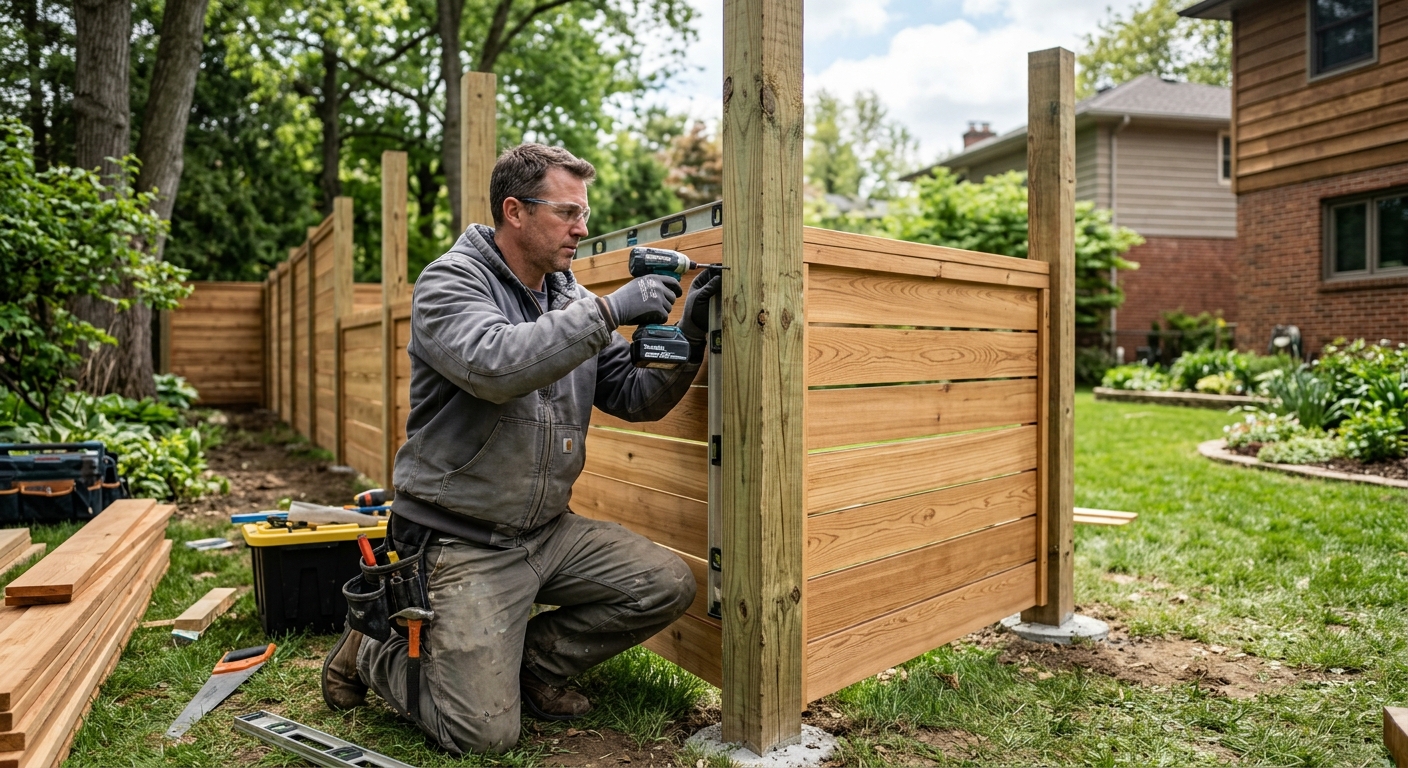
Fencing options and costs in Taber
Taber is a great place to own a home, and for many residents the fence line becomes the practical “boundary” for pets, gardens and privacy. With 92.6% of dwellings in the area being single-detached homes (Statistics Canada, 2021 Census), there’s a steady demand for new backyard and side-yard fencing—each detached property is essentially a potential fencing project. Homeownership is also strong (77.4% of households are owners), so you’ll see repeated upgrades as yards mature and older fences wear out.
In the Lethbridge–Medicine Hat region, pricing is driven by climate and soil conditions more than style. Southern Alberta frost lines typically run around 4 feet, so contractor quotes often include deeper, more structural post install work and—commonly—concrete set posts to reduce winter heave and long-term leaning. Prairie wind exposure also matters; open sites can put extra lateral load on fences, so installers may tighten post spacing, beef up rails, or choose materials that resist sail effect, especially for solid privacy wood and heavier vinyl panels. Labour availability can be another driver during peak season, but the biggest swings come from site prep, footing depth, and access around the yard and gate widths—an especially common issue in older neighbourhoods such as central Taber where lots can be landscaped and partially enclosed.
Below is a realistic “installed” comparison for Taber so you can anchor your budgeting before you request itemised quotes.
| Material |
Lifespan |
Maintenance |
Privacy Rating |
Price per Linear Foot |
| Pressure-treated pine (standard wood) |
10–15 years |
Stain/seal every 2–3 years |
Good (solid pickets) |
$35–$70 |
| Cedar (natural rot resistance) |
15–25 years |
Light staining/brightening every 2–4 years |
Good (solid pickets) |
$50–$95 |
| Vinyl / PVC (no-maintenance) |
20–30 years |
Rinse as needed; no staining |
Very good (solid styles) |
$40–$85 |
| Chain-link (galvanized steel) |
25–40 years |
Occasional rinse/spot repairs |
Low (open mesh) |
$25–$50 |
| Aluminum ornamental |
30–45 years |
Wash periodically |
Low to fair (ornamental pickets) |
$50–$110 |
| Composite / recycled material |
20–30 years |
Minimal; occasional cleaning |
Very good (solid profiles) |
$65–$115 |
Prices are estimates only and vary by project scope, site access and material selection.
What affects the price of fencing in Taber
In Taber (and across the broader Lethbridge–Medicine Hat region), two quotes for what looks like the “same fence” can vary by 30–50% because the hidden work is different: post depth, concrete volume, rail reinforcement for wind, and yard access. Even within Alberta, a wind-exposed corner lot can require sturdier posts and tighter spacing than a sheltered side yard, which shifts material and labour. Compared with milder parts of Canada, the frost-and-freeze–thaw cycle in southern Alberta pushes installers to set posts deep enough to stay below frost to limit heaving and leaning over time.
As a rule of thumb for residential sites here, posts are typically set about 4–6 inches below design frost depth. That often translates to roughly 1.5–2.0 m into the ground, especially where soils are less stable—meaning longer posts and deeper holes, plus concrete-set work. In cold climates like southern Alberta, concrete setting is commonly included, which raises both material cost and labour hours. Wind exposure on the Prairies also changes engineering choices: stronger winds increase lateral load, so contractors may add bracing, select heavier rails, or keep post spacing tighter; these choices matter a lot for privacy wood and vinyl because solid faces catch more wind.
Concrete examples from Taber pricing patterns: (1) a straight backyard run with good access often lands near the lower end of the wood band (for example, pressure-treated wood can be closer to the $35 per linear foot end when post holes are uniform and soil is workable); (2) the same length on a windy, open street with higher fences and more bracing can push pressure-treated projects toward the $70 per linear foot end; (3) replacing a shorter fence with a higher privacy style on mature lots where existing fence removal is required typically adds disposal and rebuild labour—often the difference between a “budget” quote and a “premium” quote.
| Price Factor |
Why It Matters |
Cost Impact |
| Fence length in linear feet — the primary cost driver |
Most costs scale directly with run length: posts, rails, pickets/panels, and labour |
High (biggest driver) |
| Post depth required — frost line determines post length and hole depth |
Deeper holes and longer posts resist winter heave and leaning |
Medium to high |
| Post setting method — concrete vs. gravel pack vs. driven posts |
Concrete adds materials and time; driven/gravel can reduce concrete but may not suit local soils |
Medium to high |
| Material choice — vinyl vs. cedar vs. chain-link |
Material price differences and how each system handles wind and privacy needs |
Medium |
| Gate count and type — walk-through vs. drive-through (double) |
Gates need heavier frames, hinges, latches, and often more reinforcement |
Medium to high |
| Grade and terrain — sloped yards require stepped or raked panels |
Stepped designs reduce visual “gaps” but require extra layout and material fitting |
Low to medium |
| Old fence removal and disposal |
Dump fees, labour for dismantling, and disposal of posts and hardware |
Low to medium (can spike) |
| Permit fees and survey / property line locate |
Paperwork and locate time prevents encroachment issues |
Low (but important) |
Permits & regulations in Alberta
In Alberta, fencing above a height threshold—often around 2.0 m (6.5 ft) at the rear and roughly 1.0–1.2 m (3–4 ft) at the front or corner—typically triggers a building permit requirement. Setbacks and property-line rules also apply, so the “height you want” may need to be adjusted depending on where the fence sits on your lot. For any fence, you must respect the correct property line and municipal setback bylaws, not just the position of an older fence that “looks right.”
Before any post hole is dug in Taber, ensure utility locates are completed. In Alberta, use Alberta One-Call for locating services so you don’t hit buried services. If you’re uncertain about your pins or boundaries, obtain a survey or at minimum a proper property line locate to avoid disputes. Shared fence ownership rules are governed by Alberta’s line fences legislation, so if you’re rebuilding or modifying a fence that serves as a boundary, talk to the neighbour early.
Permit vs. no-permit (typical homeowner reality): work that usually does require a permit is installing a taller fence above the local threshold (especially in front/corner areas) or adding substantial structures such as multi-section privacy barriers at higher elevations. Work that typically does not require a permit is replacing a fence like-for-like at or below the local height limit in the same approximate location (still confirm with your municipal requirements).
Step-by-step contractor verification in Alberta: (1) ask for the contractor’s licence/registration details and confirm through the appropriate online registry or licensing portal used by Alberta trade oversight; (2) request a current Certificate of Insurance showing liability coverage with your address listed or valid for the job; (3) confirm WSIB/WCB coverage (Workers’ compensation clearance letter) and that it matches the contractor’s business name; (4) keep copies for your records and ensure the insured dates cover the installation period.
Choosing the right fence material for Taber
Choosing the right fence material in Taber is mostly about matching your priorities—privacy, low maintenance, budget, and lifespan—to the realities of southern Alberta. Here the freeze–thaw cycle is real, and because frost lines commonly sit around 4 feet in the region, posts are often set deep (commonly about 1.5–2.0 m into the ground) with concrete or other approved footing methods to resist winter heave. That means your material still matters, but structural choices—post depth, spacing, and rail strength—matter just as much for long-term performance.
Pressure-treated pine is the budget-friendly option. It’s typically the easiest to finance and repair, but it will grey weather and requires staining or sealing about every 2–3 years to keep it looking sharp. Cedar offers better natural rot resistance and usually a warmer appearance, yet it still benefits from periodic maintenance. Vinyl/PVC is popular for “set-and-forget” upkeep and can deliver very good privacy with solid styles; just note that in extreme cold some vinyl products can become brittle if poor quality or an underspecified support system is used—quality framing and proper post setting are key. Chain-link is the lowest cost and longest-lived choice in the long run, but it provides low privacy unless you add slats or plant screening. Aluminum ornamental has strong rust resistance and mid-range pricing, but it’s also not a privacy fence. Composite/recycled panels can be a good middle-to-premium option for aesthetics with minimal maintenance, though it’s often priced above pressure-treated wood.
Where the price difference is justified: if you’re comparing a pressure-treated privacy fence at roughly the low-to-mid wood band (think closer to $35–$70 per linear foot) to vinyl or PVC that often runs about $40–$80 per linear foot, the “extra” can be worth it for homeowners who strongly value not staining every few years—especially on longer runs where maintenance labour adds up. For windy yards, your installer may tighten post spacing for wood and vinyl to reduce sail effect, which helps both longevity and appearance.
| Material |
Cold Tolerance |
Lifespan |
Annual Maintenance |
Best For |
Price Band |
| Pressure-treated pine |
Good (with proper installation) |
10–15 years |
Low to moderate (stain/seal every 2–3 years) |
Budget-conscious privacy and easy repairs |
$35–$70 |
| Cedar |
Good (naturally rot-resistant) |
15–25 years |
Low to moderate (maintenance every 2–4 years) |
Attractive privacy with better natural durability |
$50–$95 |
| Vinyl / PVC |
Good (depends on quality and framing) |
20–30 years |
Very low (rinse/inspect) |
Low-maintenance privacy |
$40–$85 |
| Chain-link |
Excellent |
25–40 years |
Very low (spot repairs) |
Security on a tighter budget |
$25–$50 |
| Aluminum ornamental |
Excellent |
30–45 years |
Very low (wash periodically) |
Appearance-focused front/back security |
$50–$110 |
| Composite / recycled |
Good |
20–30 years |
Low (occasional cleaning) |
Modern privacy look with minimal upkeep |
$65–$115 |
How to choose a fencing contractor in Taber
Choosing a fencing contractor in Taber comes down to verifying three things up front: Alberta trade/licence status (where applicable), liability insurance, and workers’ compensation coverage. Ask for their current Certificates of Insurance—your priority is general liability that covers the jobsite and any damage during installation. Next, confirm WSIB/WCB coverage by requesting a clearance letter that matches the contractor’s legal business name and the job period. Don’t accept “we’re covered” without documents; real fence companies provide paperwork easily because they work with homeowners and municipalities.
For pricing, get 2–3 itemised written quotes, not just a lump sum. You want line items for fence length, number of posts, post depth/footing method (concrete-set vs. alternative), labour hours, materials, gates (frame + hardware), and disposal/removal if applicable. Read the scope carefully for what’s excluded: permit pulling, utility locating, extra fence length due to layout corrections, damage restoration, and whether staining/sealing is included for wood. Ask whether your quote includes product/manufacturer warranties and the installers’ workmanship warranty, and confirm the warranty length and whether it’s transferable if you sell your home.
Payment schedule matters. A safe approach is never paying more than 10–15% upfront; the rest should be tied to milestones. Hold back a portion until the fence is complete, aligned to layout, and hardware is adjusted. Get a start date and estimated completion timeline in writing, including weather-related contingencies common to southern Alberta spring and fall.
- Verify insurance with a current COI (liability) before signing.
- Request WSIB/WCB clearance matching the contractor’s legal name.
- Confirm licence/registration details when the trade/business is required to hold one.
- Ask for a written scope that states post depth and setting method.
- Ensure gate hardware quality (hinges, latch type, and frame reinforcement) is specified.
- Get a layout plan showing where posts will be set relative to property lines.
- Confirm whether old fence removal and disposal are included.
- Check if utility locates are ordered and who pays if utilities are not located.
- Confirm whether concrete (if used) is included and estimated volume/footprint is described.
- Require itemised labour + materials—not a single “installed” number.
- Clarify warranty: workmanship length, product warranty, and transferability.
- Set a payment milestone plan and avoid large upfront deposits.
Red flags to watch for in Taber: quotes that don’t state post depth/footing method; refusal to provide proof of insurance or WSIB/WCB clearance; “we’ll figure it out later” language about property lines or permits; vague scope with no mention of gates/hardware or disposal; and demanding a large upfront payment (well beyond 10–15%) without a signed schedule and warranty details.
Frequently asked questions — fencing in Taber
How tall can my fence be in Taber?
In Taber and across Alberta, fence height limits usually depend on where the fence sits on your property (front/corner versus rear) and what local bylaws say. A common guideline homeowners run into is that rear fences may be allowed around 2.0 m (6.5 ft), while front or corner areas are often limited closer to about 1.0–1.2 m (3–4 ft). Taller fences may require a building permit. To avoid problems after installation, confirm the height threshold with your municipality before ordering materials. Also consider how your fence type affects wind loads—solid privacy styles can act like sails in prairie conditions, so even if the height is permitted, the contractor should recommend proper post spacing and reinforcement for stability.
Should fence posts be set in concrete here?
For most residential fences in the Lethbridge–Medicine Hat region—including Taber—concrete-set posts are a common recommendation because frost heave and freeze–thaw cycles can make improperly set posts lean. Southern Alberta frost lines typically run around 4 feet, and posts are often set roughly 4–6 inches below the design frost depth; in practice that often means 1.5–2.0 m of embedment with longer posts and deeper holes. That added labour and concrete volume is why you can see costs move toward the higher end of the wood band (for instance, closer to $35–$70 per linear foot depending on design) when you choose a privacy fence with solid panels and heavier rails. Your soil conditions and local layout determine the best method, so insist the quote specifies post depth and setting technique.
What's the best fence for privacy?
For privacy in Taber, solid panel styles usually perform best—pressure-treated pine with solid pickets, cedar with closely spaced boards, or vinyl/PVC in a solid privacy configuration. Chain-link is generally low privacy unless you add slats or screening, and aluminum ornamental is also usually “decorative privacy.” The best choice depends on how much maintenance you want. If you’re open to periodic upkeep, pressure-treated wood can be a strong value (often in the $35–$70 per linear foot range). If you want lower upkeep, vinyl/PVC is typically priced a bit higher (commonly about $40–$80 per linear foot) but can reduce maintenance time—no staining cycle. In prairie wind, make sure your contractor uses proper post spacing and bracing so the privacy face doesn’t rack or blow out over winters.
How do I compare fencing quotes?
Compare quotes by matching like-for-like: same fence height, same material grade, and—most importantly—same post depth and post setting method. Ask for itemised breakdowns showing labour hours, material quantities, gate hardware, concrete/gravel quantities (if applicable), and whether removal/disposal is included. Quotes can vary substantially even in the same area of Taber because one contractor might assume shallower holes or lighter rails, while another includes deeper, frost-resisting installs typical for southern Alberta. Also check what’s excluded: permits, utility locates, survey/property line locate, and any landscaping restoration. If one quote is much cheaper, it may be skipping concrete setting, bracing, or proper footing depth—items that protect your fence through freeze–thaw.
How long does fence installation take in Taber?
Typical installation timing in Taber depends on fence length, the number of gates, access to the yard, and how much removal or footing prep is required. A straightforward run with consistent footing conditions can move quickly once posts are set, but deeper frost-resistant post holes and concrete curing add time. Weather also matters: southern Alberta spring and fall can slow excavation or concrete work when soils are wet or temperatures swing. As a planning benchmark, many residential projects can be completed in days to about a week, but larger perimeters, multiple gates, and full removal/disposal can extend the schedule. Always ask your contractor for a written start date and a completion estimate that includes weather contingencies and concrete/set time so you’re not surprised.
Can I install a fence on a slope in Taber?
Yes, but you generally need a stepped or raked fence layout so the fence stays stable and visually consistent. In sloped yards common in southern Alberta, trying to “cheat” by setting uneven post depths without a plan can lead to misalignment, gaps, and extra strain on rails during wind exposure. A pro will survey the run, then use stepped panels or rails adjusted to the grade—often requiring extra labour for layout and fitting. Your quote should specify how the slope will be handled and confirm post depth is still appropriate for frost protection at each location. If you’re comparing materials, note that privacy panels (wood/vinyl/composite) show gaps more clearly than chain-link, so stepped construction becomes even more important for privacy and wind resistance.