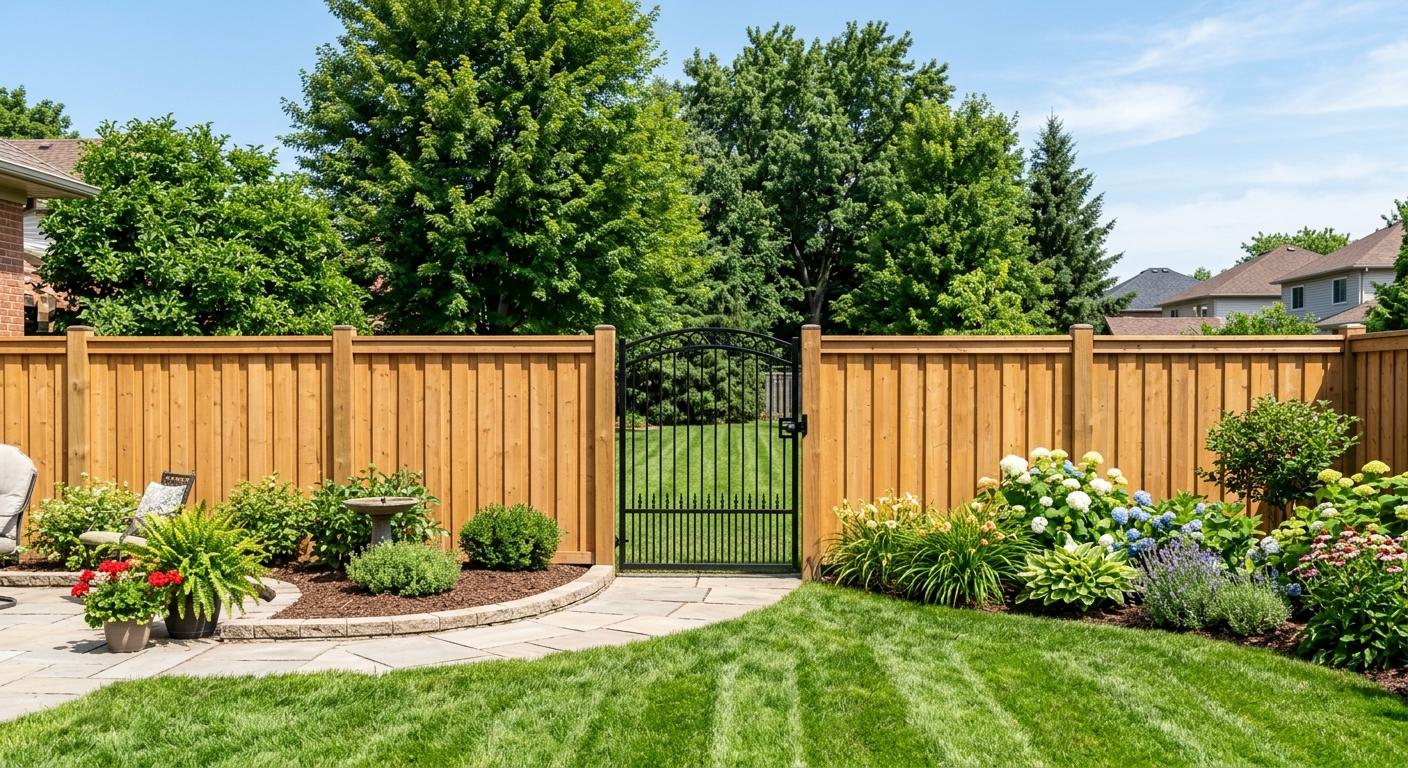
Fencing options and costs in Turner Valley
Turner Valley homeowners typically choose their fencing based on privacy needs, winter durability, and how much ongoing upkeep they can realistically handle. With 84.7% of dwellings being single-detached homes and an overall population of 2,611 (Statistics Canada, 2021 Census), demand is steady for backyard privacy, side-yard containment, and gate upgrades. It’s also worth noting that 33.0% of homes were built before 1981 (Statistics Canada, 2021 Census), which often means older boundary fencing is overdue for replacement as yards get renovated.
In the Calgary economic region, fence pricing is shaped by a Prairie continental climate—long freeze–thaw cycles and frequent wind loads. For most privacy fences, contractors set posts deeply to reduce heaving and racking; in practice, that often means around 4 ft (≈120 cm) of embedment, sometimes paired with concrete footings for higher panels and gate posts. Access and terrain also matter in this area: yards around mature lots can require extra excavation and more careful grading, especially near driveways and where the ground isn’t level.
Local trade activity is especially noticeable around the established residential pockets where side-yard fencing is common to define property boundaries and block wind-driven debris. That demand tends to keep availability good, but it also means reputable crews are booked when winter weather starts to tighten scheduling.
To help you compare realistic options for your property, use the table below as a quick budget range by material, then we’ll break down the cost drivers that move your quote up or down.
| Material |
Lifespan |
Maintenance |
Privacy Rating |
Price per Linear Foot |
| Pressure-treated pine (standard wood) |
10–20 years |
Stain/seal every 2–3 years |
Medium–High |
$40–$80 |
| Cedar (natural rot resistance) |
15–25 years |
Annual inspection; stain as needed |
High |
$55–$95 |
| Vinyl / PVC (no-maintenance) |
20–30 years |
Minimal (wash only) |
High |
$45–$90 |
| Chain-link (galvanized steel) |
20–40 years |
Low (occasional tension checks) |
Low–Medium |
$25–$55 |
| Aluminum ornamental |
25–40 years |
Low (rinse/spot cleaning) |
Low |
$70–$120 |
| Composite / recycled material |
20–35 years |
Low (wash; no painting) |
Medium–High |
$75–$130 |
Prices are estimates only and vary by project scope, site access and material selection.
What affects the price of fencing in Turner Valley
If you’re comparing quotes for the same fence line in Turner Valley, it’s normal to see swing rates of about 30–50% across Calgary and other parts of Alberta. The same “6 ft privacy fence” can cost dramatically different amounts because the budget isn’t just material—it’s frost-proofing, wind stability, excavation difficulty, and how much labour is required to install and align posts on your specific yard.
First, post depth is the big driver. In cold regions of Alberta, posts must be set deep enough to sit below the frost movement; in practical Calgary-area builds, that often means roughly 1.5–2.0 m into the ground depending on design conditions, which translates into longer posts, deeper holes, and more concrete if you’re footing-set. This is one reason heavier privacy systems (solid wood or vinyl) typically price in the mid-to-upper ranges such as $40–$80 for wood installation and $45–$90 for vinyl/PVC.
Second, Prairie wind exposure affects structure. Open exposure and gusts can rack a fence, so contractors use tighter post spacing and sturdier rails; chain-link, by contrast, costs less because it lets wind pass through, aligning with the lower-mid band like $25–$55.
Concrete examples from this area: (1) A straight run on level ground may stay near the low end because excavation is faster and holes are consistent. (2) A corner lot with gates or a drive-through opening often adds labour for reinforced posts and stronger hardware. (3) Homes built in the 1970s and earlier frequently have mature trees and buried service lines, which can force hand-digging and slow progress—raising labour even if the fence is a simple height.
Terrain and access are the final levers. A sloped backyard often requires stepped panels, more layout time, and extra material, which nudges the total even if your linear footage is unchanged.
| Price Factor |
Why It Matters |
Cost Impact |
| Fence length in linear feet |
Most materials and labour scale directly with length |
Highest cost driver |
| Post depth required |
Frost movement dictates embedment depth and post length |
Medium–High |
| Post setting method |
Concrete footings vs gravel pack vs driven posts changes labour and cost |
Medium–High |
| Material choice |
Vinyl/cedar require different rail systems and fasteners |
Medium–High |
| Gate count and type |
Drive-through and double gates need reinforcement and stronger posts |
Medium |
| Grade and terrain |
Slopes require stepped/raked sections and extra layout time |
Low–Medium |
| Old fence removal and disposal |
Demolition, haul-away, and sometimes unknown buried hardware |
Low–Medium |
| Permit fees and survey / property line locate |
Locates reduce encroachment risk and clarify boundary placement |
Low–Medium (project-dependent) |
Permits & regulations in Alberta
In Alberta, fences can require a building permit depending on height and location. As a practical rule of thumb, fences above a threshold—commonly around 2.0 m (6.5 ft) at the rear and roughly 1.0–1.2 m (3–4 ft) at the front or corner—may trigger permitting. Even when a permit isn’t required, you still must keep the fence within your property line and follow municipal setback requirements for your site.
Before digging any post holes, always arrange utility locates using Alberta One-Call. That step is critical for safety and can prevent costly rework if services cross your yard. If your boundary is uncertain—or if there’s any disagreement with a neighbour—get a survey or locate your property pins first to avoid encroachment disputes and fence removal later.
Shared fence ownership and line responsibility are generally governed by provincial line-fences legislation, but the exact approach depends on who built the boundary fence and how it sits on the lot line.
To verify a contractor in Turner Valley, request three items before work starts: (1) proof of Alberta licensing/registration where applicable, (2) certificate of insurance showing general liability, and (3) WSIB/WCB coverage (Workers’ Compensation Board). Check the contractor’s licensing details through the relevant provincial registry, confirm the COI validity and limits, and ask for a clearance letter or proof of active coverage—then keep copies with your contract.
Choosing the right fence material for Turner Valley
Choosing the right fence material in Turner Valley is mostly about matching your priorities—privacy, low maintenance, lifespan, and budget—to a climate that cycles between freeze and thaw and brings windy stretches. Pressure-treated pine is the budget-friendly starting point, but it generally needs staining or sealing every 2–3 years to prevent grey weathering and reduce surface cracking. Cedar looks great and resists rot better than many standard woods, but you’ll still want periodic maintenance to keep colour and prevent splitting.
Vinyl/PVC is a strong option for homeowners who want “install and forget”—there’s essentially no routine painting, and it’s easy to rinse clean. The caution is that extreme cold can make some plastics more brittle, so the system quality matters: proper post depth, correct rails, and the right fasteners help it stay rigid during wind-driven movement and snow load. Chain-link is the lowest-cost option with long life and great airflow in high-wind areas; it won’t give you privacy unless you add slats or a screening plan. Aluminum ornamental offers a clean, rust-resistant look and usually requires very little upkeep, but it’s not designed for full privacy.
For Calgary-area frost conditions, post depth is still the deciding factor. Even the “low-maintenance” options perform best when posts are set deep enough to reduce heaving; for many privacy styles, that also means concrete-setting for strength at corners and gate posts. On a windy run, that structural choice can be more important than the brand name of the panel.
As an example, upgrading from standard pressure-treated pine to cedar may increase your budget by roughly $15–$25 per linear foot depending on height and rail design. That extra cost is often justified if you want better appearance and longer life in a climate where surface wear and movement can accelerate deterioration.
| Material |
Cold Tolerance |
Lifespan |
Annual Maintenance |
Best For |
Price Band |
| Pressure-treated pine |
Good (with proper seal/stain) |
10–20 years |
Light inspection; stain as needed |
Budget privacy with planned upkeep |
$40–$80 |
| Cedar |
Good (natural rot resistance) |
15–25 years |
Check staining/finish; treat as needed |
Natural look and strong privacy |
$55–$95 |
| Vinyl / PVC |
Good (system must be rigidly installed) |
20–30 years |
Minimal (wash/inspect) |
Low-maintenance privacy |
$45–$90 |
| Chain-link |
Excellent |
20–40 years |
Low (tension checks) |
Security and airflow |
$25–$55 |
| Aluminum ornamental |
Excellent |
25–40 years |
Low (spot clean) |
Front-yard curb appeal |
$70–$120 |
| Composite / recycled |
Good (varies by brand system) |
20–35 years |
Low (wash; inspect fasteners) |
Long-life privacy with minimal upkeep |
$75–$130 |
How to choose a fencing contractor in Turner Valley
When you hire a fence contractor in Turner Valley, start by verifying the essentials: Alberta licensing/registration where applicable, general liability insurance, and WSIB/WCB coverage for workers. How to check—look for a current certificate of insurance with your contractor named, matching your project location, and sufficient limits for fencing work (not a generic one-page document). For WSIB/WCB, ask for proof of clearance or active coverage; don’t accept “we’re covered” verbally. If they can’t produce documentation promptly, that’s usually a sign to keep shopping.
Next, get 2–3 itemised written quotes. Ask for a breakdown that shows labour, materials, post type and setting method (concrete vs gravel pack), gate hardware, and disposal or haul-away. Avoid lump-sum quotes that don’t specify whether old fence removal is included, whether permits are pulled by the contractor, and whether property line locating is included or excluded.
Warranty matters too. Ask for the workmanship warranty length (how long they stand behind installation) and the manufacturer/product warranty for rails/panels/posts. Confirm whether warranties are transferable if you sell the home.
Finally, be careful with payment scheduling. Never pay more than 10–15% upfront; hold back the remainder until the job is complete and cleaned up. For timeline, request a start date and estimated completion in writing, because freeze–thaw periods can delay excavation and concrete work if scheduling slips.
- Request current insurance certificate and confirm coverage limits match fence work.
- Confirm WSIB/WCB clearance or active coverage before the first day on site.
- Get proof of Alberta licensing/registration (where required) and verify the details.
- Insist on an itemised quote: labour, materials, posts, rails, and hardware.
- Ask how posts will be set (concrete vs gravel pack) and embedment depth assumptions.
- Clarify gate reinforcement, hinge type, latch type, and any framing for drive-through gates.
- Confirm whether disposal/removal of the old fence is included and where debris goes.
- Ask if permits and utility locates are handled, or if you must arrange them.
- Ensure they include layout and property line confirmation (survey pin locate if needed).
- Check warranty terms in writing: workmanship duration and product warranty length.
- Use a payment schedule with a small deposit only; keep a holdback until completion.
- Get a written timeline and weather contingency plan for excavation and concrete.
Common red flags in Turner Valley include: quoting a “standard post depth” without explaining frost considerations, refusing to provide itemised pricing, suggesting you pay the majority upfront, dismissing the need for utility locates, or providing a warranty that covers only materials but not workmanship.
Frequently asked questions — fencing in Turner Valley
How tall can my fence be in Turner Valley?
In Alberta (including Turner Valley), maximum fence height depends on where the fence sits—front/corner areas usually have lower thresholds than rear yards. A common practical guidance point is that fences above about 2.0 m (6.5 ft) at the rear and around 1.0–1.2 m (3–4 ft) at the front/corner may require a building permit, and municipal setback rules still apply. Because rules can be specific to your location and corner exposure, your best step is to ask your contractor to confirm the intended height and placement before they order materials. If your fence is intended for privacy, many homeowners choose solid panels around the upper rear-yard range and then design gates and wind bracing properly for Calgary-area weather.
Should fence posts be set in concrete here?
For Turner Valley and the Calgary region’s freeze–thaw conditions, concrete-setting is commonly recommended for privacy fence posts and especially for gate posts. Frost movement is a serious consideration in this climate, so posts usually need deep embedment—often around 4 ft (≈120 cm) in practical builds, and sometimes deeper depending on design and soil. Concrete footings help prevent heaving and improve stiffness against racking in high wind exposure. That said, the “right” method can vary: some contractors use a properly prepared gravel pack in certain conditions, and chain-link systems may be less demanding structurally because they let wind pass through. When you compare quotes, ask specifically whether the price includes concrete footings and how deep they plan to set each post.
What's the best fence for privacy?
For privacy in Turner Valley, solid privacy panels are the usual best match: cedar, vinyl/PVC, or pressure-treated pine with proper spacing and rails. Vinyl and cedar typically deliver a higher privacy rating than chain-link, and they handle wind load better when installed with the right post spacing and deep embedment. Vinyl/PVC is also popular because it stays low-maintenance—often priced within the $45–$90 per linear foot range depending on height, terrain, and access. Pressure-treated pine can be more budget-friendly within about $40–$80 per linear foot, but it needs staining/sealing every 2–3 years to maintain appearance in our freeze–thaw cycles. If you want privacy but also lower wind stress, some homeowners blend materials with lattice or choose slightly adjusted panel design.
How do I compare fencing quotes?
To compare quotes fairly in Turner Valley, don’t just look at the total—compare what’s included and how the fence will be built. Ask for an itemised breakdown: labour, posts, rails, concrete or gravel pack, gate type and hardware, and disposal of the old fence. Confirm post depth assumptions for frost protection and whether they include concrete footings for privacy panels and gate reinforcement. Also check whether a permit pull and property line locate are included or excluded. A “cheap” quote often omits concrete-setting, uses lighter posts, or assumes easy terrain when the yard is sloped and needs stepped panels. For budgeting, many homeowners see wood installation roughly in the $40–$80 per linear foot band and vinyl/PVC in the $45–$90 band, while chain-link is usually lower.
How long does fence installation take in Turner Valley?
Most fences in Turner Valley are completed faster than people expect, but the timeline depends on post-setting method, gate complexity, and site access. A straight run with simple walk-through gates can take only a few days of on-site work, while projects that require heavy concrete footings, a lot of excavation, or removal of an old fence typically take longer. Weather matters too: freeze–thaw cycles can limit excavation and affect curing times for concrete, so schedule buffers help. If your quotes assume concrete setting, ask whether they expect curing time between installation stages. When planning, base your expectation on the quoted linear footage and number of gates rather than just the material type. Proper layout and boundary verification can also add time, but it prevents costly rework.
Can I install a fence on a slope in Turner Valley?
Yes, you can install a fence on a slope in Turner Valley, but it should be done with stepped or raked sections rather than forcing panels to “float” or leaving gaps that widen in winter. Sloped yards often require extra layout time, additional posts, and sometimes different rail heights for each step to keep the fence aligned and stable. In freeze–thaw conditions, correct post embedment is even more important because uneven ground can increase movement risk if posts aren’t installed to proper depth. When comparing quotes, ask how the contractor plans to handle grade: stepped panels vs. racked panels, and whether the price includes the extra materials and labour. If your slope is significant, it may push the project toward the higher end of the material band you’re targeting.