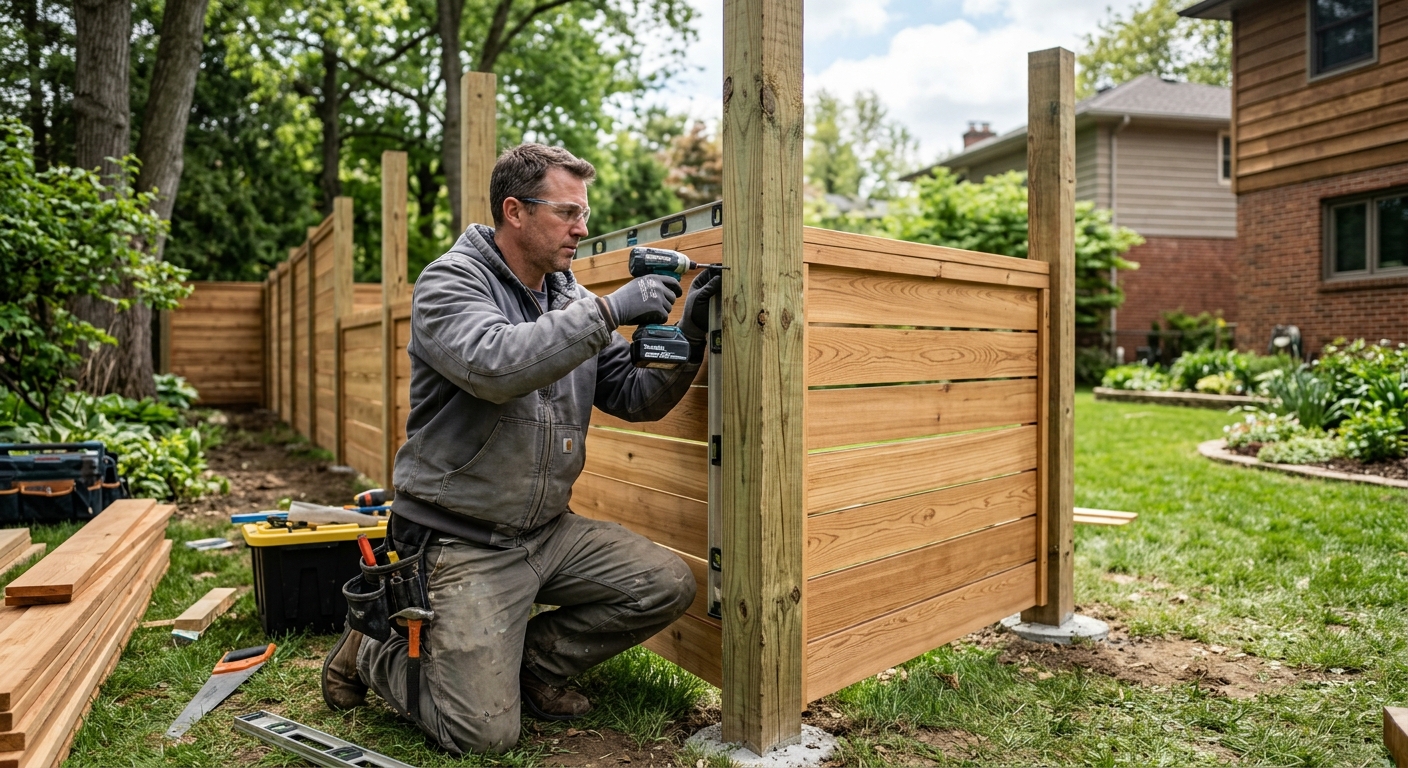
Fencing options and costs in Chambery
Chambery, Alberta is a small community where fences are less about “curb appeal only” and more about wind control, privacy and making outdoor space feel usable. With a population of 2,064 (Statistics Canada, 2021 Census), demand is driven by steady household turnover and repeat upgrades—especially around detached properties, which typically create the most fencing projects for yards, side access, and rear privacy. In the Calgary economic region, frost protection and wind loading are the two big cost levers, so installed prices often track structural details like post depth, concrete footings, and panel spacing.
Because the area experiences long freeze–thaw cycles under a Prairie continental climate, fence posts are usually set about 4 ft (≈120 cm) deep to sit below the regional frost line and reduce heaving. For taller privacy fencing (commonly 6 ft), contractors frequently use concrete footings and tighter bracing to resist racking from open Prairie exposure. That’s why heavier materials like solid wood or vinyl privacy panels generally cost more than chain-link, which allows airflow and reduces wind pressure.
In Chambery, trade activity is especially noticeable in neighbourhood pockets near the busier road connections where yard access is straightforward and homeowners are more likely to upgrade both privacy and gate openings. If you’re comparing options, the table below shows typical lifespan, maintenance level, privacy rating and the realistic price range you’ll see for installed fencing per linear foot.
| Material |
Lifespan |
Maintenance |
Privacy Rating |
Price per Linear Foot |
| Pressure-treated pine (standard wood) |
10–15 years |
Stain or seal every 2–3 years; periodic board checks |
Medium–High (solid panel/typical picket) |
$40 – $80 |
| Cedar (natural rot resistance) |
15–25 years |
Light staining/conditioning every 2–4 years |
High (solid picket/board configurations) |
$55 – $95 |
| Vinyl / PVC (no-maintenance) |
20–30 years |
Rinse only; replace warped panels if impact occurs |
High (solid privacy styles) |
$45 – $90 |
| Chain-link (galvanized steel) |
25–40 years |
Occasional wash; check tension/hinges |
Low–Medium (open mesh) |
$25 – $55 |
| Aluminum ornamental |
30–50 years |
Wash seasonally; inspect gate hardware |
Low–Medium (ornamental spacing) |
$70 – $120 |
| Composite / recycled material |
20–30 years |
Very low; clean with mild detergent |
Medium–High (board styles vary) |
$60 – $100 |
Prices are estimates only and vary by project scope, site access and material selection.
What affects the price of fencing in Chambery
Even when two neighbours want “the same fence,” Calgary-area fencing quotes can vary by 30–50% because the real pricing is tied to installation engineering: frost-safe post depth, wind-rated bracing, gate framing, and how difficult the terrain and access are. In Chambery and the wider Calgary economic region, the Prairie continental climate means contractors plan for freeze–thaw movement and strong gusts across open lots. That pushes labour and materials beyond a simple board-and-post approach.
First, frost line depth matters. To prevent heaving, posts typically need to be set about 4–6 inches below the design frost depth—often translating to roughly 1.5–2.0 m into the ground in colder Alberta regions. That requires longer posts, deeper excavation, and usually concrete setting for stability. Second, wind exposure drives tighter post spacing and sturdier panel systems for privacy styles (wood/vinyl). In contrast, chain-link systems are lighter and allow airflow, so they often fall toward the lower-mid price band of about $25–$55 per linear foot.
Concrete examples from Chambery-style yards: (1) a 6 ft rear privacy run on compacted soil often needs more excavation time and concrete, nudging wood or vinyl pricing toward the mid–upper range (often $40–$90 per linear foot depending on material and hardware); (2) a front yard run with easy access and short length can keep costs closer to the low end; (3) lots with sloped grade require stepped or raked panels, which adds measuring time and can increase material waste.
Also, older fences removed in winter or with difficult disposal can add cost. Lastly, even if your fence length is modest, every gate is a “structural component,” so gate count and hardware can be a bigger swing factor than people expect—especially when wind load is high.
| Price Factor |
Why It Matters |
Cost Impact |
| Fence length in linear feet |
More lineal footage means more posts, rails, and materials |
High (primary driver of total price) |
| Post depth required |
Frost protection governs how long and how deep posts must be set |
Medium–High (affects excavation time and materials) |
| Post setting method |
Concrete vs. gravel pack vs. driven posts changes labour and stability |
Medium–High (concrete-set typically costs more) |
| Material choice |
Vinyl/cedar is pricier than wood; chain-link is usually least expensive |
Medium (material differences move you across bands) |
| Gate count and type |
Double-drive gates require heavier frames and hardware |
Medium–High (gates often raise cost per linear foot) |
| Grade and terrain |
Slope requires stepped/raked sections and extra layout time |
Medium (waste + extra labour) |
| Old fence removal and disposal |
Demolition, hauling, and recycling/disposal fees add time and cost |
Low–Medium (varies widely by access) |
| Permit fees and survey / property line locate |
Some fences may require a permit; locate protects against encroachment |
Low–Medium (can still be essential) |
Permits & regulations in Alberta
In Alberta, fence permits are often tied to height and location. As a practical rule of thumb, fences above about 2.0 m (6.5 ft) at the rear and 1.0–1.2 m (3–4 ft) at the front or corner typically trigger a building permit requirement. Even when a permit isn’t required, you must still follow property-line rules and municipal setback bylaws. Before you dig any post holes, call for utility locates—Alberta One-Call—so crews can mark buried lines and keep you safe.
For Chambery homeowners, step one is confirming where your fence should sit. Get a survey or at least a property pin locate so the base line is clear—this is one of the most common causes of disputes when older surveys aren’t on hand. Step two is clarifying shared fence ownership: in Alberta, shared line-fences are governed by provincial line-fences legislation, and responsibilities can include maintenance and cost sharing depending on circumstances and agreements.
To verify your contractor is properly set up, ask for (and confirm) three things: (1) Alberta licence/registration status for the fencing business—check online through the relevant provincial business/licensing registry listings; (2) liability insurance certificate showing your address as an additional insured if offered, and confirm coverage amounts; (3) proof of coverage for workers under WCB (Workers’ Compensation Board) / WCB clearance letters where applicable. Any contractor who won’t provide current documents in advance should be treated as a red flag.
Choosing the right fence material for Chambery
The “best” fence material in Chambery comes down to your priorities—privacy, low maintenance, lifespan, and budget—then matching the pick to Alberta’s freeze–thaw cycle and wind exposure. In Calgary’s Prairie continental climate, fence performance depends heavily on whether posts are set deeply enough for frost protection (often around 4 ft deep for stability) and whether the panels can resist racking during gusts and snow loads. That’s why material choice should be paired with correct post depth and bracing, not just appearance.
Pressure-treated pine is the budget-friendly option, but it usually needs staining or sealing every 2–3 years to slow grey weathering and protect boards from winter moisture cycling. Cedar looks excellent and naturally resists rot, often giving better long-term appearance, though you’ll still want maintenance for longevity. Vinyl/PVC is popular for low maintenance: no annual sealing, but in extreme cold it can be more impact-sensitive, so gates and corner supports must be built solidly. Chain-link is the lowest-cost and typically longest-lasting for corrosion resistance, but it offers the least privacy (great for pet containment and boundary definition). Aluminum is rust-resistant and mid-priced, but it’s ornamental—so if you want privacy, you usually pair it with landscaping or choose a solid-panel system.
A practical dollar example: if you’re considering a wood privacy fence around $40–$80 per linear foot versus vinyl at roughly $45–$90, the vinyl premium can be justified when you want “set it and forget it” maintenance over many years—especially on a long rear run where staining schedules become annoying. However, if your top concern is value and you’re willing to maintain, pressure-treated pine can make sense while still using concrete-set posts for stability in freeze–thaw conditions.
| Material |
Cold Tolerance |
Lifespan |
Annual Maintenance |
Best For |
Price Band |
| Pressure-treated pine |
Good (needs proper sealing and good post support) |
10–15 years |
Inspect + light touch-ups; stain every 2–3 years |
Budget privacy with acceptable maintenance |
$40 – $80 |
| Cedar |
Very good (resists rot in Alberta’s wet/dry swings) |
15–25 years |
Condition/stain every 2–4 years |
Premium look and natural durability |
$55 – $95 |
| Vinyl / PVC |
Good (can be impact-prone in brittle cold) |
20–30 years |
Rinse and inspect hardware; no staining |
Low maintenance privacy |
$45 – $90 |
| Chain-link |
Excellent (metal survives temperature cycling) |
25–40 years |
Wash/inspect once or twice a year |
Boundaries, security, pets |
$25 – $55 |
| Aluminum ornamental |
Excellent (no rust when set correctly) |
30–50 years |
Minimal cleaning + hardware check |
Low-maintenance curb appeal |
$70 – $120 |
| Composite / recycled |
Good (works well when supported correctly) |
20–30 years |
Low; wash with mild cleaner if needed |
Long-life privacy with low upkeep |
$60 – $100 |
How to choose a fencing contractor in Chambery
Choosing the right contractor in Chambery starts with proof, not promises. In Alberta, ask for (1) Alberta business registration/licence details for the fencing contractor—confirm it online where the provincial business listing is available; (2) liability insurance certificate (COI) with your job address listed or coverage terms stated; and (3) WCB/WCB coverage proof via a clearance letter or current WCB documentation where applicable. A legitimate contractor should provide these without pressure and before work begins.
Next, get 2–3 itemised written quotes. You want labour and materials broken out (posts, rails, panels, hardware, concrete/footings, removal and disposal), not just a lump-sum line. Review scope items carefully: confirm whether permits (if required), property line locating, and utility locates are included, and whether old fence removal and debris hauling are part of the price or billed separately.
Warranty matters too. Ask for two warranties in writing: a workmanship warranty (how long they stand behind installation) and the product/manufacturer warranty (what defects are covered). Also confirm whether the product warranty is transferable if you sell your home.
Payment schedule should be conservative. Never pay more than 10–15% upfront; use a milestone plan and hold a portion back until the job is complete, inspected, and cleaned. Finally, demand a written timeline with a start date and realistic completion estimate—frost depth excavation, concrete cure time, and material lead times in the Calgary region can affect scheduling.
- Request WCB/WCB clearance or coverage proof before signing.
- Ask for a COI liability certificate and confirm expiry date.
- Verify the contractor’s Alberta business details are current.
- Insist on itemised labour/materials—no vague “materials included.”
- Confirm post depth approach for frost protection (concrete-set if required for your fence height and soil).
- Ask whether concrete footings are poured per post or as continuous bases.
- Clarify how gates are built and whether hinges/catch hardware is included.
- Confirm whether disposal/removal of old fencing is included.
- Check if permits (when needed) are the contractor’s responsibility to obtain.
- Verify utility locates are called before excavation.
- Ask for a workmanship warranty duration and what it covers.
- Hold back 10–20% until final walk-through and cleanup are done.
Red flags we commonly see with fencing contractors in the Chambery area: quotes that don’t specify post depth or setting method, refusal to provide insurance/WCB documents, “permit included” language that doesn’t explain what’s actually covered, vague warranties with no duration in writing, and schedules that start immediately without confirming measurements, property line details, and utility locate steps.
Frequently asked questions — fencing in Chambery
How long does a wood fence last in Chambery?
In Chambery and the Calgary region, a properly installed pressure-treated wood fence typically lasts about 10–15 years, assuming posts are set deep enough for frost protection and boards are maintained. Cedar often lasts longer—commonly 15–25 years—because it handles moisture and rot better through Alberta’s wet/dry swings and freeze–thaw cycles. The biggest lifespan influencers are not just the species; they’re installation choices like concrete-set posts (often expected for privacy fences) and whether you keep up with staining or sealing every 2–3 years. If you skip maintenance, you may see greying, warping, and faster fastener corrosion even if the posts were set correctly. If you’re budgeting, wood installation commonly lands in the $40–$80 per linear foot range depending on height, gates, and site access.
Who owns and maintains a shared fence?
For shared fences in Alberta, ownership and maintenance are usually governed by provincial line-fences legislation and any agreements between adjoining property owners. In practice, “shared” means the fence sits on or near the property line and both properties benefit from it (privacy, boundary definition, or security). Maintenance responsibilities can be cost-shared depending on how the fence was originally established and what your neighbour agrees to. Before replacing a shared section, document the current condition, confirm the exact line location (survey pins/locate), and discuss scope in writing—especially for height changes and material upgrades. If your fence is under a height threshold where permits may not be required, you may still need to follow municipal setback rules. For higher privacy fence builds near the typical 2.0 m rear threshold, plan for possible permit requirements and ensure your shared-fence agreement aligns with the final design.
How do I find my property line before fencing?
Your best starting point in Chambery is to locate your property pins from the original survey or obtain an updated survey if you don’t have one. Many homeowners have only rough boundary knowledge, and Alberta winters can amplify the consequences of being even slightly off—posts get set permanently once you excavate below frost depth. If you have survey documents, bring the plan and locate map to a local surveyor for pin verification, or request a property line locate where applicable. Visually, don’t rely solely on old fence placement because previous owners may have shifted it over time. Before digging, confirm the line and also ensure utility locates are called for safety and compliance. This protects you from encroachment disputes and helps your fencing quote reflect accurate linear footage, post counts, and gate placement.
What's the most low-maintenance fence?
For Alberta homeowners looking for minimal upkeep, vinyl/PVC and aluminum are typically the most “hands-off” options. Vinyl privacy panels generally require little more than periodic rinsing, and aluminum ornamental fencing doesn’t rust in the same way as untreated metals. That said, low maintenance doesn’t mean “no inspections”—in a Prairie freeze–thaw climate you should still check gate latches, hinge screws, and look for panel movement after heavy wind or snow events. If you choose chain-link, it’s also low-maintenance and can last decades, but it won’t provide privacy. In terms of budget reality, vinyl commonly sits around the $45–$90 per linear foot band, while chain-link is often lower at about $25–$55 per linear foot. The “most low-maintenance” choice often depends on whether you want privacy or just boundary/security.
How tall can my fence be in Chambery?
Fence height limits depend on where the fence sits (rear vs front/corner) and Alberta municipal bylaws. As a planning guide used by many contractors in the Calgary area, fences over about 2.0 m (6.5 ft) at the rear and 1.0–1.2 m (3–4 ft) at the front or corner can require a building permit. Even when the design stays under those thresholds, you must still respect setbacks from property lines and any local rules around visibility and access near driveways. For Chambery homeowners, the safest approach is to provide your proposed height and exact location to your contractor and ask whether a permit will be needed before finalizing. That reduces the risk of rework after posts are already set below the frost line and concrete has cured.
Should fence posts be set in concrete here?
Often, yes—especially for privacy fences and gate posts in the Calgary economic region. In Chambery (Prairie continental climate), long freeze–thaw cycles create ground movement, and proper frost protection usually means posts are set deep enough—often around 4 ft (≈120 cm) for many installations—to reduce heaving. Concrete-set posts help lock the post in place and resist racking when wind loads are high and panels are solid (wood/vinyl). That said, the exact setting method can vary by soil conditions and your fence design; some lighter systems may use an alternate method like a gravel pack, but gates and heavier privacy fences typically benefit from concrete footings for long-term stability. If you’re comparing quotes, look specifically for post depth and setting method detail—concrete setting can shift pricing upward, frequently moving wood or vinyl privacy closer to the upper portion of the $40–$90 per linear foot ranges.