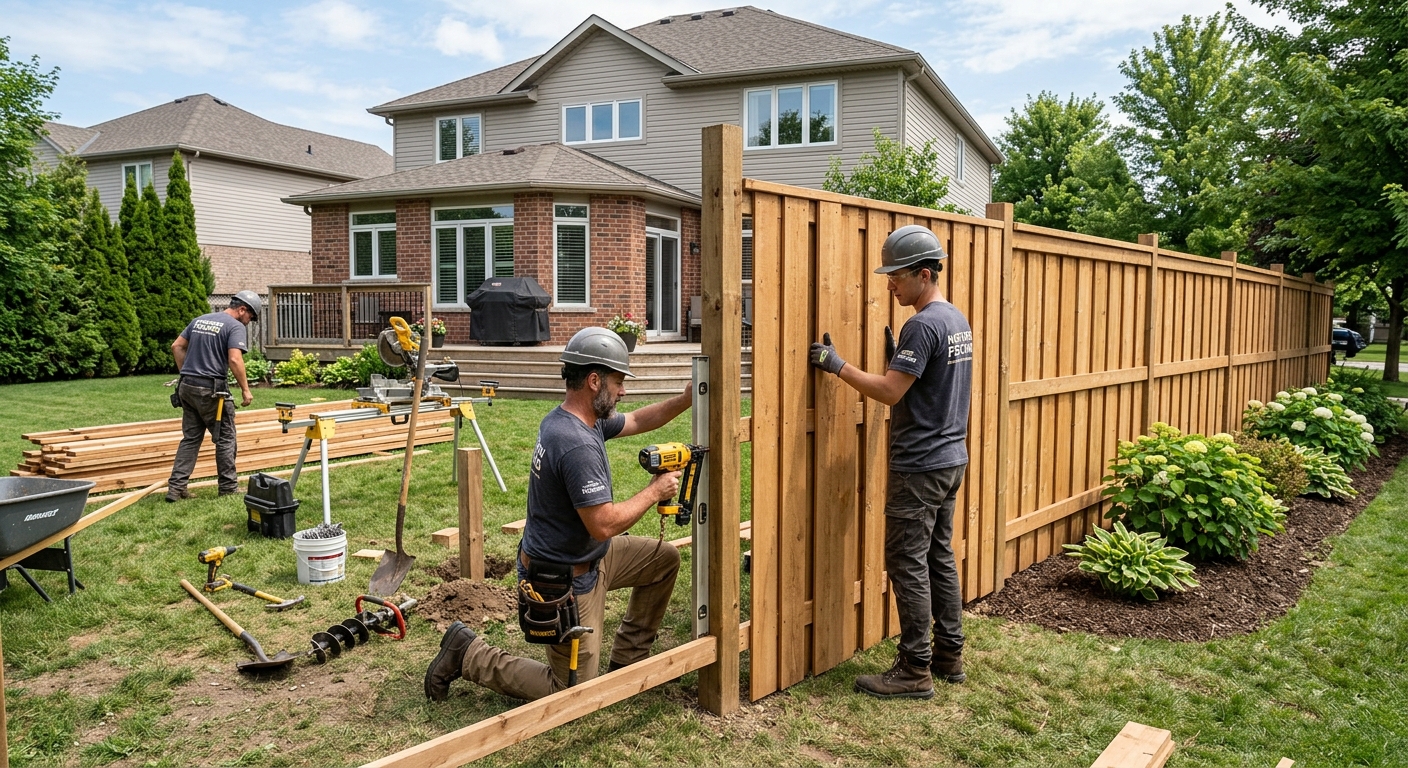
Fencing options and costs in Bon Accord
Bon Accord, Alberta is a small community where fencing demand is strongly tied to who owns their home. In 2021, there were 470 homeowner households, with 84.7% of local households owning their property (Statistics Canada, 2021 Census). That matters because fencing decisions usually come from long-term homeowners protecting pets, privacy, and yard access—especially in neighbourhoods where detached homes make up most dwellings (85.6% single-detached).
In the Edmonton economic region, fence pricing is driven less by material alone than by site and climate conditions. Edmonton-area winters mean contractors have to plan for frost depth so posts sit below the frost line; that often increases hole depth, labour time, and sometimes the need for concrete-set posts. Wind exposure on the Prairies is another cost shaper—open sites can stress panels and fasteners, so many contractors recommend tighter post spacing and sturdier builds for privacy fences. If your yard is older (and many homes were built before 1981, making 63.1% of the housing stock), you may also encounter buried services, less predictable property lines, or more frequent fence removal—each one adds time to the install.
In Bon Accord, trade activity can be especially busy around Rural areas just off the main corridors toward Edmonton, where larger lots and more open wind exposure are common. If you’re comparing options, the table below gives typical installed ranges and how each material performs for privacy and day-to-day living—so you can line up your priorities before requesting quotes.
| Material |
Lifespan |
Maintenance |
Privacy Rating |
Price per Linear Foot |
Price Range |
| Pressure-treated pine (standard wood) |
10–15 years |
Stain/seal every 2–3 years |
Medium (semi-closed pickets) |
$12–$22 |
$3,000–$6,500 |
| Cedar (natural rot resistance) |
15–25 years |
Annual inspection; stain as needed |
Medium–High (solid or close spacing) |
$14–$28 |
$3,500–$7,200 |
| Vinyl / PVC (no-maintenance) |
20–30 years |
Wash occasionally; no staining |
High (solid panels) |
$16–$32 |
$3,500–$8,000 |
| Chain-link (galvanized steel) |
25–40 years |
Occasional tension checks; rinse |
Low (open mesh) |
$9–$16 |
$2,000–$4,500 |
| Aluminum ornamental |
25–35 years |
Occasional wash |
Low–Medium (decorative pickets) |
$18–$35 |
$4,000–$9,000 |
| Composite / recycled material |
20–30 years |
Wash; no staining |
High (solid boards) |
$17–$35 |
$4,000–$8,500 |
Prices are estimates only and vary by project scope, site access and material selection.
What affects the price of fencing in Bon Accord
In Bon Accord and across the Edmonton region, the same fencing design can come back with quotes that differ by 30–50% because contractors price the work around your site, not just the product. Two yards can have the same linear footage but radically different realities: frost-set depth, wind loading, ground conditions, gate complexity, and whether an old fence needs removal. Labour availability also fluctuates—when multiple crews are scheduled for larger installs, scheduling and mobilization can affect pricing.
Frost is the big one in Alberta. Posts typically must be set about 4–6 inches below the design frost depth to reduce heaving. In practice around Edmonton, that can mean posts installed roughly 1.5–2.0 m into the ground, frequently requiring longer posts and concrete setting for stability. That added excavation and materials time is why wood work that might look “simple” can still land in the mid range—often closer to $3,000–$6,500—once you account for frost-safe installation. Wind exposure on the Prairies is another factor: in more open lots, contractors may tighten post spacing and use heavier rails to keep panels from racking. Even for a privacy build, that can move you toward sturdier systems (and sometimes toward vinyl builds that commonly fall within $3,500–$8,000 depending on height and panel style).
Bon Accord examples that commonly raise cost include: (1) yards with hard, rocky soil—extra digging time pushes labour higher; (2) sloped ground that needs stepped or raked panel layouts, which uses more rails and custom measuring; and (3) projects that start with fence removal, where disposal and extra demo time add to the total. Cost can be lower when you have clear access for equipment, straight runs with minimal gates, and known property line locations.
| Price Factor |
Why It Matters |
Cost Impact |
| Fence length in linear feet |
Most fencing costs scale directly with total linear measurement and number of posts |
Major (often 60–80% of total) |
| Post depth required |
Frost line determines hole depth and post length to prevent heaving |
Major (+ labour and materials) |
| Post setting method |
Concrete vs. gravel pack vs. driven posts changes excavation time, materials, and long-term stability |
Moderate to major |
| Material choice |
Vinyl/cedar require different panel systems and hardware; chain-link uses different installation technique |
Moderate (product pricing) |
| Gate count and type |
Drive-through double gates and swing gates need heavier frames, hinges, and often additional posts |
Major for multiple gates |
| Grade and terrain |
Slopes require stepped panels or racking rails, increasing layout time and sometimes material waste |
Moderate |
| Old fence removal and disposal |
Demo time, hauling, and disposal fees add up quickly—especially with anchored posts |
Moderate to major |
| Permit fees and survey / property line locate |
Planning and verification reduce rework and boundary disputes |
Low to moderate (varies by site) |
Permits & regulations in Alberta
In Alberta, fence permit requirements typically start when you’re building a fence above common height thresholds—often around 2.0 m (6.5 ft) for rear yards and 1.0–1.2 m (3–4 ft) for front yards or corner locations. That said, local setback rules and the exact placement along property lines still matter, so your contractor should confirm the plan before digging. Practically, many homeowners don’t need a permit for lower boundary fences, but taller privacy fences and certain corner/visibility situations can trigger the need for a building permit.
Before you set any posts, call for utility locates through Alberta One-Call. Post holes go straight down and fencing layouts are often close to services—so this step is non-negotiable. You should also confirm property pins (or obtain a survey/locate) before installing to avoid encroachment disputes.
For shared fencing, line-fences arrangements are governed by provincial line-fences legislation, which is why it’s smart to clarify responsibility with adjacent property owners early—especially if you’re replacing an existing fence.
To verify your contractor in Bon Accord: ask for a copy of their Alberta licence/registration details (from the appropriate online registry for their trade), proof of liability insurance (certificate of insurance naming you as additional insured if possible), and proof coverage for workers under WCB (Workers’ Compensation Board) or the applicable clearance documentation. A reputable fence contractor should provide certificates on request without hesitation.
Choosing the right fence material for Bon Accord
Choosing the right fence for Bon Accord comes down to matching material to your priorities—privacy, low maintenance, upfront budget, and how long you want to avoid replacing boards or panels. Around Edmonton, cold snaps and wind load mean the “best” fence is the one that’s installed correctly for frost depth and built with adequate bracing for Prairies weather. With many homes in the area built before 1981 (63.1% of the housing stock), you’ll also find yard layouts and older boundaries that can add setup work, so material that holds up reduces repeat cost.
Pressure-treated pine is usually the budget-friendly route, but it needs staining or sealing every 2–3 years to reduce grey weathering and extend service life. Cedar looks better and resists rot more naturally; however, it still benefits from maintenance to keep colour and prevent surface checking. Vinyl/PVC is the classic low-maintenance option—no staining—but extreme cold can make some panels more brittle if they aren’t installed with proper expansion allowances and quality hardware. Chain-link is typically the longest-life low-cost barrier, but it won’t give privacy unless you add slats or screening. Aluminum ornamental offers a clean, rust-resistant look with mid-range cost and good durability, but it won’t block sightlines like a solid privacy fence. Composite/recycled boards can deliver strong privacy with little upkeep, but they’re often priced closer to higher-end systems.
Post depth matters regardless of material. With Edmonton-area frost considerations, concrete-set posts are often recommended for stability when frost heaving risk is higher—especially for tall privacy fences in exposed yards. For example, if a vinyl privacy fence comes in around $3,500–$8,000 and a pressure-treated pine option lands nearer $3,000–$6,500, the extra cost can be justified if you want fewer ongoing maintenance trips over the years—particularly if your yard gets a lot of wind-driven debris and you’d rather not re-stain on a tight schedule.
| Material |
Cold Tolerance |
Lifespan |
Annual Maintenance |
Best For |
Price Band |
| Pressure-treated pine |
Good with proper posts and hardware |
10–15 years |
Low to moderate (stain plan) |
Budget fencing with traditional look |
$3,000–$6,500 |
| Cedar |
Good (natural rot resistance) |
15–25 years |
Low to moderate (inspection; stain as needed) |
Appearance + durability without full replacement |
$3,500–$7,200 |
| Vinyl / PVC |
Good; depends on installation tolerances |
20–30 years |
Very low (wash/inspect fasteners) |
Low maintenance privacy |
$3,500–$8,000 |
| Chain-link |
Excellent in cold winters |
25–40 years |
Low (rinse; tension checks) |
Security with low upfront cost |
$2,000–$4,500 |
| Aluminum ornamental |
Excellent (won’t rust like steel) |
25–35 years |
Very low (wash if needed) |
Attractive boundary fencing |
$4,000–$9,000 |
| Composite / recycled material |
Good (varies by product system) |
20–30 years |
Low (wash; inspect) |
Privacy with minimal upkeep |
$4,000–$8,500 |
How to choose a fencing contractor in Bon Accord
Start by verifying that your fence contractor is set up to work legally and safely in Alberta. Ask for their Alberta licence/registration for the applicable trade category, then request proof of general liability insurance—your quote should be backed by an insurance certificate showing coverage in effect during the project. For workers’ compensation, confirm WCB coverage (or provide the appropriate clearance documentation). Don’t accept “we’re covered” as a statement—ask for the paperwork and read the dates. If they’re legitimate, they’ll provide documents quickly.
Next, request 2–3 itemised written quotes. Look for a breakdown of labour, concrete/post setting, materials, hardware, gate frames, and any optional items like removal/disposal. Avoid lump-sum pricing that doesn’t specify post spacing, fence height, number of gates, and whether rails are stepped/raked on slopes. Make sure you’re comparing like-for-like: permit pull included or not, survey/locate included or not, and disposal hauled away or left for you. Also check warranty terms—workmanship warranty length, manufacturer product warranty, and whether the warranty is transferable if you sell your home.
Payment schedule matters. In Bon Accord installs, a common best practice is keeping upfront payment around 10–15%, then paying the remainder after key milestones. Hold back a portion until completion and final cleanup. Finally, get a written start date and completion estimate so your schedule has something concrete to rely on.
- Confirm Alberta licence/registration details for the contractor’s trade category (not just a company profile).
- Request a current certificate of liability insurance and verify coverage dates.
- Provide WCB coverage or clearance documentation for workers.
- Insist on itemised quotes: post depth/setting method, rails, panels, concrete, hardware, and gates.
- Check post spacing and confirm frost-depth approach for Alberta conditions.
- Ask whether removal and disposal of the old fence is included.
- Confirm whether a survey/property pin locate is included or recommended.
- Verify permit pulling is included if your project crosses the usual height thresholds.
- Review the scope for exclusions (damaged landscaping, buried utilities, uneven ground corrections).
- Ask who supplies and sets the line layout and how property lines are confirmed.
- Confirm warranty: workmanship length and whether manufacturer warranty transfers to homeowners.
- Keep payments to 10–15% upfront; use a holdback until final completion.
Concrete red flags to watch for in Bon Accord: (1) no proof of WCB coverage or insurance when requested; (2) quotes that don’t specify post depth/setting method in Alberta frost conditions; (3) “price includes everything” language without listing gates, concrete, removal, and disposal; (4) refusal to provide a written scope, start date, or completion timeframe; and (5) demands for large upfront deposits with no milestone plan.
Frequently asked questions — fencing in Bon Accord
What's the most low-maintenance fence?
In Bon Accord, the lowest-maintenance options are typically vinyl/PVC and aluminum ornamental, followed by composite/recycled boards. Vinyl and composite usually mean no staining and minimal annual upkeep—mostly a rinse and a quick hardware check after winter. If you want to stay within the region’s typical ranges, vinyl privacy builds commonly land around $3,500–$8,000 depending on height, posts, and gate count. The key is proper installation for Edmonton cold: good contractors use correct spacing and secure fastening so panels don’t become brittle from stress. Cedar and pressure-treated pine can be long-lasting, but in Alberta they generally require planned maintenance every couple of years to keep surfaces looking good.
How tall can my fence be in Bon Accord?
Fence height limits in Alberta commonly follow a height-threshold approach: rear yards are often regulated around 2.0 m (6.5 ft), while front or corner visibility areas are frequently around 1.0–1.2 m (3–4 ft). In Bon Accord, the practical rule is that the exact placement matters, so you should confirm the location relative to front yard and corner lines before you order materials. If you’re planning a tall privacy fence, assume it may require a building permit, especially if it exceeds common thresholds. Also consider wind exposure—taller panels catch more wind on the Prairies—so even if height is allowed, the structure must be built for stability with frost-safe post depth and solid bracing.
Should fence posts be set in concrete here?
Often, yes—particularly for privacy fences and taller panel systems where stability against wind and frost heaving is critical. In the Edmonton area, contractors usually set posts below the frost line (commonly planned about 4–6 inches below the design frost depth), and that frequently means deeper holes and concrete-set posts for reliable anchoring. Whether concrete is “required” in every case can depend on soil conditions, fence type, and the contractor’s method statement, but in Bon Accord many installs benefit from concrete because it reduces the risk of posts shifting in freeze-thaw cycles. Concrete also increases labour and material time, which is one reason costs can fall within the typical installed wood range of $3,000–$6,500 when posts and setting are done to Alberta standards.
What's the best fence for privacy?
For privacy in Bon Accord, solid or close-spacing systems score highest: vinyl privacy (solid panels), composite boards, and wood privacy fences built with close pickets. Cedar can be excellent for privacy too, especially if you choose a close-board layout. Chain-link provides security, but it generally doesn’t block sightlines unless you add slats or a privacy screen. Because Prairies wind can rack lighter panels, the “best” privacy fence is also the one with proper post spacing and sturdy rails designed for wind load. If you’re budgeting, vinyl privacy often falls in the $3,500–$8,000 band, while pressure-treated privacy wood frequently aligns with $3,000–$6,500, with longer-term maintenance trade-offs for wood.
How do I compare fencing quotes?
Compare quotes line-by-line, not by the final number. Ask each contractor to itemise labour, materials, and site work: post depth and setting method, number of posts, rail type, panel type, gate count, and whether old fence removal and disposal are included. Confirm if permit pulling is included if your height/placement triggers it, and whether they account for Alberta utility locates before digging. Also compare warranty terms (workmanship and manufacturer) and payment schedule. For example, a lower quote in the $2,000–$4,500 chain-link band can look cheaper until you realise the quote excludes tension adjustments, gate hardware, or disposal. The cheapest bid is often not the best value if key frost-safe installation steps or wind-stability upgrades are missing.
How long does fence installation take in Bon Accord?
Timing depends on length, ground conditions, and whether there’s removal. For smaller straight runs, many installs can be completed in a day or two. Privacy fences with deeper post holes for frost protection, multiple gates, sloped yards (stepped panels), and old fence removal generally take longer because excavation, concrete setting, and layout work add time. In Bon Accord—where many properties are detached and owners often plan complete backyard upgrades—site preparation and utility coordination can be a meaningful part of the schedule. If your fence needs a permit or a survey/locate to confirm boundaries, that can extend the timeline beyond the physical install days. A contractor should provide a written start date and completion estimate; if they won’t, it’s hard to plan around your yard access and pets.