Fencing options and costs in Evanston
Evanston, Alberta has a fast-growing mix of newer homes and established lots, and that combination keeps fence demand steady year-round. With a population of 18,710 (Statistics Canada, 2021 Census), the Calgary economic region continues to add homeowners who eventually need boundary fencing, gates, and repairs. In practice, detached housing is especially common around Evanston—every new yard is a potential “first fence” project, and every mature yard eventually needs panel replacements after freeze–thaw cycles. That steady base matters because it affects labour availability and scheduling, particularly in peak spring and early fall installs.
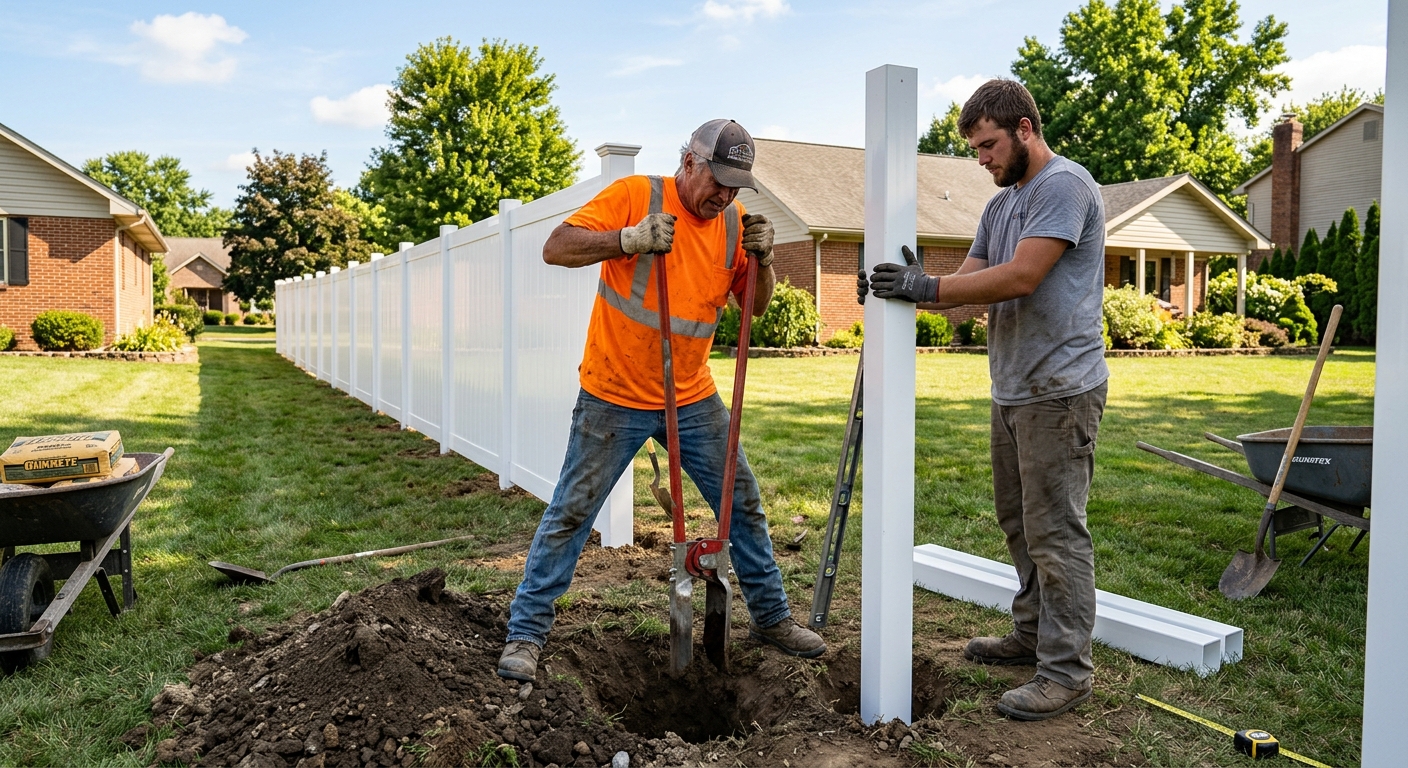
Cost in Evanston is shaped less by material colour and more by how the Prairie climate attacks fences. Calgary’s long freeze–thaw cycles push frost deeper than many milder regions, so contractors typically set posts about 4 ft (≈120 cm) deep to reduce heaving risk. For privacy fences and gate posts, that often means concrete footings plus tighter hardware to handle wind loading across open exposure. If your fence is in a more exposed area (near open fields, back alleys, or wind corridors), you’ll usually see higher installed pricing than a similar run behind other structures.
In Evanston, we often see the strongest fencing installs on the busier residential blocks along newer development pockets such as the west and south edges of the community, where lots are commonly unfinished at purchase. If you’re pricing your project now, the comparison below will help you baseline materials before we factor in your total linear footage, gate count, and access.
| Material |
Lifespan |
Maintenance |
Privacy Rating |
Price per Linear Foot |
| Pressure-treated pine (standard wood) |
10–20 years |
Stain/paint every 2–3 years; check for loose pickets |
Medium (solid panels); high if dog-eared/boarded |
$40 – $80 |
| Cedar (natural rot resistance) |
15–25 years |
Stain/coat every 2–4 years; occasional board replacement |
Medium–High (board-on-board styles) |
$55 – $95 |
| Vinyl / PVC (no-maintenance) |
20–35 years (with proper installation) |
Rinse only; inspect rails after extreme cold snaps |
High (solid privacy) |
$45 – $90 |
| Chain-link (galvanized steel) |
20–30 years |
Minimal; occasional tension/hinge adjustments |
Low (privacy screening optional) |
$25 – $55 |
| Aluminum ornamental |
30–45 years |
Wash occasionally; tighten hardware as needed |
Low–Medium (decorative pickets) |
$70 – $120 |
| Composite / recycled material |
20–30 years |
Low; rinse and check post hardware |
High (solid/composite privacy boards) |
$65 – $110 |
Prices are estimates only and vary by project scope, site access and material selection.
What affects the price of fencing in Evanston
In Evanston, you can get quotes for the “same” fence that differ by 30–50% because the work isn’t only about panels—it’s about what the ground and wind demand. Two contractors may both list a 6 ft privacy fence, but one may assume lighter post depth or wider spacing, while the other accounts for frost-protection excavation, concrete setting, and stronger rails for racking. Labour capacity also plays a role: when installs stack up in spring, the same crew charge higher daily rates and allocate more time for mobilization, hauling and disposal.
The biggest driver is frost. In the Calgary economic region, frost line depth sets how deep posts must be set—typically 4–6 inches below the design frost depth—to prevent heaving. That often translates to roughly 1.5–2.0 m into the ground, with longer posts and deeper holes. Concrete setting is commonly expected for 6 ft privacy fences and for gate posts, which increases material cost and excavation time. On top of that, open Prairie exposure creates higher wind loading; solid wood or vinyl privacy panels usually need closer post spacing and heavier bracing than chain-link, which allows airflow.
Two practical examples we see around Evanston: (1) a backyard run on hard clay can slow excavation and increase concrete use—pushing wood or vinyl toward the higher end of the $40 – $80 (wood) or $45 – $90 (vinyl) bands; (2) a short, sheltered run with easy access may reduce labour, keeping chain-link closer to $25 – $55 while a privacy line still sits mid-to-upper due to structural demands.
Housing age also matters. Newer subdivisions often have cleaner property lines and fewer obstructions, while older lots can bring buried services, irregular grades, and more time verifying boundaries—costs that show up as higher labour even when material prices are unchanged.
| Price Factor |
Why It Matters |
Cost Impact |
| Fence length in linear feet |
Most materials and labour scale directly with total linear footage. |
Major cost driver (largest swing between quotes) |
| Post depth required |
Frost line determines post length and hole depth; deeper equals more excavation. |
Medium–High increase in cold regions |
| Post setting method |
Concrete vs. gravel pack vs. driven posts changes labour time, concrete volume and hardware. |
Concrete typically adds cost and time |
| Material choice |
Vinyl/cedar require different rails, brackets and expansion considerations; chain-link is lighter. |
High variance; can shift project band |
| Gate count and type |
Gates need heavier posts, hinges, latches, and often diagonal bracing. |
Medium–High per gate, especially drive-through (double) gates |
| Grade and terrain |
Slopes require stepped or raked panels, plus extra labour for layout. |
Medium increase depending on steepness |
| Old fence removal and disposal |
Hauling and disposal add labour and fees; buried posts can be hard to extract. |
Often a noticeable mid-project add-on |
| Permit fees and survey / property line locate |
Verification work prevents encroachment and protects both sides of the boundary. |
Low–Medium, but can be essential |
Permits & regulations in Alberta
In Alberta, fence rules are primarily handled through municipal requirements and property-line compliance, but permits commonly come into play for taller fences. As a practical rule of thumb for many Alberta communities, fences above a height threshold—often around 2.0 m (6.5 ft) at the rear and roughly 1.0–1.2 m (3–4 ft) at the front or corner—may require a building permit. Even when a permit isn’t needed, you still must respect property lines and any municipal setback bylaws. For Evanston homeowners, the easiest way to avoid a costly redo is to confirm the exact height, location (front vs. rear), and setbacks with the City before you order materials.
Before any post holes are dug, call for utility locates through Alberta One-Call. That’s a must-do step for any digging, regardless of whether you’re replacing an existing fence or building new. Also, obtain a survey or a property line locate to verify where pins are—this prevents boundary encroachment disputes that can stall or require reconstruction mid-season.
For shared fencing, line-fences responsibilities follow provincial line-fences legislation, which typically requires communication with the adjoining owner on shared costs and maintenance. To verify a contractor in Evanston: (1) check their Alberta licence/registration in the relevant trade registry; (2) request a current certificate of insurance showing liability coverage (and confirm limits); (3) ask for proof of coverage for workers where applicable (WSIB/WCB coverage documents or clearance letter, as provided in Alberta). Any hesitation usually signals scheduling or coverage gaps.
Choosing the right fence material for Evanston
Choosing the right fence for Evanston comes down to matching material behaviour to Prairie winter conditions: long freeze–thaw cycles, strong wind, and freeze-safe post installation. Pressure-treated pine is the budget-friendly choice, but to look good it typically needs staining or coating every 2–3 years to prevent grey weathering and keep pickets from drying out. Cedar offers a more premium look and better natural resistance to rot, yet it still benefits from regular staining to maintain colour and protect the surface.
Vinyl/PVC is popular for “set it and forget it” yards—no painting, just occasional rinsing. The trade-off is upfront cost and the need for correct installation so rails and panels can accommodate cold contraction without stress cracking. Chain-link is usually the lowest upfront and longest-life option, but it provides limited privacy unless you add screening (which can increase wind loads and maintenance). Aluminum ornamental sits at the top end of typical cost ranges; it won’t rust and looks crisp, but it’s not a true privacy solution.
Post-depth requirements matter regardless of material. Because Calgary-area frost protection is a priority, post holes often need to be dug deep (commonly around 4 ft / 120 cm for many installs) and set securely with concrete for privacy panels and gate posts. Concrete-set posts cost more, but they reduce heaving risk that can otherwise crack rails, loosen posts, and shorten fence life. For a clear budget example: if a vinyl privacy line lands near the mid-to-upper band of $45 – $90 per foot while a comparable wood privacy option is closer to $40 – $80, the incremental cost is often justified when you want fewer future repairs and lower ongoing maintenance during busy Alberta seasons.
| Material |
Cold Tolerance |
Lifespan |
Annual Maintenance |
Best For |
Price Band |
| Pressure-treated pine |
Good if posts are set deep and wood is coated |
10–20 years |
Inspect twice; plan stain/coat every 2–3 years |
Lower upfront cost with willingness to maintain |
$40 – $80 |
| Cedar |
Very good; handles seasonal expansion/contraction well |
15–25 years |
Inspect; stain/coat every 2–4 years |
Natural look and rot resistance |
$55 – $95 |
| Vinyl / PVC |
Good when installed with correct clearance and bracing |
20–35 years |
Rinse and check hardware as needed |
Low-maintenance privacy |
$45 – $90 |
| Chain-link |
Excellent for cold; corrosion-managed with galvanized steel |
20–30 years |
Minimal; re-tension occasionally |
Security and pets with airflow |
$25 – $55 |
| Aluminum ornamental |
Excellent; won’t rust in winter salt exposure |
30–45 years |
Wash and tighten hardware |
Appearance with durable, low-rust performance |
$70 – $120 |
| Composite / recycled |
Good; behaves well in cold when properly supported |
20–30 years |
Low; rinse and inspect for fastener wear |
Modern privacy with low upkeep |
$65 – $110 |
How to choose a fencing contractor in Evanston
When you hire a fence contractor in Evanston, Alberta, start with verification: ask for their current Alberta trade/contractor credentials (and ensure the work they’ll do matches the scope of your contract). Next, request liability insurance and confirm the effective dates and coverage limits on the certificate of insurance. For workers on site, ask for WSIB/WCB coverage documentation or a clearance letter—if they can’t provide proof, that’s a major risk for you.
Then get 2–3 itemised written quotes. You want a breakdown that separates labour from materials (posts, rails, pickets/panels, gates, hardware, concrete and disposal). Avoid “lump sum” quotes that don’t show post depth, gate hardware type, or what happens if your ground conditions differ. Carefully read exclusions: Is permit pulling included or not? Is old fence removal included? Is disposal of rails and posts covered? If they’re vague, ask for it in writing.
Warranty matters in the cold. Ask for the workmanship warranty length and confirm whether the manufacturer warranty transfers to you for vinyl/composite/aluminum components. Review the payment schedule: never pay more than 10–15% upfront; hold back funds until the job is complete and walk the line with them to confirm alignment, post depth, and gate operation. Finally, demand a start date and completion estimate in writing so you can plan around the short Alberta building window.
- Provide proof of current Alberta credentials before signing.
- Show liability insurance certificate with your name/address listed as applicable.
- Provide WSIB/WCB coverage proof or clearance letter for workers.
- Use itemised quotes (labour vs. materials vs. concrete vs. disposal).
- State post depth and setting method (concrete vs. gravel pack) explicitly.
- List gate hardware brand/model and whether gates include diagonal bracing.
- Confirm who pulls permits (if required) and whether fees are included.
- Clarify disposal: hauled away and dumped where, or left for homeowner.
- Detail layout and how property lines are verified (survey vs. locate pins).
- Document warranty: workmanship duration and product manufacturer coverage.
- Payment terms: maximum 10–15% upfront; retainage at completion.
- Provide a written timeline with weather contingency expectations.
Common red flags in Evanston include: (1) refusing to show insurance/coverage documents; (2) quoting “standard” post depth without discussing frost protection; (3) giving a single all-in price that doesn’t break down gate and concrete costs; (4) starting work before utility locates are completed; (5) asking for large deposits (more than 15%) before any measurable work begins.
Frequently asked questions — fencing in Evanston
What's the most low-maintenance fence?
In Evanston and across the Calgary economic region, the lowest maintenance option is usually vinyl/PVC or well-built aluminum. Vinyl privacy fences typically require no painting and only benefit from rinsing and quick hardware checks after extreme cold snaps. Aluminum ornamental is also very low maintenance because it won’t rust, though it’s not ideal if you need maximum privacy. If you’re comparing budgets, vinyl often sits in the $45 – $90 per linear foot range, while chain-link is commonly lower at $25 – $55 but you won’t get privacy without added screening. Pressure-treated pine can be “low effort” day one, but it usually demands staining or coating every 2–3 years to prevent weathering.
How tall can my fence be in Evanston?
Fence height limits in Alberta are usually governed by municipal bylaws and depend on where the fence sits on the property (front/corner versus rear). A common benchmark in many Alberta contexts is that taller fences—often around 2.0 m (6.5 ft) in the rear and roughly 1.0–1.2 m (3–4 ft) in front or corner areas—can require a building permit. For Evanston homeowners, the practical step is to confirm: (1) your exact height and location, (2) required setbacks, and (3) whether a permit is triggered before ordering panels. If you’re planning a 6 ft privacy fence, also consider wind exposure on the Prairies, because taller solid panels can require sturdier posts and bracing for stability.
Should fence posts be set in concrete here?
Yes, in Evanston you should strongly expect concrete setting for most privacy fences and for gate posts. The reason is frost: Calgary’s freeze–thaw cycles mean posts must be set below the design frost depth (often achieved with about 4 ft / 120 cm post depth for many installs), otherwise heaving can loosen rails and cause racking. Concrete footings also help when wind loading is high and the fence has less airflow, like solid wood or vinyl privacy panels. Chain-link can sometimes use alternative methods (like gravel packs) depending on design, but privacy fences commonly benefit from concrete for longevity. If a quote doesn’t specify post depth and setting method, ask directly—those details often explain why prices vary widely between contractors.
What's the best fence for privacy?
For privacy in Evanston, the best choices are typically vinyl/PVC privacy panels or solid wood designs (board-on-board, spaced boards with narrower gaps, or solid panel systems). These materials provide the highest privacy rating because they block wind-driven sightlines across the yard. Vinyl privacy usually lands mid-to-upper on cost, around $45 – $90 per linear foot, while pressure-treated pine is often closer to $40 – $80. Cedar can be a step up in appearance and comfort under sun and wind, but it often costs more than standard pine. The key is not only material—it’s also correct post spacing, solid rails, and concrete-set gate posts where necessary to prevent sagging.
How do I compare fencing quotes?
Compare quotes in Evanston like-for-like: ask for itemised labour and materials, and confirm the hidden essentials—post depth, post setting method (concrete vs. gravel pack), rail construction, and gate hardware. Ensure each quote includes utility locates before excavation, and verify whether disposal and old fence removal are included (or listed as an extra). A good comparison also checks whether the contractor is accounting for grade and terrain; sloped yards may require stepped panels, which increases layout time. If one quote is far cheaper, it’s often because of lighter structural assumptions or missing concrete/disposal. Use the local band expectations as a sanity check: wood often falls in $40 – $80, chain-link in $25 – $55, and vinyl in $45 – $90.
How long does fence installation take in Evanston?
Typical installation timelines in Evanston depend mostly on linear footage, fence type, and how complex the ground is. A straightforward run of chain-link can progress quickly once posts are set, while privacy fences take longer due to deeper excavation and bracing—especially with concrete-set posts and gates. In cold-season planning, crews usually focus on workable weather windows because wet/icy ground slows excavation and concrete. If your project includes removal of an old fence, utility coordination, and a permit/survey locate, add time for verification and disposal. For many mid-sized residential projects, expect multiple days of on-site work, with the overall schedule stretching longer when crews are booked in spring. Request a written start date and completion estimate so you have a realistic window.