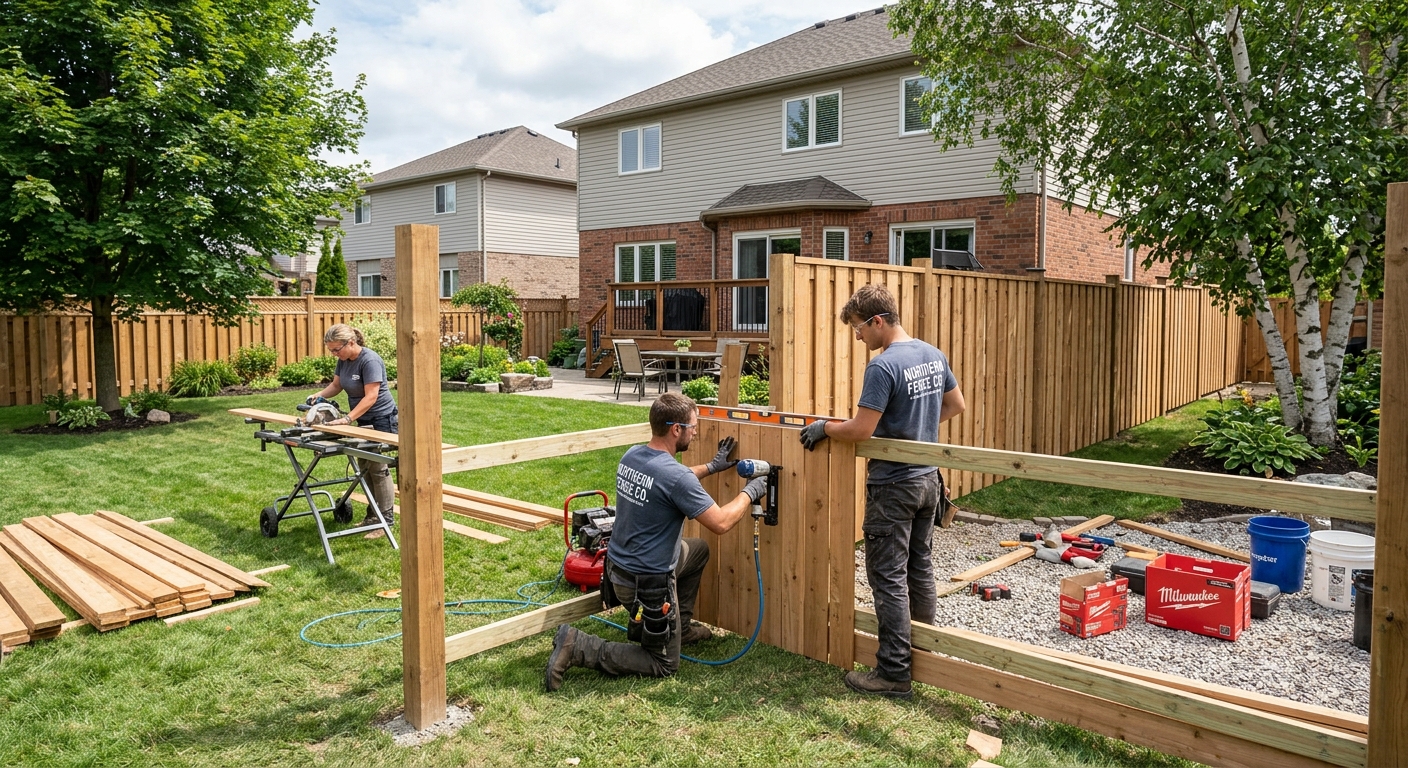
Fencing options and costs in Smoky Lake
In Smoky Lake, fence projects tend to follow the same local pattern: when homeowners upgrade their yards, they’re usually matching privacy and durability to northern Alberta’s freeze-and-thaw schedule. With 79.8% of dwellings being single-detached homes and 73.9% of households owning their properties (Statistics Canada, 2021 Census), there’s a steady base of “at-home” clients who are willing to invest in long-lasting boundaries. Those demographics matter because detached properties typically need more linear footage and more gates than shared or multi-unit buildings.
In the Wood Buffalo–Cold Lake economic region, costs are shaped by frost depth, soil conditions, and wind. Contractors in this part of Alberta commonly set posts below the design frost depth to reduce heaving, which usually means deeper holes, more excavation, and often concrete-set posts for stability. Winter access can also tighten scheduling, and exposed prairie winds can push installers toward tighter post spacing and more rigid panel systems—especially for taller privacy fences.
In Smoky Lake proper, demand is especially visible along residential stretches where yards meet open lots and wind corridors, such as around the downtown residential blocks and areas on the edge of town (where wind exposure tends to feel higher). If you’re comparing options, the table below summarizes typical lifespan, maintenance, privacy performance, and expected per-foot pricing for common materials.
| Material |
Lifespan |
Maintenance |
Privacy Rating |
Price per Linear Foot |
Price Range |
| Pressure-treated pine (standard wood) |
10–15 years |
Stain/seal every 2–3 years |
Good (solid boards) |
$40–$60 |
$2,400–$5,000 |
| Cedar (natural rot resistance) |
15–25 years |
Light stain/cleaning as needed every 2–4 years |
Very good (solid boards) |
$55–$80 |
$3,300–$7,200 |
| Vinyl / PVC (no-maintenance) |
20–30 years |
Rinse wash only |
Very good (solid or capped pickets) |
$55–$100 |
$3,500–$9,000 |
| Chain-link (galvanized steel) |
25–40 years |
Minimal (wash occasionally) |
Low to medium (screening options) |
$30–$50 |
$2,000–$4,200 |
| Aluminum ornamental |
25–35 years |
Occasional rinse; never rust |
Low (ornamental spacing) |
$70–$120 |
$4,200–$10,500 |
| Composite / recycled material |
20–30 years |
Minimal; follow manufacturer wash schedule |
Good (solid composite) |
$75–$120 |
$4,400–$10,800 |
Prices are estimates only and vary by project scope, site access and material selection.
What affects the price of fencing in Smoky Lake
In Smoky Lake and across the Wood Buffalo–Cold Lake region, two quotes for “the same fence” can differ by 30–50% because the real drivers aren’t just height and length—they’re post depth, wind design, and how the contractor builds for frozen ground. In practice, a long stretch of standard fencing can land near the region’s wood band (around $40–$80 per linear foot depending on build), while a taller, more rigid privacy layout with concrete-set posts and heavier panel framing can climb quickly, especially when vinyl or composite systems are chosen (often $55–$110 or more depending on complexity).
The biggest swing factor is frost. Local installation typically requires setting posts about 4–6 inches below the design frost depth to prevent heaving, and in colder Alberta that often means posts going roughly 1.5–2.0 m into the ground. Deeper holes mean longer auger time, more excavated spoil, more labour, and frequently longer posts—plus concrete if you choose a concrete-set method for stability. On top of that, Prairie wind exposure pushes contractors toward tighter post spacing and sturdier rails. That affects labour and sometimes adds hardware. For context, coastal BC builds often price differently because rot risk is the dominant wood problem, whereas here the freeze/thaw cycle and soil movement are the headline risks.
Concrete examples from Smoky Lake jobs: (1) If you remove and replace an older fence that has been partially heaved, the excavation and extra bracing can add significant time, raising total cost versus building on a clean, flat base. (2) If you’re replacing with a chain-link perimeter, you may see the overall budget sit closer to the $30–$60 band because the framework tolerates wind better with simpler components and generally less rigid panel work. (3) If you’re installing privacy boards on uneven ground or near town drainage swales, you may pay more for stepped sections or raked panels because material and layout time increase.
| Price Factor |
Why It Matters |
Cost Impact |
| Fence length in linear feet |
The more runs, the more posts, rails, and labour time. |
Highest impact (often 50–70% of the total) |
| Post depth required |
Frost depth determines hole depth and required post length. |
Can add 10–25%+ |
| Post setting method |
Concrete vs gravel pack vs driven posts changes materials and labour. |
Concrete-set posts often add 5–20%+ |
| Material choice |
Vinyl/composite typically cost more than chain-link; cedar vs wood varies. |
Often 15–40% swing |
| Gate count and type |
Drive-through double gates require heavier frames and hardware. |
Can add 10–30% depending on gate complexity |
| Grade and terrain |
Slopes require stepping/racking, plus extra layout time and cut materials. |
Often 5–15% |
| Old fence removal and disposal |
Disposal fees, labour, and handling of buried posts can increase scope. |
Commonly 5–25% |
| Permit fees and survey / property line locate |
Verifying property lines prevents disputes and may be required for taller fences. |
Typically 0–10%+ |
Permits & regulations in Alberta
In Alberta, whether your fence needs a building permit often depends on height and location. As a practical rule in many communities, fences above a height threshold—typically around 2.0 m (6.5 ft) at the rear and 1.0–1.2 m (3–4 ft) at the front or corner—may require a permit. Your municipality may also apply specific setback rules, so it’s important to confirm the local bylaw before you order materials or schedule excavation.
Before any post hole is dug, call for utility locates through Alberta One-Call to mark buried services. Next, get a survey or locate your property pins so the fence is built on your property line—this is one of the easiest ways homeowners avoid expensive encroachment disputes. If a fence is shared, the rules around line fences are handled under provincial line-fences legislation, but you should still document agreements with neighbours (especially where there’s shared cost).
What usually DOES require a permit: taller fencing near front/corner areas, and any fence where local height thresholds are exceeded or where a municipality requires approval. What typically does NOT: standard-height backyard fences on a clearly verified property line when local thresholds aren’t exceeded (still confirm, because local bylaws can vary).
To verify your contractor in Smoky Lake, ask for a copy of their Alberta licence (check the provincial registry for status), request liability insurance (certificate of insurance showing current coverage and the correct business name), and confirm WCB/WSIB-style coverage (in Alberta this is WCB). A reputable contractor can also provide letters of clearance/coverage and will include proof in your contract file.
Choosing the right fence material for Smoky Lake
Choosing a fence material in Smoky Lake is mostly about matching climate performance to what you want to live with day-to-day: privacy, upkeep, budget, and lifespan. With many homes in the area built before 1981 (70.5% of dwellings, Statistics Canada, 2021 Census), upgrades often include boundary improvements that need to hold up through decades of freeze-and-thaw, frost heave risk, and windy Prairie conditions. That reality matters because weaker post bases or flexible panel designs can shift when soils move.
Pressure-treated pine is the budget-friendly option, but it typically needs staining/sealing every 2–3 years to limit grey weathering and keep boards looking solid. Cedar has better natural rot resistance and a warmer appearance, and it often stretches your maintenance interval to every 2–4 years, though it still benefits from stain or protection. Vinyl/PVC offers “set-and-forget” upkeep and is popular for homeowners who want no painting, but in extreme cold it can become more brittle—so proper installation (including post spacing and wind-rated bracing) is important. Chain-link is usually the lowest-cost long-life choice; it survives well and can be enhanced with privacy slats or screening, but it won’t provide full privacy by itself. Aluminum ornamental provides good curb appeal and won’t rust, but it’s not a privacy solution. Composite/recycled boards can deliver privacy with minimal maintenance, but they’re usually mid-to-upper priced.
On whether concrete-set posts are necessary: with Wood Buffalo–Cold Lake frost concerns, many installs benefit from concrete or at least proper engineered post setting to reduce movement. Whether you go full concrete or a gravel pack approach depends on soil and drainage, but in heaving-prone ground, concrete-set posts are often the safer long-term bet. As a dollar example, if a pressure-treated pine privacy fence is in the $40–$80 wood band while vinyl privacy might be in the $55–$110 range, vinyl can be justified when you value lower maintenance and longer look consistency—especially if you’d otherwise be budgeting staining labour or weekend time every few years.
| Material |
Cold Tolerance |
Lifespan |
Annual Maintenance |
Best For |
Price Band |
| Pressure-treated pine |
Good (with proper treatment and proper post setting) |
10–15 years |
Low to moderate (inspect; plan stain every 2–3 years) |
Budget privacy with periodic upkeep |
$40–$80 |
| Cedar |
Good (natural oils; still needs sealing/protection) |
15–25 years |
Low (clean and stain as needed every 2–4 years) |
Appearance + rot resistance |
$55–$90 |
| Vinyl / PVC |
Good (proper installation needed in very cold snaps) |
20–30 years |
Very low (rinse wash; quick panel checks) |
Low-maintenance privacy |
$55–$110 |
| Chain-link |
Excellent (durable galvanized steel) |
25–40 years |
Very low (occasional wash) |
Security on a budget |
$30–$60 |
| Aluminum ornamental |
Good (coated metal performs reliably) |
25–35 years |
Low (rinse; tighten hardware as needed) |
Attractive boundary with visibility |
$70–$140 |
| Composite / recycled |
Good (engineered boards; installation matters) |
20–30 years |
Low (follow manufacturer cleaning guidance) |
Privacy with minimal upkeep |
$75–$120 |
How to choose a fencing contractor in Smoky Lake
When you’re picking a fencing contractor for a project in Smoky Lake, start with proof, not promises. Ask for their Alberta licence/registration details (and check the provincial registry for current status), plus a certificate of liability insurance showing adequate coverage for your address and correct business name. Next, confirm WCB coverage (in Alberta) and request documentation such as a clearance letter or evidence of active coverage—this is important for worker safety and for protecting you if an accident happens on-site. If they can’t provide documentation promptly, treat that as a serious warning sign.
Then get 2–3 itemised, written quotes. You want line items that break down labour, materials, concrete/post setting method, gate hardware, and removal/disposal—rather than a single lump-sum number. Read the exclusions carefully: is permitting included if required for your fence height? Is site prep included (stump/rock removal, minor grading)? Is old fence removal and hauling included, or is it an added charge?
Warranty should be spelled out separately for workmanship and for products. Ask how long the workmanship warranty lasts, whether it covers post movement, loose rails, and wind-related issues caused by improper installation, and whether the manufacturer warranty is transferable to you if you sell the home. Payment terms matter too: never pay more than about 10–15% upfront, and plan a holdback until the job is complete and cleaned up.
Finally, request a start date and completion estimate in writing. In northern Alberta conditions, delays can occur due to frozen ground and equipment access, but a contractor should still commit to a realistic timeline window.
- Ask for licence/registration details and verify current status online.
- Request a certificate of liability insurance before signing anything.
- Confirm WCB/coverage documents (clearance/active coverage proof).
- Get 2–3 itemised quotes with labour + materials line items.
- Check whether concrete/post setting method is included and specified.
- Confirm gate count, gate type, and hardware are listed (not “allowance”).
- Verify disposal/removal of old fencing is included or costed separately.
- Ask if permits/property line locate/survey costs are included.
- Read the warranty section for workmanship vs product coverage.
- Confirm whether warranties are in writing and what conditions void them.
- Use a payment schedule with no more than 10–15% upfront.
- Require a written start date and completion estimate with allowances for weather.
Red flags to watch for: contractors who won’t provide insurance/WCB proof, quotes that omit post setting method (concrete vs gravel pack), “best price” lump sums with no itemization, pressure to pay large deposits upfront, and promises that ignore frost depth or wind bracing requirements in northern Alberta conditions.
Frequently asked questions — fencing in Smoky Lake
How tall can my fence be in Smoky Lake?
In Smoky Lake, Alberta, fence height limits typically depend on where the fence sits on your lot (front/corner versus rear) and the local bylaw thresholds. A common Alberta rule of thumb is that fences above about 2.0 m at the rear and around 1.0–1.2 m at the front or corner may trigger permit requirements. Because setbacks and bylaw details can vary, you should confirm with the municipality before you order materials. If your goal is privacy, many homeowners choose a lower back-yard height and use solid boards plus taller gate framing to achieve the look while staying within what doesn’t require a permit. When quoting, make sure your contractor includes any permit pull work if the design exceeds local thresholds.
Should fence posts be set in concrete here?
In the Smoky Lake area, many installs benefit from concrete-set posts because frost heave risk is a real factor on frozen and silty Prairie soils. With Wood Buffalo–Cold Lake conditions, posts are usually set below the design frost depth—often about 4–6 inches deeper than the frost line requirement—and that depth can be roughly 1.5–2.0 m depending on site conditions. Concrete setting improves stability when soils move seasonally, and it’s especially helpful for privacy fences that resist wind loads. That said, some sites with well-drained soil may use alternative methods like engineered gravel packing, so the best approach depends on your yard’s drainage and soil. If a quote is unusually low, check whether the contractor is cutting corners on post depth or using a post method that may not hold up in a freeze-and-thaw cycle.
What's the best fence for privacy?
For privacy in Smoky Lake, the usual top picks are solid-board pressure-treated pine, cedar, or vinyl/PVC privacy fencing—because they block sightlines while standing up to wind when installed with proper post spacing and sturdy rails. Vinyl can cost more upfront (often aligned with the $55–$110 band), but many homeowners like the low-maintenance lifestyle—no staining every 2–3 years. Cedar offers a middle ground with better natural rot resistance and appearance, while pressure-treated pine is the budget route if you’re willing to maintain it. If you’re comparing quotes, ask how the contractor will handle wind exposure and whether the fence is built for snow/wind load impacts (for example, stronger bracing for taller privacy runs). Also confirm whether the fence is solid at the bottom—gaps can reduce privacy significantly during winter when snow drift patterns shift.
How do I compare fencing quotes?
Compare quotes by line item, not just by the final total. Ask each contractor to show labour and materials separately, and confirm what’s included for excavation, post setting method (concrete vs gravel pack), gate hardware, and removal/disposal of the old fence. Because northern Alberta frost depth drives deeper holes, a “cheap” per-foot number can sometimes hide a difference in post depth or post spacing. Make sure the quotes reflect the same height, same material (pressure-treated vs cedar vs vinyl), and the same number/type of gates. If one quote lands closer to the wood band (around $40–$80) and another is closer to vinyl pricing ($55–$110), look for exactly what upgrade is driving that difference—often maintenance savings, stronger components, or a more wind-rigid layout. Also verify they’re using an agreed property line or locate/survey information before installation.
How long does fence installation take in Smoky Lake?
Timeline depends on the length, number of gates, and whether your yard is accessible with equipment. For typical residential runs in Smoky Lake, crews often complete installation in a matter of days once posts are set and panels are assembled, but deeper frost-driven post holes can increase drilling time. Projects that include old fence removal and disposal usually take longer because of extra labour and hauling. Weather also matters—during deep freeze periods, the ground can be harder to excavate, which can shift start dates. If you’re choosing vinyl or composite, assembly and rail alignment can add a bit of time, but it’s usually manageable for standard backyard projects. Ask for a written schedule window and a start/completion estimate, and make sure the contract clarifies how weather delays are handled.
Can I install a fence on a slope in Smoky Lake?
Yes, you can install a fence on a slope in Smoky Lake, and it’s common. You’ll generally need one of two approaches: stepped panels (where the fence height changes in sections) or raked/graded panels (where the fence follows the slope). Stepped builds often look cleaner with traditional rail systems, but raked builds can be beneficial where you want a smoother sightline. Either way, sloped yards usually increase layout time and sometimes add materials because posts may be set at different depths to keep the fence level-to-grading. Before quoting, confirm how the contractor measures grade and how they’ll treat the bottom edge so privacy isn’t lost to gaps—especially important in winter when snow may sit differently along the slope. If your quote doesn’t mention grading, stepping, or racking, ask for clarification before you commit.