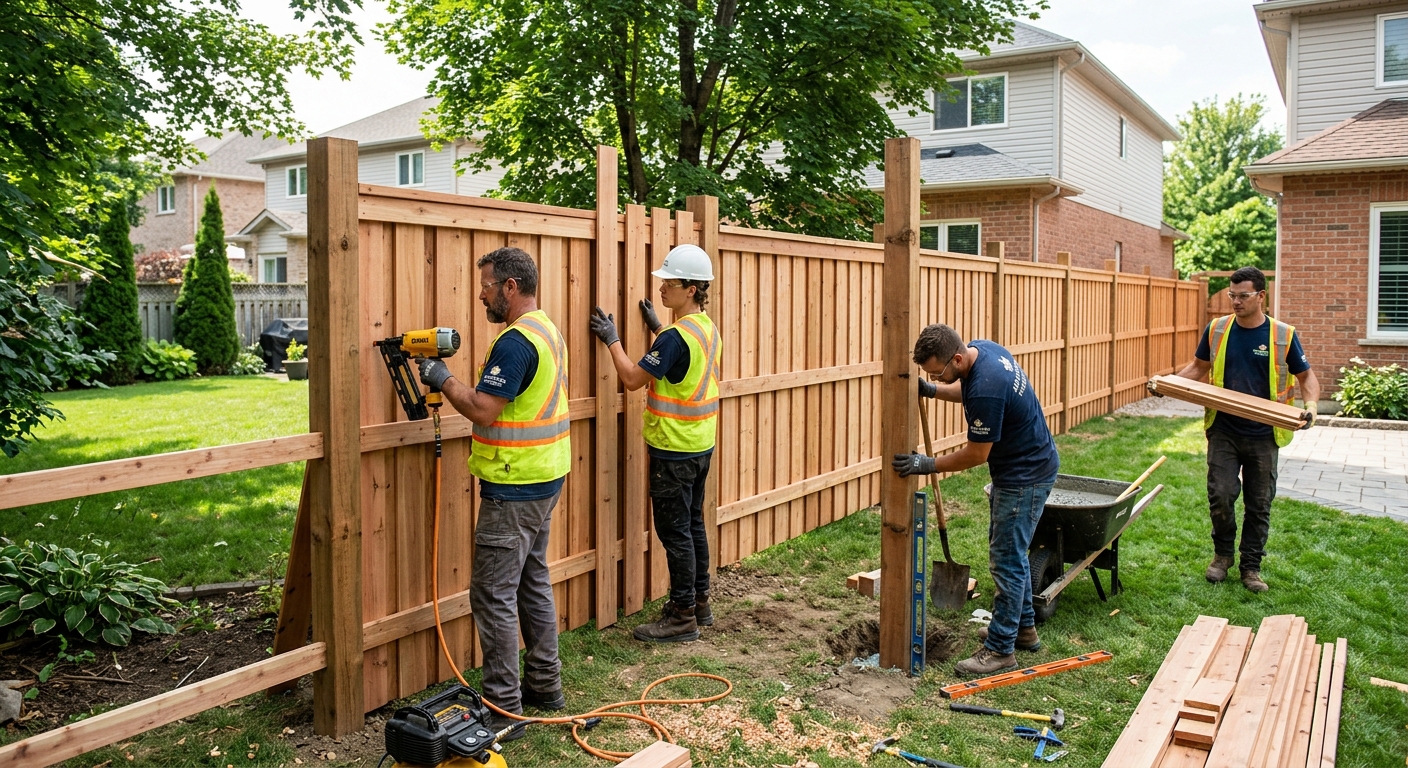
Fencing options and costs in Vermilion
Fencing in Vermilion, Alberta comes down to a straightforward reality: most of the homes needing new or upgraded fencing are single-detached properties, and local ownership rates are strong (Statistics Canada, 2021 Census). With single-detached houses representing 78.2% of dwellings, each detached lot is a direct opportunity for a backyard privacy upgrade, pet containment, or boundary replacement. Just as importantly, 77.0% of households own, so homeowners are more likely to invest in longer-lasting materials and deeper engineered footings rather than short-term solutions.
In the Camrose–Drumheller economic region, costs are shaped less by the “panel price” and more by how posts behave in our climate. Frost depth in much of Alberta sits roughly in the 1.5–2.1 m (5–7 ft) range, so permanent residential fencing typically needs posts set about 90 cm or deeper and at least 15 cm below local frost line to reduce frost heave and leaning over time. Add Prairie wind exposure—especially on open lots near the Vermilion River area—and taller fences often require closer post spacing and sturdier rails.
Contractor availability also matters. In Vermilion, trades can be booked ahead during the spring install window, and projects that require excavation in heavier clay or include gate builds tend to take longer on site. If you’re in a neighbourhood with lots of exposed yard space—such as near the Vermilion River corridor—privacy fences and heavier frameworks are especially in demand. Use the cost ranges below as a baseline, then we can narrow it to your exact lineal footage and footing method.
| Material |
Lifespan |
Maintenance |
Privacy Rating |
Price per Linear Foot |
| Pressure-treated pine (standard wood) |
10–15 years |
Stain/seal every 2–3 years; periodic repairs |
Medium to High |
$14 – $22 |
| Cedar (natural rot resistance) |
15–25 years |
Seal/stain every 3–4 years |
High |
$18 – $30 |
| Vinyl / PVC (no-maintenance) |
20–30 years |
Rinse as needed; inspect posts/gates after storms |
High |
$22 – $40 |
| Chain-link (galvanized steel) |
20–35 years |
Minimal; occasional tension/repair |
Low to Medium |
$10 – $18 |
| Aluminum ornamental |
25–40 years |
Minimal cleaning; check for gate alignment |
Low to Medium |
$20 – $36 |
| Composite / recycled material |
20–30 years |
Low; wash and check fasteners |
High |
$24 – $42 |
Prices are estimates only and vary by project scope, site access and material selection.
What affects the price of fencing in Vermilion
In Vermilion and across the Camrose–Drumheller economic region, two quotes for what looks like the same fence can easily diverge by 30–50%. The reason is that fencing pricing is dominated by structural build requirements—post depth, wind load design, labour time for excavation—and not just the material you see. In Alberta, “installed cost” rises quickly when crews must dig deeper holes, mix and place more concrete, and set heavier corners and gates to resist racking. Meanwhile, in more sheltered or easier-access yards, the same material can come in closer to the lower end of the price band.
Frost line depth sets how deep posts must be set. A practical rule contractors use is to set footings about 4–6 inches below the design frost depth to help prevent heaving and leaning. In many areas of Alberta, that means posts need to be driven or set to around 1.5–2.0 m into the ground; for permanent residential fencing, that typically translates to longer posts and more excavation, with concrete setting increasing labour and material costs. Wind exposure on Prairie sites can also force tighter post spacing for tall privacy fences—especially vinyl/PVC and wood—so the fence doesn’t rack or shift after sustained gusts.
Two local examples that often push the total upward in Vermilion: (1) clay or poorly draining soil requiring deeper holes and more concrete per post to keep alignment; and (2) yards with open exposure where we add mid-rails and stronger corner/bracing for stiffness. On the other hand, cost can come down when chain-link is used for perimeter security—at a lower baseline of $30 – $60 for installed chain-link in the region—or when your job is short, straight, and doesn’t include multiple gates. Housing age also matters: in communities with many homes built before 1981 (54.6% locally, Statistics Canada, 2021 Census), older fence lines may include buried posts or sagging sections that require removal and additional labour.
| Price Factor |
Why It Matters |
Cost Impact |
| Fence length in linear feet |
Everything scales with length: posts, rails, labour and materials |
High (primary driver) |
| Post depth required |
Frost line determines hole depth, post length and footing volume |
High in Alberta winters |
| Post setting method |
Concrete-set posts resist frost movement better than gravel pack |
Medium to High |
| Material choice |
Vinyl and metal typically need stronger posts/spacing in wind |
Medium to High |
| Gate count and type |
Gates require heavier hardware, bracing, and alignment |
Medium to High |
| Grade and terrain |
Slopes require stepped layouts or raked panel systems |
Medium |
| Old fence removal and disposal |
Hauling and extra labour for concrete remnants |
Low to Medium |
| Permit fees and survey / property line locate |
Some height configurations and line clarifications add admin and time |
Low to Medium |
Permits & regulations in Alberta
In Alberta, fence permitting can depend on the fence height and where it’s located on your property. As a general planning guide for Vermilion homeowners, fences above a typical threshold—often around 2.0 m (6.5 ft) in the rear and 1.0–1.2 m (3–4 ft) at the front or corner—may require a building permit. Even when a permit isn’t required, fences must follow property-line rules and municipal setback bylaws, so the first step is confirming exactly where your fence can sit.
Before digging any post holes, you must call for utility locates. In Alberta, that’s done through Alberta One-Call so crews can mark buried services. Also, obtain a survey or confirm your property pins/locate your corners before installing. This is essential for avoiding encroachment disputes with neighbours—especially where older fencing (common in housing stock built before 1981, Statistics Canada, 2021 Census) may no longer match the legal line.
Shared fence ownership and line-fence expectations are handled under Alberta’s line-fences legislation, so if you’re replacing a shared boundary fence, confirm with the neighbour who owns which sections and the intended responsibility for costs.
To verify your contractor in Vermilion, ask for: (1) proof of Alberta licence/qualifications for the scope they perform; (2) a certificate of insurance showing general liability for your address and job; and (3) confirmation they’re covered under WSIB/WCB requirements for their workers. You should be able to review their insurance certificate before work starts; and you can also look up their standing through online provincial resources where applicable. A clearance letter or updated certificate is the best document to keep in your records.
Choosing the right fence material for Vermilion
Choosing the right fence material in Vermilion is mostly about matching your priorities—privacy, low maintenance, upfront budget and long-term lifespan—to what Alberta’s freeze–thaw cycles and wind exposure do to fences. Because our frost line commonly runs around 1.5–2.1 m (5–7 ft), post depth and footing quality matter as much as the fence face material. Most permanent fences perform best when posts are set deep enough to resist frost heave, and when corners and gate openings are engineered to handle wind and repeated loads.
Pressure-treated pine is the budget-friendly approach, but it usually needs staining or sealing about every 2–3 years to limit grey weathering and keep boards from drying out. Cedar looks better and resists rot naturally, yet it still benefits from periodic sealing to keep colour and reduce surface cracking. Vinyl/PVC is popular for low upkeep, but extreme cold can make some panels more brittle—so quality installation (correct brackets and secure post alignment) is key. Chain-link is typically the lowest installed cost and has excellent longevity, but it provides little privacy unless you add privacy slats or vegetation. Aluminum ornamental offers a clean look and won’t rust, but it won’t fully block views. Composite/recycled panels aim to combine appearance and longevity with low maintenance.
On the footing side, Camrose–Drumheller’s frost depth means many builds will use concrete-set posts or engineered concrete footings rather than relying on shallow tamped gravel, especially for privacy fences in exposed yards. If your lot is sheltered and your fence is shorter, costs can trend toward the lower end of regional bands. A practical example: upgrading from pressure-treated wood (often $45 – $80 per linear foot installed is too broad for all jobs, but wood installation in the region typically falls in that range overall) to vinyl / PVC (commonly $70 – $120) can be justified when you want 20+ years of low maintenance and you’re planning multiple panels of full privacy where wind load and post stability matter.
| Material |
Cold Tolerance |
Lifespan |
Annual Maintenance |
Best For |
Price Band |
| Pressure-treated pine |
Good (with proper sealing) |
10–15 years |
Low to moderate (stain/seal every 2–3 years) |
Budget privacy or perimeter fencing |
$45 – $80 |
| Cedar |
Good (natural rot resistance) |
15–25 years |
Low to moderate (seal/stain about every 3–4 years) |
Attractive privacy with solid rot resistance |
$55 – $95 |
| Vinyl / PVC |
Moderate to good (quality installation helps) |
20–30 years |
Minimal (rinse; inspect after storms) |
Low maintenance full privacy |
$70 – $120 |
| Chain-link |
Good |
20–35 years |
Minimal (tension checks as needed) |
Security, pets, and budget perimeter lines |
$30 – $60 |
| Aluminum ornamental |
Good (won’t rust) |
25–40 years |
Minimal (wash as needed) |
Curb appeal with partial barrier |
$65 – $110 |
| Composite / recycled |
Good |
20–30 years |
Low (wash; check fasteners) |
Long life with low upkeep |
$75 – $130 |
How to choose a fencing contractor in Vermilion
To choose a fencing contractor you can trust in Vermilion, start by confirming Alberta compliance and site safety. Ask for a copy of their liability insurance certificate (it should list coverage amounts and your project/address details). Next, verify WSIB/WCB coverage for their workers—request proof before work begins so you’re not exposed if an injury occurs on your property. For licensing/qualification, ask what permits or registrations apply to the specific scope they’ll perform and verify it through the appropriate online provincial registry or documentation they provide.
Then get 2–3 written, itemised quotes. Avoid lump-sum-only pricing. Your quote should break down labour and materials separately (including rails, fasteners, hardware, and post components), and it should clearly state: post depth and setting method; fence type and panel spacing; gate size and hardware; and whether wind stiffening/bracing is included for your layout.
Read the scope carefully for exclusions: is old fence removal and haul-away included? Is permit pulling included (if required for your fence height/layout)? Are utility locates included or is that your responsibility? Warranty matters too: ask for the length of workmanship coverage and whether the product/manufacturer warranty is included, and whether you can transfer it if you sell the home.
Payment schedule is another signal. Never pay more than about 10–15% upfront, and hold a portion until the fence is complete and aligned. Finally, demand a start date and completion estimate in writing, plus a plan for weather delays—important on the Prairie where digging and concrete work can be affected by frozen ground and sudden melts.
- Provide proof of liability insurance (certificate of insurance) before scheduling start.
- Provide WSIB/WCB coverage proof for workers assigned to your job.
- Confirm Alberta licensing/qualifications that match the fence scope they’re doing.
- Quote includes post depth, spacing, and whether posts are concrete-set or otherwise engineered.
- Itemised labour vs materials (no “mystery allowance” line items).
- Gate hardware listed by brand/model or clear specification (hinges, latches, posts, bracing).
- Old fence removal/disposal explicitly included or excluded.
- Utility locates responsibility is clearly stated (Alberta One-Call marks should be addressed before digging).
- Permit responsibilities are written: who pulls it and who pays fees (if required).
- Warranty details: workmanship length, product warranty, and whether it’s transferable.
- Payment schedule stays within 10–15% upfront; final payment after cleanup and walkthrough.
- Timeline is in writing with a completion target and weather-delay communication plan.
Red flags to watch in Vermilion: a contractor who won’t confirm insurance/WSIB/WCB in advance, quotes that skip post depth and footing method, vague language like “standard install” for wind-prone layouts, pressure to pay the full amount upfront, and no written scope for gate hardware or disposal.
Frequently asked questions — fencing in Vermilion
How do I find my property line before fencing?
In Vermilion, the safest approach is to get a survey or confirm your property pins/corners before any post holes are dug. Older fences are sometimes not on the legal line, and with many homes built before 1981 (Statistics Canada, 2021 Census), mismatches can be more common than people expect. If you have a recent survey, bring it to your fencing consultation so the crew can lay out the line and agree where the fence will sit. If you don’t have one, ask your contractor if they can coordinate a property line locate or recommend a surveyor. Avoid “guessing” with tape measures; it’s a common cause of neighbour disputes and rework.
What's the most low-maintenance fence?
For low maintenance in Alberta winters, vinyl/PVC is often the top choice because it doesn’t need annual painting or frequent staining. With correct installation and sturdy post alignment, you can typically plan for years of simple rinsing after dust or storms and periodic inspection of gates and fasteners. If you want even less visual maintenance, chain-link is also low upkeep, but it won’t provide privacy by itself unless you add slats. In Vermilion, the trade-off is upfront cost: vinyl/PVC commonly lands in the $70 – $120 range for installed pricing in the region, whereas chain-link is often closer to $30 – $60. That cost difference is usually justified when you want to avoid regular maintenance trips and board staining.
How tall can my fence be in Vermilion?
Fence height limits depend on where the fence sits (front/corner versus rear) and can trigger permitting. A common Alberta planning guideline is that fences over about 2.0 m (6.5 ft) at the rear and roughly 1.0–1.2 m (3–4 ft) at the front or corner may require a building permit. Even when a permit isn’t required, you still need to respect property lines and municipal setback bylaws. Because rules can vary by location and configuration, confirm the proposed height and placement before installation. If you’re unsure, ask your contractor to outline the exact height on each side and whether they include any permit paperwork or advise you on next steps.
Should fence posts be set in concrete here?
In Vermilion, it’s often wise to use concrete-set posts (or an engineered concrete footing approach) for permanent fences because frost depth in Alberta commonly runs around 1.5–2.1 m (5–7 ft). Contractors typically aim to place footings at least 15 cm below the local frost line, which helps reduce frost heave and leaning over time. For privacy fences and tall installs—especially where wind exposure is higher—concrete setting is also a practical way to keep posts stable and straight. That said, the “right” method depends on soil type, post depth, and the fence design. Your quote should clearly state post depth and the setting method; if it doesn’t, you should ask.
What's the best fence for privacy?
Best privacy usually comes from solid panels: cedar, vinyl/PVC, composite, or wood board systems with close spacing. In Vermilion, privacy fences also need enough structure to resist Prairie wind, so the build often includes heavier or closer post placement and strong corner/bracing plus well-aligned gate frames. If you want the “set it and forget it” route, vinyl/PVC is popular for its low upkeep and long service life, and it commonly falls in the $70 – $120 installed range. Pressure-treated wood can be a lower upfront option, often aligning with the $45 – $80 band for installed wood in the region, but it usually requires staining/sealing on a schedule. Cedar offers a middle ground on appearance and rot resistance, though it still needs maintenance.
How do I compare fencing quotes?
When comparing fencing quotes in Vermilion, don’t compare only the total price—compare the scope behind the total. Ask for itemised quotes that list labour and materials separately, and verify key details: post depth, spacing, and whether posts are concrete-set or otherwise engineered for frost movement. Confirm the fence type (panel height, board spacing, rail system), gate size, and hardware specs. Make sure disposal of old fencing is included or excluded, and clarify whether utility locates and permit pulls are handled. Look for warranty terms (workmanship vs product/manufacturer) and whether they’re transferable. If one quote is dramatically lower, it’s often because footing depth, wind bracing, or gate build quality has been reduced—important in Alberta’s cold winters and windy Prairie stretches.